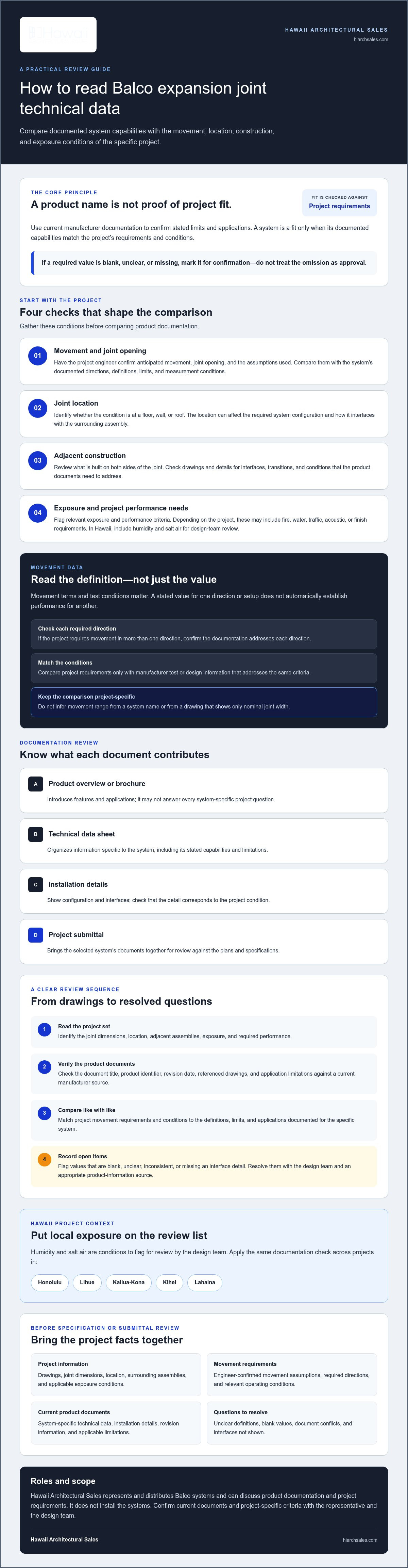
Balco expansion joint technical data is useful when you can compare it with the movement, location, and exposure requirements of a specific project. A product sheet may look complete but still leave questions about whether the system fits the joint shown in your drawings. For architects, engineers,...
Balco expansion joint technical data is useful when you can compare it with the movement, location, and exposure requirements of a specific project. A product sheet may look complete but still leave questions about whether the system fits the joint shown in your drawings. For architects, engineers, and contractors, the key is to identify what each value describes and whether it addresses the project condition.
Start by checking the required movement range, joint dimensions, installation location, and adjacent construction. In Hawaii, humidity and salt air are also conditions to flag for review by the design team. These factors matter whether a project is in Honolulu, Lihue, Kailua-Kona, Kihei, or Lahaina.
This guide explains how to interpret product information, spot missing details, and compare documentation against project requirements. It also covers what to gather before specification or submittal review. Hawaii Architectural Sales represents and distributes Balco systems, and can discuss product documentation and project requirements. Confirm current documents and project-specific criteria with the representative and design team.
Key Takeaways
• Use Balco expansion joint technical data to compare documented system limits and applications, not product names alone.
• Confirm movement requirements with the project engineer, and use current manufacturer documentation to clarify movement directions and operating conditions.
• Build a project-specific comparison around joint location, adjacent assemblies, and required performance. Mark undocumented values for confirmation.
• Review drawings, exposure conditions, and submittal documents in sequence, then resolve open questions with the design team.
• Gather project details and current Balco documents before contacting Hawaii Architectural Sales, which represents and distributes Balco systems but does not install them.
What Balco expansion joint technical data tells you about a system
Technical data describes a system’s documented limits, configuration, and intended application. It helps project teams check product information against drawings and design requirements. A general overview of an Expansion joint explains the purpose of these joints, but selecting a specific system requires current manufacturer documentation.
Read Balco expansion joint technical data as documentation of stated capabilities, not as a substitute for project-specific engineering. Exact dimensions, movement values, ratings, and limitations must come from current Balco documents for the specified system. A brochure may introduce features and applications; a technical data sheet organizes system-specific information. Installation details show configuration and interfaces, while project submittals bring the selected system’s documents together for review against the plans and specifications.
A joint system is a fit only when its documented capabilities match the project’s movement requirements, location, adjacent construction, and exposure conditions.
Which technical data fields should you locate first?
Begin with joint geometry and movement. Compare the scheduled or drawn joint width with the product document, then locate the stated movement directions, range, and measurement conditions. Don’t assume similar terms in different documents describe identical movement. Check each term’s definition and limits in the documentation for the specific system.
Next, check the intended location and the construction on both sides of the joint. A floor, wall, or roof condition may require a different configuration or interface. Record other performance needs only when they apply to the project, such as fire, water, traffic, acoustic, or finish requirements. If the document doesn’t address a required attribute, mark it for confirmation rather than treating the omission as approval.
How to confirm you have the right Balco document
Check the document title and product identifier against a current manufacturer source. Review the revision date, referenced drawings, and stated application limitations. Make sure the document matches the joint location and assembly in the project set, not just a broadly similar application.
Keep a short list of questions for the manufacturer or representative:
• Values that are blank, unclear, or inconsistent across documents
• Movement definitions or measurement conditions that don’t match the project notes
• Details that don’t show how the system interfaces with adjacent construction
For a Honolulu project, this document check helps establish a clear technical basis before comparing options. The same review process applies to projects in Lihue, Kailua-Kona, Kihei, and Lahaina. Confirm current Balco documentation and project-specific requirements with the design team and an appropriate product-information source.
How movement, joint location, and building conditions shape selection
A product category can narrow the search, but it can’t show whether a system suits a specific joint. The project engineer should confirm anticipated movement, joint opening, and design assumptions based on project conditions. Don’t infer movement range from a system name or a drawing that shows only nominal joint width.
Movement terminology and test conditions matter. Review current manufacturer documentation to see which directions of movement it describes, how those directions are defined, and what conditions apply to stated values. A value for one direction or test setup doesn’t automatically demonstrate performance under another. Compare project requirements only with manufacturer test or design information that addresses the same criteria. Specified movement must remain within the system capability documented for the project’s required directions and conditions.
What movement information belongs in the project review?
Ask the responsible engineer to identify anticipated movement and opening conditions, including the assumptions used to establish them. Compare those requirements with the definitions and limits in the applicable Balco documentation. If movement is required in more than one direction, check that the documentation addresses each direction. Don’t treat a single figure as a complete answer.
The Federal Construction Council’s Technical Report No. 65 provides background on expansion-joint design and location. Use it as a reference, not as a replacement for project engineering or current, system-specific manufacturer information.
Why joint location and adjacent assemblies matter
Review each joint in context. An interior floor condition differs from an exterior wall, roof, or parking assembly. The surrounding construction affects the interface the selected system must address, so note what the drawings show on both sides of the joint before comparing product documents.
Location
Identify whether the joint is at a floor, wall, roof, parking area, or another assembly, and whether it is interior or exposed to exterior conditions.
Adjacent construction
Note substrates, edge conditions, finishes, transitions, and interfaces shown in the details.
Site conditions
For Hawaii projects, identify relevant exposure and environmental requirements for design-team review. Humidity and salt air are reasons to flag exposure for evaluation, not to assume that a system has a particular rating.
Clear movement criteria and assembly details make technical comparisons more useful. If project requirements or Balco documentation need clarification, discuss the open items with Hawaii Architectural Sales, which represents and distributes Balco systems for Hawaii projects.
How to compare Balco expansion joint technical data without guessing
Compare each candidate system against the same project conditions. Start with the joint’s application, location, adjacent assembly, and movement requirements. Then review values documented for that specific system in current Balco literature. This keeps the comparison focused on project fit instead of broad labels or assumed similarities.
Similar category labels do not prove technical equivalence; compare documented capabilities against the same project requirements. A product description may identify intended applications or general features, but it isn’t interchangeable with a tested rating, a stated design limit, or project approval. Record these items separately and confirm the evidence behind any value that affects the design.
A project-ready comparison matrix
Use one row for each system under review and the same fields for every option. Keep unknowns visible rather than filling gaps with estimates.
System identifier
Application and joint condition
Required movement
Project criteria
Documented performance and source
Open questions
Exact identifier from current Balco documentation
Floor, wall, roof, parking, or other location; note adjacent assembly
Project requirement and direction, as confirmed by the responsible engineer
Include applicable fire, water, traffic, acoustic, and finish requirements
Record only values documented for this system; cite document title and revision
List missing, unclear, or conflicting information for confirmation
This format helps reviewers assess differences without implying that every criterion applies to every joint. For example, include traffic requirements where the project specifies traffic performance. Don’t treat an unlisted value as either compliant or noncompliant. Match each documented value to its source and the project condition it addresses.
How to handle missing or conflicting values
Mark absent information as confirmation required. Don’t borrow a value from another system, application, or document revision, even if the products appear similar. A number without its context may describe a different condition or measurement basis.
For a discrepancy, identify the exact document and revision, drawing detail, and project requirement. Then ask Balco or its representative to clarify how the information applies. Keep engineering judgments, code interpretations, and project-compliance decisions with the responsible design professional. This gives reviewers a traceable basis for comparison and helps prevent assumptions from carrying into specifications or submittals.
Hawaii project checklist for reviewing expansion joint submittals
Start a coordinated submittal review with the project documents, not the product sheet alone. For projects in Honolulu, Lihue, Kailua-Kona, Kihei, and Lahaina, identify site exposure and applicable project requirements for the design team to assess. Humidity or salt-laden air should prompt review of relevant material and exposure requirements, but neither condition by itself confirms a product rating.
What to coordinate before submitting product data
Use this sequence to assemble what reviewers need and identify gaps before formal review:
Review the drawings.
Confirm each joint’s location and dimensions, movement criteria, substrate, edge conditions, and adjacent assembly. Check that details and schedules describe the same condition.
Gather current documents.
Assemble Balco product data and details for the specified system, relevant specification sections, and project-specific selections. Check that the product identifier and document revision are current.
Identify project performance criteria.
Record environmental exposure and any specified fire, water, or traffic requirements. Include only criteria relevant to that joint, and note where supporting documentation is needed.
Confirm governing requirements.
Ask the design team to verify applicable code editions, standards, and authority requirements for the project. Don’t rely on a product document alone to interpret code applicability or establish compliance.
For a project with seismic joint covers, coordinate the required movement and assembly conditions with the responsible design professional and current manufacturer documentation. A dedicated guide to seismic expansion joint covers may provide additional context once its published URL is confirmed.
What to verify during submittal review
Compare the submitted system identifier with the project selection, and check that referenced details and document revisions agree. Review the package against the drawings and specifications. A complete-looking document set can still leave a project requirement unanswered.
• List deviations from the specified selection and explain where they occur.
• Flag omitted criteria, unclear values, and conflicts between drawings, specifications, and product documents.
• Route engineering decisions and code interpretations to the responsible design professional; seek product-document clarification from Balco or its representative.
Keep responsibilities clear. Hawaii Architectural Sales distributes and represents Balco systems and can discuss current Balco expansion joint technical data and project requirements. Product supply coordination is separate from engineering approval and installation, which are not services provided by Hawaii Architectural Sales.
To discuss Balco documentation for a Hawaii project, contact Hawaii Architectural Sales with the relevant drawings, joint criteria, and open submittal questions.
Get Balco product information and technical support for your Hawaii project
A focused product discussion starts with project information that identifies the joint condition and the criteria the selected system needs to address. Before requesting Balco expansion joint technical data, gather the relevant documents. This helps the representative discuss current product information and gives your design team a clearer basis for review.
What to prepare for a product discussion
Organize the project details and questions in one place. Include:
Project context
The Hawaii project location, building type, and joint location, such as a floor, wall, roof, or parking assembly.
Drawings and details
Relevant plans, sections, schedules, and adjacent construction details showing joint dimensions, substrates, transitions, and finishes.
Known design criteria
Movement requirements confirmed by the responsible engineer, plus applicable fire, water, traffic, acoustic, finish, and exposure requirements identified in the project documents.
Review history
Product documents already consulted, including titles and revisions, along with unanswered questions or conflicting information.
If some criteria are still being developed, identify them as open items. Don’t estimate missing movement values or assume that an undocumented performance attribute applies. Clear questions help separate product-document clarification from decisions that require the design team.
How Hawaii Architectural Sales supports project teams
Hawaii Architectural Sales distributes and represents Balco expansion joint systems for Hawaii projects. The company can discuss project requirements and help locate current Balco product information for the team to review. Confirm document currency and project-specific product information with the representative before relying on a submittal or making procurement decisions.
Product representation and distribution are distinct from design approval and installation. The project’s responsible design professionals determine engineering criteria and review code or project compliance. Hawaii Architectural Sales does not provide installation or general contracting.
For a productive conversation, share the project location, relevant drawings, known movement criteria, and a concise list of open questions. This gives the representative a basis to discuss potentially relevant current Balco documents and identify information that still needs confirmation. Contact Hawaii Architectural Sales to discuss Balco product requirements for your Hawaii project.
Move Your Hawaii Specification Forward with Clear Documentation
Reliable joint selection starts with project requirements, not a product name. Confirm movement criteria with the responsible design professional, then compare the joint location and adjacent assembly with current Balco documentation. Treat missing or conflicting values as open questions, and coordinate Hawaii exposure and applicable project requirements with the design team.
Using Balco expansion joint technical data this way keeps product comparisons traceable and submittals clearer. Gather relevant drawings, specifications, document revisions, and unresolved questions before discussing system options.
Hawaii Architectural Sales distributes and represents Balco expansion joint systems as part of its architectural product portfolio. For product information, share your project location and requirements with the representative. Discuss Balco expansion joint product information for your Hawaii project with Hawaii Architectural Sales.
Frequently Asked Questions
What technical data should I review for a Balco expansion joint?
Review the current system-specific data sheet and details for joint width, movement directions and range, measurement conditions, intended application, and stated limitations. Compare these with the drawings and adjacent construction. Check fire, water, traffic, acoustic, or finish information only where the project requires it. Confirm the document identifier and revision, and flag missing or conflicting values for clarification rather than assuming they apply.
How do I determine the movement capacity required for an expansion joint?
The responsible project engineer should establish anticipated movement, joint opening, required directions, and design assumptions. Compare those criteria with current manufacturer information that addresses the same movement directions and conditions. Don’t infer capacity from a product category or nominal joint width alone. If the drawings don’t define movement requirements clearly, ask the design team for clarification before selecting or specifying a system.
Are Balco expansion joint systems suitable for seismic movement?
Some expansion joint systems are designed for seismic applications, but suitability depends on the specific system and project conditions. Confirm that current Balco documentation for the identified system addresses the required seismic movement directions and project criteria. The project engineer should establish movement demands, and the design team should verify applicable requirements. Don’t assume every system in a broad product category supports the same movement or performance.
What is the difference between architectural and seismic expansion joint covers?
Architectural expansion joint covers are selected for a building assembly and its documented requirements, such as location, finish, and movement needs. Seismic covers are evaluated against the seismic movement demands specified for the project. The categories may overlap, but the labels alone don’t establish performance or equivalence. Check current manufacturer documentation for the specific system, its movement conditions, application limitations, and compatibility with the adjacent assembly.
Can expansion joint technical data confirm a system meets Hawaii project requirements?
Product data can document system attributes, but it can’t by itself confirm compliance with every Hawaii project requirement. The design team should verify applicable code editions, standards, authority requirements, and project specifications, then compare them with current system documentation. Assess site exposure, including humidity or salt air where relevant, as a project condition. Don’t treat exposure as proof of a product rating unless documentation supports that claim.
What should an expansion joint submittal include?
A submittal should include current product data and details for the specified system, with identifiers and revisions matching the project selection. Coordinate it with relevant drawings, specifications, joint dimensions, movement criteria, location, substrates, and adjacent assemblies. Include documentation for specified fire, water, traffic, or other performance requirements where applicable. Identify deviations, omissions, or unclear values so the design team can resolve them during review.
Does Hawaii Architectural Sales install Balco expansion joints?
No. Hawaii Architectural Sales distributes and represents Balco expansion joint systems and provides product information, but it doesn’t offer installation or general contracting. Project teams can discuss current documentation and product requirements for work in Honolulu, Lihue, Kailua-Kona, Kihei, and Lahaina. Installation arrangements, engineering decisions, and project approvals remain separate responsibilities. Confirm current Balco documents for the specific project with the representative.