Fire Rated Expansion Joints in Hawaii: A Technical Specification Guide
In Hawaii's demanding climate, a fire-rated expansion joint is far more than a simple code requirement. It's a high-performance building envelope asset that must survive intense volcanic seismic activity and the relentless corrosion of salt-laden trade winds. Specifying fire rated expansion joints H...
In Hawaii's demanding climate, a fire-rated expansion joint is far more than a simple code requirement. It's a high-performance building envelope asset that must survive intense volcanic seismic activity and the relentless corrosion of salt-laden trade winds. Specifying fire rated expansion joints Hawaii projects require means balancing the life-safety mandates of UL 2079 with the practical reality of tropical durability. You understand that a failure in these systems isn't just a maintenance headache; it's a breach in the building’s primary fire defense.
This technical guide simplifies the complexities of selecting systems that withstand Hawaii’s unique environmental stressors under the 2018 International Building Code. You'll learn how to master the interplay between seismic movement requirements and fire-resistance testing standards like ASTM E119. We'll detail the specific advantages of Balco expansion joint systems and explain how to achieve maintenance-free durability without compromising on aesthetic integration. By the end of this article, you'll have the expertise needed to specify resilient, code-compliant solutions for any island project.
Key Takeaways
• Understand how UL 2079 standards ensure fire-rated systems effectively block smoke and toxic gases during significant seismic events.
• Learn to engineer for both tropical thermal expansion and the intense lateral movement requirements found in Hawaii’s volcanic regions.
• Identify the best material specifications for fire rated expansion joints Hawaii environments to prevent salt-air corrosion from destroying architectural metal covers.
• Explore the technical advantages of Balco’s Meta-Block® and advanced fire barrier systems for high-performance, maintenance-free durability.
• Discover how technical consultation during the schematic design phase prevents costly compliance failures and ensures seamless building envelope integration.
Understanding Fire Rated Expansion Joints and Life Safety
Expansion joints represent a fundamental engineering requirement for large-scale structures. These intentional gaps, often described as Understanding Expansion Joints, allow a building to absorb movement without sustaining structural damage. However, these gaps create significant vulnerabilities in a building’s fire-resistance strategy. Without proper protection, an expansion joint acts as a chimney, facilitating the rapid spread of smoke, toxic gases, and flames between compartments. In commercial and multi-family construction, passive fire protection is a non-negotiable life safety requirement.
When specifying fire rated expansion joints Hawaii professionals must account for three critical variables: nominal joint width, anticipated movement percentage, and the required fire-rating duration. These factors dictate the type of fire barrier or intumescent material needed to maintain the integrity of walls, floors, and ceilings. Larger joints require specialized barriers that can span wide openings while still compressing and expanding during seismic events. If the joint width is miscalculated, the fire barrier may fail to provide the necessary protection during an actual fire event.
The Role of UL 2079 and ASTM E1966
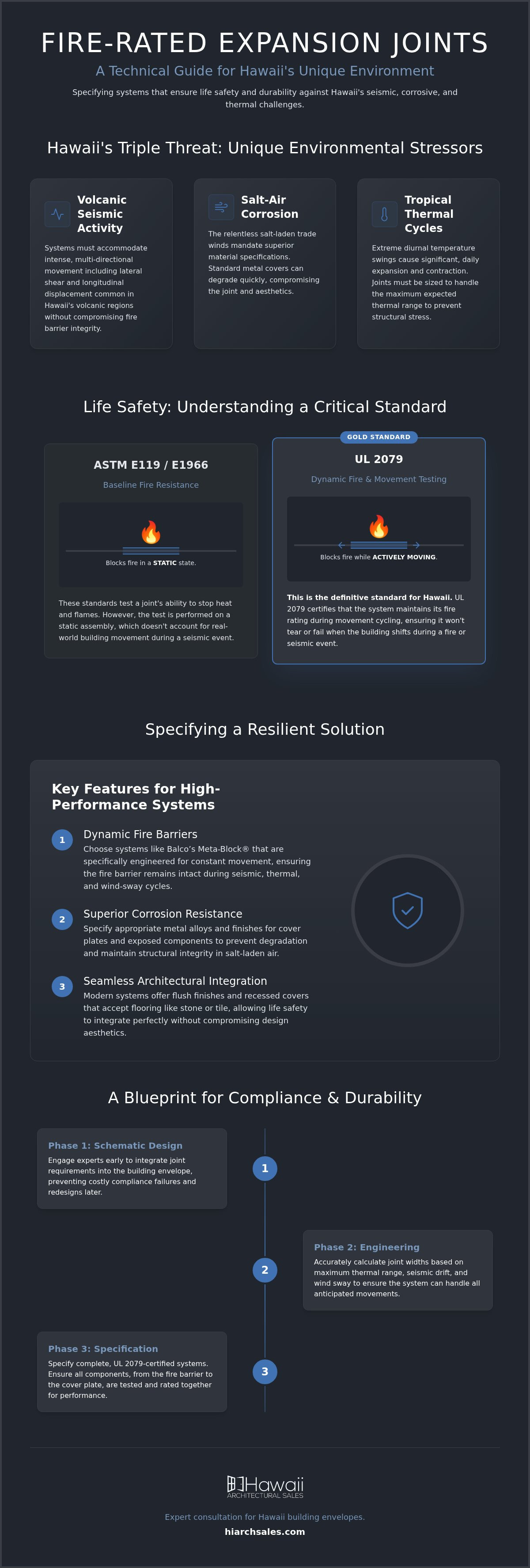
Rigorous testing standards differentiate a standard joint cover from a life-safety system. ASTM E119 and ASTM E1966 provide a baseline for fire resistance, but UL 2079 is the definitive standard for joint systems. The primary difference lies in movement cycling. A "fire-resistant" material might stop heat, but a UL 2079 certified system is tested while the joint is actively moving. It ensures the fire barrier doesn't tear, fatigue, or degrade when the building expands or shifts. For projects in Hawaii, where seismic and thermal activity is constant, this dynamic testing is essential for long-term compliance and safety.
Passive Fire Protection in Modern Architecture
Modern design often demands seamless transitions between different building materials. Fire-rated expansion joints must integrate perfectly with the broader fire-rated envelope. This involves maintaining continuity across floor-to-floor, floor-to-wall, and wall-to-wall assemblies. Safety shouldn't compromise design. High-visibility areas require systems that offer flush finishes or recessed covers that accept floor finishes like stone or tile. The goal is a protected envelope where the fire barrier remains invisible but fully functional. This ensures the fire-rating duration of the joint matches the rating of the surrounding assembly, preventing any weak points in the structural defense.
Engineering for Movement: Seismic and Thermal Dynamics
Designing for Hawaii requires a departure from standard mainland specifications. While many regions focus primarily on thermal expansion, island projects face a complex intersection of volcanic seismic activity, high-velocity wind sway, and extreme diurnal temperature swings. Specifying fire rated expansion joints Hawaii structures require means selecting systems that accommodate multi-directional movement. These joints don't just move left to right; they must handle vertical shear and longitudinal displacement simultaneously without compromising the fire barrier's integrity.
High-rise developments in Honolulu present a specific challenge: wind sway. Tall buildings naturally oscillate during trade wind gusts or storm events. If the expansion joint is too rigid, this constant movement leads to premature fatigue of the metal covers or tearing of the internal fire seal. A truly resilient system maintains a tight seal during these minor but frequent oscillations, ensuring the building's fire-rated envelope remains unbroken throughout its service life.
Thermal Expansion in Tropical Climates
The tropical sun is relentless. Concrete and steel have different thermal expansion coefficients, and in Hawaii’s heat, these materials move at different rates. Diurnal swings, the temperature difference between the midday sun and the cooler evening, can cause significant expansion and contraction cycles every 24 hours. Architects must calculate joint widths based on the maximum expected thermal range to prevent structural cracking. Proper placement of joints ensures that these inevitable movements are absorbed safely, protecting the building’s aesthetic finishes and structural bones from stress-related damage.
Seismic Resilience for Hawaii Structures
Hawaii’s unique tectonic environment, particularly on the Big Island and Maui, demands rigorous Engineering for Seismic and Thermal Dynamics. Seismic events in volcanic zones often involve unpredictable lateral and vertical shifts. It’s critical to specify expansion joint systems that can "reset" after a minor event. For major shifts, the design must prioritize life safety by preventing cover plate "pop-out." A falling metal plate in a stairwell or corridor during an earthquake is a major hazard. Modern Balco systems are engineered to remain captive or swing clear without becoming projectiles, ensuring egress paths stay clear during emergencies.
Ensuring your specifications meet these rigorous movement demands is a technical process. For assistance with movement calculations or system selection, you can consult with our technical team to find the right balance of safety and performance.
The Hawaii Factor: Corrosion Resistance and Salt Air
Hawaii's coastal environment is notoriously aggressive. While fire safety and seismic resilience are critical, salt-air corrosion is often the primary cause of premature system failure. For fire rated expansion joints Hawaii projects, specifying standard off-the-shelf components often leads to rapid oxidation and mechanically seized joints. High-chloride environments demand a proactive approach to material science to ensure the expansion joint remains functional for its intended 25-plus year lifespan. A joint that cannot move due to corrosion is a joint that will fail during a seismic event.
Humidity and persistent moisture also threaten the internal fire barrier. If moisture infiltrates the joint, it can lead to mold growth or the degradation of intumescent materials. Following Best Practices for Fire-Rated Expansion Joints ensures that the specified system includes secondary moisture barriers or integrated drainage paths. Additionally, intense island UV exposure can cause standard rubber gaskets and flexible seals to become brittle. Selecting UV-stabilized materials is essential to prevent the seal from cracking and allowing water into the structural gap.
Material Selection: Stainless Steel vs. Aluminum
In coastal Hawaii, 316-grade stainless steel is the gold standard for architectural covers. Unlike 304-grade or standard aluminum, 316 stainless contains molybdenum, which provides superior resistance to pitting and crevice corrosion. Standard clear anodized aluminum often fails within years when exposed to direct salt spray, developing unsightly white blooms of oxidation. While protective high-performance powder coatings can extend the life of aluminum joint covers, they require consistent maintenance and are susceptible to scratching. For high-visibility or exterior applications, stainless steel offers the most reliable long-term value and structural integrity.
Durability in High-Traffic Hospitality Environments
Resorts and hospitality projects present unique challenges for joint design. Expansion joints in lobbies and lanais must handle heavy foot traffic and luggage carts while remaining perfectly flush for ADA compliance. Trip-hazard prevention is paramount. Specifying high-movement joints that maintain a smooth transition is critical for guest safety. These systems often work in tandem with other high-performance materials; for example, you can learn how salt resistant window frames complement these systems to create a fully resilient building envelope. For integrated architectural metal and shutter systems, you can check out Sahara Doors & Metals LLC. In parking structures, where joints are exposed to both salt air and vehicular fluids, heavy-duty elastomeric seals with stainless steel retainers provide the necessary durability for the island's unique conditions.
Specifying Balco Expansion Joint Systems in Hawaii
Balco represents the intersection of engineering precision and architectural flexibility. When specifying fire rated expansion joints Hawaii projects require, the Meta-Block® series stands out as a premier solution for high-performance building envelopes. These systems are specifically engineered to exceed UL 2079 requirements. They offer a unique advantage by providing a factory-tested fire barrier that maintains its integrity even after the significant seismic displacement common in volcanic regions. This reliability ensures that life safety systems remain functional long after the initial installation.
For high-end hospitality and luxury residential developments, aesthetics are as critical as technical performance. Balco provides extensive customization options for cover plates, including architectural brass, bronze, and 316-grade stainless steel. These materials offer the necessary corrosion resistance for island projects while allowing the safety systems to complement sophisticated interior designs. This level of customization addresses a common gap in the market where safety components often conflict with the visual intent of luxury spaces.
Floor, Wall, and Ceiling System Integration
Seamless transitions are essential for both safety and design continuity. Recessed cover plates allow architects to install stone, tile, or carpet directly into the joint assembly. This creates a nearly invisible transition that maintains required fire protection without disrupting the floor’s visual flow. In industrial environments or commercial loading docks, heavy-duty floor joints provide the structural capacity needed to withstand constant vehicular traffic and heavy machinery. For a broader look at how these components fit into a complete project, see our guide on specialty building materials in Hawaii.
Technical Documentation and CAD Support
Navigating the requirements of the Honolulu Department of Planning and Permitting (DPP) demands precise and accurate documentation. Balco simplifies this process by providing comprehensive CAD details and BIM models that integrate directly into your project plans. Hawaii Architectural Sales provides an additional layer of expertise by offering technical reviews of joint schedules. Our team ensures that every specified system aligns with local building codes and environmental stressors, reducing the risk of field errors or submittal rejections. This collaborative approach turns a complex specification into a manageable, reliable part of the design process.
If you need assistance with movement calculations or product selection for your next project, request a technical consultation with our local experts today.
Expert Consultation for Hawaii Building Envelopes
Hawaii Architectural Sales acts as the authorized representative for Balco, providing a direct link between the manufacturer’s engineering team and the local AEC community. Specifying fire rated expansion joints Hawaii projects require involves more than just selecting a part number. It requires a partner who understands the high stakes of large-scale construction in a region where seismic activity and salt air are constant threats. Since 1985, we've provided technical consultation to ensure that life safety systems perform exactly as intended under local conditions.
Engaging our team during the schematic design phase allows for meaningful design-assist services. We help architects identify potential conflicts between joint movement and architectural finishes before they become costly field issues. This proactive approach ensures that expansion joints are treated as an integral part of a holistic architectural building envelope solution. Whether your project is on Oahu, Maui, Kauai, or the Big Island, we streamline the logistics of island-wide delivery to keep your timeline on track. Unlike transaction-focused sellers, we provide the localized support necessary to troubleshoot field conditions and ensure code compliance.
Why Local Representation Matters
Local expertise is indispensable when navigating Hawaii’s unique regulatory environment. We maintain a deep understanding of the 2018 International Building Code (IBC) and its specific local amendments. This knowledge ensures your specifications meet the rigorous UL 2079 and ASTM E119 standards required for modern commercial structures. Our proven track record across the islands' most iconic projects gives us the perspective needed to troubleshoot complex field conditions. By serving as a technical consultant rather than just a distributor, we bridge the gap between high-end manufacturing and practical, on-site application. This partnership minimizes risk and ensures long-term durability for the building owner.
Next Steps for Your Specification
Moving from a preliminary design to a final specification requires accurate data and physical verification. We offer a range of resources to support your firm’s workflow. You can request physical samples to verify finish quality or technical data sheets to confirm movement capabilities. For firms looking to deepen their expertise, we schedule technical lunch-and-learn sessions focused on seismic resilience and fire-safety compliance. These sessions provide your team with the latest industry insights and testing updates. When you're ready to finalize your joint schedule, Contact Hawaii Architectural Sales for technical support. Our specialists are ready to review your project requirements and provide the precision engineering support your design deserves.
Elevate Your Building’s Resilience and Safety
Specifying fire rated expansion joints Hawaii projects demand requires a precise intersection of life-safety compliance and environmental endurance. You've learned how UL 2079 certification ensures movement capability during an emergency. You also understand that selecting 316-grade stainless steel or specialized coatings is non-negotiable for resisting salt-air corrosion. By treating these joints as high-performance building envelope assets, you protect both the structure and its occupants from the islands' unique seismic and thermal stressors.
Hawaii Architectural Sales serves as your authorized Balco representative with over 40 years of local experience. We provide technical design-assist services to ensure your joint schedules are precise, code-compliant, and aesthetically integrated. Our team bridges the gap between high-end manufacturing and practical island application. Don't leave your project’s fire-rated envelope to chance. We look forward to supporting your next design with the technical expertise it deserves.
What is the most common fire rating required for expansion joints in Hawaii?
The most common fire rating required for commercial projects in Hawaii is a 2-hour rating. This specification aligns with standard construction for multi-family residential and high-rise commercial structures under the current building codes. While 1-hour and 3-hour ratings are available for specific assemblies, the 2-hour requirement covers the majority of floor and wall compartments. You must ensure the joint’s fire rating matches or exceeds the rating of the surrounding structural assembly.
Can expansion joints be customized to match luxury floor finishes like marble or wood?
Expansion joint systems are highly customizable to integrate with luxury finishes such as marble, stone, or wood. Recessed cover plate designs allow the floor finish material to be installed directly into the joint assembly. This creates a nearly invisible transition while maintaining full movement capability. When specifying fire rated expansion joints Hawaii luxury resorts often require, these recessed systems provide the necessary life safety without compromising the high-end aesthetic of the interior.
How does seismic activity in Hawaii influence the width of expansion joints?
Hawaii’s active volcanic and tectonic zones require wider expansion joints to accommodate significant lateral and vertical movement. The nominal joint width is calculated based on the anticipated seismic drift of the building segments. In active zones, these gaps must be larger to prevent structural collision during an earthquake. A properly engineered seismic joint allows the building to shift safely without compromising the fire barrier or damaging the surrounding architectural finishes.
Are Balco expansion joints UL-certified for both floor and wall applications?
Balco expansion joint systems are UL-certified for both floor and wall applications. These systems undergo rigorous testing under the UL 2079 standard, which evaluates fire resistance while the joint is in motion. This certification ensures that the fire barrier remains effective during thermal expansion or seismic events. Whether your project requires floor-to-floor or wall-to-wall protection, Balco provides tested and listed assemblies that meet the stringent safety requirements of local building codes.
What is the lead time for shipping Balco joint systems to Honolulu?
Lead times for shipping Balco systems to Honolulu typically range from six to ten weeks depending on the complexity of the custom finishes. Because these systems are manufactured on the mainland and shipped to the islands, it's essential to account for transit times in your construction schedule. Hawaii Architectural Sales assists with logistical planning to ensure that your materials arrive on-site when needed. Early coordination during the design phase helps prevent delays in the building’s enclosure schedule.
How do I ensure an expansion joint is ADA compliant in a high-traffic area?
To ensure ADA compliance in high-traffic areas, specify flush-mount expansion joints that maintain a smooth transition. The joint cover should have a maximum gap and vertical change in level that adheres to ADA standards, typically not exceeding 1/2 inch. Additionally, selecting covers with slip-resistant or serrated surfaces improves safety for pedestrians. These features prevent trip hazards in resort lobbies and public walkways while still allowing for the necessary structural movement and fire protection.
What maintenance is required for fire-rated expansion joints in salt-air environments?
Fire-rated expansion joints in salt-air environments require periodic inspections and regular cleaning to prevent chloride buildup. In coastal regions, salt can accumulate in the joint tracks, potentially causing metal covers to seize or corrode. Specifying 316-grade stainless steel significantly reduces maintenance needs. However, you should still inspect the internal fire barriers annually for any signs of moisture damage or degradation. Proper maintenance ensures that the system remains fully operational for its intended lifespan.
Does Hawaii Architectural Sales provide installation for Balco products?
Hawaii Architectural Sales does not provide installation services for Balco products. We operate as the authorized technical representative and distributor, focusing on design-assist services and technical consultation for architects and engineers. While we don't perform the physical installation, we provide detailed CAD drawings and technical support to the general contractor or specialty subcontractor. This ensures that the systems are installed according to the manufacturer’s specifications and the project’s unique engineering requirements.