Hopes Steel Windows Hawaii: A Reference Guide for Architects & Developers
Can a window frame be thin enough to disappear into a Pacific horizon while remaining strong enough to withstand a Category 5 hurricane? For architects and developers, the challenge of balancing minimalist aesthetics with Hawaii's 160 mph wind load requirements often feels like a series of compromis...
Can a window frame be thin enough to disappear into a Pacific horizon while remaining strong enough to withstand a Category 5 hurricane? For architects and developers, the challenge of balancing minimalist aesthetics with Hawaii's 160 mph wind load requirements often feels like a series of compromises. You need the structural strength of steel to meet the 2018 International Building Code standards, but you also demand the refined, narrow sightlines that define modern luxury. Hopes steel windows Hawaii provide the definitive answer to this engineering conflict.
We understand that building in a coastal environment presents unique challenges, especially regarding salt-spray corrosion and strict impact-resistance mandates. This reference guide explores how Hopes handcrafted windows combine advanced protective coatings with unmatched structural durability. You'll learn about specific product lines like the Jamestown175 and Old World Suite, confirm technical compliance for wind-borne debris regions, and discover how to access local specification support. By the end of this article, you'll have the technical confidence to integrate these high-performance systems into your most demanding tropical designs.
Key Takeaways
• Learn the technical distinction between hot-rolled and cold-rolled steel and how these materials enable ultra-thin sightlines for expansive architectural openings.
• Discover why Hopes steel windows Hawaii are the premier solution for meeting 160 mph wind load requirements while maintaining a minimalist aesthetic.
• Understand how the Power of 5™ Finishing System provides a definitive defense against salt-air corrosion in harsh coastal environments.
• Navigate Hawaii building codes with confidence by utilizing Florida Product Approval data and impact-rated specifications for island structures.
• Streamline your specification process by partnering with a local technical representative to manage custom design requirements and project submittals.
What Defines Hopes Steel Windows in Modern Architecture?
Hopes stands as the premier manufacturer of handcrafted solid steel and bronze windows. Unlike the hollow-core metal alternatives often found in standard commercial builds, Hopes products are forged from solid material. This distinction is critical for long-term performance. Solid steel provides a level of structural integrity that allows for incredibly narrow sightlines without compromising the frame's ability to support heavy, high-performance glass loads. This is a primary reason why Hopes steel windows Hawaii are specified for the state's most ambitious residential and commercial projects.
The manufacturing process involves both hot-rolled and cold-rolled steel. Hot-rolled steel offers a traditional, slightly textured finish that is synonymous with classic architectural strength. Cold-rolled steel allows for more precise tolerances and sharper profiles, catering to the exacting demands of modern, high-precision design. Every unit is handcrafted in the USA. This legacy ensures a level of quality control that is necessary for high-exposure environments where precision isn't just an aesthetic choice, but a requirement for durability.
The Legacy of Solid Steel and Bronze
Hopes has utilized solid steel and bronze since 1912 to create windows designed for century-long durability. While steel offers a sleek, industrial aesthetic, bronze provides a living finish that develops a rich patina over time. These materials are particularly valued for historic renovations in Honolulu, where maintaining the original character of a structure is paramount. When specifying these materials in coastal zones, understanding Galvanic corrosion is essential. Hopes addresses these electrochemical risks through advanced finishing systems that isolate the metal from the aggressive salt air. This ensures the structural frame remains intact for generations, even when subjected to constant coastal spray.
Architectural Versatility: From Historic to Ultra-Modern
The versatility of Hopes products allows architects to transition between diverse design languages without switching manufacturers. The Landmark series replicates the heavy, traditional profiles required for historic preservation, while modern suites focus on maximizing the glass-to-frame ratio. Because steel is inherently stronger than aluminum, it supports monumental sizes. This means developers can design grand island vistas with massive spans of glass that don't require bulky intermediate supports. Customization is a standard part of the process. Every project in Hawaii has a unique architectural footprint. Hopes provides the flexibility to create bespoke shapes and configurations that meet specific site conditions, ensuring that the window system complements the building's structural and aesthetic goals.
Engineering for Hawaii’s Unique Environmental Demands
Hawaii's topography creates complex wind patterns, from coastal gusts to accelerated flows down mountain ridges. Standard window materials often require bulky reinforcements to meet these pressures. Hopes steel windows Hawaii offer a structural advantage because solid steel is inherently stiffer than aluminum or uPVC. This material density allows for massive spans of glass in coastal villas without the need for heavy internal reinforcements. The result is a clean, intentional design that remains structurally sound under the most intense atmospheric conditions.
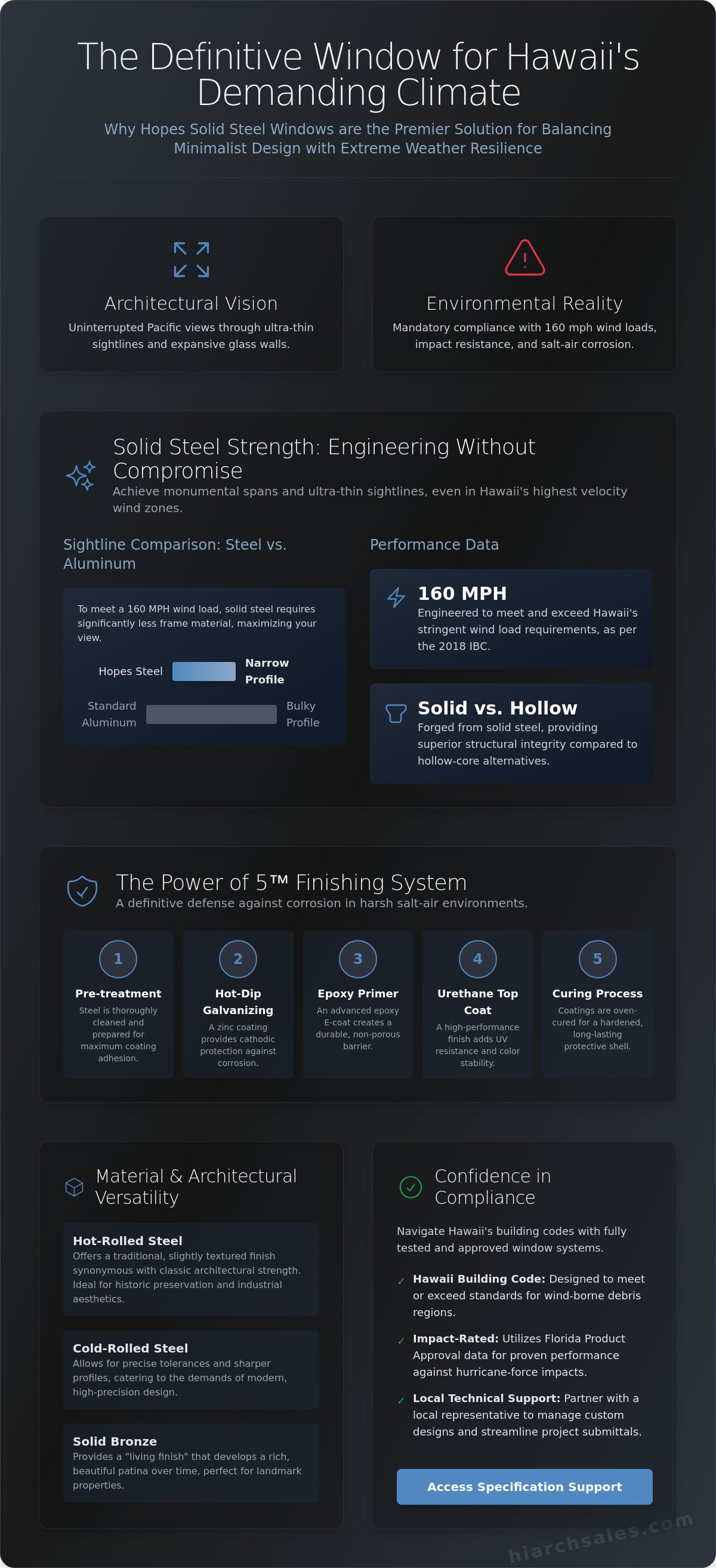
Material stiffness is the primary defense against deflection. During a storm, excessive frame movement can cause glass breakage or seal failure. Steel’s high modulus of elasticity ensures that even in large-scale openings, the frames maintain their shape. This rigidity is essential for compliance with the Hawaii State Building Code, which mandates that structures withstand wind speeds of up to 160 mph in specific zones. By using solid steel, developers can create expansive glass walls that appear delicate but function with the strength of a structural member.
Maximising Ocean Views with Ultra-Thin Sightlines
In luxury residential design, the frame shouldn't compete with the view. Traditional aluminum frames must be thick to achieve the necessary moment of inertia for high wind loads. Steel achieves the same strength with a fraction of the profile width. This allows architects in Lihue or Kihei to specify ultra-thin sightlines that enhance the indoor-outdoor flow essential to island living. Minimalist frames like those found in the Old World Suite™ series provide the unobstructed views clients demand while meeting the performance requirements of a high-exposure site.
Structural Integrity and High Wind Load Capacity
The physics of solid steel allow it to handle much higher positive and negative pressures than hollow-core alternatives. In Hawaii’s mountainous terrain, wind loads can vary significantly from one side of a property to the other. Hopes products are engineered to manage these fluctuations through superior material strength. Systems like the Jamestown175™ are specifically tested for hurricane impact, providing a verified barrier against wind-borne debris. If you're designing for a site with extreme exposure, it's beneficial to consult with a local technical representative to review specific wind-load calculations and product certifications early in the design phase. This ensures your project meets the structural demands of the region without compromising on the architectural vision.
Durability in Salt-Air Environments: Overcoming the Corrosion Challenge
The primary concern for architects specifying Hopes steel windows Hawaii is the aggressive nature of the Pacific salt air. Hawaii’s high humidity and constant salt spray create an environment that accelerates oxidation on standard metal surfaces. However, the belief that steel cannot survive in coastal zones is a misconception based on outdated technology. Modern metallurgical engineering and advanced finishing systems have transformed solid steel into one of the most resilient materials available for island architecture.
While aluminum is often marketed as a corrosion-resistant alternative, it's susceptible to pitting and filiform corrosion when the factory finish is breached. Solid steel, when protected by a comprehensive coating system, provides a level of structural longevity that aluminum cannot match. This is particularly true in high-exposure areas where the performance of galvanized steel in coastal environments serves as a technical benchmark for protecting metal from electrochemical breakdown. Hopes utilizes these principles to ensure their frames remain pristine for decades.
The Power of 5™ Finishing System
Hopes addresses the corrosion challenge through the Power of 5™ finishing system. This is a multi-stage pretreatment and coating process designed specifically for extreme exposures. The process begins with a thorough cleaning and a zinc phosphate pretreatment. This is followed by an electro-deposition (e-coat) primer that encapsulates the entire frame, ensuring no surface is left exposed. A zinc-rich epoxy primer is then applied to provide a secondary layer of cathodic protection. The final stages include a high-performance polyurethane topcoat and an optional clear coat. Each unit undergoes rigorous salt spray testing to verify that the finish can withstand thousands of hours of exposure without failure.
Steel vs. Aluminum: Performance in Salt-Air Regions
High-end residential projects in Lahaina and other coastal communities often prefer the weight and tactile feel of steel over aluminum. Beyond the aesthetic appeal, the technical longevity of a properly finished steel frame is superior in high-wind, high-salt zones. Aluminum frames are often hollow, which can trap moisture and salt internally, leading to "invisible" corrosion that weakens the structure over time. Because Hopes windows are made of solid steel, there are no internal cavities where salt air can settle. This solid construction, combined with the Power of 5™ system, effectively eliminates the "rust myth" and provides a dependable solution for Hawaii’s most demanding building sites. Maintenance in these zones is straightforward; regular rinsing with fresh water to remove salt deposits is typically all that's required to preserve the finish integrity. For homeowners looking to maintain the rest of their property to the same high standard, you can discover Performance Painting and their expert advice on selecting specialized contractors for exterior work.
Technical Specifications and Compliance for Island Structures
Compliance in the Hawaiian islands requires more than just high-quality materials; it demands verified performance data that aligns with the 2018 International Building Code (IBC) and local county amendments. For architects, the most reliable benchmark for Hopes steel windows Hawaii is often Florida Product Approval (FPA). Because Florida and Hawaii share similar high-velocity hurricane zones (HVHZ), FPA provides a rigorous framework for verifying that window systems can withstand extreme pressure and impact. This certification simplifies the submittal process for local building departments in Honolulu, Maui, and Kauai by providing a pre-vetted standard of structural excellence.
Hurricane and Impact Ratings for Hawaii
Hopes subjects its products to rigorous missile impact and cyclic pressure testing to ensure they meet the highest safety standards. In wind-borne debris regions, windows must resist the impact of a nine-pound 2x4 traveling at 50 feet per second. Series like the Old World Suite™ Impact and Jamestown175™ are specifically engineered to pass these tests. Compliance isn't just about the frame; it's about the entire assembly, including the glazing and anchoring systems. Specifiers must ensure the chosen configuration matches the required Design Pressure (DP) ratings for the specific elevation and exposure of the project site. This ensures the building envelope remains intact during Category 5 wind events.
Thermal Efficiency in Tropical Climates
Managing solar heat gain is a critical requirement for Hawaii’s energy codes, particularly for projects at elevations below 2,400 feet. The "Tropical Zone" designation allows for certain exemptions, but high-performance glazing is still necessary to maintain interior comfort. Hopes modern steel window systems can incorporate thermal breaks that reduce heat transfer through the frame. By selecting low-E coatings with a low Solar Heat Gain Coefficient (SHGC), architects can maximize natural light while minimizing cooling loads. This thermal precision is a significant advantage for LEED-certified developments or projects aiming for high-efficiency standards in the tropical sun.
Beyond thermal and structural needs, the density of solid steel provides superior acoustic performance. In urban Honolulu developments, where traffic and city noise are constant, the mass of a steel frame significantly reduces sound transmission. This creates a quieter, more refined interior environment for luxury condominiums and commercial spaces. To ensure your project meets all local regulatory and performance requirements, request a technical specification review from our team to confirm compliance for your specific island location.
Specifying Hopes Windows for Hawaii Projects
Successful implementation of Hopes steel windows Hawaii depends on a seamless transition from the architect's vision to the final installation on-site. Hawaii Architectural Sales serves as the essential link between the custom manufacturing capabilities of Hopes and the practicalities of island construction. We act as your local technical representative, providing the specialized support necessary to navigate the complexities of high-performance specifications. Our role is to ensure that every custom detail is technically feasible, structurally sound, and compliant with the specific environmental demands of your project site.
Technical Support for Architects and Developers
We provide consultative services that go beyond simple product distribution. Our team assists with building envelope integration, ensuring that the window systems interface correctly with diverse wall assemblies and waterproofing systems. We provide detailed assistance with shop drawings and engineering calculations to confirm that your designs meet the wind-load requirements discussed in previous sections. By engaging with us early in the concept phase, you can ensure that the chosen Hopes products align with both the project’s aesthetic goals and the established budget. This proactive approach prevents costly redesigns and ensures that the structural integrity of the solid steel is leveraged to its full potential.
The Procurement Process in Hawaii
Logistics are a primary concern for any developer working in the islands. Shipping premium steel systems from the mainland requires precise coordination to avoid delays and site damage. Working with a local representative for Hopes steel windows Hawaii reduces lead-time uncertainty by providing a clear line of communication throughout the manufacturing and shipping phases. We coordinate directly with general contractors to manage delivery schedules for sites in Lihue, Kailua-Kona, or any of the neighboring islands. This local oversight ensures that the product arrives on-site in the correct sequence and is handled with the care required for high-end architectural finishes.
The next step for your project is to move from general research to site-specific application. We invite you to contact Hawaii Architectural Sales for a professional technical consultation. We'll review your initial plans, provide preliminary detailing support, and help you select the Hopes series that best fits your performance and design criteria. This collaborative process ensures that your investment in handcrafted steel results in a building envelope that is as durable as it is visually striking. Our goal is to provide the technical confirmation and logistical support needed to bring world-class architecture to Hawaii's unique landscapes.
Advancing Hawaii’s Architectural Standards with Solid Steel
Integrating Hopes steel windows Hawaii into your next project ensures a building envelope that doesn't compromise between aesthetic vision and structural necessity. By leveraging the inherent stiffness of solid steel, you can achieve the minimalist sightlines required for high-end coastal villas while meeting the state's stringent 160 mph wind load requirements. These systems are engineered to withstand the unique pressures of the Pacific environment, from salt-spray corrosion to the thermal demands of the tropical sun.
As the Authorized Hopes Representative for Hawaii, our team brings 40+ years of island architectural expertise to your design process. We are specialists in hurricane-rated building envelopes and provide the technical guidance needed to ensure every submittal meets local county ordinances. Whether you're navigating historic preservation in Honolulu or designing a modern estate in Maui, we offer the localized knowledge required for a successful installation. Our partnership ensures that your specifications are both technically sound and logistically viable.
Take the next step in refining your project's performance and design. Consult with a Hopes Windows Expert for Your Hawaii Project today to discuss your specific technical requirements. We look forward to helping you build a legacy of durability and modern design in the islands.
Frequently Asked Questions
Are Hopes steel windows hurricane rated for Hawaii?
Yes, specific Hopes product lines are hurricane and impact-rated to meet the requirements of the Hawaii State Building Code. Series such as the Jamestown175™ and Old World Suite™ have undergone rigorous testing for missile impact and cyclic pressure. These systems are engineered to withstand wind speeds of up to 160 mph, ensuring the building envelope remains secure during Category 5 events in wind-borne debris regions.
Do steel windows rust in Hawaii’s salt air?
Hopes steel windows Hawaii
don't rust when protected by the Power of 5™ finishing system. This multi-stage process includes a zinc phosphate pretreatment and an e-coat primer that encapsulates the solid steel frame. While salt air is aggressive, regular maintenance, such as rinsing the frames with fresh water to remove salt deposits, preserves the finish integrity for decades in coastal environments.
What is the difference between Hopes steel and bronze windows?
The primary difference lies in the base material and the resulting aesthetic. Steel provides an industrial, high-strength frame that is typically finished with a high-performance coating. Bronze is a copper-based alloy that is naturally corrosion-resistant and develops a rich patina over time. Both materials offer the structural benefits of solid metal, but bronze is often selected for its "living" finish in luxury coastal estates.
How do Hopes windows compare to aluminum in terms of sightlines?
Steel windows offer much thinner sightlines than aluminum because the material is inherently stiffer and denser. To achieve the same structural performance as steel, an aluminum frame must be significantly wider and deeper. This allows Hopes windows to maximize the glass-to-frame ratio, providing the ultra-minimalist look that aluminum systems can't replicate without bulky internal reinforcements.
Can I get thermal break steel windows for energy efficiency?
Yes, Hopes provides thermally broken steel window systems that significantly improve energy efficiency. These systems incorporate a thermal barrier that reduces heat transfer through the frame, which is essential for managing the Solar Heat Gain Coefficient (SHGC) in Hawaii’s tropical sun. This technology helps architects meet local energy codes while maintaining the narrow profiles of solid steel.
Where can I see Hopes windows in Honolulu?
You can view Hopes products at various high-profile locations across the islands, including historic replications at the Pearl Harbor Naval Shipyard. Because most installations are in private luxury residences or secured commercial sites, we recommend contacting Hawaii Architectural Sales directly. We can provide samples or arrange a consultation to view specific series in a professional setting.
What is the lead time for Hopes windows in Hawaii?
Lead times for Hopes windows are determined on a project-by-project basis due to their fully custom nature. Factors such as the complexity of the design, the specific series selected, and current manufacturing capacity influence the schedule. We recommend engaging with a local representative early in the design phase to establish a realistic timeline for your project submittals and delivery.
Does Hawaii Architectural Sales provide installation services?
Hawaii Architectural Sales doesn't provide installation services, general contracting, or retail hardware sales. We act as a technical consultant and authorized representative for the manufacturer. Our role is to support architects and developers with specifications, engineering data, and procurement. We work alongside your chosen contractor to ensure the product is delivered and integrated correctly according to the design intent.