Hurricane Code Compliance Windows in Maui: How to Verify Protection
A window can look impact-ready and still fail a code-compliance review. For hurricane code compliance windows in Maui, the key is matching the window or opening-protection system to the project’s applicable code and documenting how it mitigates debris. Hawaii state building codes require new constru...
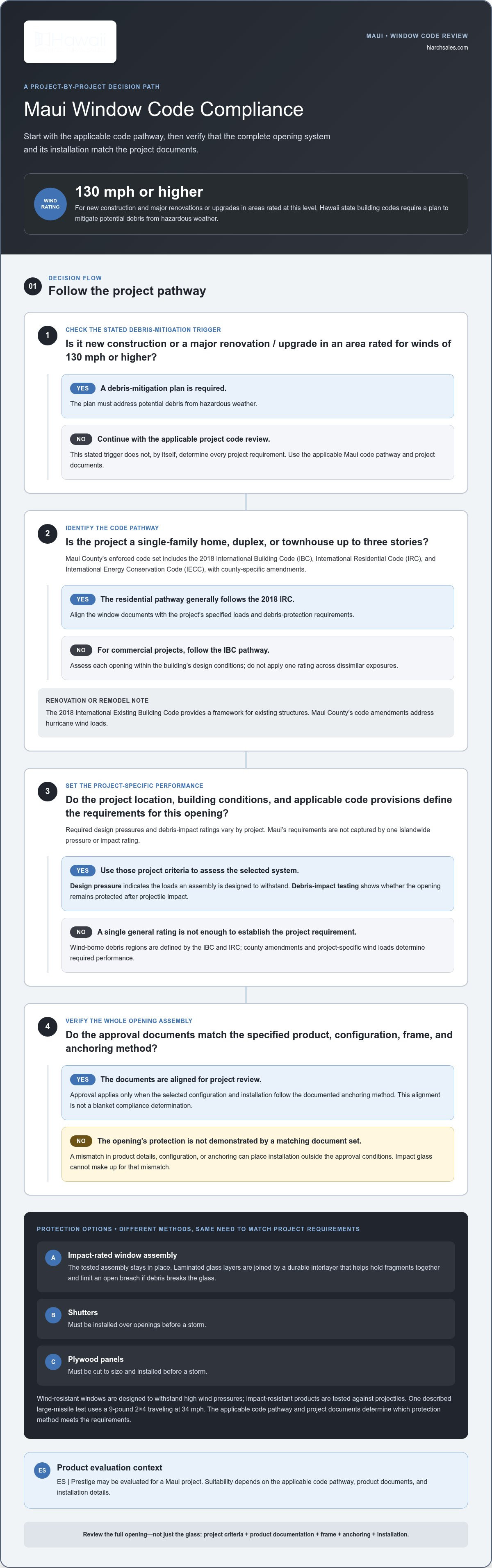
A window can look impact-ready and still fail a code-compliance review. For hurricane code compliance windows in Maui, the key is matching the window or opening-protection system to the project’s applicable code and documenting how it mitigates debris. Hawaii state building codes require new construction and major renovations or upgrades in areas rated for winds of 130 mph or higher to have a plan to mitigate potential debris from hazardous weather.
That distinction matters: laminated impact glass is one part of protection, while the full opening assembly and its installation also matter. Maui County has enforced the 2018 International Building Code, International Residential Code, and International Energy Conservation Code with county-specific amendments since October 28, 2023, according to the Maui County Department of Public Works.
This guide explains how residential and commercial code pathways differ, what impact-glass and debris-protection documents can show, and how to assess whether a window system meets a project’s requirements in Maui.
Key Takeaways
• Assess the full opening-protection system, not just the glass: laminated impact glass is designed to hold together if debris breaks it.
• For new construction and major renovations or upgrades in areas rated for winds of 130 mph or higher, Hawaii state building codes require a plan to mitigate potential debris from hazardous weather.
• Since October 28, 2023, Maui County has enforced the 2018 International Building Code, the 2018 International Residential Code, and the 2018 International Energy Conservation Code with county-specific amendments, according to the Maui County Department of Public Works.
• When evaluating window options for a project, Hawaii Architectural Sales offers ES | Prestige as a product to consider within the project’s code pathway.
Laminated impact glass has multiple glass layers joined by a durable interlayer. If debris breaks the glass, the interlayer helps hold fragments together and limit an open breach. For hurricane code compliance windows in Maui, assess the full opening assembly, including the frame and anchoring, not just the glass.
Hawaii state building codes require new construction and major renovations or upgrades in areas rated for winds of 130 mph or higher to have a plan for mitigating potential debris from hazardous weather. Wind-resistant windows are designed to withstand high wind pressures, while impact-resistant products are tested against projectiles. A described large-missile test uses a 9-pound 2×4 traveling at 34 mph.
Impact-rated windows and shutters can both protect openings, but they work differently. A tested window assembly stays in place, while shutters must be installed over openings before a storm. Plywood is another protection method, but panels must be cut to size and installed before a storm. The applicable Maui code pathway and project documents determine which method meets the project requirements.
A noncompliant window can leave an opening without demonstrated debris protection and create a code-compliance issue. Hawaii’s stated requirement sets the mitigation obligation, not a specific penalty amount. The key question is whether the project’s protection meets the applicable requirements.
For a practical review, match the product documents to the project and opening, then check the frame and anchoring details. A window’s approval applies only when installation follows the anchoring method in its approval document. This matters for residential openings and larger commercial assemblies alike: impact glass cannot make up for installation outside the approved conditions.
Residential and commercial code pathways
Maui County’s applicable code set is the starting point for window review. Since October 28, 2023, Maui County has enforced the 2018 International Building Code, the 2018 International Residential Code, and the 2018 International Energy Conservation Code with county-specific amendments, according to the Maui County Department of Public Works. Those amendments address hurricane wind loads.
The residential pathway generally applies to single-family homes, duplexes, and townhouses up to three stories under the 2018 International Residential Code. Commercial projects follow the International Building Code. Renovations and remodels also involve the 2018 International Existing Building Code, which provides the framework for existing structures.
Required design pressures and debris-impact ratings depend on the project location, building conditions, and applicable code provisions. The International Building Code and International Residential Code define wind-borne debris regions; county amendments and project-specific wind loads determine required performance. Maui’s requirements are not captured by one islandwide pressure or impact rating.
For either protection method, compare project documents with the window’s performance information. Design pressure ratings indicate the loads an assembly is designed to withstand. Debris-impact testing shows whether the opening remains protected after projectile impact. Approval applies only when the selected configuration and anchoring method match the approved documents.
Residential example
Confirm the project falls under the IRC pathway, then align the window documentation with its specified loads and debris protection.
Commercial example
Use the IBC pathway and assess each opening within the building’s design conditions, rather than applying one rating across dissimilar exposures.
For the product-selection stage, explore architectural window systems that can be evaluated against the project’s code requirements.
Hawaii Architectural Sales: ES | Prestige
Hawaii Architectural Sales helps project teams consider window options against design and performance requirements. ES | Prestige may be suitable for evaluation on a Maui project, but compliance depends on the applicable code pathway, product documents, and installation details.
Bring the project requirements into product selection so the window can be assessed for its intended application. Contact Hawaii Architectural Sales to discuss ES | Prestige for your project.
Move Your Project Toward a Clear Window Specification
The next step is to align window selection with the project’s design intent and compliance documents. For teams assessing hurricane code compliance windows in Maui, the product must suit the opening, performance criteria, and approved installation details. Hawaii Architectural Sales supplies ES | Prestige, ES | Elite, and ES | uPVC window options for that selection process.
Bring the project’s requirements into the conversation early, while the design and product specifications can still be coordinated. This helps keep window decisions connected to the broader building plan rather than treating them as a late-stage substitution. Contact Hawaii Architectural Sales to discuss the options for your project and take the next step with confidence.
Frequently Asked Questions
How do you verify a window is code-compliant?
To assess hurricane code compliance for windows in Maui, compare the specified product and configuration with its approval documents and project records. Match the window schedule, submitted product details, and installation drawings, including anchoring. For projects in Lahaina or Kihei, keep records specific to each building and opening to prevent later substitutions from creating mismatches.
What should buyers verify before ordering?
Before ordering, confirm that the selected window configuration matches the project schedule, opening dimensions, and design documents. Check that product documents correspond to the ordered configuration, not merely a similar model or appearance. For projects in Honolulu, Lihue, Kailua-Kona, Kihei, and Lahaina, organize specifications and approved substitutions by project to reduce ordering and documentation errors.
What are the risks and penalties for installing noncompliant windows in Maui?
A noncompliant window can leave an opening without demonstrated debris mitigation and create a code-compliance problem. For applicable new construction and major renovations or upgrades in areas rated for winds of 130 mph or higher, Hawaii requires a plan to mitigate potential debris from hazardous weather.
What building codes and wind-speed maps govern window replacement in Maui?
Maui County enforces the 2018 IBC, IRC, and IECC with county-specific amendments; the 2018 IEBC provides the framework for renovations and remodels. The IBC and IRC define wind-borne debris regions, and county amendments and project-specific wind loads determine performance requirements. Hawaii also requires a debris-mitigation plan for new construction and major renovations or upgrades in areas rated for winds of 130 mph or higher.