HVHZ Rated Window Systems: What Hawaii Project Teams Need to Know
Could an HVHZ approval support a Hawaii window specification without proving the system complies with the project’s requirements? HVHZ rated window systems carry evidence of testing against demanding Florida hurricane standards, but that evidence needs to be read in context. The rating alone doesn’t...
Could an HVHZ approval support a Hawaii window specification without proving the system complies with the project’s requirements? HVHZ rated window systems carry evidence of testing against demanding Florida hurricane standards, but that evidence needs to be read in context. The rating alone doesn’t establish that a specific product configuration meets a Hawaii project’s design pressures, code requirements, or approval process.
It’s understandable to look to a Florida approval when evaluating performance in a high-wind environment. Hawaii’s adopted building code references impact standards for certain glazed openings, but project teams still need to confirm the applicable jurisdiction, code edition, and requirements with the design professional and authority having jurisdiction.
This article explains what an HVHZ rating demonstrates, what it doesn’t establish for a Hawaii project, and how to compare approvals, test reports, and product specifications. You’ll learn which manufacturer documentation to request, including the tested configuration and installation criteria, and why those details matter. Hawaii Architectural Sales is an independent manufacturer’s representative and distributor that can help project teams coordinate product information and available manufacturer documentation for review.
Key Takeaways
• Understand what an HVHZ approval documents, and why its scope depends on the tested product configuration and conditions.
• Use a structured review to match product identity, options, test evidence, and approval limitations before specifying a system.
• Evaluate HVHZ rated window systems alongside Hawaii project criteria, including the applicable jurisdiction and adopted code.
• Separate confirmed documentation from unresolved questions, then direct each item to the appropriate project team member for verification.
• A Hawaii-based manufacturer’s representative can help identify relevant product information and coordinate requests for manufacturer documentation.
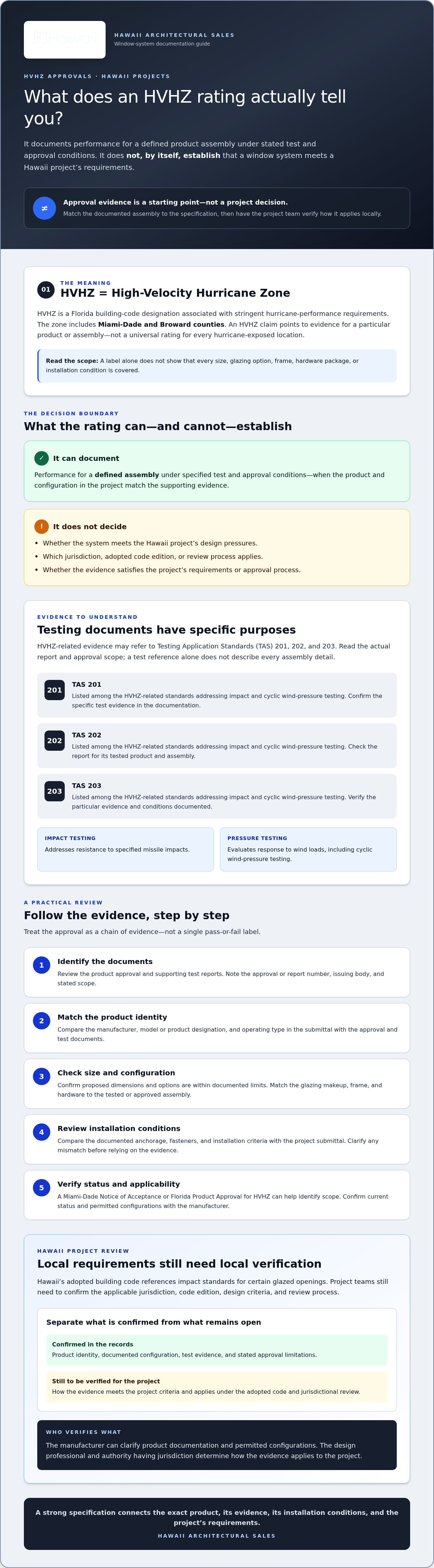
HVHZ means High-Velocity Hurricane Zone, a Florida building-code designation associated with stringent hurricane-performance requirements. HVHZ rated window systems have documentation showing that a specific product or assembly was evaluated under applicable criteria. The designation isn’t a universal rating for every hurricane-exposed location, and a label alone doesn’t establish suitability for a particular project.
Definition: An HVHZ designation points to Florida-specific approval or test evidence for a documented window product, configuration, and set of conditions. Its relevance to another project depends on matching that evidence to the project’s requirements.
What it can establish: As a concise rule, an HVHZ designation can establish documented performance for a defined assembly under specified test and approval conditions, not blanket approval for every building or location.
What does the High-Velocity Hurricane Zone designation refer to?
The designation applies in Florida’s HVHZ, which includes Miami-Dade and Broward counties. It reflects a particular code and approval context, not a generic label for all coastal or hurricane-prone areas. Wind-resistant design also depends on how building components work together, including the protection of openings and the transfer of loads through the structure. For general background, see these hurricane-resistant construction methods.
For a project outside Florida, including one in Hawaii, the term may help identify relevant performance evidence, but it doesn’t decide whether that evidence satisfies local requirements. Project teams need to evaluate the applicable jurisdiction, adopted code, design criteria, and review process.
What documentation sits behind an HVHZ claim?
Look beyond marketing language. Request the product approval, supporting test reports, and documentation describing the tested or approved assembly. HVHZ-related evidence may refer to Testing Application Standards (TAS) 201, 202, and 203, which address impact and cyclic wind-pressure testing. These forms of evidence serve different purposes: impact testing addresses resistance to specified missile impacts, while pressure testing evaluates response to wind loads. Neither alone describes every detail of an approved assembly.
Check that the documents identify the relevant product and configuration. Size, glazing, frame, hardware, anchorage, and installation conditions can affect whether the evidence applies to the specified system. A report for one configuration shouldn’t be assumed to cover another.
Product approval
Check the approval number, product identity, and stated scope.
Test reports
Confirm which performance tests were conducted and what assembly was tested.
Configuration details
Match sizes, glazing, frame, hardware, and installation conditions to the project submittal.
A Miami-Dade Notice of Acceptance or Florida Product Approval for HVHZ may help identify the approval scope. Confirm its current status and permitted configurations directly with the manufacturer, then have the project design professional and authority having jurisdiction determine how that evidence applies.
How to Read HVHZ Window Testing and Approval Documents
Review approval documents as a chain of evidence, not as a single pass-or-fail label. The goal is to confirm that the proposed unit matches the product and conditions represented in the records, then identify any gaps for the project team to resolve.
Which details should a project team check first?
Start with product identity. Compare the manufacturer, model or product designation, and operating type shown in the submittal with the approval and test documents. A mismatch, even in a detail that appears minor, should be clarified before relying on the evidence.
Identify the document
Record its title, approval or report number, issuing body, date, and stated scope.
Match the product
Confirm manufacturer, model, product designation, and operating type across the submittal and supporting files.
Verify size and configuration
Check that the proposed dimensions and options are within the documented limits. Confirm the glazing makeup, frame, and hardware match the tested or approved assembly.
Review attachment conditions
Compare required anchorage, fasteners, and installation details with the project’s design documents. These conditions can affect whether the evaluated assembly represents the proposed one.
Log limitations
Record exclusions, conditions, permitted configurations, and document dates for the design team. Ask the manufacturer to verify current approval status and clarify any missing or unfamiliar information.
Approval evidence is meaningful only within its documented scope; a change in size, components, or attachment conditions may require further review.
How should performance reports be compared?
Compare like with like. First check whether reports address the same test method and comparable product configurations. Different criteria or test setups may not support a direct performance comparison. Keep impact-related findings distinct from pressure-performance data, and avoid treating one result as proof of every aspect of system performance.
If terminology is unfamiliar, or the approval references a supporting report that isn’t in the submittal package, request clarification and the relevant files from the manufacturer. Keep the question specific: identify the document, model, configuration, and detail that need confirmation.
For Hawaii projects, a Florida approval is documentation to evaluate, not a determination of local code compliance. The project design professional and authority having jurisdiction should review how the evidence relates to the project’s requirements. Teams considering HVHZ rated window systems can also discuss product categories and available manufacturer documentation with Hawaii Architectural Sales, an independent manufacturer’s representative and distributor.
HVHZ Rated Windows for Hawaii: What the Rating Does Not Decide
An HVHZ approval is rooted in Florida’s code and review framework. It can provide useful evidence about a documented product, but it doesn’t decide whether the system meets a Hawaii project’s requirements. A jurisdiction-specific approval is evidence to evaluate, not automatic project acceptance.
Does Florida product approval automatically satisfy Hawaii requirements?
No. Don’t assume a Florida product approval establishes compliance in Hawaii. The project design professional and authority having jurisdiction should review the documents against the applicable jurisdiction, adopted code, and project criteria. That review determines whether the evidence is relevant to the proposed use and what additional submittals may be needed. Avoid treating a Florida approval as a direct code-equivalency determination.
The review depends on both the evidence and the project context. Use this comparison to identify what’s documented and which questions still need a project-specific answer:
Florida HVHZ evidence
Hawaii project requirements
Questions for professional verification
Identifies the approved product or tested assembly and the conditions within the document’s scope.
Depend on the project location, applicable code, building design, and specified performance criteria.
Does the approval cover the exact product and configuration proposed? Does it address the project’s required performance?
May include conditions, limits, or permitted configurations tied to the Florida approval.
Are established through project design and the applicable review process, not by the Florida document alone.
Are additional calculations, reports, or supporting documents needed for review?
Provides a reference point for evaluating documented performance.
Must be considered in relation to the building and opening design.
Has the design professional and authority having jurisdiction confirmed how the evidence applies?
Which Hawaii project conditions should inform review?
Start with the project documents. Consider location, exposure, building type, opening dimensions and design, and specified performance criteria. These factors can shape what evidence the team needs to evaluate and submit. A project in Honolulu may have different design conditions from one in Lihue, Kailua-Kona, Kihei, or Lahaina. Don’t assume one island-wide answer; tie the review to the specific project.
Use the project team’s review to connect manufacturer documentation to the design and approval requirements. For broader local context, consult the related guide on hurricane-rated windows in Hawaii. It can complement this discussion, while project-specific decisions remain with the design professional and authority having jurisdiction.
A Practical HVHZ Window-System Specification Checklist
Use this checklist to compare proposed systems against the project specification, not broad marketing descriptions. For HVHZ rated window systems, a product label is only a starting point. The submittal needs to show how the documented product and configuration relate to the actual project criteria.
What should the window submittal package include?
Project criteria
Record the applicable jurisdiction, adopted code information, specified performance criteria, and relevant opening requirements. Confirm these with the project design professional.
Product identity
Request current manufacturer literature and identify the exact manufacturer, model, operating type, and product designation proposed.
Opening schedule
Check that drawings and schedules identify each opening’s size, operating type, glazing, and selected options. Flag any difference from the supporting documentation.
Test and approval evidence
Include applicable product-specific test reports and approvals. Check their scope, limitations, date, and permitted configurations with the manufacturer.
Assembly and attachment details
Compare the documented frame, glazing makeup, hardware, anchorage, and installation conditions with the proposed assembly and project details.
Submittal record
List missing files, unclear conditions, and configuration mismatches. Track responses and revised document versions through the project submittal process.
Separate the package into two working lists: confirmed documentation, which matches the proposed system, and open questions, which still need an answer. This distinction helps prevent an unresolved assumption from being treated as an accepted product condition.
Which questions help resolve gaps before specification?
Direct each question to the person best placed to answer it. Ask the manufacturer to clarify the scope and limitations of its product evidence, confirm permitted configurations, and provide missing supporting files. Have the design professional assess how the documents relate to project criteria and code review. Coordinate installation details with the responsible project team member, and confirm who will review those details before acceptance.
• Does the evidence cover the exact model, size, glazing, options, and attachment conditions proposed?
• Are any exclusions or limits inconsistent with the drawings or schedule?
• Which documents remain outstanding, who owns each follow-up, and what version is being reviewed?
For product-specific context, consult the manufacturer's engineering and performance documentation alongside current technical guides. Don’t assume that a guide or general product literature establishes HVHZ approval for a particular configuration. To discuss architectural window-system categories and available manufacturer documentation, contact Hawaii Architectural Sales, an independent manufacturer’s representative and distributor.
Working With a Hawaii Window-System Representative on HVHZ Documentation
HVHZ documentation can be easier to evaluate when product information is coordinated early with the design team. A manufacturer’s representative can help identify relevant product categories, locate manufacturer resources, and request current literature or configuration-specific documents. That support helps architects, engineers, contractors, and developers organize the information they need to review proposed systems.
What can a product representative help coordinate?
Hawaii Architectural Sales is an independent manufacturer’s representative and distributor of architectural window and door systems. The company can help project teams identify represented product categories and coordinate requests for available manufacturer documentation. Any claim that a specific system is HVHZ approved or suitable for a project must be supported by current, product-specific evidence from its manufacturer.
This role is focused on product expertise and material distribution. Hawaii Architectural Sales does not provide installation or general contracting. Compliance decisions remain with the project’s design professionals and authority having jurisdiction, who assess the submitted evidence against the project criteria.
What information should you prepare before a project discussion?
A concise project brief makes document requests more focused. Share the information available, and note what remains undecided. Useful items include:
Project context
Location and building type, plus relevant project criteria.
Opening information
The window schedule, including proposed operating types, sizes, glazing, and options.
Performance requirements
The specified criteria or design documents the team is using for evaluation.
Documentation gaps
Missing test reports, unclear approval scope, configuration differences, or questions that need manufacturer confirmation.
Review responsibilities
The project team members responsible for product selection, technical review, code compliance, and installation details.
These details help distinguish a general product inquiry from a request tied to a particular opening and configuration. They also make it easier to identify which questions require manufacturer input and which require project-level review. A representative can help coordinate information, but the project team determines whether the documentation supports the specification.
Strong window specifications start with evidence that matches the proposed product and the project’s requirements. Treat HVHZ rated window systems as documentation to evaluate, not automatic confirmation of Hawaii project compliance. Confirm the product configuration and approval scope, then leave code and compliance determinations with the project design professional and authority having jurisdiction.
For architects, engineers, contractors, and developers, coordinating product information early can make review more organized. Founded in 1985, Hawaii Architectural Sales is an independent manufacturer’s representative and distributor serving Hawaii, providing product expertise and material distribution for architectural projects. Its role is to help teams identify product categories and coordinate available manufacturer documentation, not to install products or provide general contracting.
Bring your project location, opening schedule, performance criteria, and any documentation questions to the discussion. Discuss architectural window systems with Hawaii Architectural Sales and take the next step with a clearer path for product review. With the right information and project-team coordination, your team can move forward with greater confidence.
Frequently Asked Questions
Does an HVHZ approval automatically meet Hawaii building requirements?
No. Don’t assume an HVHZ approval automatically satisfies requirements for a Hawaii project. It may provide useful performance evidence, but its relevance depends on the applicable jurisdiction, adopted code, building design, and review process. Check that the proposed product configuration matches the assembly in the submitted documents. The project design professional and authority having jurisdiction should assess whether the evidence addresses the project criteria and whether additional documentation is needed.
Is a Miami-Dade NOA the same as an HVHZ rating?
A Miami-Dade Notice of Acceptance (NOA) is an approval document for specified products and conditions, and it may be relevant when evaluating HVHZ-related evidence. It isn’t a blanket statement covering every product option or project location. Review the exact product identity, permitted configuration, limitations, and current document status. If the system is proposed outside Florida, have the project’s design professionals and authority having jurisdiction determine how the document applies.
What documents should I request for an HVHZ window system?
Request current manufacturer product literature and applicable product-specific test reports or approval documents. Compare the manufacturer, model, operating type, dimensions, glazing, hardware, and installation conditions with the proposed system. Note limitations, exclusions, missing reports, or mismatches for follow-up. The design professional should review whether the package addresses the project specification and applicable jurisdictional requirements. Product descriptions alone don’t confirm that a particular configuration is covered.
Can an impact-rated window be assumed to be HVHZ-rated?
No. “Impact-rated” and “HVHZ-rated” describe evidence that shouldn’t be treated as interchangeable. Check which tests or approvals support the claim, what product configurations they cover, and whether the submitted assembly matches the documents. Then have the project team assess whether that evidence addresses the specified requirements. A label or marketing description can help identify a product claim, but it can’t replace current manufacturer documentation and project-specific review.
Who determines whether an HVHZ window system is acceptable for a Hawaii project?
The project’s design professionals and the relevant authority having jurisdiction determine applicable requirements and review submitted evidence. A product representative can help identify product categories and coordinate requests for manufacturer documentation, but doesn’t make the project’s compliance determination. Share the location, building type, opening schedule, performance criteria, and proposed configuration. Hawaii Architectural Sales represents and distributes architectural systems for projects in Honolulu, Lihue, Kailua-Kona, Kihei, and Lahaina.