Justifying cost of premium windows to clients Hawaii
Justifying Premium Window Costs to Hawaii Clients
What if the strongest case for a premium window isn’t a promise of savings, but evidence that it fits the project? For architects, engineers, and owners, justifying cost of premium windows to cl...
Justifying cost of premium windows to clients Hawaii
Justifying Premium Window Costs to Hawaii Clients
What if the strongest case for a premium window isn’t a promise of savings, but evidence that it fits the project? For architects, engineers, and owners, justifying cost of premium windows to clients Hawaii means connecting documented product attributes to the building’s actual conditions, not relying on broad claims about durability or efficiency.
Clients are right to examine the initial price. They also need a clear view of what that price includes and which trade-offs matter over the building’s life. Conditions vary by location, elevation, orientation, and project requirements, so a feature that matters at a coastal site in Lahaina may not be decisive for a project in Honolulu, Lihue, Kailua-Kona, or Kihei.
This article offers a project-specific framework for comparing window options transparently. You’ll learn how to identify relevant performance documentation, assess lifecycle considerations without overstating savings, and connect product characteristics to project requirements. Hawaii Architectural Sales provides technical product expertise for product-fit and specification questions, helping project teams build a clearer, evidence-based comparison.
Key Takeaways
• Define required window performance separately from preferences such as sightlines, operation, and finish.
• Use current manufacturer documentation that matches the proposed window’s size, configuration, and intended use.
• Make justifying cost of premium windows to clients Hawaii more transparent by comparing equivalent scopes and showing trade-offs without unsupported savings claims.
• Present the recommendation in a client-ready sequence: priorities, evidence, comparable options, trade-offs, and decision.
• Use a decision checklist to identify missing project criteria, documentation, and open questions before selecting an option.
Start with the Hawaii project: what must the window actually deliver?
Start with the project’s demands, not a product tier. A residence near the shoreline and a building in a more sheltered setting may have different surrounding conditions, design priorities, and engineering criteria. The comparison should reflect those differences instead of assuming one specification suits every Hawaii site.
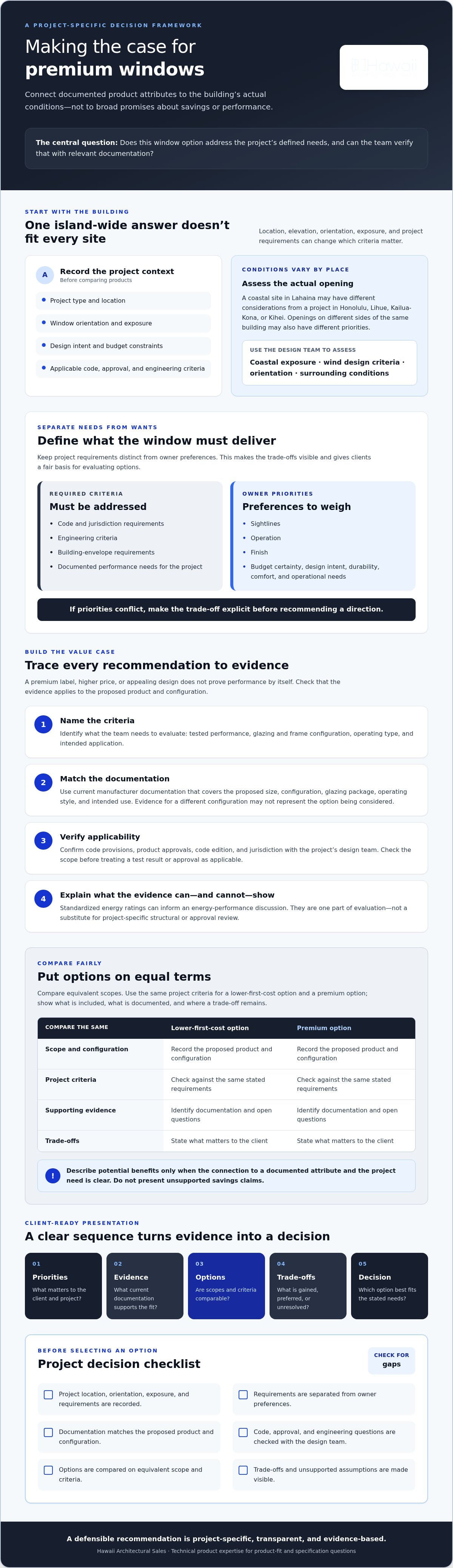
Before discussing options, record the project type, location, window orientation, exposure, design intent, and budget constraints. Then separate requirements from preferences. Code, engineering, and building-envelope requirements belong in the first category. Sightlines, operation, and finish may be owner priorities unless the project team identifies them as requirements. This distinction gives clients a clear basis for weighing options.
Translate Hawaii site conditions into documented criteria
Assess coastal exposure, wind design criteria, orientation, and surrounding conditions with the project’s design team. Openings on different sides of the same building may have different priorities. Confirm applicable code, approval, and engineering requirements for the project and jurisdiction rather than relying on a general claim about Hawaii.
Site conditions should guide window selection because they determine which documented performance criteria are relevant to each opening.
Record the required configuration and the evidence needed to evaluate it. For example, verify the glazing assembly. Insulated glass units (IGUs) use multiple panes separated by a space, which may contain gas. Whether a particular assembly suits the project depends on its documented properties and requirements, not on the “premium” label alone.
Clarify what the client values before presenting options
Ask the client to rank budget certainty, design intent, durability, comfort, and operational needs. These priorities help explain why one option may be preferable without suggesting every premium feature is essential. Keep owner preferences distinct from criteria set by the code, engineer, or envelope design team. If priorities conflict, make the trade-off explicit before recommending a direction.
For teams focused on justifying cost of premium windows to clients Hawaii, a concise project brief is the starting point. Connect each proposed attribute to a stated need and identify evidence still required. For related technical context on wind considerations, see Hurricane Rated Windows in Hawaii: The Architect’s Technical Guide. Confirm project-specific requirements with the design team before treating any performance or approval claim as applicable.
Build the premium-window value case from verifiable performance
An evidence-based value case shows how current, product-specific documentation addresses defined project requirements, then explains the trade-offs in plain language. A premium label, higher price, or appealing design doesn’t prove performance by itself. The case is strongest when clients can trace each recommendation to a stated need and relevant evidence.
Match product documentation to the project specification
First identify the criteria the project team needs to evaluate. These may include tested performance, glazing and frame configuration, operating type, and intended application. Then check whether the manufacturer’s current documentation covers the proposed product and configuration. Test data for a different size, glazing package, or operating style may not represent the option under consideration.
Keep compliance questions specific. Confirm applicable code provisions, product approvals, and code edition with the project’s design team and relevant jurisdiction. Don’t present an approval or test result as applicable until its scope has been checked. For energy-related comparisons, understanding the NFRC label can help teams interpret standardized window energy ratings. Those ratings are one part of the evaluation, not a substitute for project-specific structural or approval review.
Connect features to client outcomes without promising savings
Translate a documented attribute into a potential project benefit only when the connection is clear. A verified energy rating, for example, can inform discussion of energy performance. The design team can assess how it relates to the building and its goals. Describe it as relevant evidence, not a guaranteed reduction in bills. Comfort, durability, maintenance, and lifecycle outcomes also depend on the full design, product selection, and other project conditions. Verify claims before including them in a recommendation.
Verified performance comes from current documentation for the proposed configuration. Marketing language alone doesn’t establish how a window will perform on a specific project.
A practical evidence record can list the criterion, supporting document, configuration covered, and any limitation or open question. This makes it easier to explain where an option meets a requirement, where information is incomplete, and what needs confirmation. That distinction supports a credible comparison without overstating benefits.
Hawaii Architectural Sales is an independent manufacturer’s representative and distributor with product expertise. Project teams can review architectural window product information as part of gathering documentation and evaluating specification questions.
Compare premium and lower-first-cost windows on equal terms
An apples-to-apples comparison shows whether a price difference reflects a meaningful difference in scope or documented performance. If one option has a different opening type, glass package, finish, or required accessory, make that difference visible. Otherwise, clients may mistake an incomplete or non-equivalent proposal for a like-for-like alternative.
Use a consistent framework for each option. Keep these fields aligned wherever possible:
Opening and size
Record the same operating type and dimensions, or note where they differ.
Assembly
List the frame, glazing, hardware, configuration, and accessories included.
Performance
Identify the criteria being compared and cite current documentation for the proposed configuration. The National Fenestration Rating Council provides verifiable window performance ratings for energy-related characteristics. Confirm which ratings apply to the project’s priorities.
Scope and documentation
State what each option includes, what’s excluded, and which product or project documents remain to be confirmed.
Cost basis
Compare project-specific proposals using the same scope. Avoid unsupported assumptions about future savings or costs.
Mark missing information as “not provided” or “not equivalent.” Don’t assume two products have the same performance, accessories, or documentation. Product-specific context, such as ES | Prestige: High-Performance Architectural Window Systems for Hawaii, can help teams identify questions to confirm against current manufacturer materials. Hawaii Architectural Sales represents and distributes window systems, including ES product lines, and can provide product expertise for specification questions.
Compare the complete specified assemblies
Discuss lifecycle considerations carefully
Lifecycle comparisons can help explain trade-offs, but only when the inputs are supported. Ask the project team to verify maintenance guidance, replacement implications, operating priorities, and any documented service-life or warranty terms for the specific options. Include assumptions and their sources. Don’t promise energy savings, payback periods, insurance reductions, or a particular service life without evidence that applies to the project.
The goal isn’t to declare one option universally better. It’s to show how each complete assembly compares against the same requirements, where the evidence is strong, and what remains uncertain. For residential projects where long-term replacement cycles and proper installation dictate everyday performance, consulting residential specialists such as Select Windows and Doors Inc can provide helpful context on how product tiers perform in practice.
Present the premium-window recommendation in a client-ready sequence
A clear recommendation starts with the client’s priorities, then shows how each option responds to them. Use a short presentation and a one-page matrix so the decision rests on project facts, not a broad claim that premium is always better.
State the project need.
Summarize the client’s priorities and the requirements established by the design team.
Show the evidence.
Identify current product documentation supporting each proposed specification, including any limits on what it covers.
Present comparable options.
Include a premium recommendation and, where appropriate, a lower-first-cost alternative with equivalent scope wherever possible.
Explain trade-offs.
Note which criteria each option addresses, where documented performance differs, and what remains unverified.
Confirm the decision.
Identify open questions, agree on any follow-up review, and record the client’s priorities and direction.
A one-page matrix keeps the discussion focused. Use one row per project criterion, with columns for requirement, supporting evidence, assumption, and open question. Put a project-specific performance requirement in the first column and the relevant documentation beside it. If the document doesn’t cover the proposed configuration, record that gap as an open question rather than implying it’s resolved.
Explain trade-offs without pressuring the client
Present a viable lower-first-cost option when it fits the project’s requirements. Describe what each alternative satisfies and where the available evidence differs. If documentation is incomplete or not directly comparable, say so. Don’t suggest a lower-cost option is unsafe or unsuitable unless project-specific evidence supports that conclusion. This respects budget limits while keeping required criteria distinct from preferences.
Answer the cost objection with project facts
Acknowledge the budget constraint, then ask which requirements are fixed and which preferences may be flexible. Use verified project documentation to explain the reason for each proposed specification. If the client values a particular sightline or operation, show how that preference affects the options. Don’t present it as an engineering requirement unless the design team has established it.
The strongest presentation is transparent about both the case for the recommendation and its limitations. Hawaii Architectural Sales is an independent manufacturer’s representative and distributor with product expertise. Its role can include helping project teams address product-fit and specification questions. Installation and general contracting are not provided.
Connect Hawaii clients with the right architectural window expertise
A decision-ready recommendation doesn’t need a blanket claim about premium products. It needs a clear record of what the project requires, what each option documents, and what the team still needs to verify. That structure helps clients assess the recommendation against their priorities and make an informed specification decision.
Prepare a focused product discussion
Bring the information that connects the product question to the project. A focused discussion can start with:
Project context
Project type, location, drawings, and relevant specifications.
Required performance
Criteria established by the design team, along with applicable project documentation.
Comparable scope
Proposed opening type, dimensions, glazing, finish, configuration, and accessories for each option.
Open questions
Missing test data, configuration details, product approvals, or other items that need confirmation.
Be specific about what remains unresolved. Does the documentation cover the proposed configuration? Are the options genuinely comparable? Which requirements need review by the project’s architect, engineer, or other responsible professional? For broader supplier-evaluation context, consult The Architect’s Guide to Selecting an Architectural Window Distributor in Hawaii.
Move from cost concern to an informed specification
Justifying cost of premium windows to clients Hawaii starts with verified project needs, not the premium label alone. A recommendation is easier to evaluate when each proposed attribute connects to a defined criterion and current product documentation. Note gaps where evidence is incomplete. Where options differ, explain the trade-off without promising savings, service life, or performance beyond what the available documentation supports.
Hawaii Architectural Sales is an independent manufacturer’s representative and distributor of architectural systems, including ES window lines. The company provides product representation and technical expertise for product-fit and specification questions. Project responsibilities should remain clear: coordinate design, code, and engineering review with the appropriate professionals, and separately confirm who is responsible for installation and general contracting. Hawaii Architectural Sales does not provide installation or general contracting.
Use the supplier-evaluation guide title above as a prompt to assess product expertise and documentation needs. Then bring the project criteria and unresolved questions into the product discussion.
A strong recommendation starts with what the project must deliver, then connects those requirements to current product documentation. Compare options on equivalent scope, make assumptions and gaps visible, and explain trade-offs against the client’s priorities. This makes justifying cost of premium windows to clients Hawaii a transparent decision process, not a claim that a higher-priced option is automatically right.
Connect the proposed window’s documented attributes to the project’s stated requirements. Start with the client’s priorities, show current manufacturer documentation for the specific product configuration, and compare equivalent options. Explain what each option addresses, where evidence differs, and what remains uncertain. This makes justifying cost of premium windows to clients Hawaii a transparent discussion of project fit and trade-offs, rather than a claim that premium products are always better.
Are premium windows worth the additional cost in Hawaii?
They may be worth considering when documented performance or product features address requirements that matter to the project. The answer depends on the building, site conditions, design priorities, and comparable product scope. Ask the design team to identify required criteria, then review current documentation for each option. Don’t assume a premium label guarantees better results or that a higher initial cost will produce savings or other benefits without project-specific evidence.
What should I compare when evaluating premium and standard windows?
Compare options with the same opening type, dimensions, glazing, finish, configuration, and performance criteria wherever possible. Review the complete proposed assembly, including frame, hardware, accessories, and required documentation. Record exclusions, assumptions, and missing information beside each option instead of treating gaps as equivalent performance. If a difference in scope can’t be aligned, make it visible so the client understands what the comparison does and doesn’t establish.
Can premium windows reduce energy costs in Hawaii?
Some window ratings can help teams evaluate energy-related characteristics, but a rating alone can’t predict a project’s utility-bill change. Actual outcomes depend on the selected product and configuration, the building, and other project conditions. Compare current documentation for the proposed options and ask the design team to assess its relevance. Avoid promising savings or payback unless reliable evidence supports the claim for the specific project.
How do Hawaii site conditions affect window selection?
Site conditions help determine which window criteria are relevant. Project teams should consider location, orientation, surrounding conditions, exposure, and the design team’s wind criteria instead of applying one assumption statewide. A project in Honolulu may have different requirements from one in Lihue, Kailua-Kona, Kihei, or Lahaina. Confirm applicable code, engineering, and approval requirements with the project’s responsible professionals before selecting or specifying a product.
What documentation should support a premium-window specification?
Gather current manufacturer documentation that applies to the proposed product and configuration, including relevant test data and performance ratings. Check that the opening type, glazing, size, and other tested details match the option under review. The project team should also verify applicable code provisions, product approvals, and edition details with the design team and relevant jurisdiction. Note missing or non-equivalent documentation clearly. Don’t fill gaps with assumptions.
Does Hawaii Architectural Sales install windows?
No. Hawaii Architectural Sales is an independent manufacturer’s representative and distributor of architectural products, providing product representation and technical expertise rather than installation or general contracting. Project teams should coordinate installation and contracting responsibilities separately with the appropriate professionals. Hawaii Architectural Sales represents window lines including ES | Prestige, ES | Elite, and ES | uPVC, and serves project teams in Honolulu, Lihue, Kailua-Kona, Kihei, and Lahaina.