LEED Material Selection in Hawaii: A Practical Guide
What if a material supports a LEED credit on paper but struggles with Hawaii’s salt air, humidity, or exposure conditions? Material selection for LEED certified projects Hawaii teams undertake requires more than matching a product to a credit. It means checking documentation and building performance...
What if a material supports a LEED credit on paper but struggles with Hawaii’s salt air, humidity, or exposure conditions? Material selection for LEED certified projects Hawaii teams undertake requires more than matching a product to a credit. It means checking documentation and building performance together.
Credit requirements vary by LEED rating system, and manufacturers provide different forms of product information. Sustainability goals also need to work alongside durability and project-specific design requirements. A clear review process helps teams compare options without treating documentation or environmental suitability as an afterthought.
This guide connects LEED goals with product records, performance needs, and Hawaii conditions. It explains how to organize decisions around the project’s LEED pathway, compare documents such as environmental product declarations and emissions data, and coordinate product choices early enough to inform specifications. Use the process to evaluate architectural materials, including fenestration and daylighting systems, for credit alignment and long-term project needs.
Key Takeaways
• Confirm the project’s registered LEED rating system and applicable requirements before selecting materials, so decisions align with the right credit pathway.
• Compare EPDs, ingredient disclosures, low-emitting evidence, and waste records by what each document demonstrates and how it supports project review.
• Evaluate material selection for LEED certified projects Hawaii alongside durability, maintenance, design intent, and site-specific exposure conditions.
• Treat local sourcing as a project consideration, not an automatic credit; verify how the applicable rating-system rules apply.
• Assign documentation responsibilities early across the owner, design team, contractor, and suppliers to support specifications and submittal review.
What Material Selection for LEED-Certified Projects in Hawaii Really Means
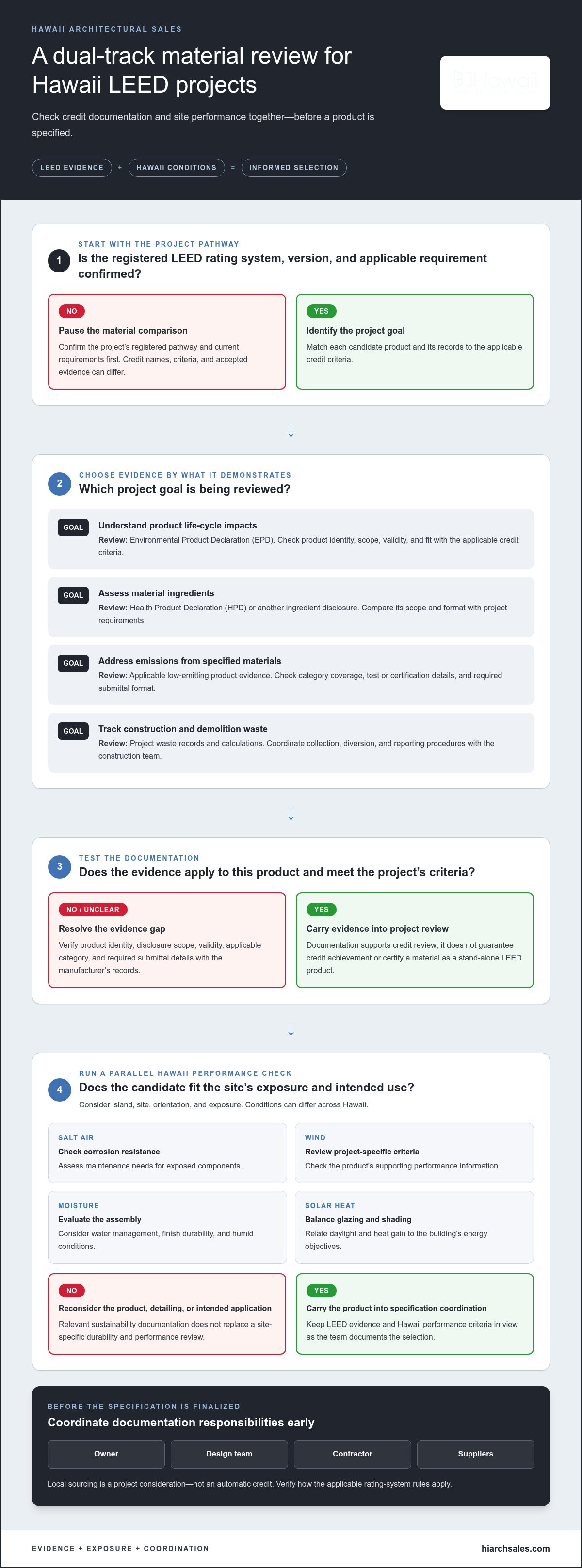
LEED evaluates a building project against a selected rating system and its requirements. Materials can contribute documentation toward particular credits, but a product’s sustainability claim does not, by itself, secure a credit or certify the building. Connect each document to the project’s registered LEED pathway and confirm that it meets the applicable rules.
LEED project certification recognizes a building’s achievement under a rating system; product documentation provides evidence about a material that a project team may use to pursue specific credits. This distinction matters when planning material selection for LEED certified projects Hawaii teams are undertaking. The broader Leadership in Energy and Environmental Design (LEED) framework helps explain how project certification relates to credit categories, including Materials and Resources.
Does LEED certify individual building materials?
Project certification applies to the building, not to each material as a stand-alone LEED-certified product. A manufacturer may provide a third-party declaration or other sustainability documentation, but that document describes defined product attributes. It does not establish that the product earns a credit in every project. Eligibility depends on the registered rating system, credit requirements, and project documentation. Verify product claims against current USGBC guidance and the project’s specific requirements.
Why Hawaii changes the material-selection conversation
Hawaii’s coastal exposure and varied microclimates make durability and building performance essential design inputs alongside LEED evidence. These conditions are not automatic LEED credits. A product can have relevant sustainability documentation and still need careful evaluation for the project’s exposure, detailing, and intended use.
Salt air
Assess corrosion resistance and maintenance needs for exposed components.
Wind
Review project-specific wind criteria and the product’s supporting performance information.
Moisture
Consider water management, finish durability, and how assemblies handle humid conditions.
Solar heat
Evaluate glazing and shading choices in relation to daylight, heat gain, and the building’s energy objectives.
Conditions can differ between Honolulu, Lihue, Kailua-Kona, Kihei, and Lahaina. Island, site, orientation, and exposure all influence what a design team should prioritize. For example, a daylighting system may support a project’s design goals, but its suitability still depends on the opening, solar exposure, moisture strategy, and required performance evidence. Review LEED documentation and Hawaii-specific criteria on parallel tracks, then compare how well each candidate meets both before specifying it.
Which LEED Material Credits and Documents Should Hawaii Teams Compare?
Start with the project’s registered LEED rating system, version, and applicable requirements. Credit names, criteria, and accepted evidence can differ, so use the U.S. Green Building Council (USGBC) LEED program as a reference and verify the current requirements for the project. For material selection for LEED certified projects Hawaii teams are coordinating, compare what each document demonstrates with what the credit asks the team to submit.
Project goal
Documentation to review
Project-team review
Understand product life-cycle impacts
Environmental Product Declaration (EPD)
Confirm product identity, scope, validity, and alignment with applicable credit criteria.
Assess material ingredients
Health Product Declaration (HPD) or another ingredient disclosure
Review disclosure scope and format against the project’s requirements.
Address emissions from specified materials
Applicable low-emitting product evidence
Check category coverage, test or certification details, and required submittal format.
Track construction and demolition waste
Project waste records and calculations
Coordinate collection, diversion, and reporting procedures with the construction team.
Documentation supports credit review, but it doesn’t guarantee credit achievement. A product attribute and the evidence used to demonstrate it are related, but they are not interchangeable. The team must also show that the document meets the credit’s criteria and applies to the specified product and project.
How EPDs and ingredient disclosures inform comparison
An EPD reports environmental impacts for a defined product and scope using a stated assessment approach. It can support comparison, but an EPD alone does not prove that a product is preferable in every application or that a project earns a credit. An HPD is one possible format for disclosing product ingredients; whether it supports a particular credit depends on that credit’s rules. Before relying on either document, compare the product identity, disclosure scope, validity, and manufacturer-provided records.
How low-emitting materials and construction waste fit the review
Low-emitting criteria apply to specified product categories under the project’s applicable LEED requirements. Confirm which categories are covered and what evidence, thresholds, and calculations apply rather than assuming one document addresses every material. Waste documentation is different: it records project practices and outcomes, so coordinate it during construction rather than treating it as a product label.
Assign review responsibilities early among the design team, contractor, and suppliers. For architectural systems, organized architectural product information can help the design team compare documentation with specification needs.
How to Compare LEED-Oriented Materials Against Hawaii Project Conditions
A useful comparison goes beyond whether a product has an EPD or another sustainability document. For each candidate, assess five dimensions together: LEED evidence, project-specific performance, expected service life, maintenance needs, and design intent. This helps teams avoid selecting a material for one attribute while overlooking exposure risks or specification requirements.
Separate documented performance from marketing language. A general claim such as “sustainable,” “coastal-ready,” or “energy efficient” needs supporting information that applies to the specific product and intended use. Local sourcing may matter to project goals, but it is not automatically a LEED credit. Check the registered rating system’s rules before attributing credit value to a product’s origin.
How salt air, wind, heat, and moisture affect material decisions
Hawaii’s conditions inform design review, but they do not replace LEED calculations. Salt exposure can affect finish and corrosion-resistance choices, while maintenance access and service-life assumptions influence long-term suitability. Evaluate wind performance and water management against project-specific criteria and assembly details, without assuming a generic threshold applies to every site. Solar heat and moisture also shape decisions about glazing, shading, and interfaces. Document these factors separately from credit evidence so each candidate is assessed on both tracks.
Compare product categories on their own terms
Windows and doors may require review of environmental documentation alongside project performance criteria for the opening, including energy, wind, and water-management considerations. Daylighting systems, louvers, and expansion joint systems have different functions and specification needs, as do specialty architectural products such as bathroom partitions and panels available through jaraco.ca. Do not assume that documentation for one category transfers to another, or that any category automatically contributes to a LEED credit. Confirm product-specific evidence against the applicable credit requirements.
Use a working matrix to record what is known and flag gaps before specifications are finalized:
Product category
LEED evidence
Exposure
Specification notes
Windows and doors
List applicable declarations or other credit evidence
Record salt, wind, moisture, and solar considerations
Note performance criteria, finish, and design intent
Daylighting systems
Identify product-specific documents for review
Record solar and moisture conditions
Note daylighting goals and assembly requirements
Louvers
Record available evidence and its scope
Review exposure and project-specific wind criteria
Document function, finish, and maintenance needs
Expansion joint systems
Identify relevant product documentation
Consider moisture and site exposure
Record movement, interface, and design requirements
For material selection for LEED certified projects, Hawaii teams can use this matrix to compare candidates consistently, then carry verified evidence and performance criteria into the specification. Treat open items as coordination tasks, not assumed product benefits. The same rigorous review extends beyond architectural envelopes to critical life-safety systems; for example, sourcing equipment from Fire Protection Parts allows teams to verify that suppression hardware meets strict safety codes while fitting neatly into project documentation schedules.
What Is the Step-by-Step Material Review for a Hawaii LEED Project?
A coordinated review keeps credit evidence, design requirements, and product decisions connected from early planning through final submittals. Hawaii teams can use the following sequence for material selection for LEED certified projects to clarify responsibilities and catch documentation gaps before they affect specifications.
Start with the project’s LEED pathway and material priorities
Confirm the registered rating system, version, project scope, and applicable credit language first. Then turn the project’s sustainability priorities into an evidence checklist. Include performance, durability, maintenance, budget, and design intent so product comparisons reflect the full specification, not just one credit goal.
Set the review basis.
The owner and LEED project lead confirm the rating system, version, scope, and target credits. Record the source of each requirement.
Assign coordination roles.
The design team identifies required product attributes and reviews technical fit. Suppliers provide product-specific documents. The contractor coordinates submittal collection and construction-stage records. The owner or designated LEED lead tracks credit documentation and decisions.
Build a prioritized evidence checklist.
For each material or system, list the applicable credit, required evidence, performance criteria, and the person responsible for review. Align the checklist with design and specification milestones.
Link products to documents.
Create a product schedule that records the specified item, manufacturer and product identifier, evidence type, document date, applicable scope, credit reference, reviewer, and status. Mark gaps clearly rather than treating missing information as approved.
Review substitutions against the basis of design.
Compare a proposed alternative’s documentation and performance with the original requirements. Reassess relevant credit evidence, Hawaii exposure needs, design intent, and specification criteria before accepting a change.
Track submittals and complete a final check.
Update the schedule as documents arrive and decisions are made. Before final review, confirm that each required record matches the installed or specified product and that the project team has retained the evidence needed for its LEED submission.
A simple status key such as “requested,” “received,” “under review,” and “accepted” makes open tasks visible. Keep the document itself, not only its file name, in the project record, and note revisions so reviewers can distinguish current evidence from superseded files.
Early coordination of architectural product information can help connect documentation with specification needs. Discuss architectural product coordination with Hawaii Architectural Sales.
How Hawaii Architectural Sales Supports LEED-Informed Product Selection
LEED-oriented product review involves more than collecting manufacturer documents. Teams need to connect product information with project specifications, exposure conditions, and applicable credit requirements. As an independent manufacturer’s representative and distributor serving Hawaii projects, Hawaii Architectural Sales provides product expertise to help design teams organize this information for review.
Coordinate product information with project specifications
Early discussions at the product-category level can clarify which technical data and environmental documents are relevant before a specification is finalized. Hawaii Architectural Sales distributes custom window and door systems, as well as Kalwall translucent panels, Super Sky skylights, AWV architectural louvers, and Balco expansion joint systems. Organizing product information around the intended application and stated design criteria gives the design team a clearer basis for comparing options and identifying documentation gaps.
Product information supports the review; it does not replace it. A manufacturer’s representative can help coordinate available product data with design requirements, while the project’s sustainability team determines whether evidence meets a particular LEED credit’s criteria. Do not assume a product or brand earns a credit without current, product-specific documentation that aligns with the registered rating system.
Connect material choices to Hawaii project requirements
Project teams can frame product discussions around location, exposure, design intent, and performance criteria. A window or door selection, for example, may need review against the project’s documentation needs and site-specific conditions. Daylighting systems and louvers serve different design functions, while expansion joint systems have their own specification context. Reviewing these categories early helps teams coordinate sustainability goals with the practical demands of the project in Honolulu, Lihue, Kailua-Kona, Kihei, or Lahaina.
Hawaii Architectural Sales has represented and distributed architectural product brands for Hawaii projects since 1985. Its product expertise spans fenestration, daylighting, louvers, and expansion joint systems. The company’s local market presence offers a resource for coordinating product information with project needs, while LEED credit determinations remain with the project team’s sustainability reviewers.
For material selection for LEED certified projects, Hawaii teams can bring product-category questions into specification discussions early, when documentation needs and performance criteria can still inform selection. Explore architectural product solutions for Hawaii projects.
Make Your Material Review Work for the Whole Project
Effective material selection for LEED certified projects starts with the project’s applicable rating system and credit requirements. Product documents can support review, but they do not guarantee credit achievement. Compare that evidence alongside performance, durability, maintenance, and the site’s exposure conditions.
A clear review process keeps decisions traceable: identify the evidence each specified product requires, assign review roles, and track documentation through submittals. This brings sustainability priorities into alignment with design intent and Hawaii project conditions, rather than treating them as separate considerations.
Which material documents are useful for a LEED project?
Useful documents depend on the project’s rating system and target credits. Teams may review Environmental Product Declarations for product life-cycle information, Health Product Declarations or other ingredient disclosures, and low-emitting evidence for categories covered by the applicable criteria. Construction and demolition waste records document project practices rather than a product attribute. Compare each document’s scope, product identity, date, and format with the project’s current submission requirements.
Can locally sourced materials earn LEED credits in Hawaii?
Local sourcing may be relevant to project goals, but a material’s Hawaii origin does not automatically earn a LEED credit. Whether sourcing information supports a credit depends on the registered rating system, version, and applicable credit language. Document where a product or its materials originate and have the sustainability reviewer assess that evidence against project requirements. Consider local sourcing alongside performance, availability, design intent, and Hawaii-specific exposure needs.
How do I choose materials for a LEED project near the coast in Hawaii?
Evaluate coastal materials for both project documentation and site performance. Review finish durability and corrosion resistance for salt exposure, project-specific wind performance, moisture management, and solar heat considerations. Conditions can differ across Honolulu, Lihue, Kailua-Kona, Kihei, and Lahaina, so account for the actual site and building design. For material selection for LEED certified projects, Hawaii teams should keep climate and exposure review distinct from credit calculations, then coordinate both in the specifications.
Do EPDs guarantee LEED credit eligibility?
No. An Environmental Product Declaration describes environmental impacts for a defined product and scope; it does not guarantee that the product is eligible for a particular credit or that the project will earn points. Compare the EPD’s product identity, scope, validity, and other relevant details with the applicable credit criteria. Eligibility depends on the registered rating system and project requirements, so the sustainability reviewer should assess the evidence before it is relied on.
What should a Hawaii project team verify before specifying a product?
Confirm the project’s LEED rating system, version, and applicable credit requirements. Then check that product documents identify the specified item and match the required evidence scope. Review performance against project-specific wind, moisture, solar, and exposure conditions, as well as maintenance and design needs. Teams working in Honolulu, Lihue, Kailua-Kona, Kihei, or Lahaina should also confirm applicable local code and project criteria. Track document dates, responsible reviewers, and submittal status.
Can architectural windows or daylighting systems contribute to LEED goals?
Yes, windows and daylighting systems may support project goals related to areas such as energy performance or daylight, depending on the design and applicable LEED criteria. A category alone does not establish credit eligibility, and product-specific evidence must match the project’s requirements. Hawaii Architectural Sales represents architectural systems that include windows and doors and daylighting solutions. The project’s design and sustainability teams determine how selected products fit the credit strategy and document any claimed contribution.