Lunch and Learn for Architects in Hawaii: A Practical Guide
A useful lunch and learn for architects Hawaii teams attend starts with a project decision, not a product pitch. A polished presentation still falls short if it overlooks local project conditions, specification questions, or the choices the team needs to make.
This guide explains how to assess a ses...
A useful lunch and learn for architects Hawaii teams attend starts with a project decision, not a product pitch. A polished presentation still falls short if it overlooks local project conditions, specification questions, or the choices the team needs to make.
This guide explains how to assess a session’s relevance and technical value, distinguish education from a sales presentation, and connect product knowledge to design and specification decisions. Topics such as architectural windows and doors, daylighting, louvers, and expansion joint systems are most useful when the discussion relates them to real project needs. You’ll also find practical steps for planning a focused session and continuing a technical conversation when a project calls for closer product evaluation. The goal is to make the time useful for your team and the information actionable in your work.
Key Takeaways
• A useful lunch and learn connects focused education to decisions the project team needs to make, rather than offering a general product overview.
• Compare sessions using consistent criteria: technical depth, audience fit, local relevance, and the value of follow-up discussion.
• Choose topics around project challenges, such as coastal exposure or material selection, to keep a lunch and learn for architects Hawaii teams consider relevant to their work.
• Plan in sequence: define the audience, select a topic, set learning outcomes, structure the discussion, and tailor examples to the project stage and location.
• Manufacturer-representative expertise can help teams continue technical product discussions and connect architectural systems with evaluation and specification decisions.
What Is a Lunch and Learn for Architects in Hawaii?
A lunch and learn for architects is a working session that combines a meal with focused professional education. Its purpose is to help participants understand a topic and apply it to design, material selection, or specification decisions, not simply to introduce a product.
The distinction is practical. A sales presentation may focus on features and brand messages, while a technical learning session explains how a product category or design consideration relates to a project. A discussion of window and door systems, daylighting, louvers, or expansion joints is more useful when it addresses questions the team faces during evaluation and specification. Participants should leave with information they can apply and a clear understanding of where product-specific details fit.
Hawaii’s varied project locations make local context important. Teams working in Honolulu or on neighbor islands may face different site conditions and project requirements. Coastal exposure, building type, and design intent can all shape which questions deserve attention. A focused session connects those considerations to the topic without suggesting that one product or approach suits every project.
Professional education and continuing-education credit are related, but they aren’t interchangeable. A Continuing Education Unit (CEU) is a measure used in continuing education; mentioning a CEU does not establish that a particular session qualifies for credit. Treat credit eligibility as a separate detail from the session’s educational value.
What makes an architect-focused session worth attending?
Look for a clear learning objective tied to a real task, such as comparing material considerations, reviewing design options, or improving specification decisions. Technical examples should show how to evaluate products in context instead of relying on broad claims. A credible session balances education with transparent product discussion and leaves time for audience questions. That gives participants an opportunity to connect the information to their own project constraints.
Who benefits from a Hawaii lunch and learn?
Architects, designers, specifiers, engineers, and firm leaders can benefit when the topic aligns with their work. Project teams involved in residential, commercial, or institutional buildings may also find a focused session useful. For Honolulu firms coordinating with teams in Lihue, Kailua-Kona, Kihei, or Lahaina, shared technical learning can help clarify questions across locations and roles. The phrase lunch and learn for architects Hawaii is most useful when it means education shaped around practical needs, not a generic presentation.
Which Lunch-and-Learn Topics Matter for Hawaii Architecture Projects?
The strongest topics start with a project challenge, not a brand or product catalogue. For a lunch and learn for architects Hawaii teams can use, frame the discussion around a decision: how to assess material options for a coastal site, coordinate openings with the building envelope, or consider daylighting in relation to building use and design intent. This gives participants a practical reason to engage and helps keep the session focused.
Continuing education is most useful when it supports ongoing professional judgment. The University of Hawaiʻi at Mānoa’s School of Architecture discusses the principle of Lifelong Learning, a useful lens for choosing sessions that deepen knowledge and inform practice rather than simply introduce products.
Match session topics to project and climate context
Site, exposure, building use, and design intent all shape the questions worth exploring. A project in Honolulu may raise different coordination questions from one in Lihue, Kailua-Kona, Kihei, or Lahaina. For coastal projects, a session might examine the considerations teams use when evaluating materials and durability. Resilience is a topic for investigation, not a guarantee. The relevant considerations depend on the specific site and project.
Other useful themes include how glazing and openings relate to the broader envelope, how daylighting supports design goals, and how different systems coordinate at transitions. Keeping the discussion focused helps teams identify what to investigate without assuming one solution suits every island, building type, or project brief.
Use product categories as focused learning subjects
Each product category can support a distinct technical discussion. Window and door systems can anchor a session about openings and design coordination. Similarly, specialized features like ADA-compliant wayfinding and commercial lobby branding, explored via industry resources like signarama.com, introduce their own code and detailing considerations. Daylighting can be considered in relation to facade design and project goals. Louvers and expansion joint systems raise their own coordination questions. A focused subject leaves more time for relevant examples and audience questions than a broad overview of several unrelated categories.
For additional background, see this guide to architectural daylighting solutions in Honolulu. It offers a dedicated technical resource to complement a focused team discussion. Hawaii Architectural Sales represents architectural system categories that can inform product evaluation. Explore architectural systems for Hawaii projects when choosing a topic for your team.
How to Evaluate a Lunch and Learn Before Committing Your Team’s Time
A useful session links a defined learning objective to a project decision. It gives attendees enough technical context to evaluate a design option, material choice, or specification question relevant to their work. Use the criteria below to compare a lunch and learn for architects Hawaii teams are considering, rather than judging it by a broad title or polished product overview.
Criterion
Look for
Watch for
Learning objective
A specific outcome tied to a design or specification decision.
A vague promise to “showcase solutions” without a clear takeaway.
Technical depth
Defined terms, relevant examples, and a transparent explanation of product capabilities.
A feature list or performance statements without supporting context.
Audience fit
Content suited to attendees’ roles, experience, and project responsibilities.
A one-size-fits-all overview that leaves specialists without useful detail.
Local relevance
Examples that account for project location, building use, and design conditions.
Assumptions that every Hawaii project faces the same requirements.
Follow-up value
Time for questions and a clear way to continue technical discussion.
No opportunity to clarify how the material relates to active work.
Assess technical value and educational balance
Technical learning explains the subject and its limits; promotion emphasizes a product or brand. A balanced session can discuss products while distinguishing documented capabilities from claims that need further evaluation. Notice whether the examples help attendees understand the decision at hand and whether they can raise questions about project-specific conditions. Treat unsupported performance statements as questions to investigate, not established facts.
Check fit with the firm’s current work
Compare the topic with active building types, design stages, and specification questions. A session on openings may be most useful during early system evaluation, before key decisions are set. Consider whether the examples relate to work in Honolulu or on neighboring islands, without assuming one approach applies everywhere. For wind-performance questions, consult this guide to Hawaii hurricane-rated window guidance.
Continuing-education credit is separate from technical value. Confirm current AIA requirements and whether the specific course qualifies through the appropriate channels. A product presentation alone doesn’t establish credit eligibility. Hawaii’s professional licensing information is also a useful reference when reviewing state licensing details.
How to Plan a Hawaii Lunch and Learn for an Architecture Team
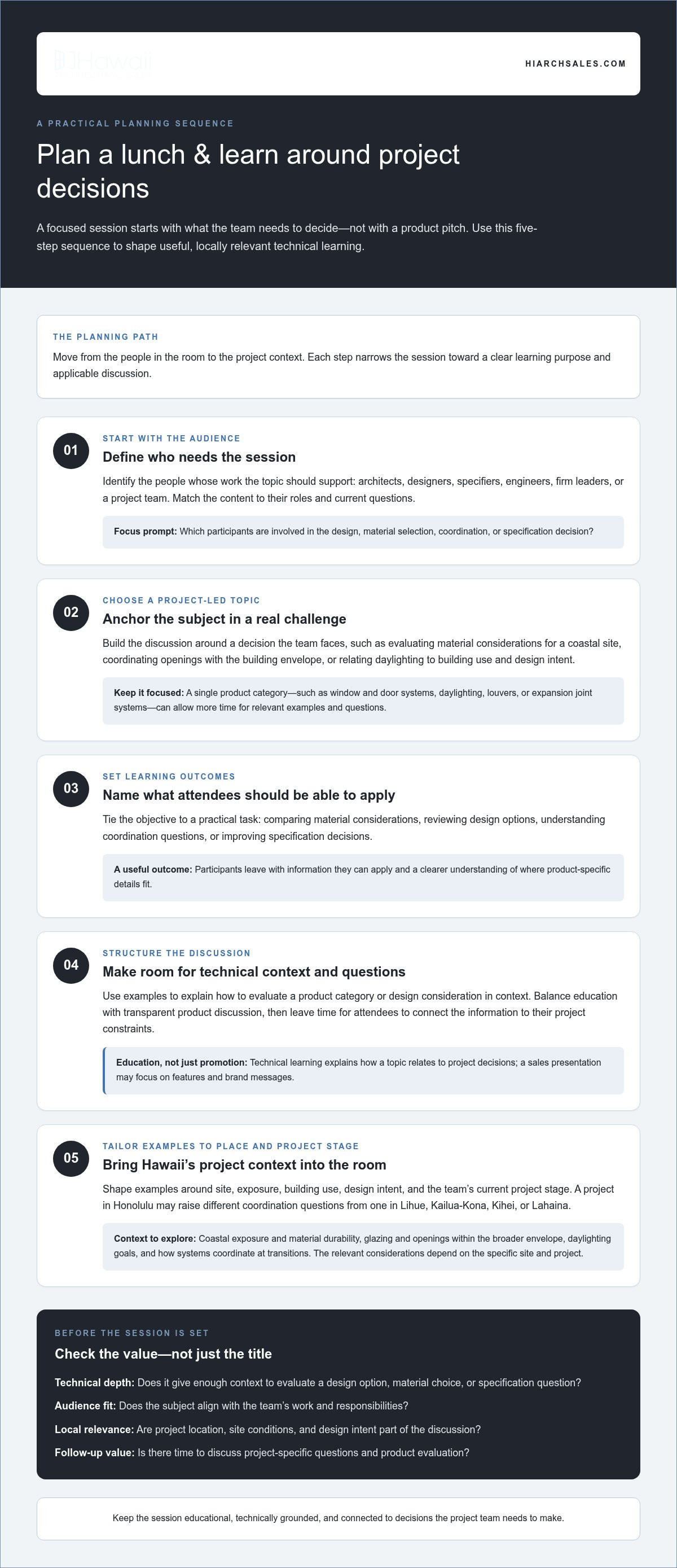
A well-planned session starts with a question the team needs to answer, then builds a focused discussion around it. This five-step sequence keeps the learning relevant to the firm’s work and gives attendees a clear reason to participate.
Define the audience.
Identify who should attend, such as architects, designers, specifiers, or engineers. Consider their roles, experience, and what they need to decide or coordinate.
Select one topic.
Choose a subject connected to current work, such as evaluating window and door systems or coordinating daylighting with facade design. Keep the scope narrow enough for meaningful technical discussion.
Set learning outcomes.
State what attendees should be better equipped to understand or do afterward. For example, they might identify key questions to consider when evaluating a system at a particular project stage.
Structure the discussion.
Build an agenda that moves from project context to technical information, relevant examples, and attendee questions. Leave time for discussion rather than filling the session with presentation material.
Follow up.
Record unanswered questions, assign an owner for each, and share relevant references so the team can continue its research and project discussion.
Build a concise agenda around a learning outcome
Begin with the project question participants should be better prepared to answer. Then organize the agenda around context, technical discussion, examples, and questions. Tailor examples to the team’s project stage and Hawaii location, whether the work is in Honolulu, Lihue, Kailua-Kona, Kihei, or Lahaina. Make materials accessible to attendees and clarify roles in advance: who is presenting, who is facilitating questions, and who will capture follow-up items. Avoid combining unrelated product categories or broad sales content in one session.
Prepare useful materials and a follow-up path
Share clear diagrams, define technical terms, and provide references attendees can revisit. If a question needs more research, record it rather than making an unsupported claim, then identify who will take the next step. For added context on the role of suppliers in project decisions, review this architectural distributor selection guide.
If a session is presented as eligible for AIA CES credit, verify that the course and provider meet current AIA program requirements before making that claim. For technical product discussions related to your team’s work, connect with Hawaii Architectural Sales.
Continue the Conversation with Hawaii Architectural Sales’ Technical Expertise
A lunch and learn for architects Hawaii can introduce a useful question, but project decisions often call for a more focused technical discussion. Hawaii Architectural Sales is an independent manufacturer’s representative and distributor serving Hawaii, providing product expertise and material distribution for architectural project teams. Its represented systems include architectural windows and doors, daylighting, louvers, and expansion joints from trusted industry brands such as Hopes, Kalwall, Super Sky, AWV, and Balco.
That product knowledge can help teams move from general learning to closer evaluation of systems relevant to their work. Discussions can focus on product information and material considerations that inform evaluation and specification decisions. Product expertise does not replace project-specific design responsibility, engineering, code review, or installation services.
Connect product questions to project requirements
Bring project context into the discussion. Project type, design intent, current design stage, and unresolved product questions help keep the exchange focused. For example, a team evaluating glass systems might clarify how system choices relate to its facade design and specification process. Teams considering windows and doors, daylighting, louvers, or expansion joints can identify the questions they need product information to address.
As a manufacturer’s representative and distributor, Hawaii Architectural Sales provides product expertise and material information to support a team’s evaluation. The goal is to connect relevant system information with the project’s stated needs, not to promise that a particular product will deliver a specific result.
Choose a relevant next step for your project team
Start with the category closest to the decision in front of your team. If glass-system questions are central, use this technical guide to architectural glass systems in Honolulu as a reference point. For another system, prepare the same essentials: project type, design intent, stage, and the specific information the team needs to evaluate.
A focused conversation can help clarify which product information is relevant and what questions remain for the project team. This is a practical next step, while an introductory discussion is not a guarantee of performance or a substitute for project review.
Turn Technical Learning into a Practical Next Step
A worthwhile lunch and learn for architects Hawaii teams choose connects a clear learning objective to real project decisions. Match the topic to the team’s current work, assess its technical depth and local relevance, and leave time for questions. Treat continuing-education credit as a separate matter that requires verification under current program requirements.
When product questions continue beyond the session, manufacturer-representative expertise can help project teams explore relevant system information and support evaluation. Founded in 1985, Hawaii Architectural Sales represents architectural systems across windows, doors, daylighting, louvers, and expansion joints, helping teams focus technical discussions on categories tied to their project needs.
Explore architectural systems for Hawaii projects and share your project context and questions with Hawaii Architectural Sales to continue the technical discussion.
Frequently Asked Questions
What is a lunch and learn for architects?
A lunch and learn for architects is a work session that combines a meal with focused professional education. A useful session has a defined learning objective, explains a topic in practical terms, and gives attendees time to ask questions. For example, a discussion of window and door systems could examine how product information informs design evaluation or specification decisions rather than simply presenting a general brand overview.
Can a lunch and learn for architects in Hawaii offer AIA CES credit?
It may offer AIA CES credit if the specific course and provider meet current AIA program requirements and the credit is clearly identified. Don’t assume a lunch-and-learn format or technical product presentation automatically qualifies. Before relying on credit, verify the course’s current status with AIA and distinguish AIA continuing-education credit from any separate state license-renewal requirements. Credit eligibility is separate from the session’s educational value.
What topics are useful for a Hawaii architecture lunch and learn?
Useful topics connect architectural systems to a project question. Teams might discuss windows and doors, daylighting, louvers, or expansion joints in relation to design intent, material selection, coordination, or specification. The relevant focus depends on building type, site, and project stage. Examples should reflect the team’s local work, whether projects are in Honolulu, Lihue, Kailua-Kona, Kihei, or Lahaina, without assuming one approach fits every location.
How long should an architect lunch and learn be?
There’s no single ideal length for every architect lunch and learn. Set the duration to match the learning objective, topic complexity, and time needed for questions. A concise agenda can reserve space for project context, technical explanation, relevant examples, and discussion. If the subject needs more depth than the available time allows, narrow the scope rather than rushing through unrelated product categories or leaving no time for attendee questions.
How can architects tell whether a lunch and learn is worth attending?
Look for a clear learning objective, technical depth, relevant examples, and a direct connection to your team’s current work. A focused session explains product capabilities transparently, separates evidence from promotional claims, and leaves time for project-specific questions. Consider whether the topic fits your building type and design stage, and whether there’s a way to follow up on unanswered technical questions. These criteria help distinguish useful education from a broad sales overview.
Can a manufacturer’s representative contribute to an architecture lunch and learn?
Yes. A manufacturer’s representative can contribute product expertise, explain relevant system information, and help project teams frame questions for evaluation and specification. Hawaii Architectural Sales is an independent manufacturer’s representative and distributor of architectural windows and doors, daylighting systems, louvers, and expansion joint systems. Its represented brands include ES, Euro-Wall, Hopes, Kalwall, Super Sky, AWV, and Balco. The discussion should remain transparent and tied to the team’s project needs.