Super Sky Skylight Dealer in Honolulu: 2026 Buying Guide
Product access alone doesn’t make a skylight supplier the right project partner. A search for “Super Sky skylight dealer Honolulu” is also a search for clear product guidance and coordination with the people responsible for design, structure, and installation.It’s reasonable to want a local contact...
Product access alone doesn’t make a skylight supplier the right project partner. A search for “Super Sky skylight dealer Honolulu” is also a search for clear product guidance and coordination with the people responsible for design, structure, and installation.
It’s reasonable to want a local contact who can help clarify product information and sourcing. Hawaii Architectural Sales is an architectural product distributor and manufacturer’s representative that supplies Super Sky skylights. Confirm current representation and product availability directly. Product supply doesn’t include installation or general contracting.
This 2026 buying guide explains how to assess Super Sky skylights for your project, evaluate a Honolulu-area supplier, and prepare the information your project team will need when requesting guidance. It covers technical documentation, project compatibility, and procurement responsibilities to verify before a product is specified or ordered. Whether your project is in Honolulu, Lihue, Kailua-Kona, Kihei, or Lahaina, early coordination helps architects, engineers, contractors, and suppliers address questions together while leaving installation planning with the appropriate project professionals.
Key Takeaways
• Distinguish the manufacturer, product representative, distributor, installer, and general contractor so each project responsibility has a clear owner.
• For a Super Sky skylight dealer Honolulu search, assess the product relationship, technical communication, documentation access, and familiarity with local project needs.
• Bring the project type, intended daylighting role, roof configuration, drawings, and design-team requirements into product discussions.
• Ask qualified project professionals to assess structural coordination, water management, maintenance access, and site-specific exposure before specifying a configuration.
• Confirm technical documents, approvals, warranty terms, availability, and lead-time information for the specific configuration before finalizing procurement or schedules.
Finding a Super Sky skylight dealer in Honolulu: what the local representative does
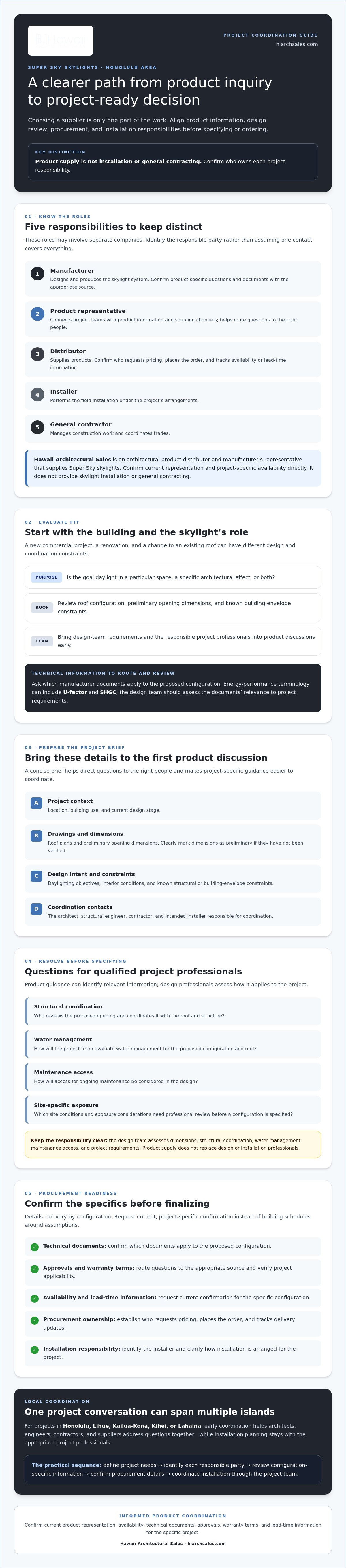
Before searching for a Super Sky skylight dealer Honolulu, clarify which project role you need. A manufacturer designs and produces the system. A distributor supplies products, while a manufacturer’s representative connects project teams with product information and sourcing channels. An installer performs the field installation. A general contractor manages construction work and coordinates trades. These roles may involve separate companies, so confirm responsibilities rather than assuming one contact covers them all.
Hawaii Architectural Sales is an architectural product distributor and manufacturer’s representative that supplies Super Sky skylights. Its product representation can help a project team route questions and coordinate sourcing. Confirm the current Super Sky relationship and availability for your specific project before relying on either. Hawaii Architectural Sales supplies architectural products; it does not provide skylight installation or general contracting.
What should a skylight dealer or representative help clarify?
A representative can help identify the right channel for product documents and questions, including which items need confirmation from Super Sky or review by the project design professional. For energy-performance terminology, the National Fenestration Rating Council (NFRC) provides ratings that can include measures such as U-factor and SHGC. Ask which documents apply to the proposed configuration, then have the design team assess their relevance to project requirements.
Use the local contact to clarify who will request pricing, place the order, and track product availability or lead-time information. These details can vary by configuration, so request current, project-specific confirmation rather than setting schedules from assumptions.
Who is the right Honolulu-area contact for a project?
The architect or other design professional develops and reviews the design; the owner sets project priorities; and the contractor coordinates construction. The product representative supports product information and sourcing, while the installer is responsible for field installation under the project’s arrangements. Identify each party early, including who reviews submittals, resolves technical questions, and receives delivery updates.
Honolulu projects may involve teams working across Oahu and other islands. A local product contact can help keep communication moving between the project team and supplier, but doesn’t replace design or installation professionals. For related supplier-selection guidance, consult the article on selecting an architectural window distributor in Hawaii.
Before specifying or ordering, route technical data, approvals, warranty terms, and project compatibility questions to the appropriate source. The design professional should verify applicable requirements, while the project team confirms procurement and installation responsibilities.
How to evaluate Super Sky skylights against your project requirements
Begin with the building and the role the skylight needs to serve. A new commercial project, a renovation, and a change to an existing roof can have different design and coordination constraints. Define whether the goal is daylight in a particular space, a specific architectural effect, or both. Then review the roof configuration and design-team requirements before comparing product options.
Prepare a concise project brief before requesting product guidance. Include:
• Project location, building use, and current design stage.
• Roof plans and preliminary opening dimensions, clearly marked as preliminary if they haven’t been verified.
• Daylighting objectives, interior conditions, and known structural or building-envelope constraints.
• The architect, structural engineer, contractor, and intended installer responsible for coordination.
This information helps direct questions to the right people. A product representative can help identify relevant manufacturer documentation, but the project design professionals must assess dimensions, structural coordination, water management, and maintenance access. For example, consider a proposed opening alongside the roof structure and surrounding assembly, rather than treating it as an isolated product choice.
What technical information should the project team verify?
Use documented criteria for the specific project, not a general description or appearance alone. Ask the responsible source for current technical data, submittals, installation requirements, and warranty information for the proposed configuration. Confirm what evidence is available for applicable wind, water, thermal, and structural criteria. Don’t assume that a rating or document for one configuration applies to another.
Where NFRC performance ratings are provided, check that the information corresponds to the proposed product and configuration. The National Fenestration Rating Council explains its role in providing fair, accurate, and credible ratings for fenestration products. Ratings such as U-factor and SHGC can inform comparisons, but the design team should determine which measures matter for the project and verify supporting documentation.
For Honolulu projects, ask the project design professional to confirm applicable code requirements and suitability for the specific location. Wind exposure, rain management, solar conditions, roof assembly, and maintenance access should be resolved through project-specific review. A broad claim of island-wide suitability isn’t a substitute for documented criteria and design-team approval.
A Super Sky skylight dealer Honolulu search can help identify a local product contact, but selection still depends on coordinated review. The Hawaii Architectural Sales product information page is a starting point for product inquiries. Confirm current representation and availability for your configuration directly.
Honolulu project conditions: questions to resolve before specifying a skylight
Honolulu’s climate makes site-specific review essential, but conditions vary by location, building, and roof. Wind exposure, wind-driven rain, salt-laden air, and strong solar exposure should be treated as design questions, not reasons to assume a particular skylight is suitable. Ask the project team to define the required performance criteria, then compare those criteria with current documentation for the proposed configuration.
A search for a Super Sky skylight dealer Honolulu can help identify a local product contact, but product guidance alone doesn’t establish code compliance or suitability. The architect and relevant engineers should confirm the design requirements, and the manufacturer should provide applicable product information. Use this table to assign questions and verification tasks early.
Project condition
Information needed
Responsible professional
Verification source
Wind exposure
Site-specific design criteria and evidence for the proposed configuration
Design professional and structural engineer
Project criteria and manufacturer documentation
Wind-driven rain
Roof assembly, water-management details, and applicable performance information
Architect or building-envelope professional
Project drawings and manufacturer guidance
Salt-laden air
Relevant material or finish guidance and maintenance considerations
Design team
Manufacturer documentation for the selected system
Solar exposure
Daylighting goals and applicable thermal-performance criteria
Architect or energy-design professional
Project requirements and product data
How can coastal exposure affect the specification process?
Ask the design team to identify the building’s exposure and envelope requirements rather than treating Honolulu as one uniform environment. A site’s conditions and roof design can affect what evidence the team needs. Where relevant, request manufacturer guidance on materials, finishes, water management, and maintenance for the proposed system. Confirm that the guidance applies to the specific configuration under consideration.
Which approvals and standards should the team check?
Have the design professional confirm the adopted code edition and local requirements that apply to the project. Ask whether product approvals, test reports, or engineering documentation are needed, and verify that each document covers the proposed configuration and intended use. Don’t label a skylight code-compliant based on a general product description or a document for a different assembly.
Keep a record of the criteria, supporting documents, and open questions as the specification develops. This gives the project team a clear basis for comparing options and helps the product representative route unanswered product questions to the appropriate source. Final suitability and code decisions belong with the responsible design professionals and authorities.
From product inquiry to procurement: a practical Honolulu skylight checklist
A well-prepared inquiry helps the product supplier respond to the actual project instead of a general product idea. Move through the process in sequence: define the need, assemble drawings, request configuration-specific information, review it with the design team, then coordinate procurement. A search for a Super Sky skylight dealer Honolulu can identify a local product contact, but availability and lead-time information still need confirmation for the specific configuration.
What should a Super Sky product inquiry include?
Provide enough context to make the request actionable. Include the project location, building type, design stage, desired decision timeline, roof plans, and preliminary opening dimensions. Mark dimensions as preliminary if they haven’t been confirmed. Add the intended daylighting role, applicable performance criteria, and known roof or structural constraints.
List the questions that remain open, such as which product documentation applies, whether the proposed configuration is available, what current lead-time information can be provided, and who will manage procurement. This gives the product representative clear points to route or clarify. For broader system context, consult the Honolulu architectural daylighting solutions guide.
How should teams coordinate submittals and installation responsibilities?
Before final specification, assign review roles. The architect coordinates design review; the structural engineer evaluates structural considerations; and the contractor and intended installer coordinate construction and installation planning. Ask the manufacturer for current installation requirements and have the separately selected installer review them. The appropriate design professionals should check product data and submittals against the project documents, including confirmation of applicable code requirements.
Keep procurement separate from technical approval. Confirm who requests the final quotation, places the order, receives delivery updates, and verifies the schedule. Recheck availability and lead-time information before setting or committing to project dates. Hawaii Architectural Sales supplies Super Sky skylights but does not provide installation or general contracting.
Define
Project needs, location, building use, and decision timeline.
Assemble
Drawings, preliminary dimensions, criteria, and known constraints.
Request
Configuration-specific product data, availability, and lead-time information.
Review
Coordinate submittals and open questions with the project team.
Procure
Confirm responsibilities and current schedule details before ordering.
Choose a Super Sky skylight dealer in Honolulu for informed project coordination
The right sourcing partner helps your team move from product interest to a documented, project-specific decision. For a Super Sky skylight dealer Honolulu search, assess more than whether a supplier can discuss the brand. Confirm its current relationship with the manufacturer, how it handles technical questions, what product documentation it can help obtain, and whether it understands the needs of Hawaii projects.
How do you compare potential product-sourcing partners?
Ask each potential supplier to explain its role and responsibilities. Can it confirm current Super Sky representation or distribution status? Can it help identify documents relevant to your proposed configuration and direct unanswered technical questions to the manufacturer? Does it distinguish product supply from design review, installation, and general contracting?
Look for clear communication about procurement steps, availability, and lead-time information. Answers should be specific to the proposed system and project, with uncertainty identified rather than replaced by broad performance claims. The design professional remains responsible for evaluating project requirements and applicable code matters; installation must be coordinated with the separately selected installer.
What is the next step for a Honolulu project team?
Prepare the project location, building type, design stage, plans, relevant criteria, and current design questions before requesting product guidance. Include preliminary dimensions and note any roof or structural constraints. This gives the supplier useful context and helps the team identify which details still require manufacturer confirmation or design review.
Hawaii Architectural Sales is an architectural product distributor and manufacturer’s representative that supplies Super Sky skylights. Contact the company to ask about current product representation and request information relevant to your project. Confirm product availability, technical documentation, approvals, and warranty terms for the proposed configuration with the appropriate source. Hawaii Architectural Sales provides product expertise and material distribution, not installation or general contracting.
Clear role boundaries help keep the process moving: the supplier supports product sourcing, the design team reviews the specification, and the project’s installation professionals plan the field work. Find product information about Super Sky skylights.
Move your skylight project forward with clear coordination
A sound skylight decision starts with project-specific requirements, current product documentation, and clear responsibility across design, procurement, and installation. Evaluate a supplier by how clearly it communicates its product relationship, supports access to relevant information, and helps your team resolve sourcing questions. The right Super Sky skylight dealer Honolulu contact can support product coordination, but design review and installation remain with the professionals appointed to those roles.
Hawaii Architectural Sales supplies Super Sky skylights and provides architectural product representation for Honolulu and other Hawaii locations, including Lihue, Kailua-Kona, Kihei, and Lahaina. Confirm current representation, availability, and applicable product information for your configuration before setting specifications or schedules. The company supplies products; it does not provide installation or general contracting.
Have your project location, plans, design criteria, and outstanding questions ready. Discuss your Super Sky skylight project with Hawaii Architectural Sales to begin a focused product conversation. With the right information and project roles aligned, your team can take the next step with greater clarity.
Frequently Asked Questions
Who is a Super Sky skylight dealer in Honolulu?
Hawaii Architectural Sales is an architectural product distributor and manufacturer’s representative that supplies Super Sky skylights. Treat the company as a local product-sourcing contact, and confirm its current Super Sky relationship and availability for your project directly. It serves Honolulu and other Hawaii locations, including Lihue, Kailua-Kona, Kihei, and Lahaina. Product representation and supply are separate from installation and general contracting.
What should I ask a Super Sky skylight dealer before specifying a system?
For a Super Sky skylight dealer Honolulu inquiry, ask whether the supplier can confirm its current manufacturer relationship and help obtain documentation for your proposed configuration. Clarify which technical questions should go to the manufacturer or design professional, and ask about current availability, lead-time information, and procurement responsibilities. Request project-specific answers rather than relying on broad performance claims. Confirm which team members review product data and handle installation planning.
Can Hawaii Architectural Sales install Super Sky skylights?
No. Hawaii Architectural Sales supplies architectural products and provides product representation, but it doesn’t offer installation or general contracting. The project owner or contractor should arrange for an appropriate installer separately and coordinate installation requirements with the manufacturer and project design team. Confirm who will review product information, manage procurement, and oversee field installation before the project schedule is set. This distinction helps prevent gaps in responsibility.
How do I know whether a Super Sky skylight suits my Honolulu project?
Suitability depends on the specific building, roof configuration, design intent, and documented project criteria. Have the project design professional assess the proposed opening, structural coordination, water management, thermal requirements, site exposure, and maintenance access. Then compare current manufacturer documentation for the exact configuration against those criteria. Don’t assume that a general product description or performance statement confirms compliance or suitability for a particular Honolulu site.
What project documents should I prepare before requesting skylight information?
Prepare the project location, building use, design stage, roof plans, and preliminary opening dimensions. Include daylighting objectives, known structural or envelope constraints, and the performance criteria established by the design team. Identify the architect, structural engineer, contractor, and intended installer, plus your decision timeline. Mark unverified dimensions as preliminary and list questions about documentation, configuration, availability, and procurement so the supplier can understand what information you need.
Are Super Sky skylights suitable for coastal conditions in Hawaii?
That can’t be determined from a general claim about Hawaii or coastal use. Ask the design team to identify site-specific wind exposure, wind-driven rain, salt-laden air, and solar conditions, then request manufacturer guidance and documentation for the proposed configuration. Requirements may differ between Honolulu, Lihue, Kailua-Kona, Kihei, and Lahaina. Have qualified project professionals compare the evidence with the building’s criteria before specifying a system.
How can I verify code and approval requirements for a Honolulu skylight project?
Ask the project architect or other responsible design professional to confirm the code edition and local requirements applicable to the project. They can determine whether product approvals, test reports, or engineering documentation are required and whether the documents match the proposed configuration. Verify technical data and approvals with the manufacturer, and confirm requirements with the relevant authorities as needed. Don’t treat a supplier’s general product information as a code determination.