Architectural Product Rep in Honolulu: Technical Support for Hawaii Projects
What if a product question could be addressed before it becomes a coordination gap? For teams working in Hawaii’s demanding climate, choosing building-envelope solutions involves more than comparing product data. An architectural product rep Honolulu project teams can rely on connects design priorit...
What if a product question could be addressed before it becomes a coordination gap? For teams working in Hawaii’s demanding climate, choosing building-envelope solutions involves more than comparing product data. An architectural product rep Honolulu project teams can rely on connects design priorities with relevant product expertise and supply.
Architects, engineers, and contractors need product information that fits the project context and a clear understanding of each participant’s role. Hawaii Architectural Sales represents and distributes residential and commercial building-envelope products, bringing local project knowledge and a worldwide supply-partner network to project discussions.
This article explains how product representation can support project coordination and how to narrow product categories for a specific building. You’ll find practical ways to frame a discussion about windows and doors, daylighting, louvers, expansion joint systems, and custom metal options around your building type, design intent, and project stage.
Key Takeaways
• An architectural product rep Honolulu project teams work with can connect project needs to relevant product expertise and help coordinate product information.
• Start with the building type and design priorities to identify relevant categories, such as windows and doors, daylighting, louvers, or expansion joint systems.
• A focused discussion covers the project stage, building type, design intent, and product categories under consideration.
• Representation and distribution support product knowledge and supply. Construction execution is a separate role.
• Hawaii Architectural Sales states “Since 1983” as a window and door manufacturer, provides Full technical support, offers Up to 10 years Guaranty, and has a network of 15+ supply partners.
What an Architectural Product Rep in Honolulu Does for a Project
An architectural product representative connects manufacturers’ product knowledge with project professionals so teams can evaluate relevant options and coordinate product information during planning. A representative helps focus product discussions on the project’s design intent, requirements, and relevant product categories. For an architectural product rep Honolulu teams engage, local project context matters: a useful conversation starts with the building type, design priorities, and products under consideration.
Building-envelope decisions involve components that work together. Windows, doors, daylighting products, louvers, expansion joint systems, and custom metal options each relate to different design questions. Understanding the Building Envelope provides background on how envelope components work together. Product expertise can help teams identify relevant information and keep discussions organized across disciplines.
Hawaii Architectural Sales represents and distributes residential and commercial building-envelope products for projects in Hawaii and the Pacific region. The company works with architects, engineers, contractors, and exclusive vendor business partners to develop high-value solutions. Full technical support brings product knowledge into project discussions, while the design and construction professionals retain their respective responsibilities.
Representative, distributor, and contractor: distinct project roles
Representation connects manufacturers, product information, and project professionals. A representative can help a design team understand product categories and coordinate product-related discussions with the manufacturers represented. Distribution is the supply role, connecting a project with products. Neither role is construction execution. Contractors manage construction work; Hawaii Architectural Sales contributes product expertise and supply, not installation or general contracting.
Who benefits from architectural product representation?
Architects and engineers can use product information to inform design development and specification work. A representative can help focus inquiries on relevant categories and provide product knowledge for the team’s consideration without replacing the design professionals’ judgment.
Contractors and developers benefit when product choices need coordination across project requirements and disciplines. A clear product discussion helps separate questions about product selection from those about design or construction planning. In Honolulu and across Hawaii, Hawaii Architectural Sales brings local project context to these conversations, supporting durable and efficient products, high-value solutions, and custom architectural solutions.
How Product Expertise Supports Honolulu’s Building-Envelope Decisions
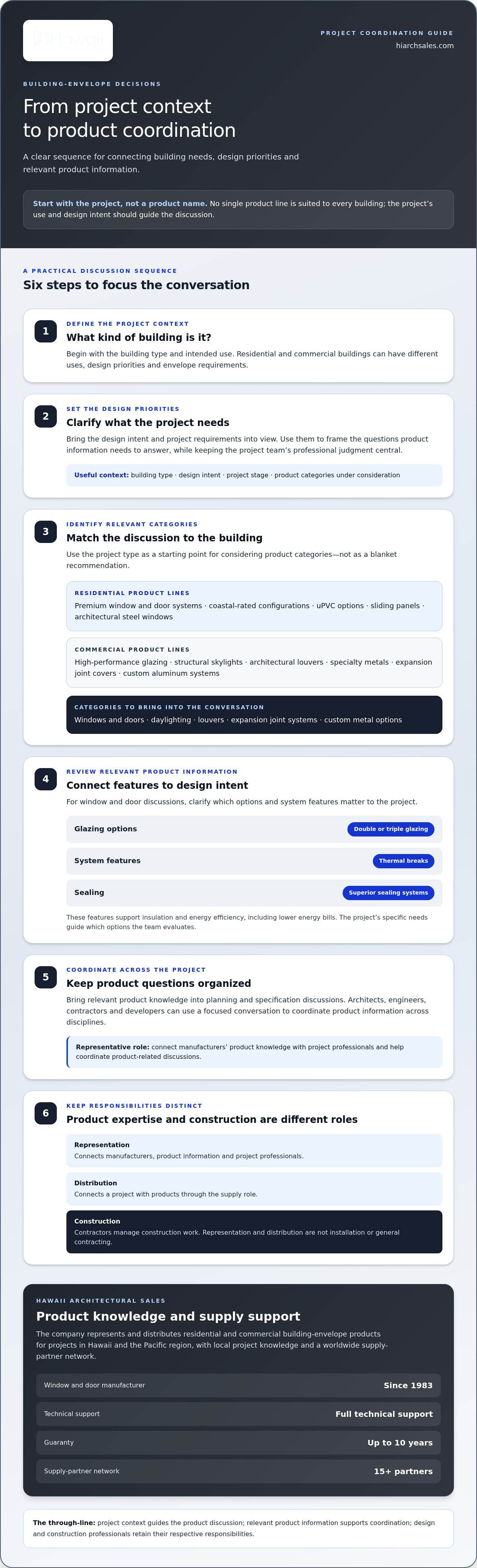
Product discussions are most useful when they begin with the project, not a product name. A residence and a commercial building can have different uses, design priorities, and envelope requirements. In Honolulu, architects, engineers, contractors, and developers can connect those priorities with relevant product categories, then organize the information needed for design and specification decisions. An architectural product rep Honolulu teams consult can help focus the conversation without substituting for the project team’s professional judgment.
Product expertise helps teams compare relevant options and make informed project decisions without assuming one product suits every building. Start with the intended use, design intent, and role a product category needs to play in the building envelope. Then identify which product information will help the team evaluate options.
Residential and commercial needs call for different product categories
Hawaii Architectural Sales organizes its portfolio around residential and commercial project needs. These product lines provide a starting point for discussion, not a recommendation that every line suits every project.
Residential
Premium window and door systems, coastal-rated configurations, uPVC options, sliding panels, and architectural steel windows.
For a residential project, the conversation may center on window and door systems or other categories relevant to the design. A commercial team can consider the applicable categories in the broader project context. Hawaii Architectural Sales’ project examples include Iolani Arrillaga Student Center, Four Seasons Resort Maui, and Civil Beat Plaza. These illustrate a range of project contexts, but do not establish which products were used in any one project.
Building-envelope features to discuss in project planning
For window and door discussions, glazing options and system features can help clarify what information matters to the design team. Windows and doors are offered with double-glazing or triple-glazing options, thermal breaks, and superior sealing systems. These features support insulation and energy efficiency, including lower energy bills. The project’s specific needs should guide which options the team evaluates.
Connect product features to the project’s design intent: identify the envelope concern, review the relevant product options, and coordinate that information with the broader project. This keeps decisions grounded in the building’s needs rather than generalized assumptions. Hawaii Architectural Sales provides Full technical support to bring product knowledge into those discussions. To explore the building-envelope product portfolio, begin with the categories that align with your project’s use and design priorities.
A Practical Framework for Matching Products to Honolulu Projects
Product selection starts with the building’s purpose and the design team’s priorities, not an assumption that one line fits every project. A residence, hospitality property, student housing project, senior residence, and commercial development each present a different context for considering envelope products. An architectural product rep Honolulu teams consult can organize the discussion around those differences and identify categories for evaluation.
Start with building type, design intent, and project requirements
First, clarify whether the project is residential, commercial, or institutional. Then identify the design priorities shaping the product conversation, such as the role of windows and doors, daylighting, or other envelope components. These are planning prompts, not product specifications. Hawaii Architectural Sales’ project examples include Iolani Arrillaga Student Center, Four Seasons Resort Maui, and Civil Beat Plaza. They illustrate varied project contexts without establishing which products were used.
Use product categories to organize early-stage discussions
Use the table to frame an initial conversation. The categories are starting points; final product fit depends on project requirements and design decisions.
Project type
Product category to consider
Planning question
Residential
Window and door systems, including residential lines such as ES | Prestige, ES | Elite, ES | uPVC, Euro-Wall, and Hopes
Which parts of the design rely on windows or doors, and what design priorities should guide product review?
Hospitality
Window and door systems; daylighting products; louvers
Which areas of the project make daylighting or other envelope categories relevant to the design intent?
Student housing or senior residence
Window and door systems; relevant commercial product categories
How should the project’s residential or institutional context shape the categories discussed?
Commercial development
Commercial product categories, including daylighting, louvers, expansion joint systems, and custom metal options
Which product categories relate to the project’s design scope and coordination needs?
For projects where daylighting is part of the design, the architectural daylighting solutions guide offers context for considering that category. Keep the conversation focused: identify the project type, state the design intent, and name the product categories that may apply. The project team can then assess relevant information without assuming a product line is suitable simply because it appears in a broad category.
This framework helps architects, engineers, contractors, and developers bring product questions into early planning in an organized way. It gives the team a clear basis for discussing options with a representative while preserving its role in determining what fits the specific building.
What to Prepare Before Discussing a Honolulu Building Project
A focused product discussion begins with a clear picture of the project, not a complete specification package. Sharing the building type, project location, current stage, and design priorities helps an architectural product rep Honolulu team identify relevant product categories. That context gives the conversation a useful scope, whether the project is in early planning or further along in design.
Preparation can be straightforward. A concise overview connects project goals with product information and supports discussion of custom architectural solutions. Focus on what the team is trying to accomplish and which building-envelope categories it is considering.
Project details that make product discussions more focused
Start with the project context, then identify the people and priorities shaping the discussion. An architect’s design intent, an engineer’s product-information needs, a contractor’s coordination role, and a developer’s project perspective can clarify what information will be useful. The goal is a shared starting point, not a replacement for the project team’s design or construction process.
Describe the building type and location.
State whether the project is residential, commercial, hospitality, student housing, a senior residence, or another context, and identify its location in Hawaii.
Summarize the project stage.
Indicate whether the team is exploring concepts, developing the design, working through product selection, or coordinating a later project phase.
State the design intent.
Briefly explain the priorities shaping the project, such as the desired role of windows and doors, daylighting, or other building-envelope elements.
Name the product categories under consideration.
These may include window and door systems, daylighting products, louvers, expansion joint systems, or custom metal options. Focus on categories central to the discussion instead of listing every possibility.
Identify the project-team roles involved.
Note whether architects, engineers, contractors, or developers are part of the conversation and what product questions they are working through.
Questions to organize product and technical conversations
Once the project overview is ready, a few focused questions can help direct the discussion. The architectural window distributor guide also provides context for teams considering window and door products.
• Which product categories align with the project’s requirements and design priorities?
• What product information will help the project team evaluate those categories?
• How can Full technical support contribute to the product discussion at this project stage?
• Where might custom architectural solutions be relevant to the project’s design intent?
Before speaking with a representative, prepare four things: project type and location, project stage, design priorities, and the product categories you want to discuss. This concise checklist keeps the conversation focused and helps the team make productive use of product expertise. To begin a project discussion with Hawaii Architectural Sales, share your project context and product priorities.
Work with Hawaii Architectural Sales on a Honolulu Project
Hawaii Architectural Sales represents and distributes residential and commercial building-envelope products for projects in Hawaii and the Pacific region. For a Honolulu project team, the company connects product expertise with supply, backed by Full technical support and a portfolio for varied project contexts. Hawaii Architectural Sales notes “Since 1983” as a window and door manufacturer. Its work now supports project discussions focused on durable and efficient products, high-value solutions, and custom architectural solutions.
The company’s 15+ supply partners support access to product knowledge across its portfolio. Its stated warranty is Up to 10 years Guaranty. These details provide context for a project discussion, while product fit depends on the building, design intent, and categories the team is evaluating.
A portfolio spanning residential and commercial building projects
Residential lines include ES | Prestige, ES | Elite, ES | uPVC, ES | Legacy, Euro-Wall, and Hopes. Commercial lines include ES, Kalwall, Super Sky, AWV, Clover, Balco, Custom Metal, and SeaWin. This range helps teams begin with the portfolio areas relevant to their project rather than treating every building the same way.
Hawaii Architectural Sales’ project examples include Four Seasons Resort Maui and Iolani Arrillaga Student Center. They show the range of projects associated with the company, but do not establish which products were used or what performance outcomes they achieved. For architects, engineers, contractors, and developers, the practical next step is to connect the project’s purpose and design priorities with product categories for discussion.
Start a product discussion for your Honolulu project
Bring a concise project overview: building type, location, project stage, design priorities, and product categories of interest. This context keeps the conversation focused, whether the team is considering window and door systems, daylighting products, louvers, expansion joint systems, or custom metal options. For projects centered on glass and window systems, the architectural glass systems guide for Honolulu offers related context.
An architectural product rep Honolulu project teams engage can connect their questions with relevant product expertise and supply. Hawaii Architectural Sales brings its representative and distributor role, Full technical support, and custom architectural solutions to project discussions while leaving design and construction decisions with the project team.
Share your Honolulu project type, priorities, and product categories with Hawaii Architectural Sales to discuss your project. A focused starting point helps identify which parts of the portfolio are most relevant to explore.
Move Your Honolulu Project Forward with a Focused Discussion
You don’t need to settle every design decision before starting a product conversation. Bring the question your team is working through and use it to guide a discussion that can develop with the project. Focused conversations help keep product considerations connected to design intent and the building’s needs.
An architectural product rep Honolulu project teams engage can connect that question with relevant product expertise. Whether you’re shaping an initial concept or refining a direction, a clear starting point gives the discussion purpose without locking the team into a premature choice.
Hawaii Architectural Sales works with architects, engineers, contractors, and developers on building-envelope product discussions for projects in Hawaii and the Pacific region. Share what your team is exploring and identify the categories you want to discuss.
What does an architectural product representative do?
An architectural product representative connects manufacturers’ product expertise with project teams’ needs. If a design team is reviewing window and door options, for example, the representative can focus product questions on the project’s design priorities and relevant categories. Hawaii Architectural Sales represents and distributes building-envelope products and provides Full technical support and custom architectural solutions for residential and commercial projects.
How is an architectural product representative different from a general contractor?
An architectural product representative supports product decisions and supply, while a general contractor coordinates construction execution. The distinction helps teams assign responsibilities: product discussions can inform design and selection, while construction planning and execution remain separate project functions. Hawaii Architectural Sales represents and distributes building-envelope products. Its role centers on product knowledge and project discussions, not construction or installation work.
Can an architectural product representative help with a Honolulu project?
Yes. An architectural product rep Honolulu project teams engage can focus discussion on the building type, design priorities, and product categories under consideration. Hawaii Architectural Sales works with architects, engineers, contractors, and exclusive vendor business partners to develop high-value solutions. For a residential development, for example, the team can identify whether windows and doors are a priority and organize product questions around that need.
What products does Hawaii Architectural Sales represent?
Residential lines include ES | Prestige, ES | Elite, ES | uPVC, ES | Legacy, Euro-Wall, and Hopes. Commercial lines include ES, Kalwall, Super Sky, AWV, Clover, Balco, Custom Metal, and SeaWin. The portfolio includes windows and doors and other building-envelope categories. Start a project discussion with the building type and the product categories central to the design, then narrow the relevant lines from there.
Does Hawaii Architectural Sales serve projects outside Honolulu?
Yes. Hawaii Architectural Sales serves projects throughout Hawaii and the Pacific region, including Honolulu, Lihue, Kailua-Kona, Kihei, and Lahaina. The company’s 15+ supply partners describe its worldwide partner network, not a worldwide sales territory. For projects in these Hawaii communities, teams can frame a product discussion around the building type, project priorities, and envelope categories under consideration.
How long has Hawaii Architectural Sales been in business?
Hawaii Architectural Sales states “Since 1983” as a window and door manufacturer. The company now represents and distributes architectural products for residential and commercial projects. Its stated focus includes durable and efficient products, custom architectural solutions, and Full technical support. For project teams, the relevant question is how product expertise can inform the categories being discussed.
What support can project teams expect from Hawaii Architectural Sales?
Hawaii Architectural Sales provides Full technical support and custom architectural solutions. The company works with architects, engineers, contractors, and exclusive vendor business partners to create high-value solutions. Teams can share design priorities and product questions to focus discussion on relevant building-envelope categories. The support centers on product expertise and project discussions, not construction execution or guaranteed outcomes.