Architectural Daylighting Solutions in Honolulu: A Guide for High-Performance Facades
In the high-stakes environment of Hawaii's commercial construction, architectural daylighting is a thermal management strategy first and an aesthetic choice second. Designers often find that the very sunlight defining the island's beauty becomes a liability when it drives up cooling loads or creates...
In the high-stakes environment of Hawaii's commercial construction, architectural daylighting is a thermal management strategy first and an aesthetic choice second. Designers often find that the very sunlight defining the island's beauty becomes a liability when it drives up cooling loads or creates uncomfortable glare in office spaces. Implementing high-performance architectural daylighting solutions in Honolulu requires more than just glass. It demands a technical approach to the building envelope that respects both the 2018 IECC requirements and the reality of salt-air corrosion.
You likely understand the frustration of balancing the 3% skylight area limit with the desire for expansive, natural illumination. This guide explores how to optimize your facade design using world-class systems engineered specifically for tropical climates. We will examine how to secure LEED credits and reduce artificial lighting costs through the strategic use of Kalwall and Super Sky systems. You will also learn how to navigate the latest Honolulu energy codes, including Ordinance 23-25, while ensuring your commercial envelope remains durable against the Pacific's harshest elements.
Key Takeaways
• Learn how to implement high-performance architectural daylighting solutions in Honolulu that balance natural illumination with strict tropical thermal control.
• Understand the technical relationship between Solar Heat Gain Coefficient (SHGC) and Visible Light Transmittance (VLT) to optimize building energy efficiency.
• Evaluate the performance benefits of Kalwall translucent panels and Super Sky glass systems for specific commercial envelope requirements.
• Determine the non-negotiable finish specifications and engineering standards needed to resist salt-air corrosion and extreme wind loads.
• Discover how partnering with an architectural representative during the design phase streamlines the permitting process and avoids expensive specification mistakes.
What is Architectural Daylighting in the Honolulu Context?
Architectural daylighting is the strategic integration of apertures to provide controlled natural illumination within a building. To answer the fundamental question, What is Architectural Daylighting?, one must look beyond simple windows. It's a technical discipline involving the precise placement of skylights, translucent panels, and vertical glazing to minimize artificial lighting needs. In Hawaii, this practice is defined by the "Honolulu Challenge." Designers must manage over 270 days of intense tropical sun without allowing the interior to become a greenhouse.
Modern architectural daylighting solutions Honolulu engineers prioritize a shift toward integrated building envelopes. These systems don't just let light in; they act as filters. They harvest the visible spectrum while aggressively rejecting infrared heat. This balance is critical for maintaining occupant comfort. High-performance design focuses on the quality of light rather than mere quantity. Excessive raw sunlight creates glare and thermal discomfort, whereas diffused, balanced light supports well-being and productivity.
The Role of Natural Light in Modern Hawaii Architecture
Natural light is a cornerstone of Hawaii's unique design aesthetic. In the hospitality sector, it allows resorts to achieve the seamless indoor-outdoor transitions that visitors expect. For educational facilities, daylighting is a performance tool. Studies consistently show that students in well-lit environments demonstrate better focus and higher test scores. From a commercial perspective, the ROI is immediate. Since lighting and cooling are often the highest energy costs for Honolulu businesses, reducing the "lighting load" directly improves the bottom line. It's a pragmatic investment in long-term operational efficiency.
Beyond Windows: The Spectrum of Daylighting Systems
Selecting the right architectural daylighting solutions Honolulu requires moving beyond standard vision glazing. While windows provide views, specialized daylighting apertures like Kalwall translucent sandwich panels or Super Sky sloped glazing systems manage light distribution. These systems often utilize advanced materials such as thermally broken aluminum or ES | uPVC frames to ensure the building envelope remains a robust thermal barrier. Whether through vertical glazing or sloped sky-roofs, the goal is to create a sophisticated light-harvesting system that meets Hawaii's stringent energy codes while providing a durable, high-aesthetic finish.
Thermal Performance: Managing Solar Heat Gain and UV in the Tropics
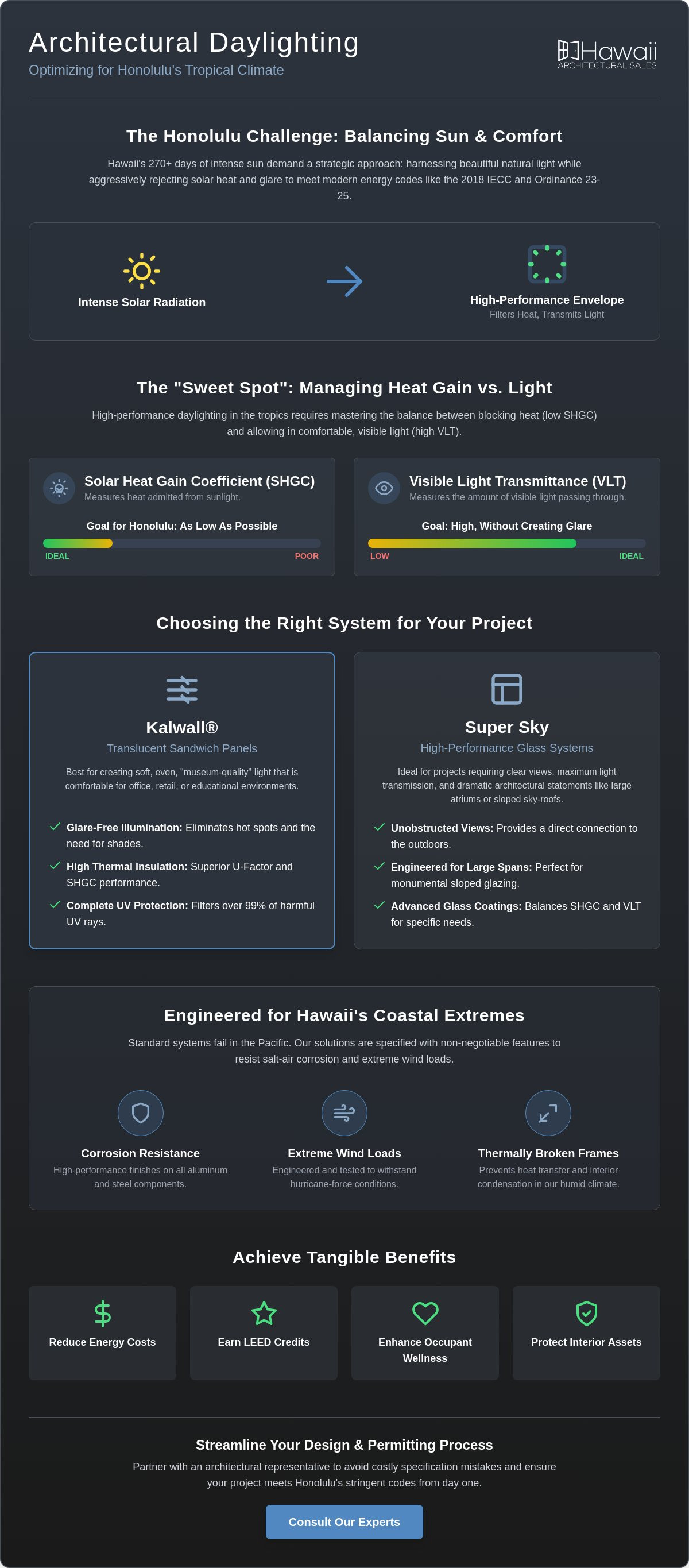
Honolulu's climate demands a rigorous approach to managing solar heat gain. The Solar Heat Gain Coefficient (SHGC) measures the fraction of solar radiation admitted through a window or skylight. In Hawaii, where the sun is nearly overhead for much of the year, ultra-low SHGC values are essential for building efficiency. A common challenge is that lower SHGC often results in reduced Visible Light Transmittance (VLT). High-performance architectural daylighting solutions Honolulu focus on finding the "Sweet Spot" where VLT remains high enough for occupant comfort while the SHGC stays within the strict limits of the 2018 IECC.
UV degradation is a secondary but equally vital concern for designers. The intense Pacific sun can quickly damage expensive interior finishes and high-end furnishings. High-performance daylighting systems filter out over 99% of harmful UV rays, protecting the owner's investment without sacrificing natural light. To maintain a healthy building envelope, thermally broken frames are required to prevent heat transfer that causes interior condensation and moisture-related issues in our humid environment.
The Physics of Translucent vs. Transparent Light
Translucent panels offer a distinct advantage over traditional transparent glass in tropical settings. While clear glass can create intense hot spots and distracting glare, translucent materials scatter light. This diffusion creates "Museum Quality" light that is even and comfortable for office or retail environments. These systems eliminate the need for blinds or shades that often negate the benefits of daylighting. Unlike tinted glass, which can absorb and reradiate heat, insulated translucent cores reflect infrared energy. This keeps the building cool while providing deep light penetration into the interior space. Architects can explore these advanced materials through specialized facade consulting to ensure optimal performance.
Meeting Hawaii Energy Codes and Sustainability Goals
Daylight harvesting is a primary driver for achieving LEED v4.1 and Living Building Challenge credits. By reducing the reliance on artificial lighting, these systems significantly lower the building's total energy consumption. This reduction often allows for smaller HVAC sizing, which provides immediate savings on equipment costs. When integrated with natural ventilation strategies, such as automated louvers, daylighting systems contribute to a holistic passive cooling strategy. This synergy is critical for meeting Honolulu's evolving energy codes and long-term sustainability mandates.
Kalwall vs. Super Sky: Selecting the Right System for Your Project
Selecting high-performance architectural daylighting solutions Honolulu requires a clear understanding of the trade-offs between transparency and insulation. While both Kalwall and Super Sky offer world-class performance, they serve different architectural intents. Kalwall is the industry leader in translucent sandwich panel technology, focusing on superior thermal insulation and glare-free light. In contrast, Super Sky specializes in custom-engineered glass skylights that provide clear views and dramatic architectural statements. The decision often hinges on three primary criteria: span capabilities, required U-values, and the desired visual connection to the exterior environment.
Hawaii Architectural Sales acts as the technical bridge between these manufacturers and the local design community. We provide the specific performance data, wind load calculations, and thermal modeling required to integrate these systems into a high-performance facade. Whether the project requires the soft, diffused glow of a translucent wall or the sharp clarity of a glass atrium, our role is to ensure the selected system meets both the design vision and the Honolulu building code.
Architects often specify Kalwall translucent systems Hawaii for large-scale applications where light quality and energy efficiency are paramount. These systems are particularly effective for gymnasiums, hangars, and industrial spaces where shadows and hot spots can create safety hazards or discomfort. The sandwich panel design uses a structural grid bonded to translucent faces, creating a lightweight yet incredibly strong component. This unique construction provides structural integrity while housing specialized insulation that significantly outperforms standard glazing.
The technical advantage of Kalwall panels Honolulu lies in their superior U-values. While traditional glass struggles to provide high thermal resistance, Kalwall panels can achieve insulation levels comparable to solid walls. This allows designers to use expansive light-transmitting surfaces without compromising the building's thermal envelope or increasing HVAC loads. It's a pragmatic solution for projects that need maximum light with minimum heat gain.
Super Sky Skylights: Iconic Transparent Spans
When the project calls for transparency and complex geometry, Super Sky is the premier choice. These systems are frequently seen in iconic Honolulu shopping centers and high-rise office atria where a visual connection to the sky is a key design element. Super Sky provides custom engineering for massive spans and intricate shapes that standard systems cannot accommodate. Their frames are built to withstand the extreme wind pressures and wind-borne debris requirements unique to the Pacific region.
Super Sky systems integrate seamlessly with high-performance glass products, including ES | Prestige glazing. This combination allows for massive transparent roofs that still meet modern energy standards. By pairing Super Sky's precision engineering with advanced low-e coatings, architects can create stunning, light-filled spaces that remain comfortable and energy-efficient even under the intense Hawaii sun.
Design Considerations for Coastal and High-Wind Environments
Designing for the Pacific requires a technical shift from standard mainland specifications. In Honolulu, the building envelope faces constant exposure to high humidity and corrosive salt spray. Integrating architectural daylighting solutions Honolulu must account for these environmental stressors to prevent premature system failure. For any exposed aluminum framing, high-performance Kynar coatings or Class I anodized finishes are non-negotiable. These finishes provide the chemical resistance required to withstand a chloride-heavy atmosphere without pitting or chalking. Standard powder coatings often fail within years in Hawaii's coastal environments, making premium finishes a requirement for long-term durability.
Water management is equally vital. Systems must be engineered for leak-proof performance during the intense, driving rainfalls common across Lihue or Lahaina. Specifying thermal break window systems Hawaii is a critical step in this process. Beyond energy efficiency, these systems isolate metal components to mitigate the risk of electrolytic corrosion. They also help manage the interior condensation that often leads to mold growth in tropical climates. A well-designed thermal break ensures that the temperature differential between the interior and exterior surfaces doesn't reach the dew point, protecting both the frame and the adjacent wall assembly.
Structural Integrity and Wind Load Engineering
Hawaii's unique wind zones, particularly V-zones near the coast, dictate the structural requirements for every aperture. Glazing must be engineered to withstand high pressures and potential wind-borne debris during hurricane events. This often requires laminated glass or specialized polycarbonate panels that meet large-missile impact standards. For large-span systems, managing building movement is a complex engineering challenge. We utilize Balco expansion joints to accommodate seismic and thermal shifts without compromising the airtight seal of the facade. Ensuring compliance with both Honolulu and Hawaii County building department standards requires early-stage coordination between the structural engineer and the daylighting consultant.
Maintenance and Longevity in Tropical Climates
Long-term liability is a primary concern for commercial developers in the islands. Traditional maintenance schedules are often insufficient for buildings exposed to salt-air and high UV. Specifying premium brands like Hopes or Euro-Wall provides the engineering precision needed to reduce these risks. These systems are designed with high-grade gaskets and hardware that resist biological growth and mechanical failure. While self-cleaning glass coatings can reduce the frequency of exterior cleaning, the durability of the frame remains the most significant factor in the building's overall lifespan. Selecting materials that are inherently resistant to tropical decay ensures that the aesthetic intent of the project remains intact for decades. Architects can request a technical consultation to review local performance data for these high-performance systems.
The Strategic Advantage of an Architectural Representative
Engaging an architectural representative is a strategic decision that moves a project from a conceptual design to a high-performance reality. Hawaii Architectural Sales operates as a specialized consultant, bridging the gap between world-class manufacturers and the local design community. Selecting architectural daylighting solutions Honolulu involves navigating complex regulatory requirements and environmental constraints. Our role is to provide the technical expertise necessary to ensure that every specification is both code-compliant and engineered for the Pacific's unique conditions. We act as a steady partner, helping architects and engineers build trust with their clients through reliable, long-term performance data.
Logistics in the Hawaiian Islands present a distinct set of challenges that mainland vendors often overlook. We streamline the supply chain by managing the intricacies of ocean freight, lead times, and local delivery schedules. This localized expertise minimizes the risk of project delays and ensures that high-performance components arrive on-site according to the construction timeline. Whether the project is a luxury residential estate—which may require custom integration from premieresystemsdesign.com to manage automated shading and lighting—a commercial high-rise, or an industrial facility, we customize daylighting strategies to meet specific performance goals. This pragmatic approach focuses on delivering value and durability rather than following fleeting design trends.
From Concept to Material Delivery
We provide comprehensive technical support throughout the design and construction phases. This includes assisting with shop drawings, thermal modeling, and the verification of performance data to meet SHGC and U-factor requirements. By working closely with contractors, we ensure that specified materials are compatible with existing site conditions and other building envelope components. Acting as a single source for windows (ES | Elite), doors (Euro-Wall), and architectural daylighting solutions Honolulu simplifies the procurement process. It ensures a cohesive aesthetic and unified performance standard across the entire facade, reducing the potential for costly specification errors.
Partnering with Hawaii Architectural Sales for 2026 Projects
Our portfolio features premier brands specifically selected for their ability to thrive in tropical environments. From the transparent elegance of ES | Prestige to the diffused perfection of Kalwall and the functional efficiency of AWV Louvers, we represent the industry's highest standards. As you plan for 2026 projects, we invite you to leverage our technical library and consulting services. We can perform a detailed review of your current daylighting specifications to identify potential performance gaps or optimization opportunities. Our goal is to be a strategic ally in your building process, ensuring every project achieves its full potential for light, comfort, and efficiency.
Elevating Facade Performance in the Pacific Environment
Successfully implementing high-performance facades in Hawaii requires a precise balance of natural illumination and aggressive thermal control. Throughout this guide, we've explored the technical necessity of managing SHGC and VLT to ensure code compliance while maintaining occupant comfort. Whether your project demands the diffused, glare-free light of Kalwall or the iconic transparent spans of Super Sky, selecting the right architectural daylighting solutions Honolulu depends on engineering accuracy during the early design phases.
Hawaii Architectural Sales provides the localized expertise needed to navigate these tropical complexities. With over 40 years of Hawaii-specific architectural experience, we serve as the authorized representative for industry leaders like Kalwall and Super Sky. Our team offers the deep technical support necessary to achieve LEED credits and ensure your building envelope meets the most stringent energy requirements. We are ready to assist with thermal modeling, wind load calculations, and material specifications for your next project.
What is the best SHGC for daylighting systems in Hawaii?
The optimal Solar Heat Gain Coefficient (SHGC) for Honolulu projects typically falls below 0.25 to meet the 2018 IECC requirements. Low SHGC values are essential for reducing the cooling load in tropical climates where solar radiation is intense. High-performance systems balance this heat rejection with sufficient light transmission to ensure the interior remains bright without becoming a thermal liability. Developers should verify specific prescriptive path requirements based on the project's total glazing area.
Can Kalwall panels be used in hurricane zones?
Kalwall panels are specifically engineered for high-wind and hurricane zones, including the stringent requirements of Hawaii building codes. These translucent sandwich panels provide exceptional structural integrity and are tested for wind-borne debris impact. This makes them a reliable choice for large-span applications like hangars or gymnasiums where safety and durability during extreme weather events are non-negotiable. Their lightweight nature also reduces the structural load on the building frame.
How do I prevent glare in a daylight-focused office in Honolulu?
Preventing glare in Honolulu office environments is best achieved through the use of translucent daylighting systems rather than clear glass. Translucent panels scatter incoming sunlight, eliminating the harsh hot spots and contrast that cause eye strain. If transparent glass is used, integrated shading or specialized coatings should be specified to manage the direct solar path during peak daylight hours. This approach ensures a balanced distribution of light across the workspace.
Are glass skylights more efficient than translucent panels for heat rejection?
Translucent panels generally provide superior heat rejection and thermal insulation compared to standard glass skylights. While high-performance glass from brands like Super Sky uses advanced low-e coatings to manage solar gain, the insulated core of a Kalwall panel offers a significantly lower U-factor. This makes translucent systems highly efficient for projects where thermal control is the primary performance metric. They are especially effective in reducing the radiant heat felt by occupants directly beneath the aperture.
What is the difference between VLT and SHGC in architectural glazing?
Visible Light Transmittance (VLT) measures the amount of visible light that passes through a glazing system, while Solar Heat Gain Coefficient (SHGC) measures the fraction of solar radiation admitted. In architectural daylighting solutions Honolulu, the goal is to maximize VLT while minimizing SHGC. This ensures the building harvests useful natural light while rejecting the infrared heat that drives up utility costs. Achieving this balance is the hallmark of a high-performance tropical building envelope.
How does salt air affect the frames of commercial skylights?
Salt air causes rapid oxidation and pitting on standard aluminum frames, leading to structural degradation and aesthetic failure. To prevent this, architectural frames in Hawaii must be specified with high-performance finishes like Kynar 500 or Class I anodizing. These protective layers act as a barrier against chloride-rich Pacific air, ensuring the longevity of the commercial envelope. Without these specific finishes, the salt spray can compromise the integrity of the gaskets and sealants within a few years.
Is daylighting required for LEED certification in Hawaii?
Daylighting is not a mandatory prerequisite for LEED certification, but it's a primary pathway for earning significant points under the Indoor Environmental Quality category. In Hawaii's sunny environment, achieving these credits is highly practical and contributes to overall energy efficiency goals. Implementing advanced architectural daylighting solutions Honolulu helps projects meet the rigorous requirements for light quality and views. It also supports the energy reduction targets required for the Energy and Atmosphere credits.
What is the maintenance schedule for a Super Sky glass system?
This proactive approach to moisture management is essential for any roof-integrated system; for example, Advanced Roofing emphasizes the importance of expert chimney flashing repair to prevent leaks and protect the building envelope in wet climates like the Pacific Northwest.
A standard maintenance schedule for a Super Sky glass system includes semi-annual inspections of the gaskets, sealants, and drainage paths. Regular cleaning is necessary to remove salt deposits and environmental debris that can obscure light transmission and trap moisture against the frame. Proper upkeep ensures the custom-engineered system maintains its structural integrity and aesthetic clarity for the life of the building. We recommend professional inspections to identify any potential issues before they lead to leaks.