Thermal Break Window Systems Hawaii: The Architect’s Specification Checklist
Why would an architect specify a technology designed for freezing winters in a climate that rarely drops below 60 degrees? In the Pacific, the decision to use thermal break window systems Hawaii is less about resisting frost and more about managing the relentless combination of high humidity and ris...
Why would an architect specify a technology designed for freezing winters in a climate that rarely drops below 60 degrees? In the Pacific, the decision to use thermal break window systems Hawaii is less about resisting frost and more about managing the relentless combination of high humidity and rising energy costs. You understand that standard aluminum frames often act as thermal bridges, leading to frame sweat and increased cooling loads that frustrate clients and challenge building performance.
It's a common struggle to balance aesthetic goals with the strict 2018 International Energy Conservation Code requirements adopted across the islands. This article provides a technical checklist to help you master the performance benefits of thermally broken systems. You'll learn how to optimize Solar Heat Gain Coefficients and U-values for code compliance. We also detail how these systems eliminate condensation and provide the necessary durability for high-salt coastal zones. By following this specification guide, you can ensure your projects remain efficient, dry, and resilient against Hawaii’s unique environmental demands.
Key Takeaways
• Understand how thermal breaks prevent frame sweating and stop aluminum profiles from acting as radiators in tropical heat.
• Compare the technical performance of polyamide strut and pour-and-debridge technologies when specifying thermal break window systems Hawaii.
• Master the relationship between U-values and SHGC to ensure your projects meet the 2018 IECC and localized energy codes.
• Learn why AAMA 2605 finishes are a mandatory requirement for maintaining structural integrity in Hawaii’s high-salt coastal zones.
• Identify advanced solutions from premium manufacturers like ES Prestige, Euro-Wall, and Hopes to optimize the performance of the building envelope.
What is a Thermal Break Window System and Why Does Hawaii Need It?
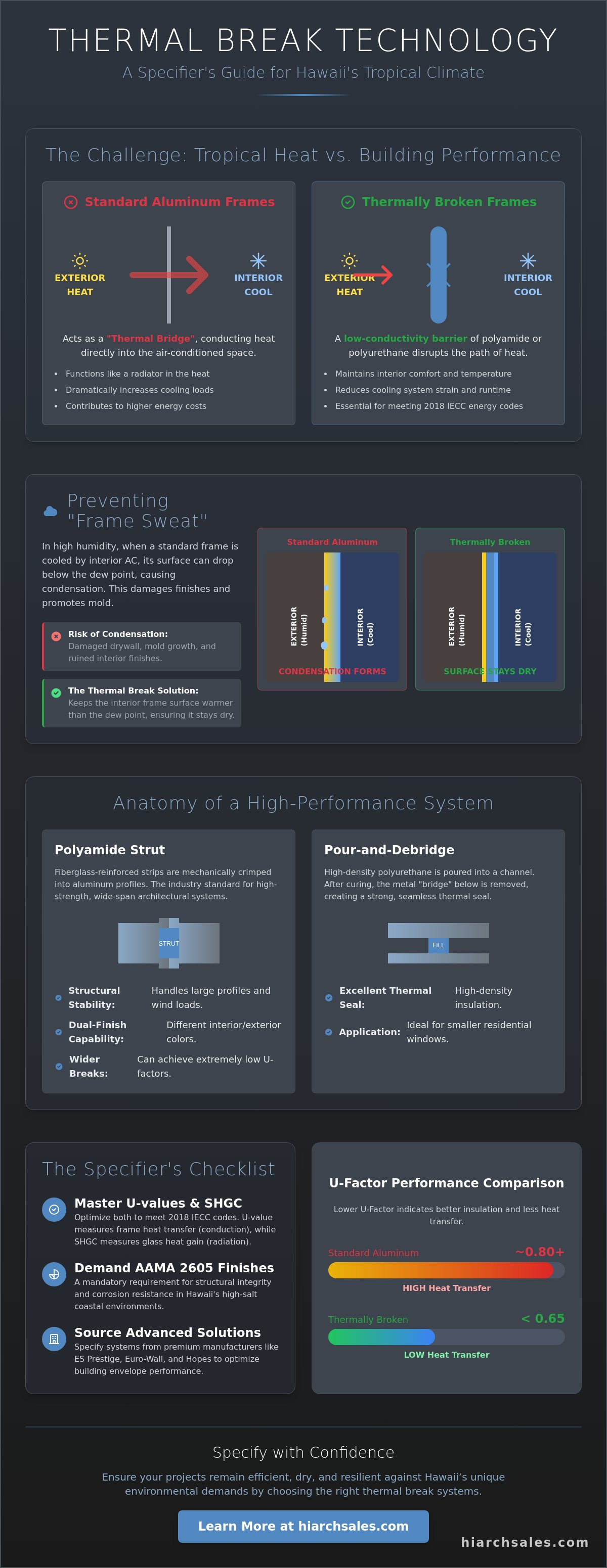
A thermal break is a low-conductivity material, such as polyamide or polyurethane, that separates the interior and exterior aluminum profiles of a window frame. This barrier disrupts the path of thermal energy. When researching What is a Thermal Break Window System?, you'll find these profiles serve as a structural insulator. For professionals specifying thermal break window systems Hawaii, this technology is vital for managing the state’s persistent solar loads. Standard aluminum is a high-efficiency conductor. Without a break, the frame acts as a thermal bridge that pulls heat into the building.
The "Thermal Bridge" problem is particularly acute in Hawaii’s high-rise developments. Standard aluminum frames act like radiators, pumping exterior island heat into air-conditioned spaces. This forces mechanical systems to run longer and harder to maintain comfort. As Hawaii moves toward stricter energy efficiency mandates, including the 2018 International Energy Conservation Code (IECC), reducing this conductive gain is no longer optional. It's a technical requirement for modern project compliance.
The Science of Tropical Heat Transfer
Conduction through aluminum frames accounts for significant cooling load increases in tropical environments. Distinguish between radiant heat, which is managed by the glass, and conductive heat, which travels through the frame. Even with high-performance glazing, a non-broken frame remains a weak point in the building envelope. Thermal bridging is the primary cause of frame-induced energy loss in Honolulu high-rises. By utilizing a thermal barrier, you create a discontinuous metal profile that limits heat flow. This ensures the building envelope performs as a cohesive, high-efficiency unit.
Preventing "Frame Sweat" in High Humidity
In humid regions like Lihue and Kailua-Kona, the dew point is a constant factor in architectural design. When interior air conditioning cools a standard aluminum frame, its surface temperature often drops below the exterior dew point. This causes moisture to condense on the frame, a phenomenon known as "frame sweat." This condensation damages drywall, encourages mold, and ruins interior finishes. A thermal barrier keeps the interior frame temperature significantly higher than the dew point. It prevents the transfer of cooling energy from the interior to the exterior-facing metal. This keeps the interior surfaces dry and protects the long-term integrity of the project.
The Anatomy of High-Performance Thermally Broken Aluminum
The internal architecture of high-performance thermal break window systems Hawaii relies on two primary insulation methods. Each method serves a specific structural and thermal purpose. Understanding these nuances is essential when Evaluating Efficiency: Thermally Broken vs. Standard Aluminum for large-scale tropical builds. While both technologies aim to reduce the default U-factor from 0.80 down to approximately 0.65, their application depends on the project's scale and design requirements.
Modern building envelopes require a balance between thermal resistance and structural rigidity. In Hawaii, where solar gain and wind pressure are constant variables, the choice of thermal break material impacts long-term durability. High-performance systems like the ES | Prestige and ES | Elite lines utilize these advanced materials to meet the 2018 IECC standards while maintaining the slim profiles architects demand.
Polyamide Struts vs. Polyurethane Fills
Polyamide strut technology is the industry standard for high-strength, wide-span architectural systems. These fiberglass-reinforced strips are mechanically crimped into the aluminum profiles, creating a composite section with high shear strength. This method is particularly effective for:
Dual-Finish Capability
Polyamide allows for different colors on the interior and exterior frames.
Structural Stability
It handles the expansion and contraction of large aluminum profiles better than liquid fills.
Wider Breaks
Struts can be specified in various widths to further lower U-factors without losing structural integrity.
Pour-and-debridge systems use a high-density polyurethane liquid. The liquid is poured into a central channel in the aluminum extrusion. Once it hardens, the "bridge" of metal is removed. This creates a high-density thermal seal that is excellent for smaller residential windows and certain commercial storefront applications. While effective, it generally offers less shear strength than reinforced polyamide struts.
Engineering for Hawaii’s High Wind Loads
Hawaii's updated building code mandates that new constructions withstand winds up to 160 mph. Thermal breaks must not become a point of failure during these Category 5 events. High-performance systems utilize 6063-T5 extruded aluminum. This alloy provides the necessary tensile strength and stiffness to support the thermal barrier under pressure. If you're designing for coastal or high-exposure zones, our technical team can provide detailed performance data on frame deflection and impact resistance.
Engineering these systems requires careful consideration of the thermal break's width. A wider thermal barrier improves insulation but can increase the risk of frame deflection under extreme wind loads. Manufacturers must test these assemblies to ensure they meet the stringent requirements of the 2018 IBC. By specifying systems that have been rigorously tested for high-velocity hurricane zones, you ensure the safety and efficiency of the building envelope.
Evaluating Efficiency: Thermally Broken vs. Standard Aluminum
Specifying the right fenestration requires a shift from qualitative benefits to quantitative performance data. In tropical environments, the thermal efficiency of the frame is just as critical as the glazing itself. Standard aluminum frames without a barrier typically carry a default U-factor of 0.80. By contrast, high-performance thermal break window systems Hawaii achieve U-factors of 0.65 or lower. This reduction is essential for LEED certification and modern building code adherence. Lower U-values mean the building envelope is more resistant to heat flow, which is the primary driver of energy consumption in island climates.
Paired with high-performance low-E coatings, these frames significantly lower the Solar Heat Gain Coefficient (SHGC). While the glass handles radiant energy, the thermally broken frame prevents conductive heat from bypassing the glass's efficiency. For a detailed technical breakdown of these material interactions, refer to The Anatomy of High-Performance Thermally Broken Aluminum. Beyond thermal performance, these systems provide measurable acoustic benefits. The non-conductive barrier acts as a secondary sound dampener. It breaks the vibration path through the metal, which is a major advantage for Honolulu projects located near high-traffic corridors or airports.
Energy Code Compliance in Hawaii
Hawaii’s adoption of the 2018 IECC places strict demands on the building envelope. In Climate Zone 1, achieving compliance through the prescriptive path often requires an SHGC of 0.25 for projects with minimal roof overhangs. Thermally broken frames allow architects to meet these targets without sacrificing large spans of glass. For projects in high-wind zones, you can achieve both thermal efficiency and structural safety by specifying Hurricane Rated Windows in Hawaii that feature integrated thermal barriers. This synergy ensures the fenestration meets both energy and safety mandates simultaneously.
ROI and Occupant Comfort
The life-cycle cost analysis for these systems is compelling. While the upfront investment is higher than standard aluminum, the 25-year energy savings in Hawaii’s high-cost utility environment often offset the initial premium. Occupant comfort also improves through the management of mean radiant temperature. Near large glass walls, a thermally broken frame stays closer to the interior air temperature, eliminating the "hot spot" effect common with standard metal frames. This thermal stability allows for a reduction in HVAC sizing requirements, saving both space and operational costs. Thermal breaks extend the life of interior finishes by preventing the moisture accumulation that leads to mold and wood rot.
The Specifier’s Checklist for Hawaii Thermal Break Systems
Moving from performance metrics to field application requires a rigorous verification process. In island environments, a thermal break is only as effective as the frame and hardware surrounding it. Specifying thermal break window systems Hawaii involves more than just selecting a U-value. You must ensure every component can withstand the synergistic effects of high UV, humidity, and salt spray. A failure in one area can compromise the entire building envelope's efficiency and longevity.
High-performance finishes are mandatory for any architectural aluminum in the Pacific. Specify AAMA 2605-compliant coatings for all profiles. This standard ensures the finish resists chalking and fading in intense tropical sun for over ten years. Beyond the finish, verify that the frame depth supports the required Insulated Glass Unit (IGU) thickness. Modern high-efficiency builds often require 1-inch or 1.25-inch units to accommodate low-E coatings and gas fills. Hardware must be 316-grade stainless steel, especially for coastal projects in Lahaina or Kihei. Lower grades of stainless will tea-stain and eventually seize when exposed to constant salt air.
Coastal Durability Standards
Salt Spray Testing
Verify the frame finish has undergone 3,000 to 4,000 hours of testing. This is the baseline for high-exposure coastal zones.
UV Stability
Confirm the thermal break material, specifically polyamide, is UV-stable. Some insulating materials degrade when exposed to direct sunlight at transition points.
Hurricane Certification
Ensure the assembly carries Florida Product Approval (FPA) or similar certifications for high-velocity hurricane zones.
Integration with Specialty Systems
Thermal breaks must integrate seamlessly with large-format openings to maintain the thermal envelope's continuity. For instance, Euro-Wall multi-slide doors utilize advanced thermal barriers to maintain efficiency across massive architectural spans. When designing for daylighting, specify thermal breaks within Kalwall translucent systems to minimize heat gain while maximizing natural light. Detail the continuity of the thermal barrier at sills and jambs. Any gap in the barrier creates a thermal bridge that leads to the frame sweat and energy loss discussed in previous sections.
Selecting brands with a dedicated local representative is a critical final step. This ensures technical submittals and shop drawings reflect Hawaii's specific wind load and energy requirements. Installation details must include proper flashing and high-performance perimeter sealants to maintain the integrity of the thermal envelope. Contact our technical consultants to receive a project-specific specification review and ensure your building envelope meets these rigorous standards.
Sourcing Advanced Building Envelope Solutions in Hawaii
Selecting high-performance fenestration requires a partner who understands the intersection of global manufacturing standards and local environmental pressures. Hawaii Architectural Sales operates as a technical consultant and distributor, bridging the gap between premium manufacturers and the specific needs of island projects. When specifying thermal break window systems Hawaii, architects benefit from a streamlined process that includes technical submittals and precise wind load calculations tailored to each island's microclimate. This localized expertise ensures that the building envelope performs as intended from day one.
Our role extends beyond simple material distribution. We provide the technical support necessary to navigate complex energy codes and structural requirements. Whether your project is a Honolulu high-rise or a coastal Maui residence, our team offers the data-driven insights needed to optimize the building's thermal performance. We help you move from initial design concepts to a fully realized, code-compliant specification that addresses the primary pains of high energy costs and frame condensation.
The ES | Prestige and ES | Elite Advantage
The ES | Prestige and ES | Elite lines represent a significant advancement in tropical window technology. These systems are engineered to provide superior thermal performance in high-salt environments where standard aluminum often fails. For residential applications requiring the highest levels of thermal resistance, the ES | uPVC line offers an alternative that virtually eliminates conductive heat transfer. These products allow for significant customization, ensuring that luxury commercial facades maintain a sophisticated aesthetic while meeting stringent performance benchmarks. By selecting these high-performance systems, you ensure the project's long-term value and occupant comfort.
Consultation and Material Distribution
Working with a local representative is the most effective way to ensure product compliance with Hawaii-specific codes. We provide the most value during the early design phases, such as Schematic Design (SD) and Design Development (DD). During these stages, we can perform a performance analysis to determine the optimal configuration of thermal break window systems Hawaii for your specific site. This proactive approach prevents costly redesigns and ensures the fenestration integrates perfectly with other specialty systems like Euro-Wall or Hopes steel windows.
Our team assists with everything from hardware selection to glazing compatibility reviews. We ensure that every component, from the 316 stainless steel hardware to the AAMA 2605 finish, is appropriate for the site's exposure level. This comprehensive support simplifies the specification process for busy professionals who need reliable, expert-backed information. Contact Hawaii Architectural Sales for technical specifications and quotes to begin your next performance analysis and secure the right solutions for your building envelope.
Optimizing Your Next Island Building Envelope
Specifying high-performance thermal break window systems Hawaii is a strategic decision that impacts a project's efficiency, durability, and occupant comfort. By breaking the thermal bridge, you eliminate the risk of frame condensation and significantly reduce cooling loads in high-humidity environments. Success relies on a rigorous specification process that balances thermal resistance with the structural demands of Hawaii’s coastal zones. Ensuring your frames feature AAMA 2605 finishes and 316 stainless steel hardware is essential for long-term resilience against salt-air corrosion.
Hawaii Architectural Sales has served the island's architectural community since 1985. We act as a technical bridge between premium manufacturers and your design goals. As an authorized representative for industry leaders like ES Prestige and Euro-Wall, we provide the localized expertise necessary to navigate Hawaii’s specific wind load and energy code requirements. Our team is ready to assist with wind load calculations, technical submittals, and performance analysis from the earliest design phases. Request a Technical Consultation for Your Building Envelope today to ensure your next project achieves peak performance and lasting value.
Frequently Asked Questions
Do I really need thermal break windows in Hawaii’s warm climate?
Thermal break window systems Hawaii are essential for managing conductive heat gain and preventing frame condensation. While many associate thermal breaks with freezing temperatures, they're critical in the tropics to stop exterior heat from radiating through the aluminum frame into cooled interiors. This technology directly reduces air conditioning loads and protects interior finishes from moisture damage.
Can thermal break windows withstand hurricane-force winds?
High-performance thermally broken systems are specifically engineered to meet Hawaii’s 160 mph wind load requirements. Modern polyamide strut technology creates a composite profile that maintains high structural shear strength. These systems undergo rigorous testing to ensure the insulating barrier doesn't compromise the frame's stability during Category 5 hurricane events.
What is the difference between a thermal break and a thermal pane?
A thermal break is an insulating material located within the window frame, while a thermal pane refers to the insulated glass unit (IGU). The thermal break stops heat from traveling through the metal frame itself. A thermal pane uses multiple layers of glass and gas fills to reduce heat transfer through the glazing area.
How do thermal break windows prevent condensation in humid areas like Hilo?
These systems prevent condensation by maintaining the interior frame temperature above the local dew point. In humid environments like Hilo, standard aluminum frames cooled by interior air conditioning often attract moisture. The thermal barrier creates a discontinuous path that stops the interior metal from reaching the cold temperatures that cause frame sweat.
Are thermally broken aluminum windows more expensive than vinyl?
Thermally broken aluminum typically requires a higher initial investment than vinyl but provides superior structural integrity and aesthetic flexibility. In Hawaii’s high-UV environment, aluminum frames with AAMA 2605 finishes are more resilient than vinyl, which can warp or become brittle over time. This makes aluminum the standard for high-end residential and commercial building envelopes.
Do thermally broken frames help with noise reduction in Honolulu?
Thermally broken frames provide a measurable improvement in acoustic performance for urban projects. The polyamide or polyurethane barrier acts as a sound dampener by breaking the continuous vibration path through the metal. This is a significant benefit for Honolulu developments located near airports or high-traffic corridors.
What maintenance is required for thermal break window systems in salt air?
Maintenance involves regular rinsing with fresh water to remove salt deposits from the AAMA 2605 finish. You should also inspect the 316 stainless steel hardware periodically to ensure it remains free of debris. While these systems are designed for high-salt zones, keeping the tracks and perimeter seals clean ensures the long-term performance of the thermal envelope.