Kalwall Panels in Honolulu: The Architect’s Technical Reference Guide
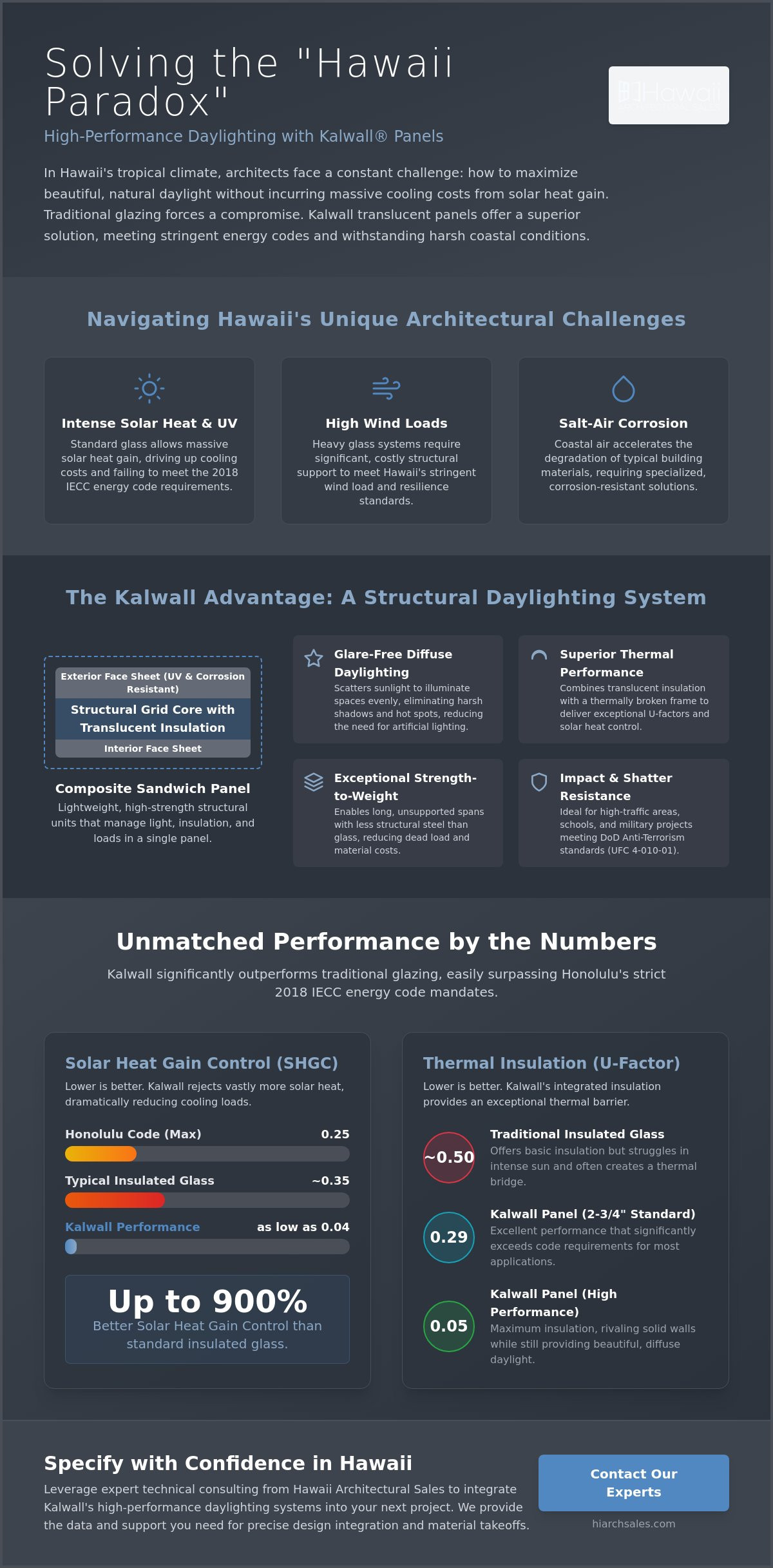
Traditional glazing often forces a compromise between natural light and thermal control in tropical climates. When specifying Kalwall panels Honolulu architects can finally solve the "Hawaii Paradox" by providing diffuse daylight without the heavy cooling penalties associated with standard glass. De...
Traditional glazing often forces a compromise between natural light and thermal control in tropical climates. When specifying Kalwall panels Honolulu architects can finally solve the "Hawaii Paradox" by providing diffuse daylight without the heavy cooling penalties associated with standard glass. Designing for Oahu means balancing aesthetic goals against harsh realities like salt-air corrosion, high UV exposure, and the updated 2018 IECC energy codes. You know that a standard skylight or window often isn't enough to withstand intense solar heat gain or the strict wind load requirements of our region.
This technical reference guide provides the specific data needed to ensure your next project meets structural compliance while significantly reducing building energy loads. We'll examine NFRC-certified U-factors as low as 0.05 and SHGC performance that can improve solar heat gain control by as much as 900% compared to traditional insulated glass units. From meeting UFC 4-010-01 DoD Anti-Terrorism standards to selecting the right panel thickness for coastal resilience, this overview serves as your roadmap for high-performance daylighting in Hawaii. You'll find the precise metrics required to satisfy both the Honolulu Building Energy Code and the most demanding environmental conditions.
Key Takeaways
• Understand the structural advantages of composite sandwich panels compared to traditional glazing or polycarbonate systems.
• Discover how specialized face sheets mitigate salt-air corrosion and UV damage in Hawaii’s coastal climate.
• Explore the architectural potential of specifying Kalwall panels Honolulu for high-span skyroofs and light-transmitting facades.
• Learn how to navigate local building codes and anti-terrorism specifications for government or military projects.
• Leverage expert technical consulting from Hawaii Architectural Sales to facilitate precise design integration and material takeoffs.
Understanding Kalwall Translucent Systems for Hawaii Architecture
Kalwall represents a specialized category of building envelope technology. It's a composite structural sandwich panel, not a simple sheet of plastic or glass. For designers specifying Kalwall panels Honolulu represents a market where this distinction is critical. While standard polycarbonate or insulated glass units (IGUs) rely on heavy framing or multiple layers of glass to achieve performance, Kalwall uses a lightweight, translucent structural grid. This technology has defined high-performance building envelopes for decades, offering a self-supporting system that manages light and heat simultaneously. It provides a level of durability and thermal control that traditional materials can't match in tropical environments.
The Composite Sandwich Panel Advantage
The core of the system is its structural integrity. The internal grid core is permanently bonded to architectural-grade face sheets, creating a "sandwich" that distributes loads across the entire surface. This results in an exceptional weight-to-strength ratio. In Honolulu, where wind load requirements are stringent, reducing the dead load of the building envelope is a major advantage. You can achieve large spans with significantly less structural steel than glass systems require. Additionally, these composite materials offer superior impact resistance. They don't shatter like glass or dent as easily as thin-wall polycarbonate, which makes them ideal for high-traffic public spaces or schools.
Daylight Harvesting vs. Solar Heat Gain
Effective daylighting principles require more than just letting light in; they require controlling its quality. In Hawaii, the intense tropical sun creates extreme glare and harsh shadows that make interior spaces uncomfortable. Kalwall panels solve this by providing perfectly diffuse daylight. The light is scattered as it passes through the panel, illuminating deep into the floor plate without creating hot spots or blinding reflections. This allows architects to maximize visible light transmission (VLT) while maintaining high thermal insulation. Balancing these factors is essential for LEED certification and meeting the energy efficiency goals of modern Pacific architecture. By reducing the need for artificial lighting and managing solar heat gain, these systems lower the overall cooling demand of the building.
This balance is achieved through the integration of translucent insulation within the panel cavity. Unlike standard glazing where insulation often compromises clarity, Kalwall's specialized infills enhance the diffuse quality of the light while providing U-factors that outperform even the most advanced triple-pane glass. It's a pragmatic solution for projects that demand high aesthetic value without sacrificing long-term energy performance.
Technical Performance: U-Values, SHGC, and Thermal Insulation
Honolulu’s transition to the 2018 IECC mandates rigorous energy performance standards that traditional glazing often fails to meet cost-effectively. For architects specifying Kalwall panels Honolulu projects must prioritize heat rejection without sacrificing daylighting quality. High-performance translucent systems provide a superior thermal barrier by combining specialized face sheets with internal insulation. This combination allows for expansive daylighting apertures that remain compliant with the most stringent local energy codes.
Optimizing SHGC for Tropical Heat Rejection
In tropical climates, the Solar Heat Gain Coefficient (SHGC) is the most critical metric for building efficiency. The Honolulu Building Energy Code requires a maximum SHGC of 0.25 for most glazed fenestration, yet Kalwall systems can achieve values as low as 0.04. This represents a significant improvement in solar heat control compared to standard insulated glass units. Panel thickness plays a vital role in these calculations. The 2-3/4" (70 mm) panel provides a range of U-values from 0.29 to 0.05, while the 4" (100 mm) panel offers even greater resistance for extreme exposures. Integrating these panels alongside thermal break window systems Hawaii ensures a holistic approach to the building envelope that addresses both vision and translucent areas.
Kalwall structural frames incorporate a specialized thermal break that eliminates the "thermal bridge" between exterior and interior surfaces to stop conductive heat gain. This technology provides a Condensation Resistance Factor (CRF) of approximately 80 or better, which is essential for maintaining interior comfort in Hawaii's humid environment.
Energy Savings and HVAC Load Reduction
Specifying these systems leads to measurable reductions in HVAC sizing and operational costs. By minimizing heat gain, buildings avoid contributing to the "heat island" effect common in dense urban Honolulu. Data shows that these high-performance insulating properties can reduce cooling costs by up to 30% compared to traditional skylight systems. The long-term ROI is found in both energy savings and the reduced maintenance of mechanical systems that no longer need to work at peak capacity to offset solar gain. Translucent insulation (TI) within the panel cavity is the primary driver of these gains, trapping air to provide U-factors as low as 0.05. This far exceeds the Honolulu skylight requirement of 0.75, allowing for larger daylighting apertures without energy penalties. For precise performance modeling, our team provides technical consulting to help you select the ideal panel configuration for your project's orientation and load requirements.
Durability in Coastal Environments: Salt, UV, and Wind Loads
Designing for the Pacific requires materials that can withstand more than just heat; they must resist the destructive power of salt-laden air and relentless ultraviolet radiation. When architects specify Kalwall panels Honolulu building sites present a rigorous test of material longevity. Standard translucent materials often succumb to "fiberbloom" or yellowing within a few years of exposure to the intense Pacific sun. Kalwall’s architectural-grade face sheets are engineered with permanent UV stabilizers to prevent these failures, ensuring the system maintains its aesthetic and structural integrity for decades.
Structural resilience is equally paramount given the region's exposure to high-wind events and tropical storms. The system is engineered to meet the stringent requirements of the Honolulu building code, which demands high performance under extreme pressure. Kalwall translucent systems have undergone extensive ASTM E330 testing to verify their structural performance under heavy positive and negative wind loads. This data provides the engineering certainty required for large-span skyroofs and high-rise facades in dense urban areas like Kaka’ako where wind tunnels can intensify pressure on the building envelope.
Corrosion Resistance and Salt Spray Testing
Salt-air corrosion is a primary cause of architectural component failure in Hawaii. Unlike traditional metal-heavy systems, Kalwall’s composite nature makes it inherently non-conductive and resistant to galvanic corrosion. For the perimeter framing, architects can choose from several high-performance finishes designed for coastal longevity:
High-Performance Coatings
Fluoropolymer finishes provide the highest level of resistance against salt spray and chemical attack.
Anodized Finishes
Hard-coat anodizing offers a durable, integrated surface that resists scratching and environmental degradation.
Maintenance in Hawaii differs significantly from mainland requirements. While the panels are self-cleaning to an extent, regular rinsing of the frames is recommended to prevent salt accumulation in crevices. This proactive approach ensures the longevity of the finish and the overall performance of the building envelope over its lifecycle.
Hurricane Resistance and Safety Standards
Meeting impact requirements is a baseline necessity for any building envelope project in the islands. Kalwall offers configurations that satisfy various impact and wind-pressure standards, providing a critical layer of defense during storm events. For projects requiring comprehensive protection, integrating these panels with hurricane rated windows Hawaii creates a unified, resilient facade. Beyond weather protection, these systems also carry "man-safe" ratings. This means they can support concentrated loads, reducing the risk of fall-through accidents during roof maintenance and enhancing overall site security. For government and military installations, the system’s compliance with UFC 4-010-01 DoD Anti-Terrorism specifications provides the necessary blast resistance and security protocols required for sensitive facilities.
Design Applications: Facades, Skyroofs, and Canopies
The versatility of translucent systems allows for architectural expressions that traditional glazing cannot support. For projects utilizing Kalwall panels Honolulu designers often focus on the material’s ability to transform the building envelope into a light-emitting element. In the city’s urban core, these systems create "glowing" facades at night while providing soft, natural light during the day. This dual-purpose aesthetic is achieved without the weight or fragility of glass, making it a pragmatic choice for high-density environments. Beyond simple wall applications, the system’s structural capacity supports wide-ranging designs from protective canopies to iconic rooflines.
Unitized curtain wall configurations offer a strategic advantage for Hawaii contractors. These factory-assembled units arrive at the job site ready for rapid installation, which significantly reduces on-site labor requirements. In dense areas like Kaka’ako or downtown Honolulu, where staging space is limited, the ability to move quickly from delivery to installation is essential. This unitized approach ensures a high-performance weather seal and consistent quality control that is difficult to achieve with field-assembled systems.
Walkways and canopies are fundamental to Hawaii's "indoor-outdoor" architectural transitions. They provide essential protection from sudden tropical downpours while maintaining a bright, open atmosphere. Unlike opaque metal or concrete covers, translucent canopies eliminate the dark, cavernous feeling often found in covered pedestrian corridors. They provide a safe, well-lit environment for transit hubs and school walkways, ensuring pedestrians remain dry without losing the benefit of natural daylight.
Commercial Facades and Unitized Systems
Architects frequently integrate Kalwall with other high-performance envelope materials to achieve a balanced facade. For example, combining translucent panels with ES | Prestige window systems allows for clear vision areas where views are desired and translucent sections where privacy or thermal control is the priority. This integration is supported by a variety of grid patterns and face sheet color options, providing the aesthetic flexibility needed for modern Pacific design. Contact Hawaii Architectural Sales to view specific grid configurations and color samples for your project.
Skyroofs® and Large-Span Daylighting
The Skyroof® system represents a self-supporting structural solution that can span up to 24 feet without requiring heavy, expensive substructures. This capability is particularly valuable in gymnasiums and atriums where large-scale daylighting is needed but structural weight must be minimized. These systems effectively eliminate the blinding glare that often plagues glass-roofed athletic facilities, providing a more functional environment for occupants. Whether designing pyramids, vaults, or complex geo-roofs, the lightweight nature of the composite panels allows for ambitious geometries that would be cost-prohibitive in glass.
Partnering with Hawaii Architectural Sales for Kalwall Specification
Hawaii Architectural Sales serves as the authorized representative for Kalwall products throughout the islands. We provide the localized technical expertise required to bridge the gap between high-performance manufacturing and practical application in the Pacific. For firms specifying Kalwall panels Honolulu projects benefit from our deep understanding of regional environmental demands and regulatory standards. We don't just distribute materials; we act as technical consultants from the earliest stages of schematic design through final material takeoff. Our goal is to ensure that every translucent system is optimized for its specific orientation and exposure.
Navigating the complexities of island logistics requires a partner who understands the nuances of the local supply chain. We streamline the delivery process, ensuring that custom-engineered components arrive on-site in a sequence that supports the contractor's schedule. Our role is to mitigate risk for the design team and the general contractor by providing a single point of accountability for the translucent building envelope. This hands-on approach is essential for maintaining project timelines in Hawaii’s unique construction environment.
Local Expertise and Technical Support
Our team has addressed Hawaii's unique building envelope challenges since 1985. This longevity provides us with a pragmatic perspective on what works in our high-UV, salt-air environment. During the pre-construction phase, we assist architects with critical calculations, including wind load analysis and thermal performance modeling. These services ensure that the specified system meets the 2018 IECC requirements and the structural codes discussed earlier in this guide. We understand the high stakes of large-scale commercial and government projects and provide the stability required for successful execution.
We maintain direct coordination with Kalwall manufacturing to facilitate custom island requirements. Whether your project requires specialized finishes for coastal proximity or specific grid configurations for a unique aesthetic, we ensure the factory submittals align with your design intent. This localized support reduces the likelihood of specification errors and ensures the system performs as intended over its full lifecycle. By acting as a strategic ally, we help you leverage the full potential of Kalwall’s daylighting technology.
The Procurement Process for Hawaii Contractors
The transition from design to construction is where technical support is most vital. We provide comprehensive submittal packages that include shop drawings, performance data, and physical samples to facilitate the approval process. For local installers and general contractors, our team offers guidance on handling and installation best practices to maintain the system's warranty and performance integrity. We understand that precision in the submittal phase prevents costly field adjustments later.
Requesting a quote or technical consultation is a direct process designed to respect your project timeline. We provide the precise data needed for accurate budgeting and scheduling, helping you avoid the delays often associated with mainland-only suppliers. If you are ready to integrate high-performance daylighting into your next project, Contact Hawaii Architectural Sales to speak with a technical consultant about your specific requirements. We are prepared to assist with everything from initial design concepts to the final coordination of delivery to your Honolulu job site.
Optimizing the Building Envelope for the Pacific
Specifying daylighting systems for the islands requires a precise balance of thermal performance and structural resilience. By selecting high-performance translucent systems, you provide occupants with glare-free light while maintaining strict compliance with Honolulu's updated energy codes. We've explored how these composite panels outperform traditional glazing in heat rejection and coastal durability. Integrating Kalwall panels Honolulu projects ensures long-term value through reduced HVAC loads and superior resistance to salt-air corrosion.
Hawaii Architectural Sales has served local architects and developers since 1985. As the authorized representative for Hawaii, we bring specialized expertise in high-wind and coastal building envelopes to every project. We're ready to assist with your specific design challenges, from early-stage wind load analysis to final material coordination. Request a Technical Consultation for Kalwall Panels to leverage our localized knowledge for your next development. We look forward to supporting your vision for a more efficient and resilient built environment in Hawaii.
Frequently Asked Questions
Are Kalwall panels hurricane-rated for use in Honolulu?
Kalwall translucent systems are engineered to meet the high-wind and hurricane requirements of the Honolulu Building Code. These panels undergo ASTM E330 testing to verify their structural integrity under extreme pressure. For projects requiring specific impact ratings, our technical team provides configurations that satisfy various high-velocity wind zone standards. This ensures the building envelope remains secure during major tropical storm events and high-wind conditions common in the islands.
How do Kalwall panels handle Hawaii’s intense UV radiation over time?
Kalwall panels utilize specialized architectural-grade face sheets that contain permanent UV stabilizers to prevent yellowing and fiberbloom. This technology is essential for the intense Pacific sun, where standard translucent materials often degrade within a few years of exposure. The panels maintain their aesthetic clarity and structural strength over decades of use. This long-term stability makes them a reliable choice for the high-UV environment found throughout the Honolulu urban core and coastal areas.
Can Kalwall panels be used for both wall and roof applications?
Kalwall systems are highly versatile and suitable for both translucent wall systems and Skyroof applications. Architects frequently specify them for glowing facades in urban Honolulu or as self-supporting roof structures that span up to 24 feet without heavy substructures. The lightweight nature of the composite sandwich panels allows for consistent daylighting across the entire building envelope. This versatility simplifies the design process by using a single, high-performance material for multiple building surfaces.
What is the typical lead time for Kalwall panels in Hawaii?
Lead times for Kalwall panels Honolulu projects typically vary based on the complexity of the custom engineering and the specific finish requirements. Because each system is factory-fabricated to project-specific dimensions, we recommend early coordination during the design phase to ensure timely delivery. Hawaii Architectural Sales manages the logistics and shipping process to streamline island delivery. Contact our technical team for a current estimate based on your project's specific material takeoff and schedule.
How does Kalwall compare to traditional glass in terms of cooling costs?
Kalwall provides superior thermal insulation that can reduce cooling costs by up to 30% compared to traditional insulated glass units. While glass often creates a greenhouse effect in tropical climates, Kalwall’s translucent insulation and low SHGC values prevent excessive heat gain. This reduces the load on HVAC systems and lowers operational expenses over the building's lifecycle. It's a pragmatic solution for projects prioritizing energy efficiency and occupant comfort in Hawaii's warm climate.
Is maintenance different for Kalwall panels in a coastal salt-air environment?
Maintenance for Kalwall in coastal environments is straightforward but requires regular rinsing to prevent salt accumulation on the perimeter frames. The composite face sheets are naturally resistant to salt-air corrosion and don't require the intensive cleaning schedules associated with high-performance glass. We recommend a simple fresh-water wash for the anodized or high-performance coated frames. This proactive approach preserves the finish and ensures the system's longevity in salt-heavy air near the shoreline.
Do Kalwall panels meet Hawaii’s energy code requirements for SHGC?
Kalwall configurations easily meet or exceed the Honolulu Building Energy Code's maximum SHGC requirement of 0.25 for glazed fenestration. These panels can be engineered to achieve SHGC values as low as 0.04, providing exceptional control over tropical heat gain. By specifying these systems, architects ensure compliance with the 2018 IECC while maximizing natural daylight. Our team provides the necessary NFRC-certified data to document compliance during the permitting and code review process.
Can Kalwall panels be integrated with other window systems like ES Prestige?
Kalwall systems are designed for seamless integration with other high-performance envelope components, including ES | Prestige windows. This allows designers to combine translucent daylighting with clear vision areas for a balanced aesthetic. Our technical consultants assist with detailing the transitions between different systems to ensure a continuous weather seal and structural alignment. This integrated approach provides a unified facade that meets both the aesthetic and performance goals of modern Pacific architecture.