Architectural Product Sourcing for Hawaii General Contractors
Architectural product sourcing for general contractors in Hawaii means more than selecting windows and doors. It involves coordinating product choices with project design, specifications, and delivery needs, whether the work is a resort, residential development, or commercial building.Product select...
Architectural product sourcing for general contractors in Hawaii means more than selecting windows and doors. It involves coordinating product choices with project design, specifications, and delivery needs, whether the work is a resort, residential development, or commercial building.
Product selection can affect how design intent translates into construction planning, so clear sourcing support matters. This article explains how architectural products, windows, and doors can be sourced for Hawaii projects, what information helps shape suitable selections, and how coordination fits into the wider project process. You’ll also see which considerations influence product suitability and how a sourcing partner can support decisions from early planning through procurement. The goal is a practical view of the steps involved, so you can assess product options with project requirements in focus.
Key Takeaways
• Align product selections with the project’s design intent, specifications, and delivery requirements from the outset.
• Understand how windows, doors, and other architectural products fit into resort, residential, and commercial projects.
• Use a sourcing partner to coordinate product options and supply needs across Hawaii projects.
• Explore how Hawaii Architectural Sales’ ES | Prestige, ES | Elite, ES | uPVC, and Hopes offerings may support product selection.
Resort, residential, and commercial project supply
Resort, residential, and commercial projects have different product and delivery needs. A resort may coordinate doors and windows across guest rooms and shared spaces, while a residential project may prioritize consistency across homes or units. Commercial construction often requires products to align with drawings, schedules, and building operations. Hawaii’s island locations also make supply planning essential: coordinate materials, shipping, and receiving for destinations such as Honolulu, Lihue, Kailua-Kona, Kihei, and Lahaina.
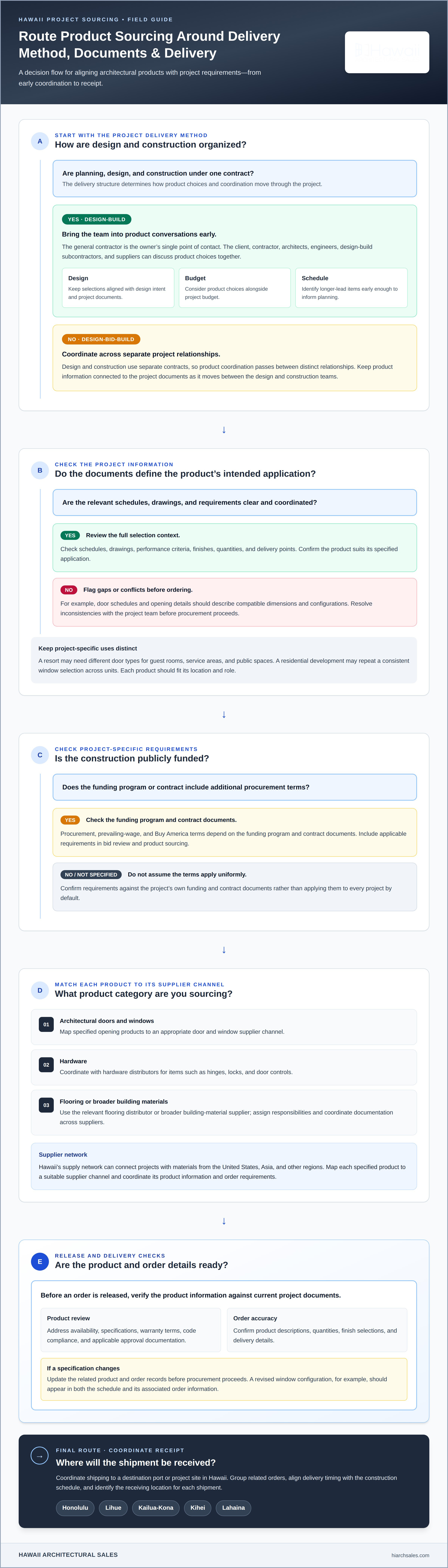
Project delivery methods shape sourcing decisions. In design-build, planning, design, and construction sit under one contract, with the general contractor as the owner’s single point of contact. The client, contractor, architects, engineers, design-build subcontractors, and suppliers can discuss product choices early, bringing design and construction considerations into decisions about products, budget, and schedule. By contrast, design-bid-build uses separate design and construction contracts, so product coordination passes between distinct project relationships.
Architects in Hawaii are licensed under Hawaii Revised Statutes Chapter 464, according to the Hawaii State Legislature. Their design intent informs product specifications, while the construction team considers how selected products fit the project documents and sequence. Project-specific solutions may involve coordinating product configurations with the intended application, rather than treating every opening or building area as identical. Early coordination can also identify long-lead items before they affect later construction planning.
For publicly funded construction projects in Hawaii, procurement, prevailing-wage, and Buy America terms depend on the funding program and contract documents. Include applicable requirements in bid review and product sourcing rather than assuming they apply uniformly to every project.
Architectural product sourcing supports the process from specification through receipt. A sourcing partner can align product options with design documents, organize information for bidding, coordinate orders with suppliers, and plan delivery to a designated port or project site. For design-build teams, early supplier coordination can help identify products with longer lead times and inform schedule decisions. Clear order and delivery coordination also helps the receiving team connect incoming products with the construction sequence.
Architectural products, windows, and doors
Architectural products connect a building’s design intent with the materials specified for construction. Windows and doors influence openings, circulation, daylight, and a façade’s appearance. A resort may use different door types for guest rooms, service areas, and public spaces, while a residential development may repeat a consistent window selection across units. Each choice needs to suit its location and role in the project.
Start sourcing with the project documents. Review schedules, drawings, performance criteria, finishes, quantities, and delivery points. Then identify products that suit the specified application and flag gaps or conflicts for resolution before ordering. For example, a door schedule and opening details should describe compatible dimensions and configurations. Clear documentation helps design and construction teams assess whether proposed materials fit their intended use.
Availability, specifications, warranty terms, and code compliance should be addressed before an order is released. A general contractor can work with a sourcing provider to review product information, request current availability from suppliers, and organize warranty documents and applicable compliance documentation. The project team can compare those materials against its specifications and approval requirements. This process supports informed decisions without assuming that one product or approval applies to every project.
Accurate orders depend on complete, coordinated information. Confirm product descriptions, quantities, finish selections, and delivery details against current project documents. If a specification changes, update the related product and order records before procurement proceeds. For example, a revised window configuration should appear in both the schedule and the associated order information.
For a project evaluating architectural products, review product options as part of the sourcing process. A focused review connects the project’s documented requirements with the products under consideration, keeping selections aligned with design intent and procurement needs.
Which Hawaii suppliers distribute architectural doors, windows, hardware, flooring, and building materials?
Choose suppliers by product category and project specification. Architectural door and window suppliers focus on openings, while hardware distributors handle items such as hinges, locks, and door controls. Flooring distributors serve a separate finish package, and broader building-material suppliers may coordinate several categories. On a resort project, packages may serve guest rooms, public areas, and back-of-house spaces, each with its own schedule and quantities.
Hawaii’s supply network can connect projects with materials from the United States, Asia, and other regions. Map each specified product to an appropriate supplier channel, then coordinate product information and order requirements. This is especially useful when a project combines architectural doors and windows with hardware, flooring, and other construction materials. Assign responsibilities clearly and coordinate the documentation across suppliers.
For island delivery, suppliers and project teams coordinate shipping to a destination port or project location in Hawaii, including Honolulu, Lihue, Kailua-Kona, Kihei, and Lahaina. Group related orders, align delivery timing with the construction schedule, and identify the receiving location for each shipment. Track products by project phase, such as windows for one building phase separately from flooring scheduled for interior finishing. Clear labels and order records help connect delivered materials with the right project area.
Supplier coordination helps keep bids and orders accurate. Organize product descriptions, quantities, specifications, and delivery details by package, then clarify how supplier proposals correspond to project documents. This lets general contractors review door, window, hardware, and flooring scopes without treating them as interchangeable. Choose the supply arrangement that fits the specifications, sequence, and delivery plan rather than expecting one supplier category to cover every material need.
Architectural door and window suppliers serve openings; hardware distributors supply items such as hinges, locks, and door controls; flooring distributors handle flooring packages. Broader building-material suppliers may coordinate several material categories.
What Hawaii building codes, energy requirements, and product approvals apply to architectural products?
Architectural products must meet the requirements for the specific project. Applicable code provisions, energy criteria, and approval documents depend on project scope, building use, and permit documents. A window for a resort guest room, for example, may have different documented criteria from a door for a commercial entrance. Do not assume documentation for one product covers every opening or application.
Begin with the construction documents and project approval conditions. The design team can identify requirements for each product schedule and connect them to product submittals. For windows and doors, organize available manufacturer specifications, performance information, and product identification with the relevant schedule references. This gives the project team a traceable basis for reviewing whether proposed products meet documented requirements.
Tie energy criteria to the project documents rather than inferring them from a product category or general description. Review a window’s stated performance information against the criteria specified for the project. Product approvals and supporting documents should also match the exact product and configuration under consideration. Documentation for one configuration does not establish compliance for a different one.
A practical review sequence is to identify applicable project requirements, match each requirement to the relevant product, and gather supporting documentation before ordering. Resolve any gaps between the specification and proposed submittal through the project’s design and approval process. This keeps code, energy, and product approval reviews connected to project records rather than broad assumptions about construction in Hawaii.
For a sourcing discussion grounded in your project’s product requirements, discuss architectural product options with Hawaii Architectural Sales. Bring the applicable schedules and specifications so product information can be considered in context.
Hawaii Architectural Sales
Hawaii Architectural Sales supplies architectural products for consideration in project sourcing. General contractors can review ES | Prestige, ES | Elite, and Hopes against project specifications and design requirements. These options can inform product discussions for resort, residential, and commercial work.
Bring relevant schedules, drawings, and product requirements to the discussion. They give the team a clear basis for considering which offerings suit the intended application and how selections fit procurement planning. Hawaii Architectural Sales is a practical next step when your project team is evaluating architectural products.
Turn project priorities into a focused product discussion. For general contractors in Hawaii, architectural product sourcing works best when the decision team understands the design intent, procurement needs, and products under consideration. That shared starting point keeps conversations specific as plans develop.
Hawaii Architectural Sales offers ES | Prestige, ES | Elite, and ES | uPVC. Consider these products alongside project requirements and design direction to help shape the next sourcing decisions.
Contact Hawaii Architectural Sales today to discuss your project’s architectural product needs. A clear next step can help your team move forward with confidence.
Frequently Asked Questions
What architectural product sourcing services are available to general contractors in Hawaii?
Hawaii Architectural Sales provides architectural product distribution and representation for residential and commercial projects. Its offerings include ES | Prestige, ES | Elite, ES | uPVC, Hopes, Kalwall, Super Sky, AWV, and Balco. Contractors working on hotels, residential developments, and commercial buildings can assess relevant products against project requirements. The company focuses on product supply and representation to support selection and procurement planning.
How do shipping, freight, and inter-island delivery affect architectural product sourcing in Hawaii?
Shipping plans need to reflect the destination and construction sequence. Receiving coordination for a Honolulu project may differ from delivery to Lihue, Kailua-Kona, Kihei, or Lahaina. Product dimensions, packaging, consolidation, port handling, and final project location all affect delivery planning. Aligning these details with order timing helps the project team plan how products will reach the site.
Which mainland suppliers ship architectural products to Hawaii, and what are their terms?
Architectural products for Hawaii projects are sourced through manufacturer and distributor channels suited to the specified products and orders. Hawaii Architectural Sales represents architectural brands and distributes products for local projects. Freight arrangements depend on shipment contents, destination, and delivery scope. Treat each product package as a separate procurement decision instead of assuming the same shipping terms apply to every order.
What risks cause delays or cost overruns when sourcing architectural products in Hawaii?
Common risks include changing specifications after procurement begins, incomplete product schedules, and delivery plans that do not match the construction sequence. A revised window configuration, for example, can affect submittal review and order coordination. Products with longer lead times can also create schedule pressure if identified late. Clear product records, timely design decisions, and coordinated receiving plans help reduce avoidable rework and keep procurement aligned with project needs.