Architectural Sales Agency Near Me for Project Budgets and Timelines
Project alignment matters more than a nearby address. An architectural sales agency near me is a strong fit when its product guidance supports the project’s design intent, budget parameters, and schedule. Set those priorities first, then assess professional certifications by their issuing organizati...
Project alignment matters more than a nearby address. An architectural sales agency near me is a strong fit when its product guidance supports the project’s design intent, budget parameters, and schedule. Set those priorities first, then assess professional certifications by their issuing organizations, scope, and relevance to the agency’s role.
It’s reasonable to expect clear, practical guidance before product decisions move forward. A defined budget and timeline help focus discussions on options that suit the project, while credential details help you understand the agency’s professional background.
This article explains how to align project goals, budget, and timing, and how to evaluate certifications without treating every credential as equally relevant. It also outlines the role an architectural sales partner can play in connecting product choices with project requirements.
Key Takeaways
• Define project goals, budget priorities, and schedule before discussing product options.
• Compare agencies by the manufacturers and product categories they represent, then assess fit with your project needs.
• Evaluate professional certifications by their relevance to the agency’s role and the work involved.
• Prepare project details and decision criteria to make the initial agency discussion focused and productive.
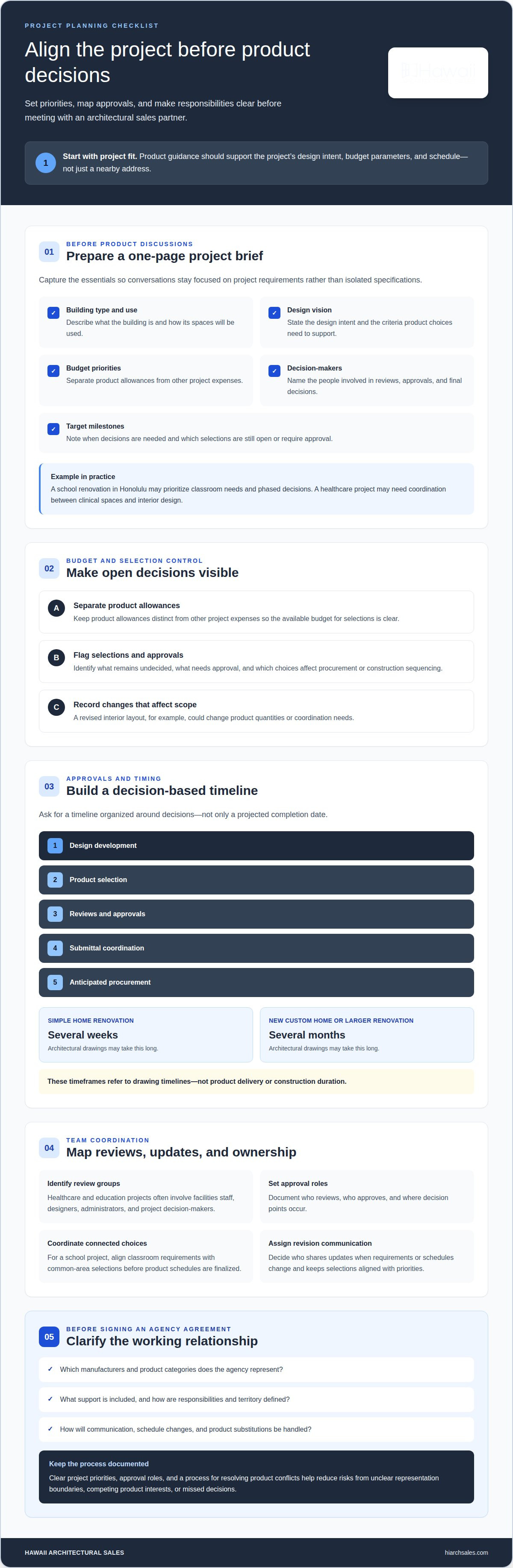
Prepare a one-page brief before discussing products with an architectural sales partner. Include building type, intended use, design vision, budget priorities, decision-makers, and target milestones. For example, a school renovation in Honolulu may prioritize classroom needs and phased decisions. A healthcare project may require coordination between clinical spaces and interior design. Clear priorities help focus product discussions on project requirements, not isolated specifications.
Separate product allowances from other project expenses. Note which selections remain open, which need approval, and when decisions affect procurement or construction sequencing. For a project in Lihue, a revised interior layout could change product quantities or coordination needs. According to the Ohio Board of Building Standards, Chapter 13 of the International Building Code, 2021 edition, as incorporated by reference, is amended.
Healthcare and education projects often involve several stakeholder groups. Map review steps for facilities staff, designers, administrators, and project decision-makers. On a school project in Kihei, align classroom requirements with common-area selections before product schedules are finalized. Institutional projects also benefit from clear approval roles, revision communication, and documented decision points.
Ask for a timeline organized around decisions, not only a projected completion date. Track design development, product selection, approvals, submittal coordination, and anticipated procurement. Architectural drawings for a simple home renovation may take several weeks. New custom homes or larger renovations may take several months. These refer to drawing timelines, not product delivery or construction duration.
For work in Kailua-Kona or Lahaina, identify project locations and coordination needs. Decide who communicates updates when requirements or schedules change. Assign responsibility for sharing revisions and keeping product selections aligned with project priorities.
Before signing an agency agreement, ask which manufacturers and product categories it represents, what support is included, and how responsibilities, territory, and communication are defined. Clarify how schedule changes and product substitutions are handled.
Common risks include unclear representation boundaries, competing product interests, and missed decisions when responsibilities remain vague. Document project priorities, approval roles, and the process for resolving product conflicts.
What products and manufacturers does each local agency represent?
An agency’s manufacturer relationships determine which product options it can discuss. Start by grouping project needs into categories such as windows, doors, skylights, or façade systems. Then match each category to the agency’s represented manufacturers. This shows whether one partner can support several product discussions or whether separate specialists may be needed. A Honolulu project with residential and commercial spaces may involve different categories across its scope.
Request a representation matrix organized by product category and manufacturer. For each entry, establish what the agency contributes, such as product information, specification resources, samples, or design coordination. These responsibilities can vary, so a clear matrix distinguishes manufacturer representation from installation or general contracting. It also shows where project teams should direct technical questions and selection decisions.
Manufacturer
Record the represented brand associated with that category.
Project fit
Match the category to the intended application, design criteria, and schedule.
Support role
Clarify what product guidance and coordination the agency provides.
Compare representation by relevance, not by the length of a manufacturer list. For example, a school in Lihue may need coordinated choices for classrooms, common areas, and entrances. A healthcare facility in Kihei may require product discussions aligned with distinct interior and exterior areas. Ask how each represented category relates to the project drawings and performance priorities. This helps identify gaps before selections enter specifications.
Manufacturer representation can also shape how substitutions are handled. Establish the process for reviewing an alternate product, documenting its fit, and communicating the decision to the design team. For projects in Kailua-Kona or Lahaina, local coverage may inform meeting coordination and understanding of regional design conditions. Keep comparisons focused on named manufacturers, relevant product categories, and defined support. This creates a practical basis for matching agency representation to project scope.
Represented products and manufacturers vary by agency. Compare them by category, such as windows, doors, skylights, façade systems, entrances, and daylighting elements. Request a matrix naming the manufacturer associated with each category.
How can I compare local architectural sales agencies by experience and services?
Use the same criteria for each agency to judge project fit. Start with relevant experience: ask about comparable building types, product categories, and the agency’s role in design coordination. A school project may need different product guidance than a residential development. Focus on specific examples rather than general claims about expertise.
Map each agency’s services across the project stages. Separate product education and specification support from installation, contracting, or design work. Clarify who handles product questions, samples, submittal information, and coordination with the project team. A written scope distinguishes the agency’s contribution from work assigned to the architect, engineer, or contractor.
Relevant experience
Compare examples involving similar building uses and project requirements.
Service scope
Record the support available during selection, specification, and coordination.
Communication
Establish the main contact and how design changes reach the agency.
Credentials
Identify the credential holder, issuing body, and relevance to the work.
Certifications and professional credentials need context. When hiring an architectural drawing company, homeowners may want to consider relevant professional credentials and how they relate to the work. They don’t all represent the same qualification or prove the same expertise. For an agency comparison, note whether a credential belongs to an individual or organization, what it relates to, and how it supports the agency’s project role.
Use a simple scoring sheet with consistent categories, such as relevant project experience, defined services, product knowledge, communication, and applicable credentials. A healthcare team might give greater weight to coordination across specialized spaces; a school team might prioritize clear product documentation. Score only evidence shared for each category. This keeps the comparison practical and helps identify a partner whose experience and service scope align with the project’s specific needs.
How do I contact and hire an architectural sales agency?
Begin with a concise project brief and a direct introduction. Include the building type, location, design stage, product categories, and key decision-makers. For example, an architect planning a school renovation can describe the affected areas and selection milestones. This gives the agency context for an initial discussion and focuses follow-up on relevant products.
Share useful documents, such as outline specifications, elevations, or a preliminary schedule. Identify which selections are open for discussion and which decisions already have approval. A healthcare project might include separate requirements for clinical areas and public entrances. Clarify whether the agency’s represented manufacturers and product categories align with the project scope.
Make contact
Send the brief and identify the project lead and preferred communication method.
Hold an introductory discussion
Review project objectives, product needs, design stage, and decision process.
Define the working scope
Document product guidance, coordination responsibilities, and expected project-team interactions.
Review the agreement
Clarify representation, territory, responsibilities, communication, and how changes are handled.
Before signing, confirm how the agency’s role fits alongside the architect, engineer, owner, and contractor. Record who receives product questions and who communicates revisions. For a project with multiple building areas, identify how discussions and product decisions will be tracked. A written scope makes those handoffs clearer and helps prevent assumptions about responsibilities.
Use the introductory meeting to assess how the agency connects its represented products to project requirements. Ask for relevant product information and discuss its role in design coordination. Set a specific next step, such as reviewing a product category against the current drawings. This provides a practical basis for deciding whether to proceed.
Hawaii Architectural Sales is a next step when your project needs architectural product options aligned with its design priorities. Its offerings include premium window lines, custom doors, steel frames, and other residential and commercial building products. The company represents and distributes products for project teams in Honolulu, Lihue, Kailua-Kona, Kihei, and Lahaina.
Bring the product category, design direction, and current decision stage to the conversation. Hawaii Architectural Sales provides high-value solutions and custom architectural solutions, with product discussions focused on project requirements. Involving the company before selections are finalized can help connect represented products with design decisions.
Contact Hawaii Architectural Sales to discuss your project and its product requirements, ensuring you find the right architectural sales agency near me for your upcoming builds.
Move Your Project Toward a Clear Product Direction
Choosing an architectural sales agency near me starts with a practical step: connect project priorities to the product decisions ahead. Bring relevant design materials and identify which selections need discussion. Hawaii Architectural Sales can help relate its represented products to your project’s direction and clarify where product coordination fits.
Hawaii Architectural Sales offers ES | Prestige, ES | Elite, and ES | uPVC, along with other residential and commercial product lines. Start with the category that aligns with your current design requirements, rather than making selections before project needs are clear.
Use your next conversation to define the product questions that matter most, the project stage, and the decisions approaching. That gives the discussion a clear purpose without assuming the outcome. Contact Hawaii Architectural Sales to discuss your project needs and take the next step with confidence.
Frequently Asked Questions
What does an architectural sales agency do?
An architectural sales agency represents and distributes building products, connecting manufacturers’ offerings with project teams. Its role can include product expertise and material distribution, helping architects and engineers understand options for a project. For example, a team planning a commercial building may use an agency to discuss represented product categories. Product representation is distinct from installation or general contracting.
How can I find architectural sales agencies near me?
Start with the project’s city and product category, then consider how the agency’s local coverage and manufacturer representation match both. For a project in Honolulu, note whether its needs involve windows, doors, or another building component. Compare the agency’s stated role with your requirements so the discussion can focus on relevant product questions.
Which architectural sales agencies serve my city or region?
Hawaii Architectural Sales serves projects in Honolulu, Lihue, Kailua-Kona, Kihei, and Lahaina, with a focus on Hawaii and the Pacific region. Its portfolio includes residential and commercial building envelope products. A project team can start by identifying the product category under consideration and the project’s design needs.
What credentials or industry memberships should an architectural sales agency have?
No single credential automatically demonstrates an agency’s fit for every project. Consider what a credential covers, who holds it, and whether it relates to the agency’s product-representation role. Architectural licensure, professional membership, and product knowledge are different qualifications. Assess each by its purpose rather than assuming one credential proves expertise across every product category.