AWV Louver Submittal Documents: Compare Ratings and Data
A louver submittal is stronger when the product data, performance ratings, and drawings all match the louver type under review. Submittal documents can be organized by louver application to make review clearer. The right comparison focuses on the specified product and the evidence submitted for it.P...
A louver submittal is stronger when the product data, performance ratings, and drawings all match the louver type under review. Submittal documents can be organized by louver application to make review clearer. The right comparison focuses on the specified product and the evidence submitted for it.
Product data and ratings may look similar at a glance, but they answer different review questions. For an AWV louver submittal, check how the selected louver’s airflow, acoustical, or wind-driven-rain performance relates to project requirements and which manufacturer documents support that selection.
This guide compares the documents, explains how to read AMCA ratings alongside product data, and distinguishes fixed, adjustable, acoustical, and wind-driven-rain options. It also covers installation drawings and provides a practical approach to assembling a clear, relevant submittal package.
Key Takeaways
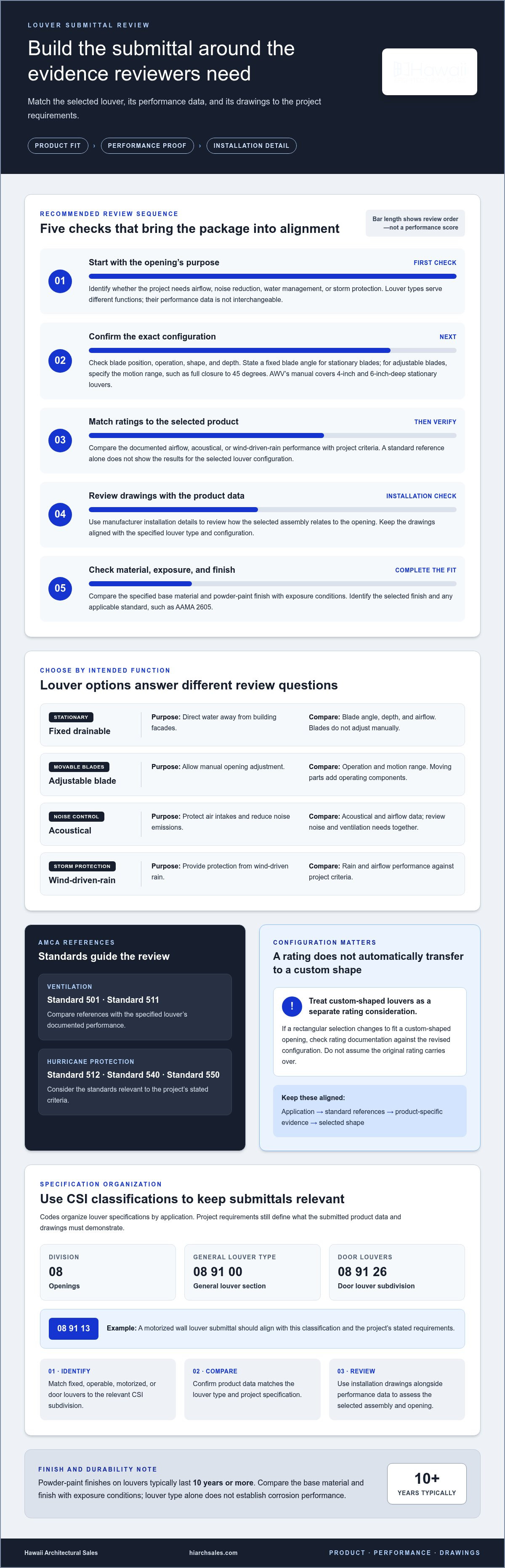
• Compare louver types by their intended function, then match the product data to the project’s airflow, noise-control, or rain-protection needs.
• Use applicable AMCA standards to understand what a rating supports, and treat custom-shaped louvers as a separate rating consideration.
• Make blade position and operation clear in the specification, distinguishing a fixed blade angle from an adjustable range of motion.
• Review installation drawings alongside performance data so the submittal package addresses both the selected louver and its installation details.
For materials and corrosion resistance, the product data identifies powder-paint finishes. Compare the specified base material and finish with the project’s exposure conditions; louver type alone doesn’t establish corrosion performance. Powder-paint finishes on louvers typically last 10 years or more. Include the selected finish and any applicable finish standard, such as AAMA 2605, in the specification.
AWV product data should identify how each louver type serves the opening. Fixed drainable louvers help direct water away from building facades. Adjustable-blade louvers allow manual positioning, while acoustical louvers are intended to protect air intakes and reduce noise emissions. Wind-driven-rain louvers are intended to provide storm protection. Because these options address different needs, their performance data is not interchangeable.
Option
Intended function
Data to compare
Practical trade-off
Fixed drainable
Drain water away from facades
Blade angle, depth, airflow
Stationary blades don’t adjust manually
Adjustable blade
Manual opening adjustment
Operation and motion range
Moving parts add operating components
Acoustical
Air intake protection and noise reduction
Acoustical and airflow data
Review both noise and ventilation needs
Wind-driven-rain
Storm protection
Rain and airflow performance
Match ratings to the project criteria
Choose by matching the louver’s intended function to the opening’s performance requirements, then compare the supporting data. For stationary blades, state the blade angle. For adjustable blades, state the motion range, such as full closure to 45 degrees. AWV’s manual covers 4-inch and 6-inch-deep stationary louvers, making depth another direct product-data comparison.
Each option has a distinct advantage and a review consideration. Drainable designs address water movement, while adjustable blades allow manual positioning. Acoustical and wind-driven-rain options target different performance needs. Selecting by product name alone can overlook critical criteria. Review blade configuration, depth, operation, finish, and relevant performance data together as part of the submittal.
AMCA standards and certified ratings
AMCA Standard 501 and AMCA Standard 511 are identified as common standards for ventilation louvers. Their presence in a specification helps define the standards relevant to review. It doesn’t, by itself, show the performance results for a selected louver. Compare the product’s stated ratings with the project requirements and the documentation submitted for that specific configuration.
For hurricane protection, include the applicable standards identified for that purpose: AMCA Standard 512, AMCA Standard 540, and AMCA Standard 550. The project’s criteria determine which ratings matter. Keep each standard’s identifier visible in the specification and compare it with the corresponding product documentation. That makes it easier to distinguish a required rating from a general reference to AMCA.
Ventilation
Review references to AMCA Standard 501 and AMCA Standard 511 against the specified louver’s documented performance.
Hurricane protection
Consider AMCA Standard 512, AMCA Standard 540, and AMCA Standard 550 when specifying louvers for this application.
Custom shapes
Treat shaped configurations separately because AMCA ratings don’t carry over to custom-shaped louvers.
This matters when the design changes. A rating for a standard configuration cannot automatically be assumed to apply after the louver shape changes. For example, if a rectangular selection is revised to fit a custom-shaped opening, check the rating documentation against the revised configuration. Keep the shape, application, and submitted performance information aligned.
Use a consistent review sequence: identify the application, record the applicable AMCA standard numbers, and compare the product-specific documentation with the required criteria. For ventilation, check the references to Standards 501 and 511. For hurricane protection, assess Standards 512, 540, and 550 as relevant to the project. Flag any custom shape for separate rating review instead of carrying over a rating by assumption.
This approach keeps standard references distinct from performance evidence. A clear submittal shows which AMCA standards apply and whether the rating information addresses the selected configuration. As product selections develop, architectural product options can be considered alongside the project’s documentation priorities.
Submittals and manufacturer documentation
CSI codes help organize louver specifications by application. Division 08 covers Openings, and section 08 91 00 identifies a general louver type. Subdivisions distinguish louvers by their operation and configuration. Door louvers are listed under 08 91 26.
These codes organize the specification, while project requirements define the review criteria. Approval depends on comparing the submitted product data and drawings with the specified louver type, operation, dimensions, and performance requirements. For example, a submittal for a motorized wall louver should align with the 08 91 13 classification and the project’s stated requirements.
Identify the category
Match fixed, operable, motorized, or door louvers to the relevant CSI subdivision.
Compare product data
Confirm the submitted configuration corresponds with the louver type and project specification.
Review drawings
Use installation details to assess how the selected assembly relates to the opening.
Manufacturer drawings add installation information that product data alone may not show. Drawing 900 covers standard louver installation methods. Drawing A900-1 covers standard installation methods for extensions and sill pans. Include the relevant drawing when those details apply to the specified assembly, and compare its conditions with project drawings.
A useful review sequence is to identify the CSI section, check that the product data matches the specified louver category, then compare applicable installation drawings. For a fixed louver, 08 91 19 provides the classification; drawing 900 can support review of standard installation methods. For extensions or sill pans, A900-1 provides the related installation reference. This keeps product, specification, and drawing information coordinated.
What wind load, water penetration, and structural test ratings apply to AWV louvers?
There isn’t one rating that answers all three questions. Compare wind-load, water-penetration, and structural-performance documentation separately against the project’s stated criteria. For hurricane protection, AMCA Standards 512, 540, and 550 are identified for specification consideration. The applicable evidence depends on the louver configuration and the performance requirements for its opening.
Wind-load review concerns the specified design pressure and the assembly’s documented structural performance. Water-penetration review concerns how the louver performs against the project’s rain criteria. Structural documentation addresses the assembly’s ability to meet specified structural demands. Keep these categories distinct: a document addressing one does not, by itself, answer the others.
Wind load
Compare the project’s required pressure criteria with the submitted louver documentation.
Water penetration
Match the rain-protection requirement to documentation for the selected louver type.
Structural performance
Review evidence for the specified assembly and its configuration.
Hurricane protection
Consider AMCA Standards 512, 540, and 550 in the specification review.
Configuration matters. AMCA ratings do not carry over to custom-shaped louvers, so a change in shape requires review of the rating evidence for that configuration. Do not treat a standard-shape rating as proof of performance for a custom-shaped opening. Keep the submitted shape, product data, and performance evidence aligned.
A practical review sequence starts with identifying the project’s wind, water, and structural criteria, then matching each criterion to supporting documentation. Confirm that the evidence corresponds to the selected louver and shape. Finally, identify any hurricane-protection standards cited in the specification and compare them with the submitted material. This keeps performance questions distinct and makes documentation gaps easier to spot.
Hawaii Architectural Sales supplies AWV architectural louvers, alongside other building-envelope products. For projects that also require window or door selections, its offerings include alternative framing systems and specialized architectural metal products. Keep those decisions separate from AWV louver ratings and submittal evidence: document each product according to its own project requirements.
Turn to Hawaii Architectural Sales when you’re considering these additional architectural offerings as part of the broader project. This is a practical next step for discussing product options, not a substitute for matching AWV documents to the specified louver. Contact Hawaii Architectural Sales to discuss your architectural product needs.
Move the Louver Review Forward
Use the submittal review to create a clear record of decisions, open items, and revisions. Tie the selected louver configuration to the documents reviewed so later design changes do not leave the team relying on outdated information. A review log can track each comment, its resolution, and the document revision that addresses it.
Before closing the review, align the approved product information with the project’s current drawings and specifications. This gives design and construction teams a consistent reference as the project advances. A structured process also helps identify when a revised selection needs another review.
If your project also involves architectural product selections, Hawaii Architectural Sales can help you consider its offerings alongside your broader project needs. For a next step, contact Hawaii Architectural Sales. Bring your priorities and project context to the conversation, and move forward with a more coordinated review of AWV louver submittal documents.
Frequently Asked Questions
What documents are typically required for an AWV louver submittal?
AWV louver submittal documents typically include product data, relevant performance documentation, and drawings for the scheduled louver. Identify the project specification and opening mark that each document supports. This creates a traceable package for projects in Honolulu, Lihue, Kailua-Kona, Kihei, and Lahaina, particularly when openings use different louver configurations.
Where can I download AWV louver product data and submittal sheets?
Use AWV’s product documentation for the selected louver to find its product data and submittal sheets. Organize AWV louver submittal documents around the chosen configuration rather than relying on a general brochure to represent every option. Keep product identification and document revisions with the project record so review materials remain organized.
What AWV louver sizes, models, and performance ratings are available?
AWV documentation covers different louver types, while the project schedule should identify the selected model and opening dimensions. Dimensions should correspond to the architectural opening, not just a general product description. Group each scheduled louver with its product identification and performance documents. This helps reviewers distinguish selections across openings without assuming one model or rating applies to all.
What airflow, pressure drop, and free area data are required for AWV louvers?
Provide airflow, pressure-drop, and free-area data so reviewers can compare the selected louver with the project’s ventilation criteria. Keep the stated airflow condition and louver configuration consistent, since changing either can affect how the figures apply. Tie each value to its schedule mark so reviewers can trace the data to the intended opening and distinguish it from other selections.
What installation details and shop drawings should an AWV louver submittal include?
Include drawings showing the louver’s position within the opening and relevant interfaces, such as extensions or sill pans when used. Compare those details with the project’s wall and opening drawings to confirm that dimensions and adjoining conditions align. Identify each drawing by its schedule mark to connect the installation detail to the correct louver.
What does AWV mean in AWV louver submittal documents?
AWV is the manufacturer name used for these louver products and their submittal documents.