Benefits of Translucent Daylighting in Schools and How Design Shapes Light
More daylight doesn’t have to mean more glare. The benefits of translucent daylighting in schools come from shaping light as carefully as bringing it in: translucent walls can diffuse daylight across interior spaces while preserving privacy and visual comfort.Window size, placement, glazing, and sha...
More daylight doesn’t have to mean more glare. The benefits of translucent daylighting in schools come from shaping light as carefully as bringing it in: translucent walls can diffuse daylight across interior spaces while preserving privacy and visual comfort.
Window size, placement, glazing, and shading all influence how daylight reaches desks and screens. A well-planned design can make classrooms feel brighter and more open without relying on direct sunlight as the only source of natural light.
This article explains how windows and translucent walls affect glare, light distribution, student alertness, attention, mood, and well-being. It also considers where diffused daylight can help, including interior areas that receive less light from conventional windows. The practical takeaway: daylighting works best when it balances natural light with the needs of each learning space.
Key Takeaways
• Balance window orientation, glazing, and shading to manage direct sun while maintaining useful classroom daylight.
• Consider how daytime light exposure may support students’ alertness and sleep-related rhythms.
• Assess daylight as part of the learning environment, including its potential influence on attention, mood, and well-being.
• Use translucent walls to distribute soft light into interior spaces where privacy and visual comfort also matter.
Window placement, size, glazing, and glare control
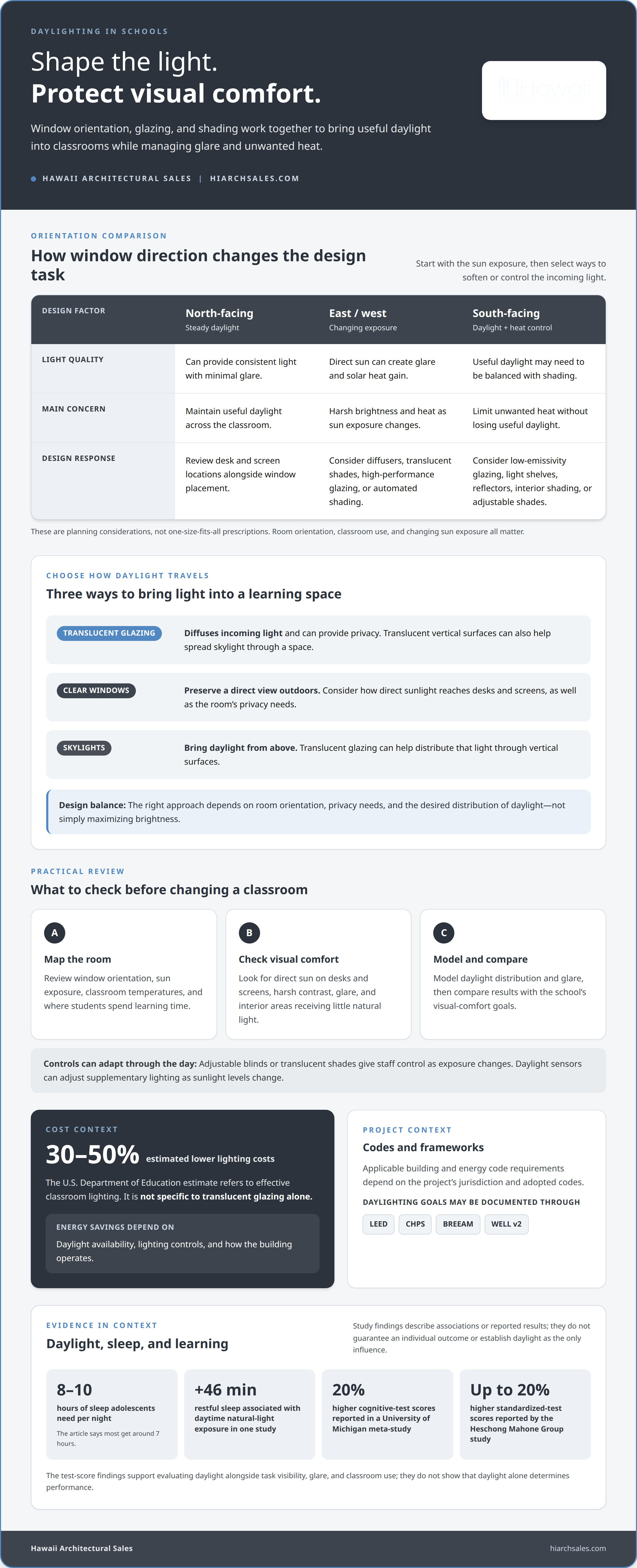
Classroom daylight depends on window orientation, glazing, and shading working together. North-facing windows can provide consistent light with minimal glare, while east- and west-facing exposures can create glare and solar heat gain.
Glare reduction strategies
Reducing glare involves window placement, light diffusion, and adjustable shading. Diffusers and translucent shades, for example, can soften direct sunlight that interferes with reading printed materials. High-performance glazing and automated shading can also limit harsh brightness. To anticipate glare, review window orientation, sun exposure, and classroom use throughout the day, then check whether desks and screens receive direct sunlight.
Solar heat gain management
Managing solar heat gain means limiting unwanted heat from sunlight while preserving useful daylight. South-facing windows may need shading, while low-emissivity glazing can admit light and help prevent overheating. Light shelves, reflectors, and interior shading can redirect or reduce incoming sunlight. Adjustable blinds or translucent shades give staff more control as exposure changes during the school day.
Translucent glazing diffuses incoming light and can provide privacy, while clear windows preserve a direct view outdoors. Skylights bring daylight from above; translucent glazing can spread it through vertical surfaces. The right approach depends on room orientation, privacy needs, and the desired distribution of daylight.
For U.S. schools, applicable building and energy code requirements depend on the project’s jurisdiction and adopted codes. Teams can also document daylighting goals through frameworks such as LEED, CHPS, BREEAM, and WELL v2.
Energy savings depend on daylight availability, lighting controls, and how the building operates. The U.S. Department of Education estimates that effective classroom lighting can lower lighting costs by 30-50%; that estimate is not specific to translucent glazing alone.
For a retrofit, assess existing window orientation, glare, classroom temperatures, and lighting use before choosing changes. Model daylight distribution and glare, then compare the results with the school’s visual comfort goals. The U.S. Department of Commerce, National Bureau of Standards, includes manufacture, installation, long-term operation, and maintenance when evaluating combined energy costs.
Circadian rhythms, sleep, and alertness
Daylight provides a daily signal that helps regulate circadian rhythms, the body’s internal timing system. Consistent natural light during school hours can support this rhythm, while classrooms lit mainly by artificial sources create a different daytime environment. Daylight exposure has also been associated with better-regulated student circadian cycles.
Sleep is one reason this matters. Adolescents need 8-10 hours of sleep per night to function properly, while most get around 7 hours. One study found that daytime natural-light exposure was associated with 46 additional minutes of restful sleep. These findings describe associations, not a guarantee that brighter classrooms will change an individual student’s sleep.
Architectural design influences how much daylight students receive throughout the school day. A translucent wall, for example, can carry diffused natural light through an interior surface to areas farther from exterior windows. This brings daylight into the learning environment without relying only on direct sunlight. The timing and distribution matter: a bright patch in one area is not the same as light spread across the occupied space.
Visual fatigue also depends on the quality and consistency of classroom lighting. Abrupt contrast between a bright window and a dim interior can make reading and screen work less comfortable. Diffused light, balanced artificial lighting, and controls that respond to changing daylight can help maintain more even visual conditions. Daylight sensors, for example, can adjust supplementary lighting as sunlight levels change.
For school projects, evaluate daylight alongside schedules and classroom activities. Map where students spend learning time, note which interior areas receive little natural light, and consider how artificial lighting can complement it. This makes daylight a deliberate part of the architectural plan, rather than an incidental result of window placement, and connects visual comfort with concentration and daytime alertness.
Daylight, attention, mood, and well-being
Daylight shapes more than brightness in educational facilities; it also affects how students experience learning spaces. Choices such as skylights, glazing, and translucent surfaces influence the quality and distribution of light.
Mood, stress, and anxiety
Daylight can support mood and well-being by connecting students with natural light and outdoor views. A bright, evenly lit classroom may feel more comfortable than one with harsh contrasts or little daylight. This matters during sustained schoolwork, when visual discomfort can add strain. Daylighting is an environmental design consideration, not a treatment for stress or anxiety.
A translucent surface, for example, can spread light through an interior area while maintaining privacy. Designers may consider this approach in corridors or shared learning spaces where clear views are not essential. In sustainable school design, the aim is to balance natural light with visual comfort, not to maximize brightness in every room.
Attention and academic performance
Daylight’s relationship with academic performance has been examined in student studies. A University of Michigan meta-study found students in classrooms with daylight scored 20% higher on cognitive tests. The finding links classroom conditions with test outcomes, but doesn’t establish daylight as the only influence on performance.
A Heschong Mahone Group study found students in classrooms with ample natural light scored up to 20% higher on standardized tests. For design teams, these results support evaluating daylight alongside task visibility, glare, and classroom use. Skylights and carefully selected glazing can contribute, but their placement and light distribution shape the actual visual experience.
Emotional well-being
Emotional well-being includes how students feel and function in the spaces where they learn. Natural light exposure has been linked to improved mood, productivity, and overall well-being. These connections make daylight relevant to school planning, alongside acoustic, thermal, and visual conditions.
Evaluate each space according to its purpose. A bright collaboration area may benefit from an outdoor view, while a private learning space may need diffused light. Translucent surfaces can help balance openness and privacy. This gives educational facilities a practical way to consider mood and comfort without treating glazing or skylights as stand-alone solutions.
Translucent walls and diffused daylight
Translucent walls use vertical surfaces to carry natural light beyond exterior windows. In schools, they can brighten corridors, stairwells, partitions, and interior courtyards while maintaining privacy between spaces. They are useful where a classroom or shared learning area needs daylight without a direct view through clear glazing.
Diffusion changes how daylight enters a room. Rather than forming a sharp sun patch, light spreads across a larger surface, which can help make visual conditions more even. Terrapin Bright Green’s 14 Patterns of Biophilic Design includes Pattern 6, “Designing With Diffuse Light.” That design principle connects diffuse daylight with spaces intended for people.
Placement determines whether a translucent wall serves an educational purpose. A partition between a daylit corridor and an interior room, for example, can pass light into a space without an exterior window. Light passing between a stairwell and corridor can also make shared areas feel more open. The design still needs to account for privacy, room use, and how much daylight reaches occupied areas.
What are the risks and maintenance requirements? Poorly controlled daylight can create glare or contribute to unwanted solar heat, so assess light distribution and temperature alongside privacy. Include routine cleaning and inspection in the building maintenance plan, since dirt or damage can affect light transmission and the wall’s condition.
Translucent daylighting complements rather than replaces windows and skylights. It can extend natural light into interior spaces and reduce reliance on artificial lighting during the day. This can support learning environments where windows alone do not distribute daylight effectively. Daylighting decisions should account for room use and lighting conditions, not simply add more luminous surface.
For a school project assessing translucent daylighting, explore daylighting options suited to the intended spaces and design goals.
Hawaii Architectural Sales
Hawaii Architectural Sales supplies architectural products for school projects where daylight, glazing, and visual comfort shape design decisions. For teams considering how windows contribute to classroom lighting, its ES | Prestige, ES | Elite, ES | uPVC, and Hopes offerings are options to consider within the broader building design.
The right choice depends on project priorities, including window placement, desired views, glare management, and how daylight should reach occupied spaces. Discussing these considerations alongside product options helps architects align glazing decisions with the school’s design intent.
Turn the benefits of translucent daylighting in schools into room-specific design priorities. Classrooms, corridors, and shared learning spaces may each need a different balance of natural light, privacy, views, and glare control. Defining those priorities early gives the project team a clearer basis for evaluating window and glazing choices.
Start with the intended experience: where should daylight reach, which areas need privacy, and how should the space feel during typical school activities? These decisions connect architectural goals with suitable product options. Hawaii Architectural Sales can help you consider its architectural offerings in light of your project’s design direction.
There is no single daylighting approach for every school. A focused discussion about the building’s priorities can help clarify the next design decisions. Contact Hawaii Architectural Sales to discuss architectural options for your school project and move your daylighting plans forward.
Frequently Asked Questions
What are the main benefits of translucent daylighting in schools?
Translucent daylighting can bring diffused natural light into spaces that receive little daylight from exterior windows. It can support privacy while making corridors, stairwells, and interior partitions feel brighter and more visually connected. In school design, its value depends on where light is needed and how each area is used. Pairing translucent surfaces with a deliberate lighting plan avoids treating daylight as a one-size-fits-all solution.
What research links daylighting to student attendance, mood, and behavior?
Research summarized on daylighting links classroom daylight with cognitive test performance, while reports also associate daylight-filled classrooms with improved mood and more positive behavior. These findings do not establish that daylight alone causes academic or behavioral changes. The available material does not identify a student attendance study, so an attendance effect cannot be stated here. For design decisions, consider daylight as one part of the broader learning environment.
How does translucent daylighting reduce glare, heat gain, and UV exposure in classrooms?
Translucent surfaces diffuse incoming light, which can soften bright contrasts that cause visual discomfort. Glazing, shading, and orientation also shape glare and solar heat entering a classroom. Polycarbonate translucent walls are described as using a coextrusion that resists UV rays; this should not be treated as a quantified guarantee of protection for occupants. Evaluate the complete assembly and room conditions when considering light, heat, and UV exposure.
What types of translucent daylighting systems are used in school buildings?
School designs can use translucent wall panels on façades, in partitions, and around corridors, stairwells, lightwells, lobbies, or interior courtyards. Polycarbonate panels are one example, with different colors, translucencies, and finishes available. Skylights and tubular daylighting devices are other ways to bring natural light into buildings, including some interior areas. The suitable system depends on the space, desired privacy, and how daylight should move through it.
What are the energy savings from translucent daylighting in schools?
Translucent walls can reduce the need for artificial lighting during the day, but savings depend on daylight availability, lighting controls, and building operation. The U.S. Department of Education estimates effective classroom lighting can lower lighting costs by 30-50%; this estimate is not specific to translucent glazing alone.