Best Window Frame Materials for Coastal Hawaii: Guide
The best material for window frames in coastal Hawaii depends on more than the frame itself. A suitable material can still fall short if the finish, hardware, seals, and complete window system aren’t matched to the project’s exposure.
Salt-laden air and moisture make durability an important consider...
The best material for window frames in coastal Hawaii depends on more than the frame itself. A suitable material can still fall short if the finish, hardware, seals, and complete window system aren’t matched to the project’s exposure.
Salt-laden air and moisture make durability an important consideration, but conditions vary from site to site. The island, distance from shore, building orientation, and design requirements all affect what a window system needs to address. Aluminum, uPVC, and other frame materials each involve trade-offs, so a simple “best” label can hide the details that matter.
This guide compares common frame-material categories using consistent criteria: coastal exposure, maintenance, design needs, and whole-system performance. You’ll also find a practical process for assessing options for a specific Hawaii project, plus an introduction to architectural window systems represented by Hawaii Architectural Sales. The goal is to help architects, developers, contractors, and owners make informed decisions based on the building’s conditions and requirements.
Key Takeaways
• Use a consistent framework to compare the best material for window frames in coastal Hawaii against your project’s exposure, design priorities, and documentation needs.
• Assess the site itself, including orientation and distance from shore, rather than treating an island or town as a measure of exposure.
• Compare complete window systems, including finishes, glazing, seals, drainage, hardware, and maintenance requirements, not just frame materials.
• Follow a five-step selection process to document priorities, evaluate options, and support clearer project decisions.
• Include Hawaii Architectural Sales’ ES Prestige, ES Elite, ES uPVC, and Hopes offerings in your product research.
Why coastal Hawaii changes the window-frame material decision
Choosing the best material for window frames in coastal Hawaii starts with the building site, not a statewide rule of thumb. Salt-laden air and moisture can affect exterior components and finishes. Wind, orientation, shelter, and building height also shape the conditions a window faces. These factors tell the project team what to evaluate, but they don’t automatically point to one frame material.
Honolulu, Lihue, Kailua-Kona, Kihei, and Lahaina illustrate the range of project locations across Hawaii. Even within the same town, a windward-facing opening, a sheltered courtyard, and an upper-floor window can face different conditions. Distance from shore provides context, but it doesn’t fully describe exposure. Assess the actual site and building design, and verify the environmental and code-related requirements for the project’s location and building type.
What does coastal exposure mean for a Hawaii window project?
Coastal exposure describes a set of project conditions, not simply a property near the ocean. Salt in the air and moisture can affect exterior frame components and finishes, so assess their suitability using relevant manufacturer documentation. Orientation and nearby buildings may shelter an opening or leave it more exposed. Building height can also influence conditions at a particular facade. These are project-specific considerations, not fixed thresholds.
Document what’s known about the site: which elevations face prevailing exposure, where nearby structures provide shelter, and how the building’s height and layout affect each opening. Confirm local code and environmental requirements for the specific project instead of relying on a general description of Hawaii’s climate.
Why is the frame only one part of the decision?
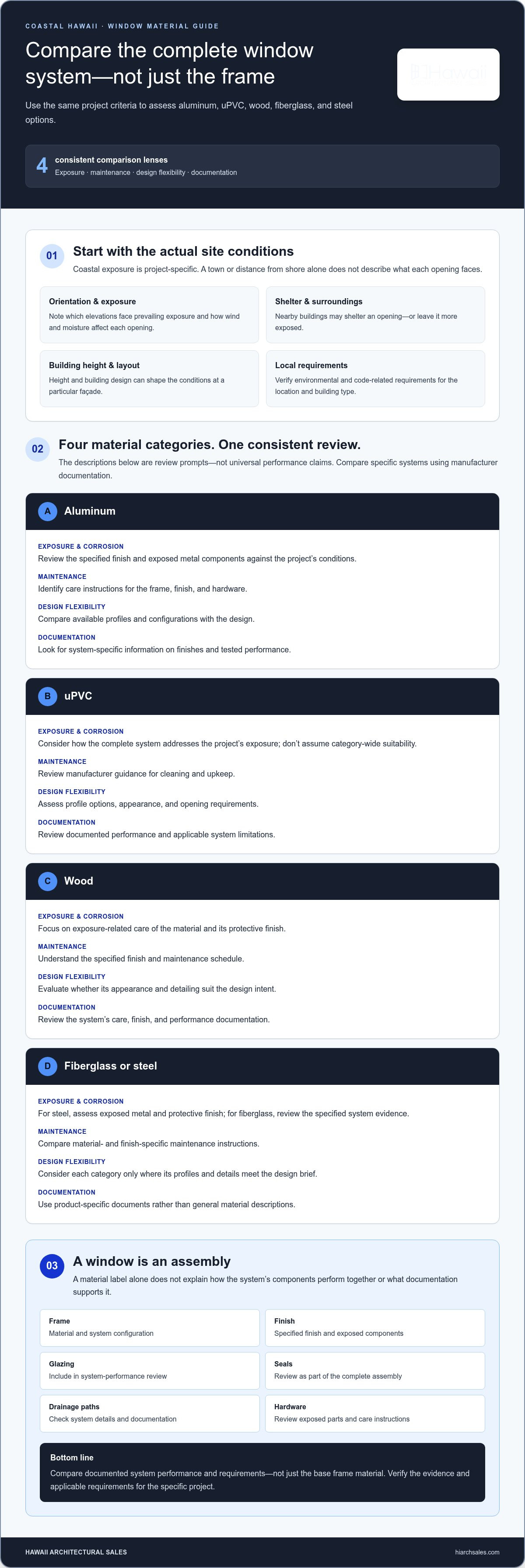
A window is an assembly. The frame and its finish work alongside glazing, seals, drainage paths, and hardware. A material label alone doesn’t explain how those components perform together or what documentation supports the complete system. For a broad overview of common categories, including wood, vinyl, aluminum, and fiberglass, see Window Frame Materials Overview.
Compare documented system performance and requirements, not just the base frame material. Identify what project documentation covers the glazing and assembled window, as well as how finishes, seals, drainage, and hardware are specified. The relevant evidence depends on the project and applicable requirements. Hawaii’s wind-related design considerations also make the complete assembly important; the Hawaii hurricane-rated window technical guide provides related context.
Quotable summary: The frame material is one decision. Documentation for the complete window system puts that choice in the context of the project.
Compare aluminum, uPVC, and other window-frame materials
No material category settles the question of the best material for window frames in coastal Hawaii on its own. Compare specific systems against the same project criteria, then use manufacturer documentation to separate verified performance from assumptions about a material. The table below is a starting point for that review.
Frame category
Corrosion considerations
Maintenance review
Design flexibility
Documentation to compare
Aluminum
Review the specified finish and exposed metal components against the project’s conditions.
Identify care instructions for the frame, finish, and hardware.
Compare available profiles and configurations with the design.
Look for system-specific information on finishes and tested performance.
uPVC
Consider how the complete system addresses the project’s exposure; don’t assume category-wide suitability.
Review manufacturer guidance for cleaning and upkeep.
Assess profile options, appearance, and opening requirements.
Review documented performance and applicable system limitations.
Wood
Focus on exposure-related care of the material and its protective finish.
Understand the specified finish and maintenance schedule.
Evaluate whether its appearance and detailing suit the design intent.
Review the system’s care, finish, and performance documentation.
Fiberglass or steel
For steel, assess exposed metal and protective finish; for fiberglass, review the specified system evidence.
Compare material- and finish-specific maintenance instructions.
Consider each category only where its profiles and details meet the design brief.
Use product-specific documents rather than general material descriptions.
Aluminum frames: evaluate the specified finish and assembly
Aluminum is a material category, not a guarantee of corrosion resistance. Consider the base material, finish, and exposed hardware separately, then review manufacturer documentation for the exact configuration. Compare finish information, maintenance instructions, design options, and system performance using the same criteria. Don’t apply a claim about one aluminum system to another without supporting documentation.
UPVC and other frame categories: compare project-specific trade-offs
Assess uPVC against the project’s appearance, maintenance priorities, and documented performance. Don’t assume every system performs alike in Hawaii’s conditions, including with respect to UV exposure or temperature-related movement. Wood, fiberglass, and steel may also be considered when they suit the design intent, but their suitability depends on the specified system and site. See the ES Prestige high-performance window systems guide for a separate system-focused discussion.
Material performance depends on the specified system, its documented components, and the conditions at the project site. A useful comparison records both the material category and the evidence for the specific configuration. Applicable project requirements matter as well. The International Code Council’s Hawaii Building Codes for Windows page provides code-adoption context. Confirm which requirements apply to the project’s location and building type.
For architects, developers, contractors, and owners comparing options, Hawaii Architectural Sales provides product representation and technical expertise for architectural systems. Explore its window-system product resources as part of a project-specific evaluation.
How to compare complete window systems for a coastal Hawaii project
Start a fair comparison with the exact window configuration under consideration, not a broad material label. Record what the manufacturer documents for the frame, finish, glazing, seals, drainage, and hardware, then compare those details against project priorities. This prevents a claim about one component from standing in for evidence about the whole assembly.
Use the same comparison matrix for each candidate system. Separate documented evidence from unanswered questions, and note which priorities matter most for each opening, such as design intent, site exposure, daylight, or maintenance. If a test, approval, or rating is cited, record what it covers and any stated limits. It isn’t proof of every performance outcome the project may require.
Specification item
Record for each system
Frame and finish
Material category, specified finish, supporting documentation, and care instructions.
Glazing
Specified glazing configuration and evidence relevant to project priorities.
Seals and drainage
Documented assembly details, maintenance guidance, and questions for the design team.
Hardware and connections
Exposed components, specified materials, and system documentation.
Performance evidence
Current test results, approvals, ratings, their scope, and stated limitations.
Which technical documents belong in the comparison?
Start with current manufacturer documents for the specific system, size, glazing, and configuration being evaluated. Record test results, approvals, ratings, and limitations as the documents state them. A result for one configuration may not describe another. Keep project-level questions visible in the matrix, including which Hawaii and county requirements the design team needs to confirm for the site and building type.
This evidence-based approach helps clarify which option best meets the project brief without treating a single certification as a blanket promise. It also gives architects, owners, and other stakeholders a shared reference when reviewing specifications or considering alternatives.
How do glazing and hardware affect the overall specification?
Evaluate glazing separately from frame material. Daylight and solar priorities can influence the glazing specification, so document the project’s goals and compare system-specific information rather than assuming the frame category determines the result. Similar considerations apply to residential projects across different climates; for instance, domestic specialists like Elite Glass & Windows illustrate how pairing tailored glass units with the right frame profiles ensures reliable long-term performance. Include exposed hardware and connection details in the coastal exposure review. Record the specified components and relevant documentation alongside the frame finish.
For a closer look at glazing considerations, the architectural glass systems guide for Honolulu adds context to a system-level review. Together, these checks help teams judge whether the documented assembly aligns with project needs. The best material for window frames in coastal Hawaii is therefore a decision informed by the complete specification, not a category name alone.
A practical material-selection checklist for Hawaii sites
A repeatable process turns site observations and design goals into a documented shortlist. Use these five steps for residential or commercial work, adjusting the detail to suit the project. The aim isn’t to choose a material by reputation. It’s to identify systems that fit the specific opening, project priorities, and verified requirements.
Define exposure.
Record the island, site orientation, building height, nearby shelter, and other project evidence describing conditions at each elevation. Ocean proximity provides context, but it doesn’t establish how exposed every opening is.
Set priorities.
List the project’s design intent, appearance, maintenance planning, daylight goals, intended use, and constraints. Note which needs are essential and which allow flexibility.
Compare complete systems.
Evaluate candidate configurations using the same criteria, including frame material, finish, glazing, seals, drainage, and hardware.
Review documentation.
Match current manufacturer information to the specific configuration under consideration. Keep code, approval, and wind-performance requirements separate from material preference, and have the design team verify which current requirements apply to the project.
Record decisions.
Capture the evidence reviewed, reasons for the shortlist, unresolved questions, and who will address them. This creates a clear basis for later specification decisions.
Build a site and project brief before comparing materials
Start with a concise brief for the openings being evaluated. Include the island and orientation, building use, exposure observations, design constraints, and priorities such as appearance, maintenance planning, daylight, or documented performance. Separate observations from assumptions. For example, describe a facade as partially sheltered rather than treating “near the coast” as a complete description.
Identify unknowns that need manufacturer documentation or review by the project team. These may include available evidence for a proposed configuration, whether a design priority can be met, or which local requirements apply. Keeping open items visible prevents an assumption from quietly becoming part of the specification.
Use evidence to narrow the shortlist
Compare systems only when the documentation relates to the configuration being considered. A side-by-side record should include material, finish, glazing, hardware, supporting evidence, and unresolved questions. Use the same categories for every candidate so differences are easy to assess and missing information remains clear.
The Hawaii architectural window distributor selection guide explains the distributor’s role in product research and technical coordination. For project-specific product representation and technical expertise, discuss your window-system requirements with Hawaii Architectural Sales. A clear brief makes that coordination more focused, whether you’re considering the best material for window frames in coastal Hawaii or refining a complete system specification.
Find a window-system partner for your Hawaii project
Turning a material shortlist into a project specification takes more than comparing frame categories. A manufacturer’s representative and distributor can help architects, developers, contractors, and owners find relevant product information, understand system options, and coordinate technical questions with manufacturer documentation. This support helps the team assess choices in the context of the building, its location, and its design priorities.
Hawaii Architectural Sales represents and distributes architectural products for residential and commercial projects. Founded in 1985, the company serves projects in Honolulu, Lihue, Kailua-Kona, Kihei, and Lahaina. Its window-system offerings include ES Prestige, ES Elite, ES uPVC, and Hopes.
What technical product support can contribute
Useful product support connects project priorities with information for the relevant system and configuration. A representative can help organize product research, clarify system options, and coordinate technical questions so the design team can review documentation in context. Keep performance claims tied to current manufacturer materials and the configuration they describe. This gives the team a disciplined basis for comparing options without promising a particular outcome.
Local project context matters, too. An opening in Honolulu may have different design constraints from one in Lihue or Kailua-Kona, and the project team remains responsible for establishing site conditions and applicable requirements. Sharing those details early can make product discussions more focused, whether the work is a new residential design, a commercial project, or a renovation with specific architectural constraints.
Move from material shortlist to project discussion
Before a discussion, gather a concise project brief. Include the project type and location, the openings or system category under consideration, design priorities, and any known requirements or documentation already reviewed. This gives product research a clear starting point and helps identify questions for technical coordination. It also keeps the conversation focused on the project rather than a general preference for one frame material.
Project context
Share the building use, location, and relevant site conditions.
Design intent
Note appearance, opening needs, and daylight priorities.
Performance priorities
Identify documented requirements and any known approval or code considerations for design-team review.
Open questions
List the system details or manufacturer information the team still needs.
This preparation helps move the question of the best material for window frames in coastal Hawaii toward a practical discussion of suitable systems and supporting information. Hawaii Architectural Sales provides product representation, technical expertise, and material distribution.
Move from a material preference to a clear project brief. Identify the openings under consideration, the conditions they face, and the priorities the selected system must address. Then match those needs with product information for the relevant configuration. This gives the design team a practical basis for deciding which option merits further development, rather than treating the best material for window frames in coastal Hawaii as a universal answer.
A focused product discussion can connect your project requirements with relevant architectural-system information. Bring your project type, location, design priorities, and any specifications or open questions you’ve already identified. Hawaii Architectural Sales can support product research and technical coordination as you refine the next step.
Is aluminum a good choice for window frames near the ocean in Hawaii?
Aluminum can be considered, but its suitability depends on the specified system, finish, exposed components, and project conditions. For a building near the ocean, review the manufacturer’s documentation for the exact finish and configuration rather than assuming the base material tells the full story. Also consider how the project team will maintain and inspect the frame. A well-documented option is easier to assess than a general claim about aluminum.
Can uPVC window frames be used in coastal Hawaii?
Yes, uPVC can be considered for coastal projects, but the material category alone doesn’t establish suitability. Compare the specific system’s documentation with the opening’s exposure, design requirements, and intended use. To assess the best material for window frames in coastal Hawaii, consider how the documented option fits the project rather than treating uPVC as a universal solution. Include appearance, cleaning guidance, and the manufacturer’s stated performance limits in the review.
What happens if salt air reaches window frames and hardware?
Salt deposits and moisture can contribute to corrosion on susceptible metal surfaces, including finishes and hardware. Over time, corrosion may affect appearance and, for moving components, operation. The effect depends on the material, protective finish, exposure, and care practices. For example, the design team can include exposed fasteners and moving hardware, as well as visible frame surfaces, in its maintenance review.
How do I compare aluminum and uPVC window frames for a Hawaii project?
Compare specific systems, not generic material labels. For each option, note the frame and finish, manufacturer care guidance, design fit, and documentation for the configuration being considered. Apply the same criteria to both materials, then mark missing information as an open item. This makes trade-offs easier to see, such as a design preference that calls for a different profile or a maintenance plan that affects long-term project operations.
Does the frame material determine whether a window is suitable for high-wind conditions?
No. Frame material alone doesn’t establish suitability for high-wind conditions. The relevant evidence applies to the complete window configuration and the project’s requirements, not simply to whether the frame is aluminum or uPVC. The design team should review documentation for the specific system and opening, then confirm applicable requirements for the building’s location and use. Don’t assume a rating or approval covers configurations beyond its stated scope.
Which window-frame material needs the least maintenance near the coast?
There isn’t a reliable universal ranking without comparing specific systems and their care instructions. Maintenance can depend on the frame finish, exposed hardware, cleaning access, and manufacturer guidance. Before selecting an option, review the routine cleaning and inspection required for the actual installation conditions. For a hard-to-reach upper-floor opening, for instance, access planning may matter as much as the material category when setting a realistic maintenance plan.
Are window frames and hardware affected differently by coastal exposure?
Yes. A frame and its hardware may use different materials and protective finishes, so their response to exposure and care needs can differ within the same window. Moving components also have operational considerations that fixed frame surfaces don’t. Review component-specific documentation and include hardware in maintenance planning. For projects in Honolulu, Lihue, Kailua-Kona, Kihei, or Lahaina, assess actual site conditions rather than assuming every opening faces the same exposure.