Building Envelope Systems Supplier in Honolulu for Product Support
In Honolulu, building envelope decisions need to account for the conditions products will face over time. A building envelope systems supplier in Honolulu can connect commercial project teams with product information and manufacturer resources to help architects, engineers, and contractors evaluate...
In Honolulu, building envelope decisions need to account for the conditions products will face over time. A building envelope systems supplier in Honolulu can connect commercial project teams with product information and manufacturer resources to help architects, engineers, and contractors evaluate suitable systems. Salt air, wind-driven rain, and thermal cycling can accelerate coating failures, corrosion, and joint fatigue in Hawaii.
Product selection is only one part of the work. Teams also need clear information to support design decisions and coordinate components across the project, particularly when envelope assemblies cover large areas.
This article explains what commercial product representation and technical support involve, which project factors shape product selection, and how to identify a practical next step. It also outlines how Hawaii Architectural Sales supports projects in Honolulu and across Hawaii.
Key Takeaways
• Clarify how product representation can support envelope-system selection and coordination across a commercial project.
• Identify the project information that helps architects, contractors, and owners assess product fit and technical needs.
• Compare suppliers by their commercial product focus and the support they bring to project teams.
• Review ES | Prestige alongside ES | Elite, ES | uPVC, and Hopes when considering represented options for your project.
When comparing suppliers in Honolulu, consider the product categories they represent, relevant commercial project experience, and customer feedback. Look for specific examples of product scope and project support, along with feedback about communication and technical responsiveness, rather than relying on a rating alone.
Lead times and shipping costs depend on the specified products, order scope, freight route, and delivery coordination. For a Honolulu project, align procurement timing with the construction schedule and account for how products reach the site.
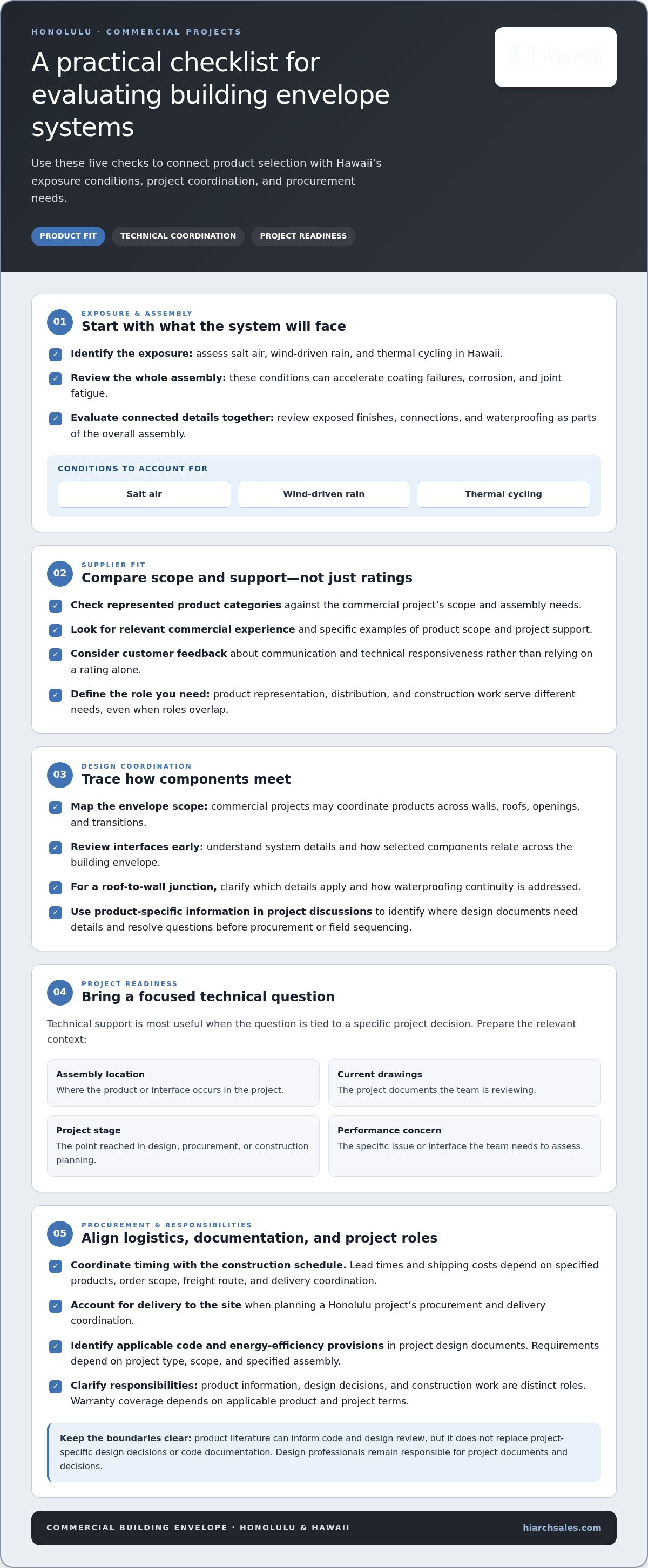
In Hawaii’s climate, assess envelope assemblies for exposure to salt air, wind-driven rain, and thermal cycling. These conditions can accelerate coating failures, corrosion, and joint fatigue. Review exposed finishes, connections, and waterproofing details together as parts of the overall assembly.
Product representation connects manufacturers’ systems with decisions by architects, engineers, contractors, and owners. Commercial projects may need coordinated products across walls, roofs, openings, and transitions. Clear product information is especially useful early, while teams define assemblies and consider how components relate across the building envelope.
Teams can review system details, understand component interfaces, and identify where design documents need product-specific information. A knowledgeable representative can make manufacturer information useful in project discussions. Design professionals remain responsible for project documents and decisions.
Consider the transition between a wall assembly and a roof. The team needs to understand how the selected products meet at the junction, which details apply, and how waterproofing continuity is addressed. Reviewing the specified assembly early can help resolve coordination questions before they affect procurement or field sequencing.
For architects and engineers, product representation can inform evaluation and specification development. Contractors can use product information to plan sequencing and coordinate trades, while owners can assess how proposed systems fit project priorities. Residential work may have different scope and coordination needs, so distinguish it from commercial procurement. Before comparing systems, define the assembly, exposure conditions, and project stage.
Technical support for architects, contractors, and building owners
Technical support makes product information more useful for project coordination. Architects can review system details alongside architectural drawings, and engineers can assess structural interfaces and enclosure continuity. Contractors can use the same information to plan sequencing around roofing, wall transitions, and exterior finishes. At a roof-to-wall junction, coordinated details help the roofing system and adjacent assemblies connect as intended.
Hawaii and Honolulu code and energy-efficiency requirements depend on project type, scope, and the specified assembly. The project team should identify applicable provisions in its design documents and assess how the proposed envelope addresses them. Product literature can inform that review, but it does not replace project-specific design decisions or code documentation.
Support is most useful when teams bring a specific question. Start with the assembly location, current drawings, project stage, and performance concern. An architect may need product details for an exterior condition; an engineer may need interface information for a structural transition; a contractor may need clarification about sequencing between trades. A focused discussion keeps the conversation tied to project decisions.
Product representation and technical coordination are distinct from design-of-record and installation. Warranty coverage depends on the applicable product and project terms, rather than being assumed as part of supplier support. Owners can clarify responsibilities by documenting who provides product information, who makes design decisions, and who performs construction work. For roofing, align the selected system with adjacent exterior details and finish requirements before procurement and field coordination. This gives each project partner a clearer basis for reviewing scope and resolving interface questions.
For complex, multi-trade building envelope programs, Native Technologies recommends design-bid-build when comprehensive documents, comparable pricing, and transparency for owners or lenders are priorities. This approach can help teams organize project information and scope around those needs. Consider it alongside the project’s specific design decisions and responsibilities.
Structural Systems is a licensed general engineering contractor in Hawaiʻi under license AC-13555. Teams can include this credential in discussions about project roles and coordination, while clarifying which parties are responsible for design decisions and construction work on the specific project.
Which suppliers in Honolulu offer building envelope systems?
For a commercial project, first identify whether you need product representation, product distribution, or construction work. These roles can overlap, but they serve different needs. A building envelope systems supplier in Honolulu may connect project teams with product information and manufacturer resources, while a distributor handles supply and a specialty contractor performs construction. Define the required role before comparing options.
Next, match represented products to the project scope. Envelope work can involve roofing, walls, openings, waterproofing, and transitions between assemblies. Consider how product information relates to the project documents and supports design coordination. A roof replacement, for example, may require attention to adjoining wall interfaces as well as the roofing product. Keep the request focused on the specified scope.
Iolani Court Plaza AOAO provides a local example of the breadth of exterior restoration work. Its 347-unit tower underwent property-wide spall repair, painting, waterproofing, and sealant replacement, completed in 2022. The example highlights the importance of separating product supply from restoration scope. A supplier’s represented products may address part of an assembly, while other project responsibilities remain with the relevant project participants.
Prepare a project brief that identifies the building type, assembly locations, design stage, and products under consideration. When comparing a building envelope systems supplier in Honolulu, match its product categories and technical information to that brief. Architects may need information for specification decisions, contractors may focus on procurement coordination and sequencing, and owners may assess how products fit the scope. Compare suppliers based on the role your project needs.
Which Honolulu suppliers specialize in commercial building envelopes?
Assess specialization by product scope, not by a supplier label alone. A commercial envelope project can involve roofing, walls, openings, waterproofing, and transitions between assemblies. Check whether the supplier’s product range addresses the assemblies shown in your drawings, then consider how its product information supports the architects, engineers, and contractors coordinating those interfaces.
Local experience can add useful project context. Alan Garduque, based in Honolulu, has over 30 years of experience in architectural and design project management positions. Jeremar Padilla, also based in Honolulu, has 20 years of experience in architectural and design project management positions. Those experience profiles illustrate the value of asking who will support project discussions and how their work relates to commercial design and coordination.
For a complex, multi-trade envelope program, define the procurement approach before comparing suppliers. Design-bid-build can help organize comprehensive project documents, comparable pricing, and transparency for owners or lenders. This approach is especially relevant when separate trades must coordinate across multiple assemblies. A supplier’s role remains distinct: product representation and technical information support decisions, while the project team manages design, procurement, and construction responsibilities.
Use a focused review process to determine whether a supplier fits:
Match scope
Compare represented product categories with the building’s specified envelope assemblies.
Review coordination
Look for product details that address connections between roofing, walls, openings, and waterproofing.
Identify support
Establish who will discuss product information with the architectural and construction teams.
Clarify responsibilities
Separate product representation from design authority and installation work.
For owners and project teams in Honolulu, Lihue, Kailua-Kona, Kihei, and Lahaina, these steps help distinguish commercial product specialists from suppliers with narrower scopes. Start with the assemblies, then compare the support relevant to each project stage.
Large commercial and institutional buildings in Kapolei may have air barrier assemblies spanning extensive areas. Confirm that the supplier’s product information addresses the specified air barrier assembly and its interfaces with adjacent envelope components. Keep the review tied to project drawings and the coordination support the team needs.
Hawaii Architectural Sales: ES | Prestige
Hawaii Architectural Sales supplies architectural products and represents manufacturers for teams evaluating commercial building envelope options in Honolulu and across Hawaii. Its represented lines include ES | Prestige, ES | Elite, and Hopes. The right product depends on the specified assembly and its role in the design, not simply its name. Architects can bring relevant drawings and performance priorities into product discussions; contractors and owners can use the project scope to focus the conversation. When your team has identified an envelope requirement, contact Hawaii Architectural Sales to discuss represented products for the project.
Move Your Honolulu Envelope Project Forward
Make the product discussion specific to your project. Before reaching out, identify the assembly under review, the project stage, and the details your team needs to resolve. This gives a building envelope systems supplier in Honolulu the context to discuss whether ES | Prestige, ES | Elite, or ES | uPVC fits the scope.
Hawaii Architectural Sales supplies these product lines for commercial building envelope projects. Architects can frame the discussion around specifications and design intent, while contractors and owners can identify the project questions that need product-level information. Bring relevant drawings and note the intended application, key interfaces, and decisions still pending. That context keeps the conversation connected to project documents and team priorities.
For product support and a discussion of your project, contact Hawaii Architectural Sales. A clear project brief is a practical place to begin, helping your team approach its next decision with greater clarity.
Frequently Asked Questions
What building envelope products do Honolulu suppliers provide?
Commercial product ranges can include windows and doors, translucent panels, skylights, architectural louvers, expansion joints, and custom metal. Hawaii Architectural Sales represents Kalwall translucent panels, Super Sky skylights, AWV louvers, and Balco expansion joints. Match each product to the assembly in the project documents, such as a skylight opening or an exterior joint, rather than treating every product as a complete envelope system.
What should buyers check when selecting a building envelope supplier in Honolulu?
Check that the supplier’s product categories align with the project specifications and that product documentation supports the team’s review. For a project in Honolulu, Lihue, Kailua-Kona, Kihei, or Lahaina, map proposed products to the project schedule and flag substitutions or unresolved interfaces for review. Also distinguish product supply and representation from design decisions and construction work, so each party’s project responsibilities remain clear.
How do Honolulu building envelope suppliers compare by products, experience, and customer reviews?
Compare suppliers by their represented product categories, relevant commercial project experience, and customer feedback on communication and technical responsiveness. Assess how their products and support fit the project scope rather than relying on a rating alone.
Which building envelope materials are best suited to Honolulu's climate?
Choose envelope assemblies suited to salt air, wind-driven rain, and thermal cycling. Evaluate exposed finishes, connections, and waterproofing details together, since these conditions can accelerate coating failures, corrosion, and joint fatigue.