The most premium-looking window or door is not automatically the strongest fit for a Lahaina project. Choosing a luxury window and door distributor in Lahaina means comparing product selection, custom finishes, authorized retailing, and hardware suited to coastal exposure. The right choice is the on...
The most premium-looking window or door is not automatically the strongest fit for a Lahaina project. Choosing a luxury window and door distributor in Lahaina means comparing product selection, custom finishes, authorized retailing, and hardware suited to coastal exposure. The right choice is the one that aligns the design intent with the project’s performance and specification needs.
Product range matters, as does how clearly each option can be matched to the openings, finish schedule, and architectural requirements. In a coastal setting, review the complete assembly and its documented product details rather than treating hardware as an afterthought. This guide explains how to compare options and custom configurations, and how distributor representation fits into the decision. Hawaii Architectural Sales offers window and door lines for projects in Lahaina and across Hawaii, including Honolulu, Lihue, Kailua-Kona, and Kihei.
Key Takeaways
• Compare finish and configuration choices against the project’s design intent and opening requirements.
• Assess product options by how well their appearance, function, and project specifications align.
• Understand how authorized brand retailing can support a more informed product comparison.
• Include coastal exposure and corrosion-resistant hardware in the specification conversation from the start.
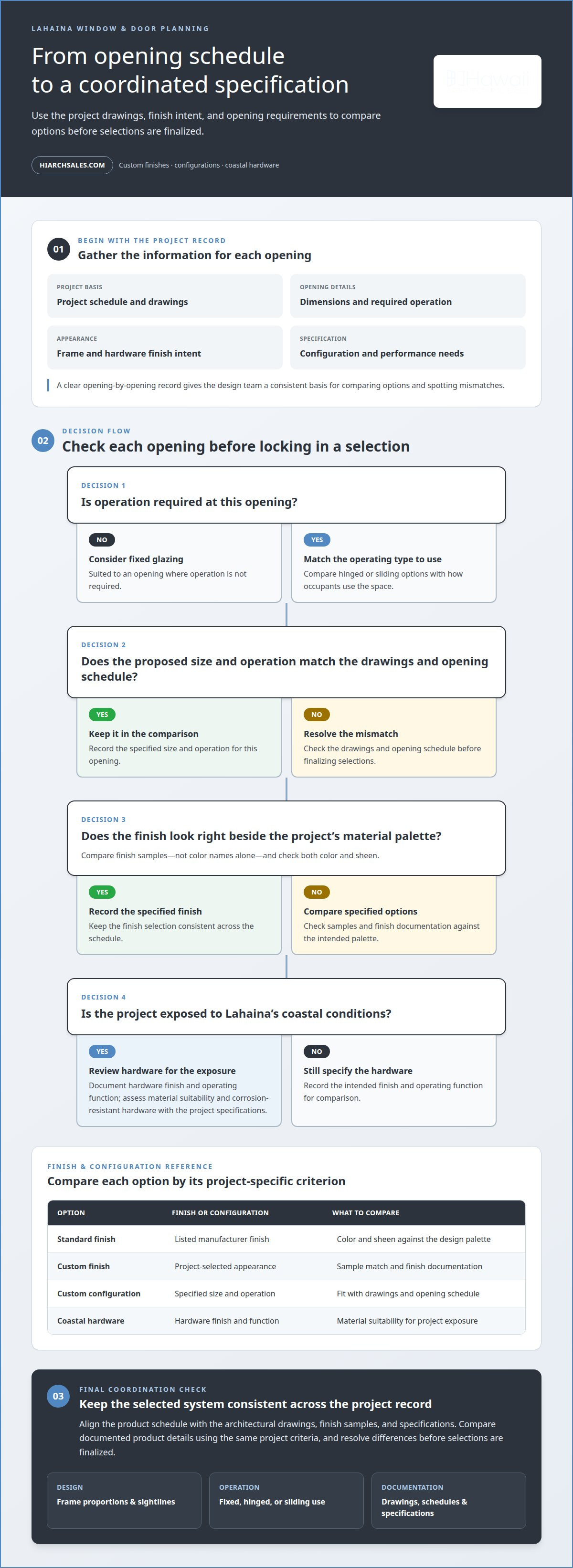
Start custom window and door planning with the project schedule, drawings, opening dimensions, and finish intent. Record each opening’s operation, frame and hardware finishes, and configuration requirements. This gives the design team a clear basis for comparing options and identifying mismatches before selections are finalized.
Finishes should be compared as specified options, not assumed equivalents. A color name alone may not describe sheen or appearance, so use finish samples alongside the project’s material palette. For coating requirements, check the project specifications and compare finish samples with the intended material palette. Hardware deserves the same attention: document the intended finish and operating function, especially for a Lahaina coastal project.
Option
Finish or configuration
Comparison criterion
Standard finish
Listed manufacturer finish
Color and sheen against the design palette
Custom finish
Project-selected appearance
Sample match and finish documentation
Custom configuration
Specified size and operation
Fit with drawings and opening schedule
Coastal hardware
Hardware finish and function
Material suitability for project exposure
Choose options that align with the drawings, finish samples, and operating needs, then keep those selections consistent across the schedule.
Are there Maui building codes or permit requirements for window and door replacement? Requirements depend on the project scope and property conditions. Confirm applicable permit requirements with Maui County before scheduling replacement work.
Which luxury window and door distributors serve Lahaina, Maui? Architectural sales distributors serving Maui are the relevant category. Compare their represented product lines against the project specifications.
Where are luxury window and door showrooms near Lahaina? Showroom access varies by distributor. Use finish samples and product documentation to assess selections when a local showroom is not part of the project process.
Do Lahaina window and door distributors offer delivery and installation? Product supply and installation are separate project scopes. Include delivery coordination and installation responsibilities in the project plan.
Which distributors handle custom sizes, hurricane protection, and historic properties? These needs depend on the product line and project requirements. Identify custom dimensions, protection criteria, and historic-property constraints in the drawings and selection schedule. Customer reviews can add context: look for comments about communication, finish coordination, and product selection on comparable projects.
Design and product selection
Begin with the design intent and the function of each opening. A Lahaina residence with broad ocean views may prioritize sightlines, while a shaded interior may emphasize daylight and ventilation. The product schedule should connect each opening to its operation, dimensions, appearance, and performance requirements. This gives the project team a consistent basis for comparing options instead of judging products by appearance alone.
Compare product categories against the drawings. Fixed glazing suits an opening where operation isn’t required; an operable window or door serves a different purpose. For a sliding door, consider the circulation path and how panel movement relates to furniture and adjacent openings. Review the manufacturer’s documentation for each option and confirm that the proposed configuration matches the opening schedule. Resolve differences before finalizing selections.
Design
Assess frame proportions, sightlines, and how the system relates to the building elevations.
Operation
Match fixed, hinged, or sliding configurations to how occupants use the space.
Documentation
Compare listed performance information and product details using the same project criteria.
Coordination
Record selections consistently across drawings, schedules, and specifications.
A distributor can organize product documentation so the design team compares equivalent information. Most competing window and door products provide a 10-year warranty, according to the market comparison. Review the written warranty’s coverage, exclusions, and duration alongside the proposed product, rather than treating the term as a complete measure of value.
How can a luxury window and door distributor help compare warranties and energy-efficiency ratings? The distributor can place warranty terms and available energy-efficiency ratings side by side for the selected products. The project team can then compare documented coverage and ratings against its design priorities and specifications.
For a Lahaina project, align the product schedule with the architectural drawings before selection decisions are complete. Explore architectural window and door options as part of that comparison.
Authorized brand retailing
For a Lahaina project, working with a distributor that represents specific product lines helps clarify the product source. Hawaii Architectural Sales represents architectural brands and supplies their products for residential and commercial projects. This relationship helps connect product information with the specified system, but it does not replace a review of project requirements, warranty terms, or product details.
Compare distributors by brand, product category, and the documentation available for each selection. A manufacturer’s authorization record should correspond to the specific brand being considered, not simply to a distributor’s general experience. A firm may represent one manufacturer for windows and another for doors. Keep those relationships distinct in the product schedule so the source of each proposed system is clear.
Representation
Match each proposed brand to its manufacturer and product category.
Documentation
Keep product literature, specifications, and warranty terms with the relevant selection.
Project fit
Compare the authorized product range with the drawings and opening schedule.
Coordination
Record the manufacturer and distributor consistently in project documents.
A clearly identified product source is useful when a Lahaina project requires a defined specification. It can help connect product information with the selected system, but it does not establish that the system suits every opening. The design team still needs to compare configurations, finishes, and documented performance with the project requirements.
Use a structured review before finalizing selections. First, identify the products and brands in the proposal. Next, connect each selection to manufacturer literature and its applicable warranty. Then compare those documents with the project schedule. If a proposal combines several brands, keep their specifications distinct rather than treating them as interchangeable.
For architects and owners, this process makes product comparisons more transparent. It also creates a clearer record for coordination among design, procurement, and construction teams. In Lahaina, identifying the specified product, its manufacturer, and the distributor representing it helps keep the selection process traceable.
Coastal durability and corrosion-resistant hardware
Lahaina’s coastal setting makes careful review of exposed window and door components important. Salt carried through coastal air can affect metal surfaces, finishes, and moving hardware. Evaluate the complete assembly, not only the visible frame. Hinges, locks, handles, rollers, and fasteners each have distinct functions and exposure.
Keep finish performance and hardware material as separate specification items. A coating requirement for a frame does not, by itself, describe the hardware. The cited coating reference is AAMA 2605-3 sections 5.0 and 5.2. Compare product documentation against the project specification, and keep the hardware finish and component details in the same schedule.
Frame coating
Record the specified coating requirements and the documentation supporting them.
Hardware
Identify each component, its material or finish, and its role in operation.
Exposure
Note whether components sit in sheltered areas or face direct coastal conditions.
Coordination
Match the hardware schedule to each opening and operating configuration.
A sliding door and a hinged entry door, for example, use different operating hardware. Their schedules should identify rollers or hinges, locking components, and finish selections separately. This helps the design team compare relevant details rather than assuming every component shares the frame’s finish specification.
Use a consistent review sequence: identify exposed components, record specified materials and finishes, then compare those entries with product documentation. This makes omissions easier to spot during specification coordination. It also gives the project team a clearer basis for discussing coastal suitability without assuming that a premium appearance alone establishes durability.
For Lahaina projects, include corrosion resistance in product discussions before the hardware schedule is finalized. Discuss coastal window and door specifications in relation to the project’s openings and exposure.
Hawaii Architectural Sales
Hawaii Architectural Sales offers architectural window and door options for projects comparing product selection, finishes, and coastal considerations. Its offerings include ES | Prestige, ES | Elite, ES | uPVC, and Hopes. These options give Lahaina project teams product lines to consider alongside their drawings, opening schedules, and design priorities.
Turn to Hawaii Architectural Sales when narrowing product choices for a new project or replacement scope. Start by identifying the openings involved and the priorities that matter most, such as configuration, appearance, or documented product details. This helps connect project requirements with relevant offerings.
Use the product decision as a coordination point for the next design phase. A clear selection record helps align the project team around intended products before procurement details are finalized. For a Lahaina project, a luxury window and door distributor can help connect product options with the architectural direction and project requirements.
Hawaii Architectural Sales offers ES | Prestige, ES | Elite, and ES | uPVC. These product lines provide starting points for a project discussion, while the right fit depends on the openings and design priorities. Bring the project drawings and selection goals to Hawaii Architectural Sales to keep decisions grounded in the actual scope.
Move forward with a defined set of priorities, then discuss the product options that fit them. Contact Hawaii Architectural Sales to discuss your Lahaina window and door project. A focused conversation can help you take the next selection step with clarity.
Frequently Asked Questions
What luxury window and door brands are available in Lahaina?
Hawaii Architectural Sales offers window and door brands including ES | Prestige, ES | Elite, ES | uPVC, and Hopes. These options serve projects in Lahaina and across Hawaii, including Honolulu, Lihue, Kailua-Kona, and Kihei. For a project team comparing a luxury window and door distributor in Lahaina, the relevant brand choice depends on the specified openings and design requirements.
Where are luxury window and door showrooms near Lahaina?
Showroom access varies by distributor. Use finish samples and product documentation to assess selections when a local showroom is not part of the project process.