Hawaii Architectural Product Lead Times: Planning Guide
Lead times for architectural products Hawaii projects rely on depend on more than a factory estimate. Product configuration, specification decisions, submittal reviews, freight coordination, and the planned delivery sequence all affect procurement planning. Mainland assumptions may leave gaps betwee...
Lead times for architectural products Hawaii projects rely on depend on more than a factory estimate. Product configuration, specification decisions, submittal reviews, freight coordination, and the planned delivery sequence all affect procurement planning. Mainland assumptions may leave gaps between approval, shipment, and the milestone when a product is needed on site, so identify the project destination and delivery requirements early.
Unresolved specifications and approvals can complicate construction schedules, especially when several project teams need to coordinate decisions. Mapping those dependencies early helps connect procurement milestones to design reviews and construction sequencing.
This guide explains the main factors that shape architectural product timelines in Hawaii and offers practical ways to compare options without relying on unsupported date estimates. It covers specifications, submittals, and delivery planning, including for projects in Honolulu, Lihue, Kailua-Kona, Kihei, and Lahaina. Hawaii Architectural Sales provides product expertise and Full technical support to architects, engineers, and contractors planning residential and commercial building-envelope projects across Hawaii and the Pacific region.
Key Takeaways
• Lead times for architectural products Hawaii projects depend on product requirements and coordination needs, not one standard timeline.
• Map procurement from requirement definition through delivery. Assign owners for decisions, reviews, and information handoffs.
• Compare windows and doors, daylighting, louvers, expansion joints, and custom metal by documenting the coordination questions specific to each category.
• Use a milestone checklist to track required documents, revisions, decision owners, and links to the construction schedule.
• Product expertise, custom architectural solutions, and Full technical support from Hawaii Architectural Sales help teams coordinate product information with project requirements.
What Determines Lead Times for Architectural Products in Hawaii?
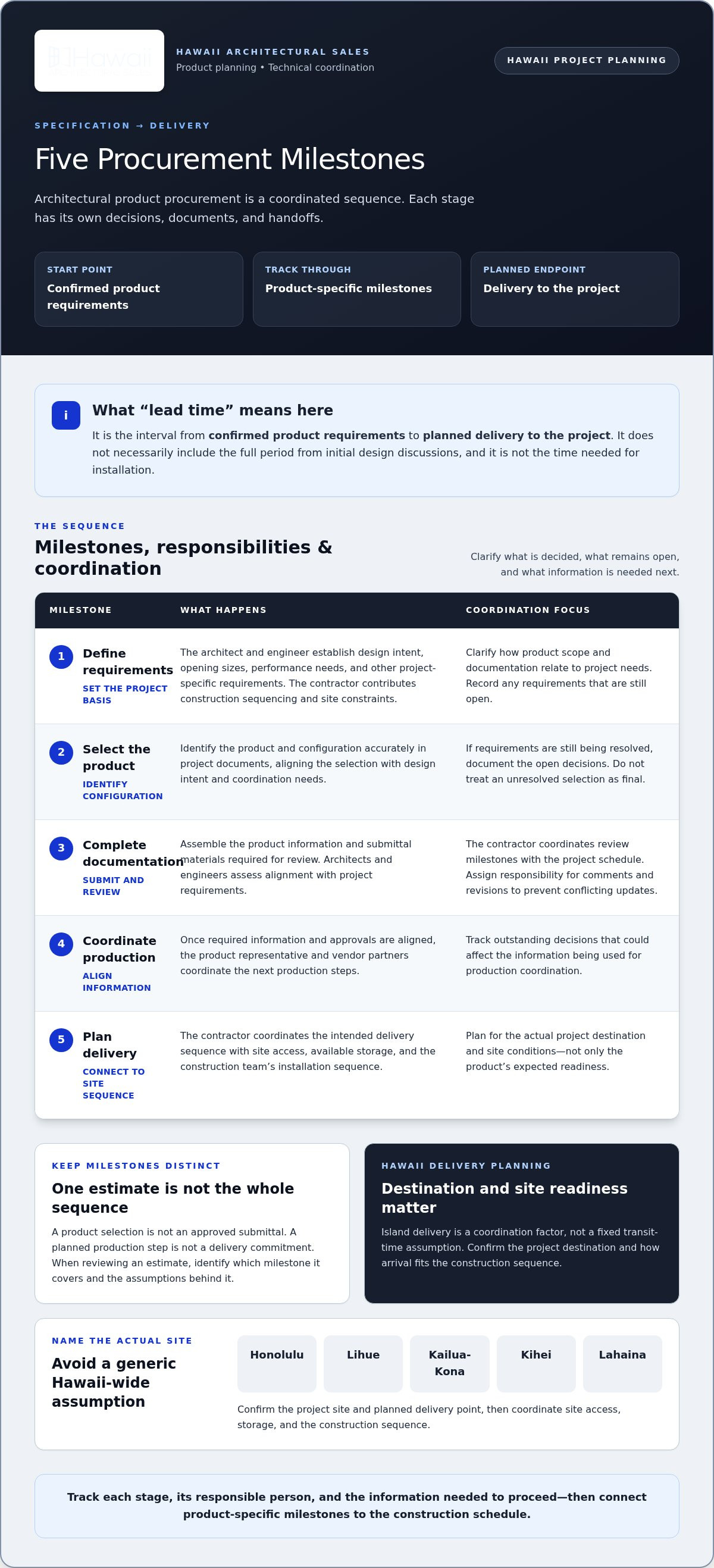
For project planning, lead time is the interval from confirmed product requirements to planned delivery to the project. It does not necessarily include the full period from initial design discussions, and it is not the same as the time needed for installation. A useful way to manage lead times for architectural products Hawaii teams can apply is to track product-specific milestones separately, then connect each one to the construction schedule.
Product requirements shape the sequence. A standard selection, a configured product, and a custom architectural solution can involve different decisions and documentation. Submittal review, production coordination, shipping arrangements, and site readiness also affect different stages. For example, a specification revision may change the information required for production, while the destination and site access plan affect how delivery is coordinated.
Why a single lead-time number can mislead project teams
A single figure can blur separate milestones: product selection, specification, submittal review, production, and delivery. When reviewing an estimate, identify exactly which milestone it covers and the assumptions behind it. A schedule for one product configuration should not automatically be applied to another, particularly when a custom architectural solution involves project-specific requirements or documentation.
Use an early planning estimate to coordinate decisions, then tie project delivery milestones to a product-specific schedule based on confirmed requirements.
Record each stage, the person responsible, and the information needed to proceed. This makes it easier to locate the source of a schedule question: an open product requirement, a document review, production planning, or delivery coordination. The broader principles of Supply Chain Management apply because procurement connects decisions and handoffs from sourcing through delivery, rather than relying on one isolated date.
How Hawaii project location shapes delivery planning
Island delivery is a coordination factor, not a fixed transit-time assumption. The project destination and the way arrival fits the construction sequence both matter. Honolulu, Lihue, Kailua-Kona, Kihei, and Lahaina are distinct destinations, so identify the actual project site and planned delivery point instead of applying a generic Hawaii-wide assumption.
Hawaii Architectural Sales supports projects across Hawaii and the Pacific region. Its 15+ supply partners worldwide describe the breadth of its partner network, not an expanded sales territory. For project teams, the practical questions are whether product requirements are settled, required documents align with the schedule, the delivery destination is clear, and the site is ready to receive the product when planned. Resolving these dependencies early helps teams compare options without relying on unverified dates.
How Architectural Product Procurement Moves from Specification to Delivery
Architectural product procurement works best as a coordinated sequence. Information and decisions pass between the design team, contractor, product representative, and vendor partners. At each handoff, clarify what has been decided, what remains open, and what information is needed next. This gives teams a concrete basis for coordinating lead times for architectural products Hawaii projects require without relying on a generic duration.
The procurement stages are requirement definition, product selection, documentation and review, production coordination, and delivery planning. These stages connect, but they are not interchangeable. A product selection is not an approved submittal, and a planned production step is not a delivery commitment.
Define requirements.
The architect and engineer establish design intent, opening sizes, performance needs, and other project-specific requirements. The contractor contributes construction sequencing and site constraints. A product representative can help clarify how the product scope and documentation relate to those needs.
Select the product.
Identify the product and configuration accurately in project documents. Align the selection with design intent and the information needed for coordination. If requirements are still being resolved, record the open decisions rather than treating the selection as final.
Complete documentation.
Assemble the product information and submittal materials required for review. Architects and engineers assess alignment with project requirements, while the contractor coordinates review milestones with the project schedule. Assign responsibility for comments and revisions to prevent conflicting updates.
Coordinate production.
Once the required information and approvals are aligned, the product representative and vendor partners coordinate the next production steps. Track outstanding decisions that could affect the information being used.
Plan delivery.
The contractor coordinates the intended delivery sequence with site access, available storage, and the construction team's installation sequence. Plan for the project destination and site conditions, not only the product's expected readiness.
Start with complete requirements. For a window or door package, the schedule should communicate relevant opening sizes, design intent, performance needs, and project-specific requirements. Avoid broad descriptions when the project calls for a particular product or configuration. Accurate product names help keep drawings, schedules, and submittal records aligned.
Incomplete or changing specifications may require teams to revisit selections, documentation, or coordination decisions. A revision is a schedule dependency to track, not proof that a delay will occur. Record what changed, who needs to review it, and whether related documents or milestones need updating.
Early coordination connects product decisions to the construction sequence before they become urgent. Hawaii Architectural Sales works with architects, engineers, contractors, and vendor partners on product expertise and custom architectural solutions. Teams can coordinate architectural product requirements with Hawaii Architectural Sales as specifications and documentation develop.
How Lead-Time Factors Differ Across Hawaii Architectural Product Types
Product categories create different coordination questions, even within the same project. A window package may depend on opening sizes and configuration decisions, while a specialty system may need closer alignment between design intent, documentation, and adjacent construction. To compare lead times for architectural products Hawaii teams should track the dependencies behind each option rather than assume every category follows the same schedule.
Use the table as a planning tool. It compares coordination factors and questions to resolve, not delivery dates or product availability. Final schedules depend on confirmed, product-specific requirements.
Product category
Planning dependencies
Questions to resolve
Windows and doors, including custom configurations, high-performance frames, and architectural steel options
Opening sizes, configuration, project specifications, and product documentation
Are dimensions and design intent coordinated? Which product and configuration are specified?
Daylighting, including Kalwall and Super Sky
Project-specific design intent and coordination with surrounding building elements
What design information and documentation need alignment before procurement planning?
Louvers
Specified requirements, location in the design, and coordination with adjacent work
Are project requirements and related details clearly documented?
Expansion joints
Project details, interfaces, and coordination across relevant building areas
Which design and construction details affect selection and documentation?
Custom metal and other commercial categories, including AWV, Balco, Clover, and SeaWin
Project-specific scope, design coordination, and documentation needs
What information defines the scope, and which team members need to review it?
Windows, doors, and large architectural openings
For windows, doors, and large openings, compare how clearly each option aligns with the opening schedule, project specifications, and design intent. Consider various residential and commercial product lines during selection. Keep the product name and configuration consistent across drawings, schedules, and submittal records so reviewers are working from the same scope.
Include the product’s documented performance features in the comparison. Hawaii Architectural Sales offers windows and doors with double-glazing or triple-glazing options, thermal breaks, and superior sealing systems, designed for energy efficiency, insulation, and lower energy bills. Review the product information alongside project requirements so the selected option is clearly represented in the specification and submittal.
Daylighting and specialty building-envelope systems
Daylighting and specialty systems call for focused coordination between the intended design and project documentation. For Kalwall and Super Sky, identify the design decisions and adjacent conditions that need to be resolved for planning. Commercial project discussions may also involve louvers, expansion joints, AWV, Balco, Custom Metal, Clover, or SeaWin. Compare each category against its documented scope rather than assumed timelines.
For a useful comparison, record open decisions and documentation dependencies beside each product option. Align those items with project review and procurement milestones. This gives architects, engineers, and contractors a consistent basis for assessing options while keeping delivery expectations tied to a verified, product-specific schedule.
How to Build a More Reliable Hawaii Product Procurement Schedule
A dependable procurement schedule makes product decisions visible before they become urgent. For lead times for architectural products Hawaii projects depend on, build the plan around confirmed requirements, review milestones, production coordination, and the actual delivery destination. Assign an owner to each decision and record what information must be complete before the next step can proceed.
Set procurement milestones before construction sequencing is fixed
During design development, align product selection and specification milestones with design reviews and construction planning. Name who prepares, reviews, and approves each document, then record the decision date needed to support the project sequence. When a specification changes, log the revision and identify every drawing, schedule, or submittal that needs to reflect it.
Use a milestone checklist that project teams can update as requirements become clearer:
Design development
Identify product categories, design intent, opening sizes, and project-specific requirements. Assign responsibility for resolving open decisions.
Product selection
Record the selected product and configuration in project documents. Note any information still needed to finalize the scope.
Submittal preparation
List required product documents, the person responsible for assembling them, reviewers, and approval responsibilities.
Review and revision
Set review milestones and revision deadlines. Track comments, decisions, and document updates in one consistent record.
Production coordination
Tie production planning to confirmed requirements and relevant project approvals. Record dependencies that could affect the planned sequence.
Delivery coordination
Set the destination, receiving responsibility, site-readiness checkpoint, and intended place in the construction sequence.
Build contingency from verified project information, not a standard buffer applied to every product. Identify unresolved approvals, pending design decisions, or delivery plans that depend on site access. Record the possible schedule impact of each open item and update the plan when it is resolved. This helps teams respond to actual conditions without presenting an unverified date as a commitment.
Coordinate island delivery with site and project teams
Delivery planning should specify where the product is expected, who will receive it, what access or storage arrangements are needed, and how arrival relates to construction sequencing. Align these details with the contractor’s schedule and the person responsible for site readiness. Honolulu, Lihue, Kailua-Kona, Kihei, and Lahaina are distinct destinations, so do not copy a logistics assumption from one project to another.
Keep delivery expectations connected to the current project schedule. If the destination, access plan, or receiving responsibility changes, update the coordination record and communicate the revision to the relevant project participants. Clear ownership helps prevent a product milestone from being mistaken for a site-ready milestone.
How Hawaii Architectural Sales Supports Product Planning and Coordination
Architectural procurement involves more than selecting a product. Teams also need to align design intent, product documentation, project milestones, and delivery planning. As a distributor and manufacturer’s representative, Hawaii Architectural Sales works with architects, engineers, contractors, and vendor partners to support product decisions. The company supplies and represents architectural products, including windows and doors, daylighting systems, louvers, expansion joints, and custom metal. It does not provide installation or general contracting.
This coordination helps project teams assess lead times for architectural products Hawaii projects require without relying on a general estimate. Product expertise, custom architectural solutions, and full technical support help teams organize product information around project-specific requirements. Hawaii Architectural Sales focuses on high-value solutions with durable and efficient products. The goal is clearer planning, not a promised delivery date.
Coordinate product selection with project-specific requirements
Early discussion connects a product category to the project’s design intent and documentation needs. For a residential project, that may mean coordinating window and door selections with project specifications. A commercial project may involve several building-envelope categories and more reviewers. In either case, aligning scope and documentation early supports informed decisions about durable, efficient products and high-value solutions.
Hawaii Architectural Sales represents product lines including ES | Prestige, ES | Elite, ES | uPVC, ES | Legacy, Euro-Wall, Hopes, ES, Kalwall, Super Sky, AWV, Clover, Balco, Custom Metal, and SeaWin. Product expertise helps teams understand how a selection fits project requirements and what information needs to stay aligned as design documents develop. For windows and doors, options include double or triple glazing, thermal breaks, and superior sealing systems designed for energy efficiency, insulation, and lower energy bills. Where a project calls for a custom architectural solution, early coordination can surface decisions and documentation dependencies while the team can still incorporate them into planning.
Connect product expertise to Hawaii project delivery
Product planning must reflect the project context. A residential or commercial project in Honolulu may have different delivery coordination needs from work in Lihue, Kailua-Kona, Kihei, or Lahaina. Hawaii Architectural Sales supports projects across Hawaii and the Pacific region, helping project teams coordinate product information with their construction and delivery planning.
The company’s 15+ supply partners describe a worldwide partner network, not an expanded sales territory. That network supports product selection across building-envelope categories, while project decisions remain grounded in the specific requirements and destination. Hawaii Architectural Sales has served the industry since 1983 as a window and door manufacturer, bringing product experience to its current distributor and representative role.
The Four Seasons Resort Maui is one example of a Hawaii project associated with the company. Project examples provide context for its work, but every procurement schedule still depends on the product and project requirements at hand. For a related explanation of how a distributor supports product selection and coordination, consult the architectural window distributor guide.
Bring product requirements into project planning while design decisions can still be coordinated. A clear record of scope, open questions, documentation responsibilities, and delivery dependencies gives the team a practical basis for procurement decisions. Planning lead times for architectural products Hawaii projects require is more useful when expectations are tied to the selected product and project milestones rather than a generic date.
Hawaii Architectural Sales brings product expertise and Full technical support to project teams. Since 1983, the company has built experience as a window and door manufacturer, supported by a worldwide network of 15+ supply partners. Its high-value solutions include durable and efficient products and custom architectural solutions that help architects, engineers, and contractors connect product choices with project-specific requirements.
How long do architectural products take to arrive in Hawaii?
There’s no single arrival period that applies to every product or project. Lead times for architectural products Hawaii teams plan around depend on confirmed product requirements and schedule assumptions. For a useful working date, distinguish when a product is expected to be ready from its planned arrival at the project. Track those milestones separately so a change to one does not silently reset the other.
What affects lead times for architectural products in Hawaii?
Configuration, custom requirements, revisions, documentation, production planning, destination, and receiving readiness can all shape the schedule. For projects in Honolulu, Lihue, Kailua-Kona, Kihei, or Lahaina, make the destination explicit in the procurement record rather than labeling it only “Hawaii.” Track open items alongside the person responsible and the milestone each item affects. This helps show whether a schedule change relates to a product decision, project review, or delivery coordination.
Do custom architectural products take longer than standard products?
Custom products may involve more project-specific design decisions and coordination than a standard selection, but the difference is not a universal time penalty. A custom opening or daylighting system, for example, may call for different drawing details and review participants. Compare the documentation and approval path for the specified product, then use its confirmed schedule for planning. The word “custom” alone cannot establish when an item will arrive.
When should architects specify architectural products for a Hawaii project?
Specify products early enough for the chosen category to inform related design documents and procurement planning, before those documents are treated as settled. The right point varies with project scope and product complexity. A practical marker is whether the team can name the intended product, identify outstanding decisions, and assign responsibility for resolving them. This gives architects, engineers, and contractors a shared reference as the project advances.
How can a project team reduce architectural product schedule delays?
Teams can improve schedule visibility by keeping one current record of product decisions, document revisions, responsible reviewers, and milestone impacts. If a drawing revision changes an opening or product scope, record the affected documents and route the update to people relying on earlier information. Pair that change log with the receiving plan, especially for a site with limited storage or tightly sequenced work. These steps help manage risk, but they do not guarantee delivery.
Does Hawaii Architectural Sales install architectural products?
No. Hawaii Architectural Sales is a specialized manufacturer’s representative and distributor, not an installation or general contracting provider. Its role includes product supply and representation, along with Full technical support for project teams. The contractor and project team coordinate installation within the broader construction plan. Architects, engineers, contractors, and developers can work with HI Arch Sales on product requirements and technical coordination while keeping installation responsibilities clearly assigned.