High Performance Glazing in Honolulu: A Technical Guide for Architects
In Honolulu, a window isn't just a design choice; it's a high-stakes engineering decision where the wrong specification leads to structural degradation or astronomical cooling costs. Architects often struggle to balance the desire for expansive, transparent views with the brutal reality of Hawaii’s...
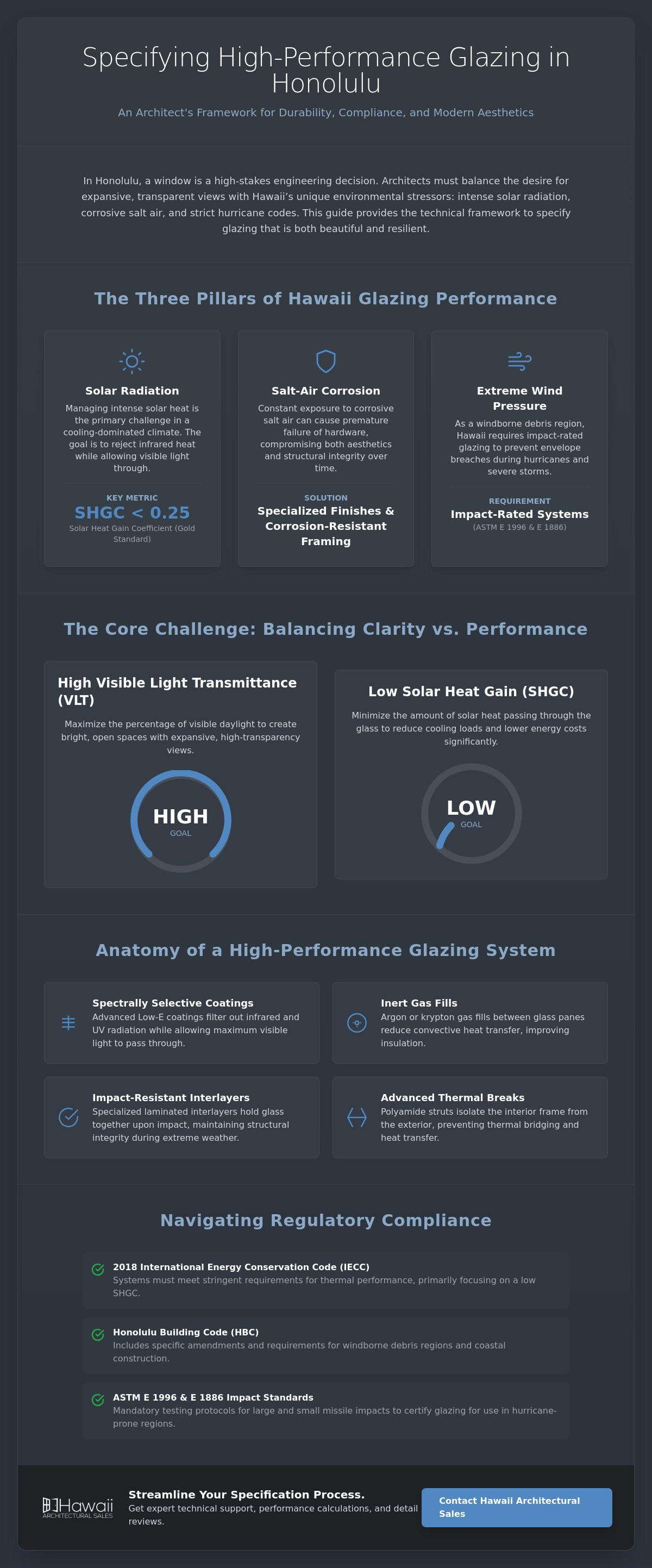
In Honolulu, a window isn't just a design choice; it's a high-stakes engineering decision where the wrong specification leads to structural degradation or astronomical cooling costs. Architects often struggle to balance the desire for expansive, transparent views with the brutal reality of Hawaii’s solar radiation, corrosive salt air, and strict hurricane codes. You shouldn't have to sacrifice a modern aesthetic to meet the 2018 International Energy Conservation Code (IECC) or survive a major wind event. Finding the right balance requires a deep understanding of localized environmental stressors and evolving building regulations.
This guide provides the technical framework you need to specify the high performance glazing Honolulu projects require to remain durable and energy-efficient. You'll discover how to optimize solar heat gain coefficients without losing transparency and how to select hardware that withstands constant salt-air exposure. We will also preview the critical requirements for impact resistance and specific Mauka area restrictions to ensure your next project is both compliant and high-performing.
Key Takeaways
• Identify the specific environmental stressors—including solar radiation and salt-air corrosion—that make standard mainland glazing specifications unsuitable for Hawaii.
• Compare the technical benefits of spectrally selective coatings and Low-E interlayers to maximize natural light while minimizing thermal gain.
• Navigate the complexities of the 2018 IECC and Honolulu-specific building codes to ensure structural safety and regulatory compliance.
• Learn how to specify high performance glazing Honolulu systems that balance long-term durability with a modern, high-transparency aesthetic.
• Discover the value of technical support in performance calculations and detail reviews to streamline the architectural specification process.
What Defines High Performance Glazing in Honolulu’s Architecture?
High performance glazing Honolulu represents a specialized category of building envelope solutions engineered to exceed standard building codes for thermal, structural, and acoustic performance. While mainland projects in California or Oregon often prioritize U-values for heat retention, Hawaii’s tropical environment demands a primary focus on solar heat gain rejection and structural resilience. What Defines High Performance Glazing? fundamentally involves the integration of low-emissivity (Low-E) coatings, inert gas fills, and thermally broken, corrosion-resistant framing to create a barrier that protects building interiors while maintaining architectural transparency.
Architects have shifted from treating windows as mere aesthetic features to viewing them as critical components of integrated building envelope performance. In a high-density urban environment like Honolulu, glazing must perform multiple roles simultaneously. It must repel intense UV radiation, resist constant salt-air exposure, and withstand the high wind loads characteristic of the Pacific. To achieve this, high-performance systems typically incorporate several core components:
Spectrally Selective Coatings
These filter out infrared heat while allowing maximum visible light to pass through.
Inert Gas Fills
Argon or krypton gas between panes reduces convective heat transfer within the IGU.
Corrosion-Resistant Framing
Systems like those from Hopes or ES | Prestige utilize specialized finishes to prevent hardware failure in coastal environments.
Advanced Thermal Breaks
Polyamide struts or poured-and-debridged barriers that isolate the interior frame from exterior heat.
Thermal Performance vs. Visual Clarity
The greatest challenge for Hawaii architects is maintaining high Visible Light Transmittance (VLT) while rejecting infrared heat. Modern glazing allows for expansive floor-to-ceiling views without the massive cooling loads associated with traditional tinted glass. Visible Light Transmittance (VLT) is the percentage of the visible spectrum of daylight that passes through a glazing system, directly impacting the balance between natural illumination and interior heat gain. By specifying systems with a high VLT and a low Solar Heat Gain Coefficient (SHGC), designers achieve a modern, high-transparency aesthetic that doesn't compromise the building's energy budget.
Impact and Safety Standards in Hawaii
Hawaii’s status as a windborne debris region necessitates the use of impact-rated glass for most coastal and high-rise developments. High performance glazing in Honolulu provides a critical layer of building security, preventing envelope breaches during extreme weather events. This isn't merely a safety preference; it's a regulatory requirement under the Honolulu Building Code. Specifying hurricane rated windows Hawaii ensures that the glazing system meets ASTM E 1996 and ASTM E 1886 standards for large and small missile tests. These systems utilize specialized interlayers that hold the glass together even upon impact, maintaining structural integrity and protecting the interior from sudden pressure changes.
The Three Environmental Pillars of Hawaii Glazing Performance
Specifying high performance glazing Honolulu projects requires a precise understanding of three environmental variables: solar radiation, salt-air corrosion, and extreme wind pressure. These forces act in concert to degrade building materials and drive up operational costs. A building envelope that fails to account for these specific island stressors will inevitably face premature hardware failure or unsustainable energy loads. Architects must look beyond standard mainland specifications to create a Specification Framework for Honolulu that addresses long-term structural durability and thermal efficiency.
Managing Solar Heat Gain in Tropical Climates
Unlike heating-dominated mainland climates, Honolulu’s cooling-dominated environment makes the Solar Heat Gain Coefficient (SHGC) the most critical metric. For high-rise developments, SHGC values below 0.25 are the industry gold standard. Lowering the solar gain directly impacts HVAC sizing; by rejecting heat at the glass surface, developers can specify smaller, more efficient cooling systems. This reduction in peak cooling demand significantly lowers the building's carbon footprint and provides a better return on investment over the lifecycle of the structure. High-performance systems filter out the infrared spectrum while maintaining the visual clarity required for premium ocean views.
Corrosion Resistance for Coastal Exposure
In Honolulu, the proximity to the ocean means salt-laden air is a constant threat to frame integrity and hardware functionality. Material selection is just as vital as the glass itself. While aluminum is a staple, it requires high-grade finishes to prevent pitting and oxidation. AAMA 2605 powder coatings provide the necessary resistance for coastal longevity, ensuring that finishes don't fade or peel under intense UV and salt exposure. Systems like ES | Prestige and ES | Elite are specifically engineered with these high-performance finishes to withstand island conditions. For projects in the Mauka area where certain materials like vinyl are prohibited, architects often turn to thermally broken aluminum or specialized steel systems from Hopes to meet both aesthetic and regulatory demands.
Managing wind loads is the final pillar of performance. Island geography creates unique pressure zones and high-velocity airflows that can compromise a building's seal. High-performance glazing must be rated for these specific design pressures to prevent air and water infiltration. Ensuring your specifications meet these rigorous standards is easier when you consult with a technical expert early in the design phase to review performance calculations and frame details.
Comparing Glazing Technologies: Coatings, Tints, and Interlayers
Selecting the right glass makeup involves more than choosing a tint; it requires a technical evaluation of how different layers interact with Hawaii's unique spectrum of solar energy. When Comparing Glazing Technologies, architects must distinguish between mainland standard products and those engineered specifically for the tropics. The primary objective of high performance glazing Honolulu projects is to selectively filter solar radiation, allowing visible light through while blocking the infrared energy that drives up interior temperatures and mechanical cooling loads.
Low-emissivity (Low-E) coatings are the fundamental tool for this filtration. Sputter-coated (soft coat) options are generally preferred for island use because they offer superior spectrally selective performance compared to pyrolytic (hard coat) alternatives. These coatings are applied to the internal surfaces of an insulated glass unit (IGU) to minimize heat transfer. To further enhance efficiency, advanced framing systems from manufacturers like ES | uPVC or Hopes incorporate thermal breaks. These polyamide or polyurethane barriers isolate the exterior frame from the interior, preventing the aluminum or steel from acting as a thermal bridge that radiates outdoor heat into the conditioned space.
Low-E Coatings Optimized for the Tropics
Many 'Northern' Low-E coatings are designed to trap heat inside a building, which is detrimental in Honolulu’s climate. Instead, architects should specify triple-silver Low-E coatings. These are optimized for maximum heat rejection, reflecting solar energy back outside before it can penetrate the building envelope. While heat retention coatings aim to keep thermal energy within a structure during cold winters, heat rejection coatings are engineered to block solar radiation from entering the building in cooling-dominated climates. Using the wrong coating type can lead to unintended solar gain and increased energy costs.
Laminated Glass for Hurricane and Acoustic Performance
Laminated glass is essential for meeting Hawaii’s stringent safety codes and urban comfort requirements. By bonding two or more glass lites with a specialized interlayer, the system gains significant structural and functional benefits:
Structural Integrity
Interlayers like SentryGlas offer high stiffness, allowing for larger spans and thinner glass profiles while maintaining impact resistance.
Acoustic Dampening
High-performance interlayers mitigate urban noise in dense areas like Waikiki, creating a quieter interior environment.
UV Protection
These layers block up to 99% of harmful UV rays, protecting interior finishes and furnishings from fading. To complement this, many luxury projects incorporate custom window treatments from Luxe Drapery and Shades for enhanced light control and privacy.
Specifying these technologies allows designers to achieve a modern, high-transparency aesthetic without sacrificing the safety or acoustic performance required for luxury developments. Balancing these requirements is often a matter of selecting the right interlayer thickness and glass type to match the specific wind load and noise criteria of the project site.
Specification Framework: A Guide for Honolulu Developers and Architects
Developing a technical specification for high performance glazing Honolulu requires navigating the 2018 International Energy Conservation Code (IECC) while accounting for specific Hawaii county amendments. Developers must balance the initial capital expenditure against long-term operational savings. While U-values measure insulation, the Solar Heat Gain Coefficient (SHGC) remains the primary driver for return on investment in Hawaii. Reducing the SHGC from a standard 0.40 to a high-performance 0.20 significantly lowers 20-year energy costs and reduces the tonnage required for mechanical cooling equipment.
Materials used in Hawaii's high-wind zones often rely on Florida Product Approval as a benchmark for performance. This certification ensures the glazing system has undergone rigorous testing for large and small missile impacts. This is critical for projects within 30 feet of grade or in high-exposure coastal sites where windborne debris is a verified risk. Calculating lifecycle costs should involve a 20-year horizon, comparing the higher upfront cost of high-performance coatings against the cumulative savings in electricity and HVAC maintenance.
Navigating Local Building and Energy Codes
Architects must choose between prescriptive and performance-based compliance paths. The prescriptive path offers a straightforward checklist, but the performance path often allows for greater design flexibility by modeling the entire building’s energy use. Consulting with a manufacturer’s representative during the schematic design phase helps identify which path aligns best with the project's aesthetic and budgetary goals. This early collaboration ensures that 'Hawaii-specific' wind speed maps and impact zones are addressed before the design is finalized. To ensure your project meets these stringent technical requirements, contact Hawaii Architectural Sales for a detailed specification review.
Daylighting and Translucent Wall Systems
High performance glazing Honolulu isn't limited to traditional vision glass. Translucent wall systems like Kalwall provide glare-free, museum-quality daylighting while offering superior thermal insulation compared to standard windows. For large-span commercial spaces, skylight systems from Super Sky can be engineered to handle extreme wind loads while providing expansive overhead views. These systems can be integrated with architectural louvers from AWV to facilitate natural ventilation. This integration helps meet the operability requirements for principal building windows in specific districts like the Mauka area, where floors one through ten must feature operable openings.
Beyond the building envelope, the same precision-engineered aluminum used in high-performance glazing is often utilized in luxury outdoor living. For developers and homeowners interested in integrating these features, Elite L.A. Patios offers a detailed guide on the costs and design possibilities of premium louvered patio covers.
Sourcing High Performance Systems with Hawaii Architectural Sales
High performance glazing Honolulu projects demand a level of technical precision that goes beyond standard product distribution. Hawaii Architectural Sales functions as a strategic ally for the design community, providing the localized expertise necessary to navigate the island's unique environmental and regulatory landscape. Instead of simply supplying materials, we offer comprehensive technical support that spans from initial detail reviews to complex performance calculations. This ensures that every specified system aligns with the structural and thermal requirements discussed in earlier sections of this guide.
We bridge the gap between global manufacturing standards and the practical realities of Hawaii construction. Our role involves vetting high-end systems for salt-air durability and wind-load compliance before they reach the job site. This proactive approach minimizes the risk of specification errors that can lead to project delays or long-term maintenance issues. Our team understands that high performance glazing Honolulu requirements vary by microclimate. We ensure your specifications reflect those differences accurately, whether your project is on the coast or in the valley.
Authorized Distribution of Premium Glazing Brands
Accessing the right materials is critical for achieving a balance between aesthetics and performance. We represent industry-leading brands that have been specifically tested for high-velocity hurricane zones and corrosive coastal environments:
ES | Prestige and ES | Elite
These lines offer high-performance solutions for both luxury residential and large-scale commercial projects. They feature advanced thermal breaks and impact-rated glass that meet the most stringent energy codes.
Hopes
Known for specialized steel systems, Hopes provides a thin-profile, luxury aesthetic that remains structurally superior. These systems are ideal for architects seeking a timeless look without compromising on island durability.
Euro-Wall
These systems specialize in wide-opening solutions, such as folding and sliding doors. They facilitate the seamless indoor-outdoor living experience essential to modern Hawaii architecture while maintaining high-performance seals against the elements.
Consultative Support for the Architectural Community
Early-stage collaboration with a manufacturer's representative is the most effective way to streamline the specification process. We assist architects during the schematic design phase by providing physical samples, technical data sheets, and the necessary compliance documentation for building permits. This consultative approach ensures that the chosen glazing technology meets both the design intent and the rigorous Hawaii building codes. It's about providing the data you need to make informed decisions for your clients. We don't just provide a catalog; we provide a technical partnership that supports the project from conception to completion.
Optimizing the Building Envelope for Hawaii’s Future
Successful architectural projects in the islands require a precise integration of thermal efficiency and structural durability. By prioritizing low solar heat gain coefficients and specifying corrosion-resistant hardware, architects create structures that withstand the Pacific’s unique stressors while meeting the 2018 IECC. High performance glazing Honolulu is more than a material choice; it's a strategic investment in the long-term viability and energy performance of the building. Balancing these technical demands ensures that modern designs remain functional and efficient for decades.
Hawaii Architectural Sales bridges the gap between high-end manufacturing and local project requirements. With over 40 years of experience in the Hawaii market, we provide the technical expertise needed to navigate complex building codes and impact-rated safety standards. As authorized representatives for industry leaders like ES | Prestige, Euro-Wall, and Kalwall, we offer the technical data and detail reviews necessary for seamless specification. Our consultative approach helps prevent costly errors while maintaining the integrity of your design.
What is the most important glass metric for buildings in Honolulu?
The Solar Heat Gain Coefficient (SHGC) is the most critical metric for any high performance glazing Honolulu specification. In a cooling-dominated climate, the priority is to minimize the amount of solar radiation that enters the building. Lowering the SHGC reduces the cooling load on HVAC systems, which directly impacts energy costs and occupant comfort. For most Honolulu high-rises, architects should aim for an SHGC value below 0.25.
How does salt air affect high-performance window frames in Hawaii?
Salt air causes rapid oxidation and pitting on standard metal surfaces, which leads to hardware failure and aesthetic degradation. High-performance frames must utilize specialized finishes, such as AAMA 2605 powder coatings, to withstand constant salt-spray exposure. Materials like those used in the ES | uPVC or Hopes lines are specifically engineered to resist these corrosive forces. Regular maintenance is still required, but selecting the right material and finish is the first line of defense.
Do I need impact-rated glass for projects that aren't on the coast?
Yes, if the project is located within a designated windborne debris region according to the Honolulu Building Code. Glazed openings within 30 feet of grade must meet Large Missile Test requirements, while openings higher than 30 feet must meet Small Missile Test standards. These requirements apply to many inland areas that are still susceptible to high wind loads during tropical storms or hurricanes. You should always verify the specific wind speed maps for your project's exact location.
What is the difference between Low-E glass for Hawaii vs. the mainland?
The primary difference lies in the coating's intent: heat rejection versus heat retention. Mainland "Northern" Low-E coatings are designed to trap thermal energy inside a building during winter. In contrast, high performance glazing Honolulu projects require "Tropical" Low-E coatings, such as triple-silver sputter coats, that reflect infrared heat away from the building. Specifying a heat-retention coating in Hawaii can lead to unintended solar gain and significantly higher cooling bills.
Can high-performance glazing help with LEED certification in Hawaii?
High-performance systems contribute significantly to LEED credits under the Energy and Atmosphere and Indoor Environmental Quality categories. By reducing the overall building energy consumption through lower solar gain, projects can earn points for optimized energy performance. Additionally, systems that maximize Visible Light Transmittance (VLT) while rejecting heat support daylighting goals. This helps create a healthier interior environment without the thermal penalties typically associated with large areas of glass.
Why is SHGC more important than U-value for Honolulu commercial buildings?
U-value measures the rate of non-solar heat transfer, which is a major concern in cold climates where keeping heat inside is vital. In Honolulu, the temperature differential between the interior and exterior is relatively small compared to the intensity of direct solar radiation. Solar heat gain through the glass accounts for the vast majority of the thermal load. While a low U-value is still beneficial for efficiency, the SHGC has a much larger impact on the building’s total energy performance.
Are there specific window frame materials recommended for Hawaii’s climate?
Thermally broken aluminum, uPVC, and specialized steel are the most common recommendations for the island environment. Aluminum is favored for its structural strength in high-wind zones, provided it has a high-grade anti-corrosive finish. Systems like ES | uPVC offer excellent non-conductive properties and resistance to salt air, though architects must remember that vinyl is prohibited in the Mauka area. Steel systems from Hopes provide the necessary strength for thin-profile designs while maintaining durability.
How do architectural louvers work with high-performance glazing systems?
Architectural louvers from brands like AWV complement high-performance glazing by providing natural ventilation and additional solar shading. They allow buildings to meet operability requirements, especially in districts like the Mauka area where windows on the first ten floors must be operable. Integrating louvers with fixed glazing units helps maintain airflow and reduces the reliance on mechanical cooling. This combination is an effective strategy for achieving both energy efficiency and regulatory compliance.