High Salt Environment Windows in Hawaii: Engineering for Coastal Longevity
If your window specification fails to account for the aggressive electrochemical reactions of the Pacific, you aren't just designing a structure; you're scheduling its envelope failure. In Hawaii, the salt zone extends far beyond the immediate shoreline. It creates a relentless environment where sta...
If your window specification fails to account for the aggressive electrochemical reactions of the Pacific, you aren't just designing a structure; you're scheduling its envelope failure. In Hawaii, the salt zone extends far beyond the immediate shoreline. It creates a relentless environment where standard components degrade at an accelerated rate. Specifying high salt environment windows Hawaii requires a precise understanding of material science to prevent rapid oxidation on aluminum frames and seized multi-slide hardware. Precision is mandatory. You've likely encountered the frustration of hardware failure or warranty claims denied due to coastal proximity exclusions.
This guide provides the technical framework needed to select systems that resist corrosion and structural degradation. We will analyze the performance of AAMA 2605 high-performance finishes, the necessity of 316-grade stainless steel hardware, and why materials like uPVC are essential for coastal longevity. By the end of this guide, you'll have the expertise to ensure long-term building integrity and hardware functionality in Hawaii's most demanding climates.
Key Takeaways
• Understand how Hawaii's trade winds transport chlorides miles inland, necessitating higher technical standards for projects far beyond the immediate shoreline.
• Identify the specific performance benefits of specialized aluminum and uPVC window systems when specifying high salt environment windows Hawaii.
• Master the hardware requirements, including 316-grade stainless steel, to prevent oxidation and mechanical seizure in aggressive coastal zones.
• Utilize an architectural specification checklist to verify AAMA 2605 finishes and ensure compliance with 160 mph wind load mandates.
• Recognize the strategic value of technical consultation from Hawaii Architectural Sales in navigating warranty exclusions and securing long-term building envelope integrity.
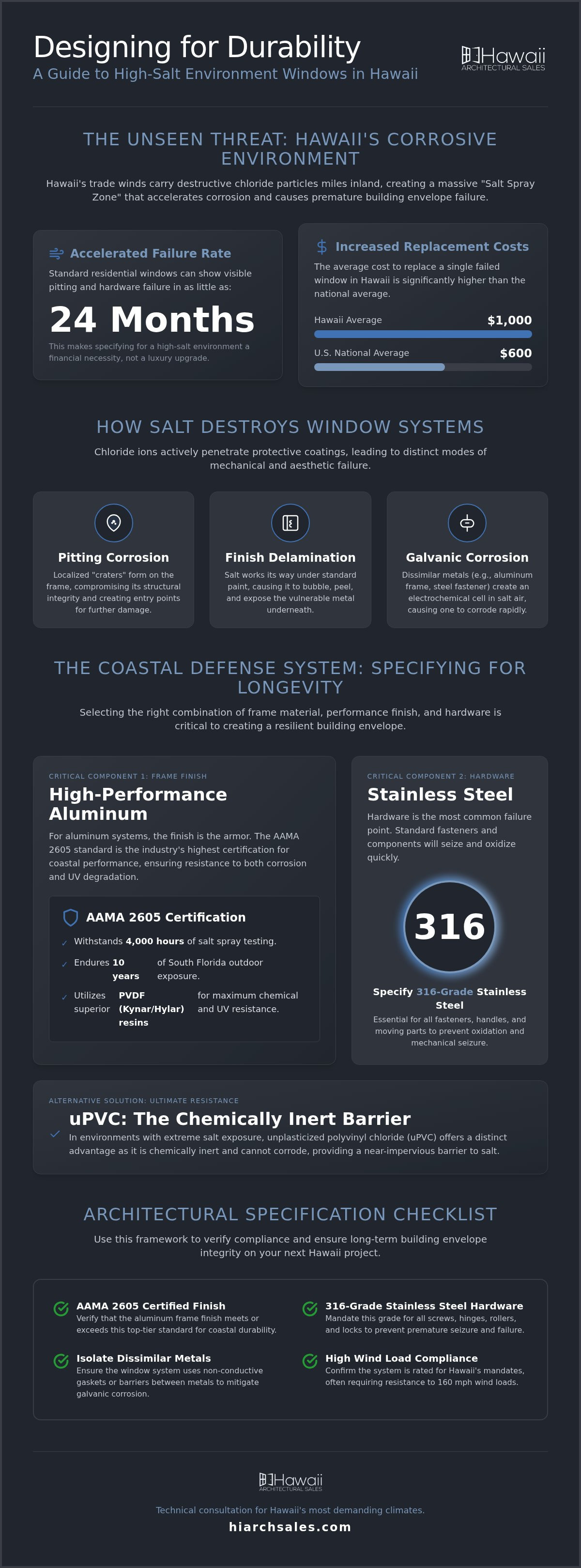
In Hawaii, the "Salt Spray Zone" isn't a suggestion; it's a technical boundary that dictates the lifespan of every building component. While many believe this zone ends a few hundred yards from the water, Hawaii's persistent trade winds carry microscopic chloride particles miles inland. This airborne salinity accelerates the process of corrosion, turning architectural metals into brittle, oxidized liabilities. Standard residential windows often show visible pitting and hardware failure within just 24 months of installation. This premature failure makes specifying high salt environment windows Hawaii a financial necessity rather than a luxury. The cost to replace a window in Hawaii averages around $1,000, which is significantly higher than the national average of $600. When an entire building envelope fails early, the financial loss for developers and homeowners is staggering.
The Chemistry of Salt-Air Corrosion
Chloride ions are uniquely destructive to architectural finishes. They don't just sit on the surface; they actively penetrate the protective oxide layers of standard aluminum frames. This leads to several distinct failure modes:
Pitting Corrosion
Localized "craters" that compromise the structural cross-section of the frame.
Crevice Corrosion
Degradation occurring in shielded areas where stagnant saline solutions collect.
Finish Delamination
The bubbling and peeling of paint as salt works underneath the coating.
High-exposure "hot spots" like Lihue, Kauai, experience high humidity and salt spray that differs from the arid, high-heat environment of Kailua-Kona. Regardless of the micro-climate, high salt environment windows Hawaii are the only way to ensure the material can withstand these chemical attacks without losing its aesthetic or structural value.
Galvanic Corrosion in Window Assemblies
The failure of a window system often occurs at the microscopic level where different materials meet. When dissimilar metals, such as an aluminum frame and a stainless steel fastener, are joined in a saline environment, they create an electrochemical cell. This triggers galvanic corrosion. Simply using stainless steel fasteners isn't a complete solution. Without isolation gaskets or specialized coatings, the aluminum frame will sacrifice itself to the more noble stainless steel, leading to loose fittings and frame failure. High-performance systems like the ES | Prestige or ES | uPVC lines are engineered to mitigate this. They utilize non-conductive barriers and specialized finishes to prevent the circuit that drives metal degradation.
Material Selection for Coastal Window Frames
Selecting the right frame material is the most critical decision in mitigating the effects of Hawaii's saline environment. While standard vinyl or thin-gauge aluminum might suffice in inland mainland climates, they fail quickly under tropical salt spray. High salt environment windows Hawaii must balance structural rigidity with chemical resistance. Architects must choose between high-performance aluminum systems and specialized uPVC barriers based on the project's specific exposure and structural requirements.
For aluminum systems, AAMA 2605 is the industry's highest performance standard. It requires finishes to withstand 4,000 hours of salt spray testing and 10 years of South Florida outdoor exposure. This level of protection ensures that the frames maintain color and gloss while resisting the pitting described in the previous section. Without this certification, aluminum frames are likely to experience finish delamination within the first few years of service. Achieving this standard requires a combination of superior resins and rigorous application processes.
ES | Prestige and Elite: Aluminum with Coastal Armor
The ES | Prestige and ES | Elite lines represent the pinnacle of aluminum engineering for coastal zones. Their durability stems from a meticulous pre-treatment process. This chrome-free pre-treatment creates a molecular bond between the metal surface and the architectural coating. This step is vital because it prevents the "under-film" corrosion common in lower-tier products. These systems utilize Kynar 500 or Hylar 5000 resins. These polyvinylidene fluoride (PVDF) resins provide a high degree of resistance to both UV degradation and chloride penetration. Standard powder coatings typically use polyester resins. These resins often become brittle and chalky when exposed to Hawaii's intense sun and salt air. By choosing ES | Prestige, designers achieve a luxury aesthetic that remains structurally sound for decades.
ES | uPVC: The Ultimate Salt-Resistant Barrier
In environments with extreme salt exposure, ES | uPVC offers a distinct advantage. Unlike metals, uPVC is chemically inert. It does not react with chloride ions. This makes it entirely immune to the electrochemical processes of corrosion. This material is particularly effective for multi-unit residential projects where long-term maintenance costs are a primary concern. Beyond its chemical resistance, uPVC provides exceptional thermal performance. Its low thermal conductivity prevents solar heat gain from entering the building envelope. This is critical for energy efficiency in Hawaii's tropical climate. You can learn more about these advantages in our guide on The Benefits of ES uPVC Windows in Tropical Climates. Architects should work with a technical representative to determine which material best suits the specific wind load and exposure requirements of their site.
Hardware and Glazing: The Often Overlooked Failure Points
Frames provide the structural skeleton of a window system, but the hardware enables its function. In Hawaii's aggressive coastal zones, hardware is frequently the primary point of mechanical failure. Specifying high salt environment windows Hawaii requires looking beyond the visible frame to the rollers, hinges, and locks that make large-scale openings possible. When salt air infiltrates these moving parts, it leads to binding, grinding, and eventual seizure. This is especially problematic for multi-slide and folding systems where the weight of the glass puts immense pressure on the operational components.
Marine-Grade Hardware for Large Openings
The distinction between 304 and 316 stainless steel is the difference between a five-year lifespan and a thirty-year lifespan. While 304 stainless steel is common in standard residential hardware, it lacks the molybdenum content found in 316-grade steel. Molybdenum provides the specific chemical resistance needed to combat chloride-induced pitting. For massive systems like Euro-Wall multi-slide and folding glass doors, roller performance is vital. Euro-Wall engineers their rollers with specialized bearings designed to handle coastal debris and salt spray without degradation. As an Euro-Wall Distributor Hawaii: Authorized Technical Representation for 2026, we ensure that every component, from the pivot hinges to the locking actuators, meets these stringent marine-grade requirements. This prevents the operational failure that often plagues luxury coastal properties.
Glazing Specifications for Salt-Air Clarity
Salt accumulation on glass surfaces does more than obscure the view; it alters the thermal performance of the building. As salt crystals build up, they can impact the Solar Heat Gain Coefficient (SHGC) by absorbing and radiating heat differently than clean glass. This can lead to unexpected cooling loads in tropical environments. Specifying high-performance glazing with easy-clean or hydrophilic coatings is a strategic solution. These coatings allow water to sheet off the glass more effectively, carrying salt particles away and reducing the frequency of professional cleaning.
Edge seal integrity is equally critical for high salt environment windows Hawaii. In these regions, the secondary seal of the Insulated Glass Unit (IGU) must be exceptionally robust. If salt air penetrates the seal, it triggers internal fogging and the oxidation of the Low-E coating. We recommend high-performance silicone seals that maintain their elasticity and bond strength under constant exposure to saline humidity. This ensures the IGU remains clear and thermally efficient throughout its service life, protecting the building envelope from internal degradation.
Architectural Specification Checklist for Hawaii Projects
Specifying high salt environment windows Hawaii requires a rigorous approach to documentation. It isn't enough to select a premium product; you must ensure the technical specifications are airtight to prevent premature envelope failure. A successful specification acts as the first line of defense against both environmental degradation and legal liability. Architects should start by verifying AAMA 2605 certification for all aluminum finishes. Don't settle for verbal assurances. Request the manufacturer's test reports to confirm the finish was applied over a proper pre-treatment layer. This verification ensures the frames will resist the delamination and pitting discussed in previous sections.
Thermal break continuity is another critical checklist item. In coastal assemblies, the thermal break does more than manage heat transfer; it provides essential galvanic isolation between internal and external metal components. Without a continuous break, the risk of internal condensation and hidden corrosion increases significantly. Finally, review the warranty terms for "coastal proximity" exclusions. Many standard manufacturers void their warranties for properties within one mile of the ocean. Ensure your chosen system offers a full warranty regardless of its distance from the shoreline. For a comprehensive review of your project's specific needs, contact Hawaii Architectural Sales to speak with a technical consultant.
Wind Load and Hurricane Compliance
In Hawaii, salt-resistant windows must also be engineered for extreme structural pressures. As of 2026, new building standards mandate that structures withstand wind speeds of up to 160 mph. This means your window systems must be impact-rated and salt-resistant simultaneously. The corrosive environment can weaken frame anchors over time, making initial wind load compliance even more vital for long-term safety. You can find detailed requirements in our Hurricane Rated Windows in Hawaii: The Architect’s Technical Guide. Navigating these overlapping regulations requires a partner who understands the local code landscape and the performance limits of high-end glazing.
Maintenance Schedules as a Specification Requirement
Longevity is a partnership between engineering and upkeep. A high-performance window system still requires a defined maintenance schedule to maintain its warranty and functionality. We recommend including these requirements directly in the project specifications. Fresh-water rinsing is the most effective way to remove accumulated chloride ions before they can initiate the process of corrosion. For high-altitude glass or hard-to-reach pivot systems, designers should plan for permanent rinsing ports or accessible walkways. Additionally, specify hardware lubricants that are non-petroleum based. These lubricants don't attract salt crystals or grit, ensuring that multi-slide rollers and folding door hinges remain operable for the life of the building.
Partnering with a Technical Representative in Hawaii
Designing for Hawaii's coastal zones requires more than just a product catalog. It demands a technical partnership. A retail dealer typically focuses on volume and standard residential applications, often lacking the depth required for complex commercial or luxury residential projects. In contrast, an architectural representative serves as a consultant throughout the design development phase. This distinction is vital when specifying high salt environment windows Hawaii, as the technical requirements for finishes and hardware exceed standard industry norms. We bridge the gap between high-end manufacturing and the practical application of these systems in the field.
Sourcing specialized brands like ES | Prestige, Euro-Wall, and Hopes requires a deep understanding of lead times and local logistical challenges. Our role involves more than just distribution; we ensure that the selected systems, including specialty items like Kalwall translucent panels or Super Sky skylights, meet the specific environmental demands of the site. This includes managing the complex delivery logistics for Neighbor Islands, including Lihue, Kona, and Kihei. By coordinating these efforts centrally, we prevent the delays and damage that often occur when shipping sensitive architectural glass and high-performance frames across the islands. Our expertise ensures that high salt environment windows Hawaii are delivered to the job site with the correct factory-applied finishes and hardware sets intact.
Streamlining the Building Envelope Specification
Architects need immediate access to technical data to maintain project momentum. We provide comprehensive support, including CAD drawings and performance data, to ensure that window assemblies integrate perfectly with other building components. This level of coordination is essential when balancing window systems with louvers from AWV or expansion joints from Balco. You can find more detail on this collaborative process in The Architect’s Guide to Selecting an Architectural Window Distributor in Hawaii. This integrated approach minimizes field errors and ensures the entire envelope functions as a single, cohesive unit capable of withstanding Hawaii's aggressive climate.
Local Expertise Since 1985
Since 1985, Hawaii Architectural Sales has served as a steady partner for the local design community. We've monitored the historical performance of ES and Euro-Wall systems in Hawaii’s unique climate for decades. This localized knowledge allows us to recommend specific configurations that have already proven their durability against Pacific salt spray. Local distribution matters because technical support doesn't end at the point of sale. We provide the expertise needed to navigate stringent building codes and evolving hurricane standards. For expert assistance with your next project, contact Hawaii Architectural Sales for a technical consultation.
Securing the Building Envelope for the Decades Ahead
Specifying the correct window system is a strategic decision that impacts a building's lifecycle and maintenance costs. You've seen how AAMA 2605 finishes and 316-grade stainless steel hardware serve as the technical baseline for coastal longevity. Selecting high salt environment windows Hawaii requires moving beyond aesthetic appeal to prioritize chemical resistance and structural integrity. By following a rigorous specification checklist and accounting for maintenance accessibility, you protect the project from the rapid degradation typical of tropical coastal zones.
We offer the localized expertise and technical support necessary to navigate these complex environmental requirements. As an authorized ES Prestige representative specialized in AAMA 2605 finishes, we've been serving Hawaii architects since 1985. We provide the technical documentation and logistical support needed to ensure your design performs as intended. Our role is to act as your consultant, bridging the gap between high-performance manufacturing and practical job-site application.
What is the best window material for a beachfront home in Hawaii?
ES | uPVC is the superior choice for beachfront properties due to its chemically inert nature. It won't corrode or pit regardless of salt spray exposure. For projects requiring the structural strength of metal, AAMA 2605-rated aluminum systems like ES | Prestige are the standard. These materials ensure the building envelope remains intact while resisting the aggressive electrochemical reactions common on Hawaii shorelines.
Does a "coastal warranty" actually cover salt corrosion?
Most standard warranties specifically exclude coastal proximity, often defined as within one mile of the ocean. A true coastal warranty should explicitly cover finish failure and hardware seizure due to salt air. It's vital to review the fine print for these exclusions. We recommend specifying systems that offer full coverage regardless of distance from the shoreline to avoid denied claims and unexpected replacement costs.
What is the difference between AAMA 2604 and AAMA 2605 finishes?
AAMA 2605 is the high-performance standard required for high salt environment windows Hawaii. It requires a 10-year South Florida exposure test and 4,000 hours of salt spray resistance. AAMA 2604 is a lower durability standard that only requires a 5-year exposure test and 3,000 hours of salt spray. For Hawaii's aggressive climate, the superior resin content of 2605 is non-negotiable for long-term color and gloss retention.
Can steel windows be used in a high salt environment in Hawaii?
Steel windows can be used if they are specifically engineered for marine environments. Systems like Hopes utilize advanced pre-treatments, such as hot-dip galvanizing and specialized primers, to prevent oxidation. Without these specific architectural-grade protections, standard steel will fail rapidly. In high salt environment windows Hawaii applications, the choice of a manufacturer with a proven track record in coastal regions is essential for project success.
How often should coastal windows be cleaned to prevent pitting?
Coastal windows should be rinsed with fresh water every three to six months to remove chloride accumulation. Properties located within 1,000 feet of the shoreline may require monthly rinsing. This simple maintenance prevents salt crystals from initiating pitting corrosion on aluminum surfaces. Regular cleaning is often a mandatory requirement for maintaining manufacturer warranty coverage in aggressive saline environments across the Hawaiian Islands.
Are uPVC windows strong enough for Hawaii’s high wind loads?
Yes, high-performance systems like ES | uPVC are engineered with internal steel or aluminum reinforcements to meet Hawaii's 160 mph wind load requirements. While vinyl has a reputation for flexibility, architectural-grade uPVC is a different class of material. It provides the necessary structural rigidity for impact-rated glazing while remaining entirely immune to salt-air degradation. It's a reliable solution for both durability and safety.
What hardware grade is required for luxury multi-slide doors in Honolulu?
Luxury multi-slide systems require 316-grade stainless steel hardware to ensure operational longevity. This grade contains molybdenum, which provides specific resistance to chloride pitting that 304-grade steel lacks. In Honolulu's humid coastal air, 304-grade components often seize or show surface rust within a few years. Specifying 316-grade rollers and locks ensures that massive glass panels continue to slide effortlessly for decades.
How do trade winds affect the salt spray zone on different islands?
Trade winds carry salt spray several miles inland, particularly on the windward sides of islands like Oahu and Kauai. This expands the salt zone far beyond the immediate beach. On leeward sides, the concentration may be lower, but salt still accumulates during Kona wind events. Architects must account for these localized wind patterns when determining the necessary finish and hardware specifications for any project.