How to Get Architectural Product Submittals Quickly: A Project-Ready Workflow
What if the quickest way to get an architectural product submittal isn’t to rush the request, but to make it complete the first time? If you’re wondering how to get architectural product submittals quickly, start with clear project context and coordinated product details. Missing information or chan...
What if the quickest way to get an architectural product submittal isn’t to rush the request, but to make it complete the first time? If you’re wondering how to get architectural product submittals quickly, start with clear project context and coordinated product details. Missing information or changing selections can trigger clarification cycles and slow the process.
A fast process still needs to protect project-specific coordination. The right information helps the team compare product details with contract documents, specifications, and review responsibilities. This article explains how to prepare a useful request, reduce avoidable follow-up, and keep product information consistent across participants.
You’ll learn which project and product details to gather, how to flag selections that are still under consideration, and how to coordinate a request with the project’s review process. For projects in Hawaii and the Pacific, Hawaii Architectural Sales provides product expertise and full technical support for architectural building-envelope products. The goal is a clear, complete request that supports an efficient workflow without sacrificing project requirements.
Key Takeaways
• Learn how to get architectural product submittals quickly by preparing project, product, and specification details before making a request.
• Separate confirmed product selections from open decisions so the project team can see what’s settled and what still needs coordination.
• Compare complete requests, piecemeal follow-up, and early coordination to identify where clarification and revision effort can be reduced.
• Use a practical sequence to review requirements, assemble references, submit a clear request, and track responses.
• See how Hawaii Architectural Sales’ Full technical support can contribute to project-specific product coordination in Hawaii and the Pacific.
Why Architectural Product Submittals Get Delayed, and What “Quickly” Really Means
An architectural product submittal is project-specific information assembled so the project team can evaluate a proposed product against contract requirements. For a window, door, or other building-envelope product, connect the product under consideration to the relevant project documents instead of sending general product information without context.
“Quickly” doesn’t mean bypassing review or compressing required steps. It means reducing preventable clarification and coordination cycles before and during review. A request can be sent promptly and still stall if the selection is ambiguous, key project details are missing, document revisions conflict, or ownership of the next action is unclear.
A complete request gives reviewers the context they need to assess the proposed product and helps reduce preventable information gaps. It won’t remove project review requirements, but it can make the information clearer from the outset.
What information does an architectural product submittal communicate?
Product-specific information helps the project team compare a proposed solution with applicable drawings, specifications, and other contract requirements. The goal is to make the product and its intended application clear. Contents vary with the product, contract documents, and project submittal requirements, so there isn’t one package that suits every request.
Product information is one part of the contractor’s wider submittal-management process. That process may involve organizing requests, assigning reviews, tracking revisions, and recording responses. A product request should support the project workflow, not replace its required procedures.
Which delays can requesters prevent before review begins?
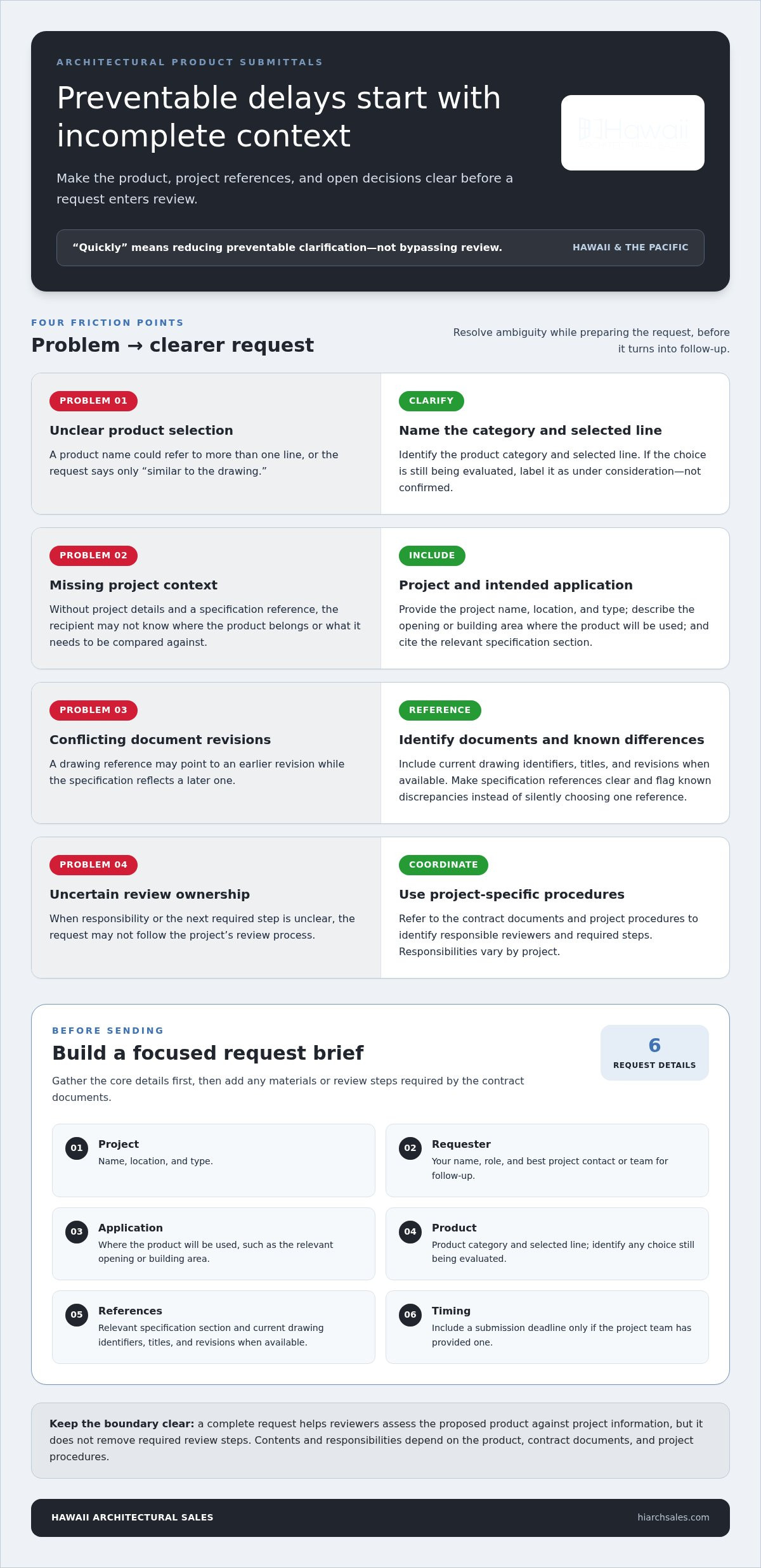
Address common friction points while preparing the request. A product name that could refer to more than one line, or a selection described only as “similar to the drawing,” leaves room for interpretation. If a decision is still open, label it as open rather than presenting it as confirmed.
Check document references as well. A drawing reference may point to an earlier revision while the specification reference reflects a later one. Include document titles and revision identifiers when available, and flag known discrepancies instead of silently choosing one reference.
Unclear selection
Identify the product category and selected line, or state which choice remains under consideration.
Missing context
Include the project name, location, and relevant specification reference.
Conflicting revisions
Make the drawing and specification references clear, and note known differences.
Uncertain ownership
Use the contract documents and project procedures to identify responsible reviewers and required steps.
These checks are a practical starting point for how to get architectural product submittals quickly: clarify the request before it enters review. Responsibilities vary by project, so use the contract documents to establish review roles and required steps rather than assuming a universal assignment.
Build a Complete Architectural Product Submittal Request Before Sending It
A useful request gives the recipient enough context to understand what product information is needed and where the product will be used. For anyone learning how to get architectural product submittals quickly, preparation starts with a focused brief, not a large collection of documents without direction. Gather the core details first, then add materials or review steps required by the contract documents.
Use this checklist to shape the request:
Project
Provide the project name, location, and type.
Requester
State your name, role, and the best project contact or team for follow-up.
Application
Describe where the product will be used, such as the relevant opening or building area.
Product
Identify the product category and selected line. If the selection is still being evaluated, say so.
References
Cite the relevant specification section and current drawing identifiers when available.
Timing
Include a submission deadline only if the project team has provided one.
Which project details make a request actionable?
Project location and type frame the request; the intended application connects the product to its place in the design. A specification section and drawing number give the recipient precise references. Include each drawing’s title or identifier and revision where available, so the request can be compared with current project information.
State what you need, such as product information for a particular application, and include any deadline communicated by the team. Don’t invent a due date or assume every request needs the same supporting documents. Contract requirements determine which additional materials and review steps apply.
How should product selections and revisions be recorded?
Name the product category and selected line clearly. If design decisions remain open, list them separately from confirmed selections. For example, identify the product line under consideration, then note that a particular choice is awaiting team direction. This prevents a preliminary choice from being mistaken for an approved project requirement.
Use consistent revision identifiers across drawings and supporting information. Replace superseded references rather than mixing versions without explanation. If current documents appear inconsistent, flag the discrepancy for coordination. This helps the recipient understand which information is current without implying that an unresolved design question has been settled.
Request summary: Include the project, requester, application, product category and line, relevant specification, and current drawing references when available. Add other documents or review requirements only when the project documents call for them.
A well-organized brief also helps align product information with project needs. For architectural building-envelope products in Hawaii and the Pacific, HI Arch Sales’ product expertise supports project-specific coordination.
Compare Submittal Workflows: Complete Request, Piecemeal Follow-Up, or Early Coordination
The best workflow depends on how settled the product selection and project requirements are. A complete request can make an established selection easier to review. Early coordination can help when important choices remain open. Piecemeal follow-up may seem faster at first, but separate messages can make it harder to keep product details, references, and revisions aligned.
Use this comparison to choose a workflow that moves a product request forward without confusing speed with a shortcut around project requirements.
Workflow
Information completeness
Likely clarification needs
Revision control
Coordination effort
Complete initial request
Strong when selection and references are established
Lower if relevant details are included
Clear when current references are identified
More preparation upfront; fewer scattered exchanges
Piecemeal follow-up
Builds in stages
Potentially higher as details emerge separately
Can be harder to track across messages
Repeated follow-up may add coordination work
Early project-team coordination
Develops while open decisions are discussed
Can surface information gaps before formal review
Needs clear distinction between preliminary and current information
Requires input from relevant project participants
A fast handoff is useful only if the product information remains aligned with project requirements. Sending something immediately won’t help if it describes an unresolved option as final or relies on outdated references. To get architectural product submittals quickly, choose a workflow that fits the project’s readiness, then follow its documented review process.
When does a complete initial request work best?
This approach works best when the product category, project requirements, and current references are established. One coordinated request can show what information is available, identify the intended application, and make open questions visible. Completeness means providing relevant information, not attaching every possible document. Include additional items only when the project documents or team process calls for them.
When is early coordination more useful than sending a partial package?
Early coordination can be more effective when a product selection or design decision is unresolved. Discussing the open item with relevant project participants can reveal what information is still needed before assembling the formal package. Keep this discussion distinct from formal submission and approval. Review responsibilities and required steps remain with the project team and its documented process.
Category knowledge can help teams frame useful questions before finalizing a request. For example, this architectural glass systems technical guide offers product-category context for early coordination. Use that context alongside, not in place of, project specifications and current documents.
Follow These Steps to Request Architectural Product Submittals Efficiently
A consistent sequence helps the requester prepare useful information while keeping decisions and responsibilities visible to the project team. Roles vary by project, so follow the contract documents and agreed procedures rather than assuming one participant owns every step. For projects in Hawaii and the Pacific, include the location and relevant project context, then check the request against applicable specifications and current drawings.
What should the requester do before contacting a product representative?
Locate the relevant specification and current drawings first. Summarize the intended application, product category, and decisions still in progress. Identify the project contact responsible for receiving or coordinating product information, as defined by the team’s process. This preparation gives the representative a clear starting point and keeps preliminary questions separate from formal review.
Review project requirements.
Locate the applicable specification, current drawing references, and documented submittal instructions. Note project-specific requirements instead of assuming every product requires the same information.
Identify the product and open decisions.
Describe the intended application and product category, then distinguish confirmed choices from unresolved options. This helps prevent a preliminary preference from being treated as a settled requirement.
Assemble current references.
Gather the relevant specification reference, drawing identifiers, and revision information available to the team. For a Hawaii or Pacific project, include its location and other context that affects how the request should be understood. Use project documents to determine which details matter.
Submit one clear request.
Bring the project context, product information, references, and specific request together in one organized communication where practical. Identify the project contact who will coordinate responses and clarify questions. Avoid sending disconnected attachments without explaining their purpose.
Track responses and next actions.
The designated project contact should record the request and monitor follow-up through the established review path. Use status language consistent with that process. Don’t describe a discussion or information exchange as formal approval unless the project procedures support that status.
How can teams keep the request moving after it’s sent?
Use a simple tracking log as a shared reference. Record the request date, product, specification reference, drawing revision, request owner, and next action. The project team can add fields required by its process, such as a formal status or reviewer. Don’t assign a response deadline unless the team has provided one.
When a clarification changes the request, share updated information and references with the relevant participants. Keep prior and current revisions distinguishable, and note what changed so the team can follow the coordination history. This is a practical way to get architectural product submittals quickly without bypassing review requirements.
How Hawaii Architectural Sales Supports Architectural Product Coordination
Architectural product coordination depends on a clear exchange between the project team and the product representative. Hawaii Architectural Sales represents and distributes architectural building-envelope products for projects in Hawaii and the Pacific. The company connects project-specific needs with product expertise and full technical support, while the project team retains its documented review and approval responsibilities.
A focused brief gives that coordination a practical starting point. Include the project location, intended product application, relevant specification reference, and current design information. If a selection is still under discussion, identify the open decision clearly. This context keeps product conversations tied to the actual project rather than general product questions.
What project context helps HI Arch Sales support a product request?
Useful context includes where the product will be used, what the project documents require, and which design decisions remain open. This matters across product categories, whether a team is evaluating specialized daylighting systems, high-performance glazing, or custom exterior assemblies. Hawaii Architectural Sales offers high-value solutions, durable and efficient products, and custom architectural solutions for project needs.
For teams considering how to get architectural product submittals quickly, early clarity helps the representative understand the request and coordinate relevant product information. It doesn’t replace project specifications or formal review. Hawaii Architectural Sales has worked as a window and door manufacturer since 1983 and draws on 15+ supply partners worldwide. Its windows and doors are offered with double-glazing or triple-glazing options, thermal breaks, and superior sealing systems, designed for insulation and lower energy bills. The up to 10 years guaranty is a product consideration, separate from submittal review.
How does a product-focused representative fit into the project workflow?
Architects, engineers, contractors, and vendor partners may each contribute information or coordination, depending on the project’s documented process. A product representative supports product-focused discussions and helps align information with the brief. That role doesn’t assign universal review authority or determine who approves a submittal. Project documents and team procedures establish those responsibilities.
For additional context on evaluating a representative’s role in product coordination, see this guide to selecting an architectural window distributor in Hawaii. Use it alongside the project’s own requirements when deciding what information to assemble and who should receive it.
For a project in Honolulu, Lihue, Kailua-Kona, Kihei, or Lahaina, bring the location, application, specification reference, and current design information into the product discussion. Discuss your project with Hawaii Architectural Sales to explore product coordination in Hawaii or the Pacific.
Make the Next Product Decision Project-Ready
Bring your project’s product questions into the same conversation as its design intent. A clear brief helps the project team and product representative focus on the decisions that matter, while formal review and approval stay within the project’s established process. That’s the practical foundation for how to get architectural product submittals quickly: keep product coordination connected to the actual project, not just a generic request.
For a project in Hawaii or the Pacific, use the next product discussion to clarify the intended application, current design direction, and choices still open. This creates room to consider solutions that fit the project requirements without treating preliminary coordination as approval.
How quickly can I get architectural product submittals?
There isn’t a single turnaround that applies to every request. Timing depends on the product information needed, how complete the request is, and the project’s review requirements. A clear brief can limit avoidable questions, but it can’t guarantee a response or approval date. To understand how to get architectural product submittals quickly, distinguish product-information coordination from the formal review schedule set by the project team.
What information should I send with an architectural product submittal request?
Include enough context to identify the request and its intended use: project name and location, product category or selected line, relevant specification reference, current drawing identifiers, and the information you’re seeking. For a project in Honolulu, Lihue, Kailua-Kona, Kihei, or Lahaina, name the location clearly so the request is tied to the correct job. If the design team is considering alternatives, label them as options rather than approved selections.
Who prepares architectural product submittals?
Responsibility depends on the project contract and established workflow. Contractors commonly coordinate formal construction submittals, while architects and engineers establish or review design requirements. A product representative or distributor can contribute product-related information and coordination within their role. For example, a contractor may assemble a formal package using product information, while the designated reviewer evaluates it. Follow project documents to determine who submits, reviews, and records each item.
Can I request product information before the design is final?
Yes. Early coordination can help the team identify product questions before a formal package is ready. Mark preliminary choices and unresolved options clearly, and note which drawing revision informed the discussion. If the design changes, share the updated direction with the relevant participants so preliminary information isn’t mistaken for the current selection. Early discussion supports planning, but it doesn’t replace formal submission or approval under the project’s process.
How can I reduce architectural submittal revisions?
Check that the product description and references agree before the request enters formal review. For example, if a drawing and specification point to different revisions, flag the discrepancy rather than choosing one without explanation. Keep a record of clarifications and identify what changed between versions. The project team’s requirements determine what makes a submission complete and how revisions should be documented, so use its process to guide corrections.
Can a product representative approve an architectural submittal?
A product representative can support coordination and provide product-related information, but that role doesn’t automatically include formal approval authority. Contract documents and the project workflow identify assigned reviewers and decision-makers. Keep information supplied during coordination distinct from a formal review outcome. When recording progress, use the project’s stated status terms and documentation process so product discussions aren’t mistaken for approval.