Milgard Windows: Hawaii Hurricane Performance Guide
A window designed for a mainland suburb is often fundamentally ill-equipped for the extreme pressures of a Hawaii ridgeline. While many residential brands offer sleek profiles and thermal efficiency, they frequently lack the structural reinforcement required for high-wind environments. Understanding...
A window designed for a mainland suburb is often fundamentally ill-equipped for the extreme pressures of a Hawaii ridgeline. While many residential brands offer sleek profiles and thermal efficiency, they frequently lack the structural reinforcement required for high-wind environments. Understanding Milgard windows limitations for hurricane zones is a critical step for architects and developers who must balance aesthetic goals with strict ASCE 7-16 compliance. Standard glazing might look the part, but it often fails to meet the ASTM E1996 Large Missile Level D standards mandated for many island projects.
You likely recognize that coastal construction demands more than just basic weatherproofing; it requires a building envelope capable of withstanding 9,000 positive and negative pressure cycles. This guide clarifies the technical differences between simple design pressure ratings and true impact resistance. We'll explore why standard residential hardware often succumbs to salt-air corrosion and how to specify high-performance alternatives through Hawaii Architectural Sales for long-term durability. You will gain a clear technical understanding of glazing limitations and the criteria necessary for specifying reliable, impact-rated systems that thrive in Hawaii’s unique environment.
Key Takeaways
• Understand how Hawaii’s unique wind-borne debris regions and ASCE 7-16 standards dictate strict performance requirements for all exterior glazing.
• Identify specific Milgard windows limitations for hurricane zones, specifically the critical distinction between standard design pressure ratings and mandatory ASTM E1996 impact certification.
• Learn why salt-air aerosols in Hawaii’s ISO Zone 4 environment require specialized hardware and frame materials to prevent premature structural failure.
• Discover high-performance alternatives like ES Prestige and Euro-Wall that provide certified protection and architectural flexibility for high-stakes coastal projects.
• Streamline the path to building permit approval by verifying Florida Product Approvals and specifying assemblies engineered for Hawaii’s extreme wind pressures.
Understanding Hawaii’s Environmental Demands on Glazing Systems
Hawaii’s geographic isolation creates a building environment unlike any in the continental United States. While mainland manufacturers often prioritize thermal performance for cold winters, island projects face a relentless combination of high-velocity winds and corrosive salt spray. Understanding the Milgard windows limitations for hurricane zones is essential for any professional involved in the design or construction of coastal envelopes. Standard residential products built for California or the Pacific Northwest often don't have the structural depth to survive the extreme pressures found on Hawaii’s ridges and shorelines.
Wind-Borne Debris Regions and Hawaii Codes
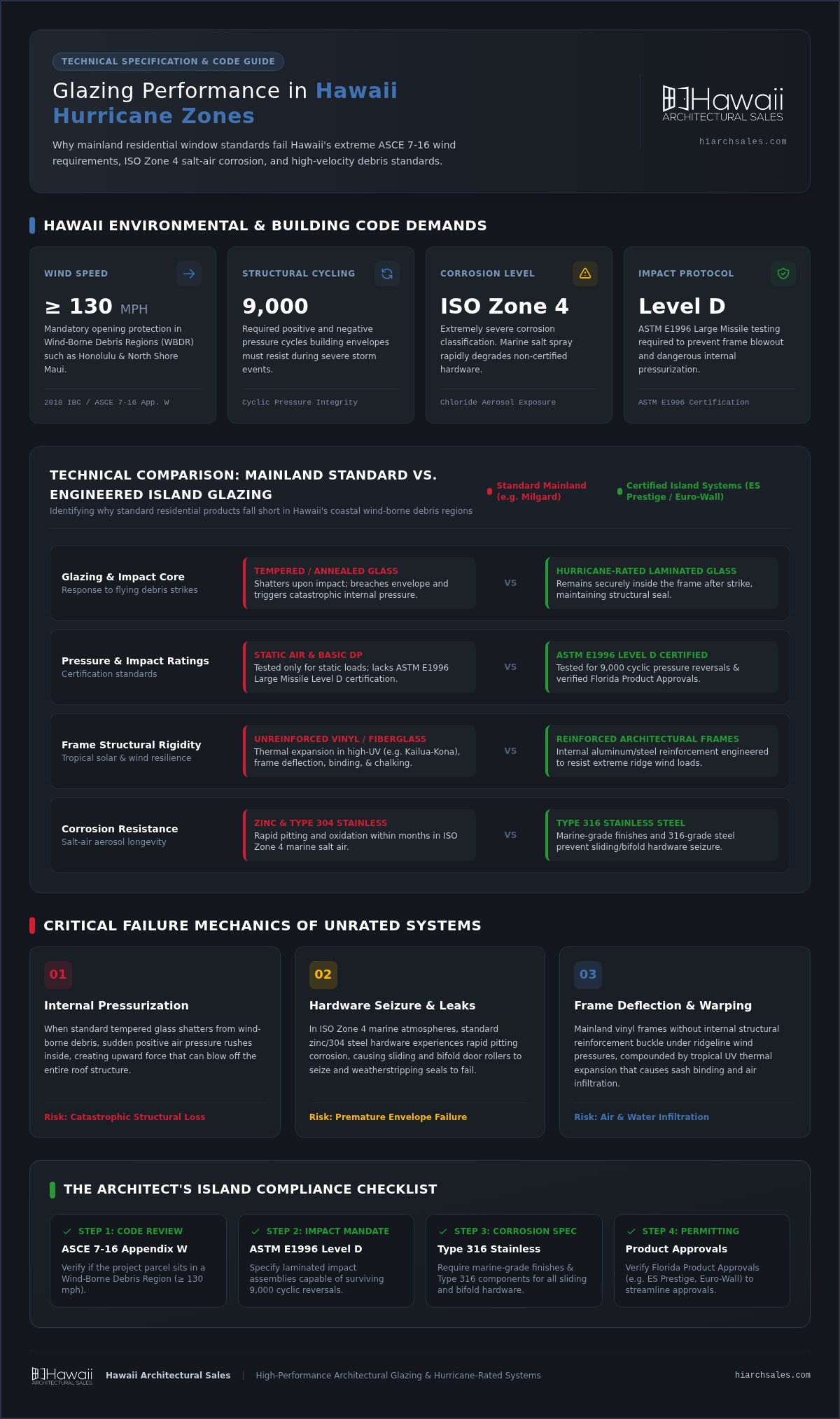
The State of Hawaii adopts the 2018 International Building Code (IBC) and ASCE 7-16, which includes specific wind design provisions in Appendix W. In regions where ultimate design wind speeds reach 130 mph or greater, such as parts of Honolulu and the North Shore of Maui, opening protection becomes mandatory. These Wind-Borne Debris Regions (WBDR) require windows to resist the structural mechanics of hurricane-proof buildings, specifically surviving high-velocity impacts from flying debris. Most standard Milgard lines are tested for static air loads but don't carry the ASTM E1996 Level D certification required for these zones. Without this specific rating, a window assembly may fail during a storm, leading to internal pressurization that can compromise the entire roof structure.
The Corrosion Factor: Salt-Air Challenges
Hawaii is classified as an ISO Zone 4 environment, representing extremely severe corrosion levels. Salt-air aerosols are not just a nuisance; they're a structural threat to standard window hardware. Standard zinc or 304-grade stainless steel components frequently found in residential lines can experience rapid pitting and oxidation within months of installation. To ensure long-term functionality, architects must specify marine-grade finishes and Type 316 stainless steel hardware. These materials resist the chloride-induced corrosion that causes sliding and bifold systems to seize or leak. Additionally, the intense tropical UV radiation in Hawaii accelerates the degradation of standard vinyl, leading to chalking and warping that further compromises the seal. Relying on products designed for milder climates often results in a shortened lifecycle and increased maintenance costs for the building owner.
Technical Limitations of Standard Residential Windows in Hurricane Zones
Standard residential windows are engineered for broad market appeal, which often compromises the structural rigidity needed for Hawaii’s extreme wind loads. When high-velocity winds strike a building, the pressure can cause standard frames to buckle or deflect beyond their design capacity. This structural failure is one of the primary Milgard windows limitations for hurricane zones. Unlike high-performance architectural systems, standard residential units may not feature the internal reinforcements necessary to maintain envelope integrity during a tropical cyclone.
Many homeowners mistakenly believe that tempered glass provides adequate protection. While tempered glass is stronger than annealed glass, it shatters upon impact. In contrast, hurricane-rated laminated glass remains within the frame even after a strike, preventing the catastrophic internal pressurization described in UH Sea Grant's Homeowner's Handbook to Prepare for Natural Hazards. Without certified impact-rated glazing assemblies, the entire building remains vulnerable to wind-borne debris.
Vinyl and Fiberglass Performance in the Tropics
Material selection is vital in high-UV regions like Kailua-Kona. Standard residential-grade vinyl often lacks the steel or aluminum reinforcement found in commercial-grade uPVC systems. Under intense solar radiation, these frames can experience significant thermal expansion, leading to sash binding or air infiltration. Similarly, standard fiberglass systems can suffer from surface chalking when exposed to constant salt spray and high UV levels, which eventually degrades the finish and structural bond of the frame.
Hardware and Operational Integrity
Operational failure often precedes structural failure in coastal environments. Standard residential rollers and locks are typically manufactured from zinc die-cast or 304-grade stainless steel. In Hawaii’s ISO Zone 4 environment, these components can seize within months due to chloride-induced pitting. High-performance systems utilize 316 marine-grade stainless steel and multi-point locking mechanisms to ensure the sash remains secure against the frame under extreme pressure. If you are designing for a coastal site, it's essential to review high-performance hardware specifications that exceed standard residential benchmarks.
Standard weatherstripping also presents a limitation. Most residential lines use pile or basic rubber seals that fail to prevent water ingress during wind-driven rain events. High-performance architectural products employ dual or triple gasket systems designed specifically to manage the extreme hydrostatic pressure associated with hurricane-force winds.
Performance Standards: Decoding DP Ratings and Impact Resistance
Specifying fenestration for Hawaii’s coastal environment requires a precise understanding of how mainland testing translates to island conditions. A common point of confusion among developers is the distinction between a Design Pressure (DP) rating and a certified impact rating. While a window may have the structural strength to resist static wind loads, it may lack the specialized glazing and frame reinforcement required to survive debris impacts. This technical gap is central to the Milgard windows limitations for hurricane zones, as residential lines are typically optimized for thermal efficiency rather than extreme cyclic pressure resistance.
Understanding Design Pressure (DP) Ratings
Design Pressure is a numerical value representing the structural load, measured in pounds per square foot (psf), that a window assembly can withstand. In Hawaii, architects must calculate these requirements based on ASCE 7-16 standards, accounting for building height, proximity to the shoreline, and topographic amplification factors. For example, a residence on a coastal ridgeline in Honolulu may require a DP 50 or higher to account for wind speed-up effects. A standard "DP 30" window, common in mainland residential applications, is often insufficient for these high-stakes zones. If the calculated wind load exceeds the window’s tested DP rating, the assembly risks catastrophic deflection or frame failure during a storm event.
Impact Testing Protocols (ASTM E1996)
To qualify as impact-resistant in Hawaii’s wind-borne debris regions, a window must pass the ASTM E1886 and ASTM E1996 protocols. The most rigorous of these is the Large Missile Test, where a nine-pound 2x4 lumber projectile is fired at the assembly at approximately 34 miles per hour. While the glass may crack upon impact, the laminate interlayer must remain intact to prevent a breach in the building envelope. Following the impact, the unit must survive 9,000 cycles of alternating positive and negative pressure. This cyclic testing simulates the erratic, high-frequency gusts characteristic of a tropical cyclone. Most standard residential windows are not engineered for this level of resilience, making them vulnerable to internal pressurization if the glazing is compromised.
Florida Product Approval (FPA) has become the gold standard for Hawaii building envelopes because the environmental pressures in Florida’s High Velocity Hurricane Zones (HVHZ) mirror our local challenges. Architects should also distinguish between water penetration resistance and structural wind load. A window might be rated for high water resistance but still fail structurally under peak wind velocities. High-performance systems, such as those from ES Prestige, are designed to exceed both benchmarks, providing a level of security that standard residential products cannot match. Verifying these test reports early in the design phase ensures that the specified products align with the parcel's specific wind speed requirements.
High-Performance Alternatives for Hawaii’s Building Envelope
Hawaii's coastline is unforgiving. While standard residential lines have their place in protected inland areas, coastal architectural projects require a different engineering philosophy. Transitioning away from the Milgard windows limitations for hurricane zones involves selecting systems designed specifically for high-velocity hurricane zones (HVHZ). These architectural-grade products prioritize structural rigidity and material longevity, ensuring the building envelope remains secure despite extreme environmental pressures.
ES Prestige and Elite: The Impact-Rated Standard
The ES Prestige and Elite lines represent a significant upgrade in structural performance. These systems are engineered to meet the most stringent Florida Product Approval (FPA) standards, which serve as the benchmark for Hawaii's wind-borne debris regions. Unlike residential vinyl, these assemblies feature heavy-duty aluminum profiles and reinforced glazing pockets that accommodate the thick laminated glass required for ASTM E1996 compliance. The finishes are specifically formulated for salt-air exposure, preventing the oxidation and pitting that often compromise standard residential hardware. For a deeper look at these specifications, read our guide on ES | Prestige Windows: Performance Standards in Hawaii.
Euro-Wall: Maximizing Views Without Compromising Safety
Modern Hawaii architecture often demands large spans and seamless indoor-outdoor transitions. Euro-Wall provides folding and sliding glass wall systems that achieve these aesthetic goals while maintaining full hurricane ratings. These systems are tested to resist massive design pressures, making them suitable for luxury homes in Honolulu or Maui that face direct trade winds. The structural integrity of a Euro-Wall system ensures that even a 10-foot tall folding door can survive the cyclic pressure testing required by local building codes. As a specialist partner, we provide Euro-Wall Distributor Hawaii: Authorized Technical Representation to assist architects in detailing these complex openings.
Beyond aluminum, other materials offer specialized benefits for the islands. ES uPVC systems provide exceptional thermal performance and are naturally immune to salt-air corrosion, making them ideal for beachfront properties. For luxury projects requiring a timeless aesthetic, Hopes custom architectural steel solutions offer incredibly thin sightlines without sacrificing the strength needed for high-wind events. These high-performance alternatives bridge the gap between standard manufacturing and the rigorous demands of tropical coastal design. To ensure your specifications meet current Hawaii code requirements, contact our technical team for a project review.
Specifying for Longevity: The Architect’s Path to Compliance
Designing for the Hawaii market requires more than just an aesthetic vision. It demands a rigorous verification of structural data and material compatibility. Navigating the Milgard windows limitations for hurricane zones is a baseline requirement for any coastal project. Architects must move beyond standard residential catalogs to find systems that meet the specific needs of our high-velocity regions. Early-stage planning ensures that the building envelope is not just code-compliant, but engineered for long-term survival in a High Velocity Hurricane Zone (HVHZ).
Success depends on looking at the window as one component of a larger, integrated system. A high-performance window is only as effective as its anchorage and the surrounding wall assembly. When the design phase begins, consulting with a technical specialist helps identify potential failure points before they become costly field issues. This proactive approach prevents the common pitfall of specifying products that fail to meet the parcel's site-specific wind speed requirements during the permit review process.
Reviewing Technical Data Sheets
When you evaluate a manufacturer’s structural test report, focus on the specific assembly tested rather than general product line claims. Verify that the Florida Product Approval (FPA) or Texas Department of Insurance (TDI) numbers align with the exact glass thickness and interlayer type required for your project’s DP needs. In Hawaii’s ISO Zone 4 environment, finish warranties are equally critical. Many standard residential warranties contain exclusions for properties within 1,000 feet of the high-water mark. You should specify high-performance organic coatings, such as AAMA 2605, to ensure the frame finish resists the combination of intense tropical UV and salt-air abrasion.
The Role of an Authorized Representative
Hawaii Architectural Sales acts as a technical consultant for architects and developers, bridging the gap between high-end manufacturing and practical island application. We provide the expertise needed to navigate the transition from design intent to engineering compliance. Our team assists in reviewing wind load calculations and ensuring that the selected systems, such as ES Prestige or Euro-Wall, meet the necessary ASTM E1996 Large Missile standards. By addressing Milgard windows limitations for hurricane zones early in the schematic design phase, professionals can avoid the risk of structural failure or non-compliance. Our focus is on providing a reliable material supply that matches project timelines while maintaining the highest standards of architectural integrity.
Securing the Building Envelope for Hawaii’s Future
Choosing the right glazing system is a decision that impacts the safety and longevity of a structure for decades. While standard products are suitable for many mainland applications, the Milgard windows limitations for hurricane zones highlight the need for specialized engineering in island environments. Protecting a building from high-velocity winds and salt-air corrosion requires assemblies that exceed basic residential benchmarks. By prioritizing ASTM E1996 impact certification and marine-grade hardware, you ensure full compliance with Hawaii’s strict building codes while minimizing long-term maintenance liabilities.
As an authorized representative for ES Prestige and Euro-Wall, Hawaii Architectural Sales provides over 40 years of architectural distribution experience. We focus on helping architects bridge the gap between design intent and technical reality through specialized expertise in Hawaii building code compliance. Contact Hawaii Architectural Sales for Technical Specs on Impact-Rated Systems to verify your project’s requirements and specify a resilient building envelope. We look forward to supporting your next high-performance coastal project.
Frequently Asked Questions
Do Milgard windows have Florida Product Approval for hurricane zones?
Standard Milgard residential lines, including the Tuscany and Trinsic series, typically lack Florida Product Approval (FPA) for High Velocity Hurricane Zones. These products are designed for Western U.S. markets and don't meet the ASTM E1996 Large Missile Level D requirements. For projects in Honolulu or Maui requiring impact certification, architects should specify high-performance systems like ES Prestige that carry active FPA documentation and certified impact ratings.
What is the difference between tempered glass and impact-rated glass?
Tempered glass is heat-treated safety glass that shatters into small pebbles upon failure; however, it doesn't prevent building envelope breaches. Impact-rated glass utilizes a specialized laminated interlayer that keeps the glass shards bonded to the frame even after a strike. This prevents the catastrophic internal pressurization that often leads to roof failure during tropical cyclones. Impact-rated assemblies must pass rigorous cyclic pressure testing to ensure structural integrity.
Are vinyl windows durable enough for Hawaii’s coastal salt air?
Standard residential vinyl often lacks the structural reinforcement and UV stability needed for Hawaii’s ISO Zone 4 environment. Exposure to intense tropical sun and salt spray can lead to frame warping or surface chalking. High-performance ES uPVC systems are a superior alternative. These systems are naturally immune to salt corrosion and are engineered with thicker profiles to handle the thermal expansion typical in high-UV regions like Kailua-Kona.
What DP rating is required for a beachfront home in Honolulu?
Required Design Pressure (DP) ratings are site-specific and must be calculated using ASCE 7-16 standards. Factors include building height, topography, and proximity to the shoreline. Beachfront properties in Honolulu often require a DP 50 or higher to resist peak wind loads. Understanding the Milgard windows limitations for hurricane zones is vital here, as standard residential units often carry lower DP ratings that are insufficient for these high-stakes coastal zones.
Does Hawaii Architectural Sales provide installation for hurricane windows?
Hawaii Architectural Sales is a specialized manufacturer's representative and distributor; we don't provide installation or general contracting services. We focus on providing technical product expertise and material distribution for premium systems like Euro-Wall and ES Prestige. We partner with architects, developers, and contractors across Honolulu and Lihue to ensure the specified products meet all local building code and performance requirements for the building envelope.
Can I use standard residential windows in a Hawaii High Velocity Hurricane Zone?
You can only use standard residential windows in a High Velocity Hurricane Zone if they're paired with code-approved protective shutters or engineered safe rooms. Without secondary protection, standard assemblies fail to meet the mandatory ASTM E1886/E1996 protocols required for any site with design wind speeds of 130 mph or greater. This is a primary factor in Milgard windows limitations for hurricane zones when specifying for coastal projects.
How does salt air affect the warranty of mainland window brands?
Many mainland brands include specific exclusions or significantly shortened warranty periods for properties located within a certain distance of the coastline, often 1,000 feet to two miles. Salt-air aerosols cause rapid corrosion of standard zinc or 304-grade stainless steel hardware. Architectural-grade systems from brands like Hopes or ES Prestige use marine-grade finishes and 316 stainless steel to ensure durability and maintain full warranty coverage in Hawaii’s severe environment.
What are the best alternatives to Milgard for high-wind architectural projects?
For projects requiring certified impact resistance and high design pressures, ES Prestige and ES Elite are the industry standards. These systems are engineered for hurricane zones and carry full Florida Product Approvals. For large-span openings, Euro-Wall offers folding and sliding glass walls with full hurricane ratings. These alternatives provide the structural integrity and salt-air resistance that standard residential lines cannot provide for high-stakes Hawaii developments.