Multi-Family Housing Window Supplier in Lahaina: A Project Buying Guide
What should project teams look for in a multi-family housing window supplier Lahaina can rely on? Start with how well the supplier’s products and technical information align with the building’s requirements, site conditions, and procurement plan, rather than choosing by brand name alone.
Coastal ex...
What should project teams look for in a multi-family housing window supplier Lahaina can rely on? Start with how well the supplier’s products and technical information align with the building’s requirements, site conditions, and procurement plan, rather than choosing by brand name alone.
Coastal exposure, design intent, applicable code requirements, and project schedules all shape product selection. When specifications and purchasing information are not coordinated across multiple units, even a promising product choice can create confusion.
This guide outlines practical steps for evaluating window performance and product fit, organizing specification information, and coordinating supply for a multifamily build in Lahaina. It also explains how an architectural product representative can connect project requirements with suitable systems. Hawaii Architectural Sales is an independent manufacturer’s representative and distributor founded in 1985. It supplies window and door offerings including ES | Prestige, ES | Elite, ES | uPVC, and Hopes. The focus is a clear buying process from planning through procurement.
Key Takeaways
• Turn the project brief and site conditions into clear window selection criteria before comparing options.
• Evaluate a multi-family housing window supplier in Lahaina by product fit, technical information, communication, and distribution role.
• Compare frame material, glazing, and configuration against documented project requirements instead of assuming one category is best.
• Use a coordinated workflow to connect product review, specification documents, and procurement planning across the project team.
• Manufacturer representation can help teams understand product information and make project-led decisions without a one-size-fits-all recommendation.
Planning Windows for a Multi-Family Housing Project in Lahaina
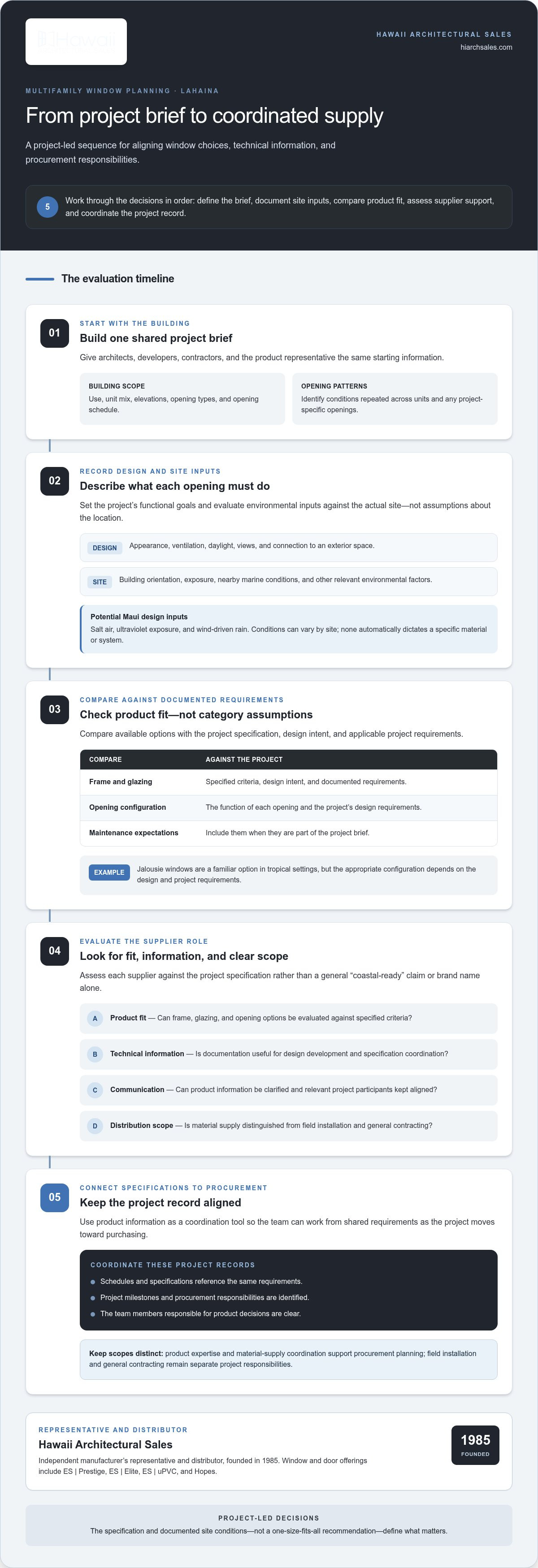
Choosing a window package for a multifamily project involves more than selecting a supplier. First define what each opening must do, how the building will be used, and how product decisions will move through specification and procurement. A clear brief gives a multi-family housing window supplier Lahaina teams can work with the details needed to evaluate product fit, rather than relying on assumptions about location or appearance.
Start with the building use, unit mix, elevations, opening schedule, and design priorities. Note the intended function of each opening, such as bringing in daylight, providing ventilation or views, or connecting a room to an exterior space. Jalousie windows are one familiar option in tropical settings, but the appropriate configuration depends on the design and project requirements. A general overview of window types and materials can help the team align terminology before evaluating specific systems.
What should a Lahaina multifamily window brief include?
Organize the brief so architects, developers, contractors, and the product representative are working from the same information. Include:
Building scope
Use, unit mix, elevations, and opening types. Identify conditions repeated across units and any project-specific openings.
Design priorities
Desired appearance, ventilation, daylight, views, and other functional goals.
Site inputs
Building orientation, exposure, nearby marine conditions, and other environmental factors relevant to product selection.
Coordination needs
Current specification documents, project milestones, procurement responsibilities, and the team members responsible for product decisions.
This brief helps identify what information is needed for product review and where decisions must appear in project documents. It also clarifies who coordinates product information and purchasing, keeping material supply distinct from installation and general contracting.
How do Maui conditions affect window planning?
Salt air, ultraviolet exposure, and wind-driven rain are potential design inputs, not automatic reasons to select a particular material or system. Conditions can vary from site to site, so evaluate products against the building’s actual exposure and documented requirements. Do not assume that one coastal product suits every elevation or property.
For a focused discussion of wind-related considerations, see the Hawaii hurricane-rated window technical guide. Use it alongside the project brief and applicable project documentation, not as a substitute for site-specific review.
Window planning starts with the building use, unit mix, elevations, opening schedule, design priorities, site exposure, project milestones, specifications, and procurement responsibilities.
Window Supplier Criteria for Lahaina Multi-Family Housing
Compare suppliers against the project specification, not a general claim that a window is “coastal-ready.” For a multifamily build, assess whether a supplier can connect product options and supporting information to documented requirements, communicate clearly with the design team, and coordinate material supply with procurement. These criteria help teams assess a multi-family housing window supplier Lahaina project by project, rather than relying on name recognition alone.
Product fit: Can available frame, glazing, and opening configurations be evaluated against the project’s specified criteria and design intent?
Technical information: Is product documentation organized and useful for design development and specification coordination?
Project communication: Can the product representative clarify product information and keep relevant project participants aligned?
Distribution scope: Are material supply and procurement coordination clearly distinguished from field installation and general contracting responsibilities?
Which window product factors belong in the comparison?
Compare frame and glazing options, opening configurations, and design requirements against the project documents. For example, repeated opening types across multiple units make consistent schedules and specification references especially useful. Include maintenance expectations when they are part of the project brief. Avoid ranking materials or configurations in the abstract. The specification and documented project criteria should define what matters.
What supplier support helps a multifamily team?
Product documentation is a coordination tool. When schedules, specifications, and product information refer to the same requirements, architects, developers, and contractors can work from a shared record. Clear technical representation during design development helps the team understand product options and identify information that needs to be reflected in project documents.
Hawaii Architectural Sales represents manufacturers and distributes architectural window and door systems, helping project teams connect product information with specification and procurement needs. Learn more about architectural window supply for Lahaina projects.
Comparing Window Options for Lahaina Multifamily Projects
Compare window options against the project brief, not a general claim that one material or system is best for every Lahaina building. Relevant criteria may include documented site exposure, design intent, opening function, and specified performance needs. Applying the same criteria to each option helps the team identify meaningful differences and keep selection decisions aligned with the building.
Let the project specification guide each product comparison, using manufacturer information to evaluate options against the stated requirements.
How should teams compare frame and glazing choices?
Start with the performance and design criteria documented for the project. Review frame and glazing options against those criteria, then consider how each choice relates to the building’s elevations, exposure, and intended appearance. Use the relevant manufacturer’s published product information to assess specific product claims. Do not assume a frame material or glazing choice meets a requirement simply because it is commonly used in coastal construction.
Apply the same discipline to configuration. Consider how the proposed system aligns with the opening schedule, room use, and design intent. If maintenance expectations are part of the project brief, include them in the comparison instead of relying on broad material generalizations. The result should be a documented, project-specific assessment, not a universal ranking.
When should a project consider different window configurations?
Room function and façade intent can help determine whether an opening should be operable or fixed. For example, the team may evaluate operable windows where ventilation is a design priority and fixed units where the opening primarily serves the façade or view. Larger openings need their own design review. Treat these as prompts for comparison, not recommendations independent of the project documents.
Keep window-system selection distinct from choosing a separate door system, even when both contribute to a shared façade design. Hawaii Architectural Sales’ architectural window and door portfolio includes ES | Prestige, ES | Elite, ES | uPVC, Euro-Wall, and Hopes. These products should be reviewed against the project requirements; their names alone do not establish which requirements a system meets. Compare the applicable product information with the specification.
For additional context on one part of the portfolio, review the ES | Prestige Hawaii window systems guide. Use product-specific information to inform the comparison, while tying final selection to the project’s documented criteria.
Coordinating Window Specifications and Supply for a Lahaina Build
A defined coordination sequence keeps window decisions connected to project documents and procurement planning. It also gives architects, developers, contractors, and a multi-family housing window supplier Lahaina teams can work with a shared process for identifying information gaps before they complicate product review or purchasing.
What steps help organize a multifamily window package?
Assemble the project brief.
Gather current drawings, opening schedules, design priorities, and documented performance requirements. Identify which information is final and which items still need resolution.
Review product options.
Compare relevant product categories and manufacturer information against the project criteria. Record the reason for each selection so decisions can be traced to the corresponding requirements.
Coordinate the specification.
Align product descriptions and supporting information with the project’s specifications and schedules. Architects can lead design documentation, while developers and contractors contribute sequencing and procurement needs.
Plan material procurement.
Map selected products to the project’s purchasing sequence and identify who is responsible for each coordination step. Keep material supply distinct from field installation and general contracting responsibilities.
Use this workflow to flag unresolved items early, such as missing opening information, unclear performance criteria, or product details that have not been coordinated with the documents. Assigning each question to the appropriate project participant helps prevent assumptions from becoming embedded in a schedule or specification.
How should teams handle local code and performance requirements?
Have the project’s design professionals determine which Hawaii and Maui County requirements apply to the specific building and confirm them against current project documents. Then compare product-specific claims with current manufacturer information and the project’s stated criteria. Broad statements about local conditions or product categories are not a substitute for this review.
Clear documentation supports a more precise conversation between the design team and product representative. It also makes it easier to identify what has been reviewed and what remains open without promising a particular compliance outcome. For additional context, consult the Hawaii window engineering compliance guide.
Hawaii Architectural Sales provides architectural window product expertise and material distribution for Hawaii projects. Review window product options with Hawaii Architectural Sales as your team coordinates specifications and procurement planning.
Work with Hawaii Architectural Sales on Lahaina Window Supply
Window selection for a multifamily project should reflect its drawings, design priorities, and documented requirements. Hawaii Architectural Sales is an independent manufacturer’s representative and distributor, providing product expertise to help project teams review architectural window and door options in relation to the building rather than rely on a one-size-fits-all recommendation.
The company represents and distributes systems including ES | Prestige, ES | Elite, ES | uPVC, Euro-Wall, and Hopes. Product representation helps architects, developers, and contractors understand relevant manufacturer information and coordinate it with project specifications. Material distribution supports procurement planning. Installation and general contracting remain separate responsibilities.
How does technical product representation support a project?
A product resource helps the team connect project needs to relevant manufacturer offerings. This can include organizing product information for review, aligning selected options with the project’s specification documents, and coordinating material distribution with procurement planning. For teams evaluating a multi-family housing window supplier Lahaina projects can use, the distinction matters: the supplier supports product selection and material supply, not field installation or construction management.
Early involvement can help the team identify information gaps while design and procurement decisions are being coordinated. Product choices remain guided by project requirements and applicable manufacturer documentation.
What should you prepare before discussing a window package?
A concise set of project materials makes the product discussion more specific. Gather the project location and building type, elevations, opening schedules, and current specification documents. Include design priorities and known performance requirements, along with open questions to resolve during product review.
With those materials in hand, the discussion can focus on which portfolio options merit consideration and how product information and material supply fit the project’s procurement sequence. This gives the design and development team a practical starting point without presuming that one system fits every opening or building.
A well-planned multifamily window package starts with project requirements, not brand preference. Define site conditions, design priorities, and documented performance needs, then compare product information against those criteria. Coordinating specifications and procurement early helps keep decisions clear across the project team.
Hawaii Architectural Sales is an independent manufacturer’s representative and distributor founded in 1985. Its window and door portfolio includes ES | Prestige, ES | Elite, ES | uPVC, Euro-Wall, and Hopes. Product expertise and material distribution support project-led selection and supply coordination, while installation and general contracting remain separate responsibilities.
For a multi-family housing window supplier Lahaina project teams can work with, prepare the project location, building type, drawings, opening schedules, and known requirements. Hawaii Architectural Sales supports projects in Lahaina, Honolulu, Lihue, Kailua-Kona, and Kihei. Discuss your Lahaina multifamily window project with Hawaii Architectural Sales to move your window package forward.
Frequently Asked Questions
What should I look for in a multi-family housing window supplier in Lahaina?
Look for product expertise, clear manufacturer information, and material distribution that aligns with your project documents and procurement sequence. A multi-family housing window supplier in Lahaina should connect product options to the building’s documented requirements rather than rely on broad claims about a product or material. Clarify the supplier’s role too: product representation and material supply are distinct from field installation and general contracting.
How do I choose windows for a multifamily building in Lahaina?
Start with the project specification, opening schedule, elevations, and design priorities. Compare frame and glazing options, configurations, and documented performance against those criteria. Consider how each opening will serve its room and façade, then use the relevant manufacturer’s product information to assess specific claims. Confirm applicable requirements with the project design professionals. Avoid choosing by brand name alone or assuming one window type is right for every building.
Are coastal conditions important when selecting Lahaina windows?
Yes. Site exposure can inform window planning, including potential salt air, ultraviolet exposure, and wind-driven rain. Evaluate these conditions for the specific site and building rather than treating them as a one-size-fits-all product rule. Give the design team location and exposure information, then compare options against the project’s documented needs and manufacturer information. Coastal context is one input in selection, not a substitute for project-specific review.
Can Hawaii Architectural Sales install windows for a Lahaina multifamily project?
No. Hawaii Architectural Sales is an independent manufacturer’s representative and distributor, providing product expertise and material distribution for architectural window and door systems. The company does not provide installation or general contracting. It supports product review and supply coordination in relation to project requirements, while field installation is handled separately through the project’s construction process. Keeping these roles distinct helps define scope and responsibilities across the build.
What information should I provide when requesting multifamily window product guidance?
Share the project location, building type, current drawings, elevations, and opening schedules. Include specification documents, design priorities, and known performance requirements, along with project milestones or procurement coordination needs. Identify unresolved questions too, such as openings that still need definition or requirements awaiting design-team review. An organized project package helps focus product discussions on relevant options and gives the team a clearer basis for specification coordination.
Which window brands does Hawaii Architectural Sales represent?
Hawaii Architectural Sales represents and distributes window offerings including ES | Prestige, ES | Elite, ES | uPVC, Euro-Wall, and Hopes. Product fit depends on the project brief and applicable manufacturer information, so compare these offerings against the building’s documented requirements rather than treating them as interchangeable. The company supports project teams in Lahaina, Honolulu, Lihue, Kailua-Kona, and Kihei with product expertise and material distribution.