Seismic Expansion Joints in Hawaii: Island Resilience 2026
Specifying a building's movement joints in the Pacific requires more than just meeting lateral displacement requirements; it is a direct confrontation with the most corrosive environment on the planet. For Hawaii architects and engineers, the challenge is twofold. You must specify seismic expansion...
Specifying a building's movement joints in the Pacific requires more than just meeting lateral displacement requirements; it is a direct confrontation with the most corrosive environment on the planet. For Hawaii architects and engineers, the challenge is twofold. You must specify seismic expansion joints Hawaii building codes mandate while ensuring components don't succumb to salt-air oxidation before the first maintenance cycle. We understand that balancing 2018 IBC compliance with 160 mph wind-load requirements often feels like a choice between engineering precision and long-term durability.
This technical guide provides a framework for specifying high-performance systems that withstand these unique tectonic and environmental demands. You'll learn how to integrate Balco QuakeSpan technology to accommodate multi-directional movement without compromising the building envelope. We also address the logistics of local technical support, providing a roadmap to reduce maintenance costs and ensure your specifications remain resilient through the 2026 code updates and beyond.
Key Takeaways
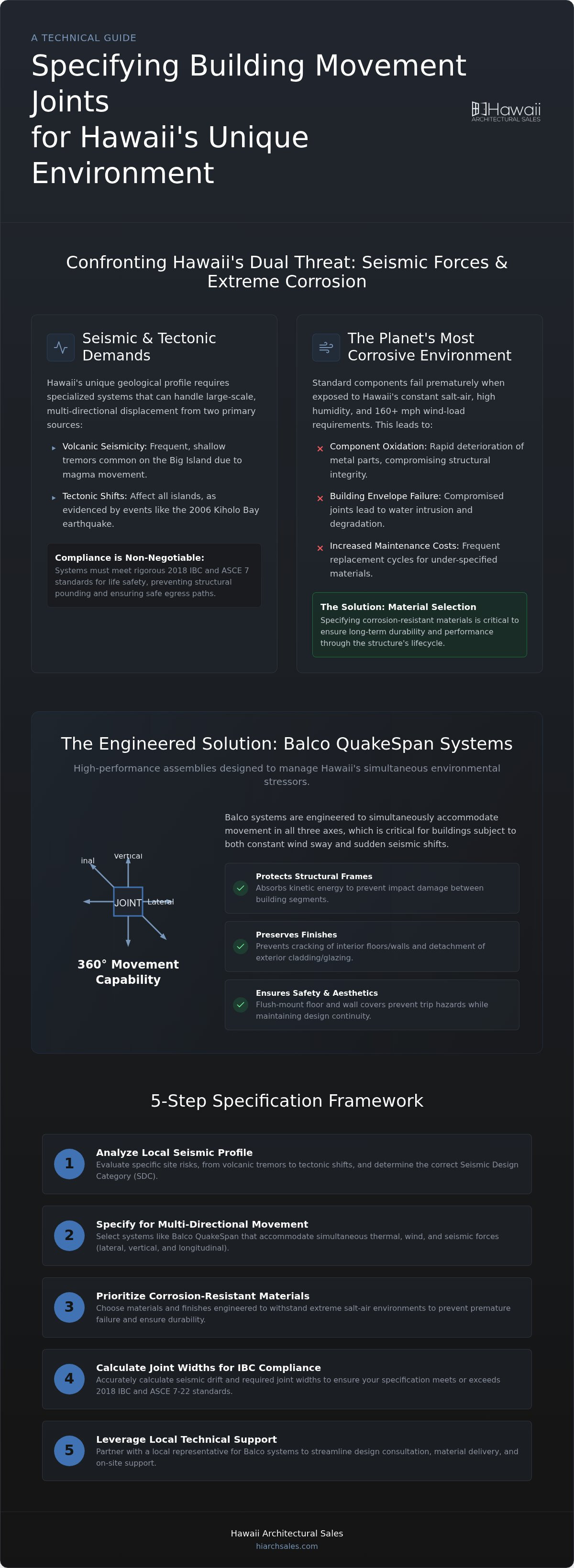
• Understand how Hawaii’s unique seismic profile, from volcanic activity to tectonic shifts, dictates specific building envelope requirements.
• Learn how to specify high-performance seismic expansion joints Hawaii projects require to accommodate simultaneous thermal, wind, and seismic movement.
• Discover why material selection is critical in coastal environments to prevent premature failure from extreme salt-air corrosion.
• Access a five-step specification framework to accurately calculate joint widths and ensure 2018 IBC compliance for island construction.
• Explore the benefits of partnering with a local technical representative for Balco systems to streamline design consultation and material delivery.
Understanding Seismic Movement Requirements in Hawaii’s Built Environment
Seismic expansion joints are specialized structural gaps designed to absorb the energy and movement generated during an earthquake. Unlike standard thermal joints, which primarily manage expansion and contraction from temperature changes, Understanding Expansion Joints in a seismic context requires planning for large-scale, multi-directional displacement. In commercial architecture, these systems are critical. They prevent adjacent building segments from "pounding" against each other during a tremor. This protection ensures the building envelope remains intact, preventing water intrusion and structural degradation after the shaking stops.
Specifying seismic expansion joints Hawaii projects require involves a deep understanding of local geological conditions. Standard thermal joints simply don't have the capacity for the lateral and vertical travel necessary in seismic-prone zones. Without the correct movement rating, a joint cover can buckle or detach. This creates hazards for occupants and leads to costly repairs for owners. High-performance systems protect several key areas:
• Structural frames from kinetic impact damage
• Interior finishes and floor coverings from cracking
• Exterior cladding and glazing from detachment
Tectonic vs. Volcanic Seismic Risks in Hawaii
Seismic hazards aren't uniform across the island chain. Specifying the correct seismic expansion joints Hawaii projects demand requires a localized approach. The Big Island faces volcanic seismicity, characterized by frequent and often shallow tremors related to magma movement. Conversely, older islands like Oahu and Kauai face tectonic risks. Historical events, such as the 2006 Kiholo Bay earthquake, remind us that seismic activity can impact any island. Localized knowledge is critical. A project in Lihue faces different soil conditions and seismic categories than one in Kailua-Kona. Architects must design for the specific peak ground acceleration of the site to ensure the specified hardware performs as expected.
Compliance with IBC and ASCE 7 Standards
Navigating the 2018 International Building Code (IBC) is a primary concern for Hawaii's design professionals. The code mandates that buildings be assigned a Seismic Design Category (SDC), which dictates the performance requirements for expansion joint covers. Recent updates in ASCE 7-22 have further refined how we calculate seismic drift. Code compliance is about more than just structural stability; it's about life safety. If a joint cover fails during an earthquake, it can block egress paths or create trip hazards. Specifying Balco hardware ensures that your project meets these rigorous standards while maintaining the aesthetic and functional requirements of the building envelope.
Engineering for Multi-Directional Movement: Balco Seismic Joint Systems
Balco is recognized globally for engineering precision in expansion control. Their systems are not merely covers; they are highly engineered assemblies designed to withstand the violent displacements of a seismic event. For high-performance seismic expansion joints Hawaii architects specify, the ability to handle multi-directional movement is non-negotiable. These systems must accommodate lateral shear, vertical displacement, and longitudinal expansion simultaneously to prevent structural pounding. Balco’s commitment to rigorous testing ensures that every assembly maintains its integrity under the most demanding movement cycles.
A critical feature of these systems is 360-degree movement capability. In Hawaii’s high-wind environment, building joints must manage constant building sway during storms while remaining ready for sudden tectonic shifts. Standard joints often fail because they lack the "give" required in all three axes. Balco engineered the QuakeSpan system specifically for these large-scale, multi-directional demands. By specifying these high-load performance systems, you ensure the building envelope remains resilient against both daily environmental stressors and rare seismic occurrences.
Floor, Wall, and Roof Expansion Joint Covers
Architects designing Honolulu’s commercial towers prioritize flush-mount floor covers to prevent trip hazards in high-traffic areas. These floor systems allow for significant seismic drift without creating obstructions for pedestrians. For walls and ceilings, Balco provides covers that maintain aesthetic continuity. This ensures that essential safety hardware doesn't compromise the interior design vision. Complex building footprints often require specialized roof-to-roof or roof-to-wall transitions. These solutions are vital for maintaining the building envelope's integrity and preventing water intrusion during Hawaii’s heavy rain events.
Heavy-Duty Systems for Public Infrastructure
Public infrastructure like airport terminals and parking garages requires heavy-duty solutions that go beyond standard architectural requirements. These environments demand systems capable of handling high wheel loads and frequent vibration without mechanical failure. Integrating fire-rated barriers with these joint covers is a critical step for life safety compliance. Balco’s fire barriers are tested to UL 2079 standards, providing a seamless safety solution when paired with their seismic covers. If you need assistance selecting the right model for your specific project requirements, consulting with a local technical specialist can help you navigate the complexities of high-load specification.
Overcoming Hawaii’s Environmental Challenges: Corrosion and Salt Air
Hawaii’s atmosphere is uniquely aggressive toward architectural metals. While movement ratings are vital for safety, the longevity of seismic expansion joints Hawaii projects depend on is determined by material science. Salt spray from the Pacific Ocean creates a highly conductive electrolyte that accelerates oxidation. If the specified metals aren't compatible or lack sufficient protection, the system can seize or fail structurally long before a seismic event occurs. This atmospheric reality means that durability is not a luxury; it's a fundamental requirement for building envelope integrity.
Preventing galvanic corrosion is a primary engineering concern in these assemblies. When dissimilar metals like aluminum and carbon steel touch in a salty, humid environment, an electrochemical reaction occurs. This often leads to "frozen" joints that cannot move during an earthquake. If a joint seizes, the energy from a tremor is transferred directly into the surrounding concrete or drywall, causing catastrophic failure of the interior finishes. We recommend specifying assemblies where fasteners and structural components are matched or isolated with non-conductive shims. Regular maintenance remains essential; clearing salt deposits from joint cavities prevents the abrasive buildup that can degrade seals and mechanical parts.
Material Selection: Aluminum vs. Stainless Steel
For projects within 3,000 feet of the shoreline, 316 stainless steel is the gold standard. It offers superior resistance to chloride-induced pitting and crevice corrosion compared to 304 stainless steel. In less aggressive zones, high-quality anodized aluminum provides a durable, cost-effective alternative. The anodization process creates a thick oxide layer that resists the elements while allowing for a range of architectural finishes. Waterfront developments in Honolulu require expansion joint components that have successfully passed a minimum of 3,000 hours of salt-spray testing to guarantee long-term performance in a high-chloride environment.
Seals and Gaskets in Tropical Climates
Tropical environments present a different set of challenges for non-metallic components. High UV exposure in Hawaii can cause standard gaskets to become brittle and crack within years. Specifying UV-stabilized silicone or specialized EPDM seals is necessary to maintain flexibility under the intense Pacific sun. Additionally, the constant humidity promotes mold and mildew growth within joint cavities. We specify antimicrobial treatments for seals to prevent biological degradation that can compromise the air barrier. Ensuring complete water-tightness is non-negotiable; driving rain can force moisture into the structure if the seismic joint doesn't maintain a perfect seal during wind-induced building sway.
How to Specify the Right Seismic Joint System for Hawaii Projects
Successful specification requires a methodical approach that aligns structural requirements with environmental realities. For seismic expansion joints Hawaii architects must follow a rigorous process to ensure long-term performance. This 5-step framework serves as a roadmap for selecting the correct Balco system:
Identify the Seismic Design Category (SDC)
Determine the building's risk category based on site-specific seismic data.
Calculate Total Movement
Combine predicted seismic drift with thermal expansion and wind sway.
Evaluate Environmental Exposure
Assess the proximity to the coast to determine if 316 stainless steel or anodized aluminum is required.
Select Cover Type
Choose between flush-mount, recessed, or heavy-duty covers based on floor finishes and traffic loads.
Precision in calculating the required joint width is the most critical phase of this process. It is not enough to simply meet the minimum requirements of the 2018 IBC. Architects should collaborate early with structural engineers to define the maximum expected displacement. In many cases, over-specifying the joint width by a small margin can significantly reduce the risk of structural pounding during a major event. This foresight often saves ownership substantial costs in post-event repairs and building downtime.
Calculating Movement and Joint Width
Determining displacement requirements involves more than looking at seismic tables. You must account for the thermal expansion and contraction inherent in Hawaii’s large-scale concrete structures. While the temperature range in the islands is relatively stable, the sheer volume of material in commercial developments leads to significant cumulative movement. By calculating these variables together, you ensure the joint remains functional in all conditions. This collaborative effort between the design team and the structural engineer prevents the specification of undersized hardware that could fail under stress.
Aesthetic Integration and Surface Finishes
Specifying a high-performance system doesn't mean sacrificing the design vision. Balco offers recessed covers that allow for the installation of stone, tile, or carpet directly into the joint plate. This creates a "hidden" look that maintains the aesthetic continuity of high-end interior spaces. Coordination with a professional architectural window distributor Hawaii is also essential for exterior applications. This ensures that the building envelope remains watertight where seismic joints meet window mullions and cladding systems. For personalized assistance with your project’s unique requirements, contact our technical team for a specification review.
Technical Representation and Support: Partnering with Hawaii Architectural Sales
Selecting the right hardware is only half the challenge; ensuring that specialty components are correctly integrated into the project workflow is equally vital. Hawaii Architectural Sales serves as the authorized representative for Balco, providing the localized expertise necessary to implement the seismic expansion joints Hawaii projects require. We act as a critical link between mainland manufacturing precision and the unique logistical demands of island construction. By positioning ourselves as technical consultants rather than mere distributors, we help architects navigate the complexities of high-performance building envelope systems.
Our role is to streamline the path from specification to delivery. Because specialty building components often involve long lead times and complex shipping requirements, having a local partner is essential for maintaining project schedules. We understand the specific environmental and regulatory pressures facing Hawaii’s design professionals. This localized knowledge allows us to offer pragmatic solutions that prioritize reliability and long-term value. We ensure that every specified system meets the rigorous demands of the Pacific environment while adhering to the latest safety standards.
Local Expertise for Global Brands
Since our founding in 1985, we've spent over 40 years supporting Hawaii’s architectural and engineering communities. We provide direct technical support for developers and architects across Honolulu, Lihue, and Kona. This long-standing presence allows us to bridge the distance between Balco’s engineering team and your local jobsite. When you work with us, you gain direct access to factory-level technical resources through a partner who understands local soil conditions, salt-air challenges, and building codes. We simplify the procurement process for specialty items, ensuring that the transition from design intent to physical material is seamless and efficient.
Project Consultation and Support
Technical support starts during the earliest phases of design and continues until the material is successfully delivered to the site. We assist architectural teams by reviewing submittals and technical drawings to ensure that seismic expansion joints Hawaii specifications are accurate and code-compliant. This proactive coordination between architects, structural engineers, and general contractors helps identify potential conflicts before they reach the field. While we don't provide installation services, we offer the technical guidance necessary for contractors to handle Balco systems with confidence. Our reviews focus on ensuring that the building envelope remains intact and functional for the life of the structure. Contact us today for a comprehensive technical review of your project's expansion joint requirements.
Securing Future Stability with Engineered Resilience
Designing for Hawaii’s built environment requires a dual focus on seismic safety and environmental durability. We've examined how specifying the correct seismic expansion joints Hawaii projects demand involves more than just meeting lateral drift requirements. It requires a commitment to high-performance materials like 316 stainless steel to combat salt-air corrosion and a methodical approach to calculating multi-directional movement. By integrating these technical considerations into your early design phases, you ensure that the building envelope remains resilient against both daily environmental stressors and infrequent tectonic events.
As the authorized Balco representative in Hawaii, Hawaii Architectural Sales provides the localized knowledge necessary to bridge the gap between complex engineering and practical island application. With over 40 years of experience, we offer specialized technical support to help you navigate strict building codes and specialty material procurement. We invite you to Request a Technical Consultation for Balco Seismic Joints to review your project's specific requirements. Together, we can build structures that stand the test of time and nature.
Frequently Asked Questions
What is the difference between a thermal and a seismic expansion joint?
Seismic joints are designed to accommodate large, multi-directional displacements, including lateral shear and vertical movement. Thermal expansion joints primarily manage the smaller, linear expansion and contraction caused by temperature fluctuations. While thermal joints protect against daily structural stress, seismic systems are engineered to prevent structural pounding and maintain life safety during significant earth vibrations. Specifying seismic expansion joints Hawaii projects require ensures the building envelope remains intact during extreme tectonic events.
Are Balco expansion joints compliant with Hawaii's current building codes?
Yes, Balco systems are engineered to meet the 2018 International Building Code (IBC) and ASCE 7 requirements adopted across the islands. These systems undergo rigorous testing to ensure they satisfy the Seismic Design Category (SDC) assigned to specific project sites. We provide all necessary technical documentation and performance data to support your submittal process. This ensures your specification remains compliant with local amendments and high-wind resilience standards.
How do I choose the right finish for an expansion joint in a high-salt environment?
Material selection is critical for preventing premature failure due to salt-air corrosion. For coastal projects, we recommend specifying 316 stainless steel or high-quality clear anodized aluminum. These materials offer superior resistance to chloride pitting and oxidation compared to standard architectural metals. Selecting the correct finish ensures the joint assembly remains mechanically functional and aesthetically consistent throughout the building's lifecycle in Hawaii’s aggressive marine climate.
Can seismic expansion joints be fire-rated?
Yes, seismic joint assemblies can be integrated with specialized fire-rated barriers to maintain code-mandated safety. Balco offers fire barriers tested to UL 2079 standards that move in tandem with the joint cover. This integration ensures that the fire protection remains continuous even during significant building displacement. You don't have to choose between seismic resilience and fire safety; both can be achieved through a single, coordinated specification.
Do you provide installation services for Balco expansion joints in Hawaii?
Hawaii Architectural Sales is a manufacturer’s representative and distributor; we don't provide installation services or general contracting. We specialize in providing technical expertise and material procurement for architects, engineers, and developers. While we provide the hardware and technical guidance, the physical installation is handled by general contractors or specialty subcontractors. We are available to consult with the project team to ensure the system is correctly specified for the site conditions.
What information do I need to provide for a seismic joint quote?
To provide an accurate quote for seismic expansion joints Hawaii applications, we require the nominal joint width and the total expected movement. Please also specify the surrounding floor or wall finishes and whether fire rating or moisture barriers are necessary. Providing structural drawings or specification sections allows our technical team to recommend the most efficient Balco system for your project’s unique demands. This precision helps avoid costly delays during the procurement phase.
How do I calculate the joint width needed for my Honolulu project?
Joint width calculation must be led by the structural engineer’s predicted seismic drift and thermal movement data. You must account for the maximum displacement in all directions to prevent adjacent building segments from impacting one another. It's often beneficial to slightly over-specify the width to ensure the hardware can handle extreme events without failure. Our technical team can review your drift calculations to help select the Balco system that best fits the required gap.
Are there ADA-compliant seismic joint covers for high-traffic areas?
Yes, Balco manufactures several flush-mount seismic joint covers that are fully ADA-compliant. These systems provide a smooth, level transition across floor gaps to eliminate trip hazards in high-traffic environments like hospitals and airport terminals. They maintain accessibility for all occupants while still allowing for significant lateral movement during a seismic event. This ensures that your building remains safe and accessible without compromising on essential structural performance.