Sourcing Building Products for Hawaii: Strategic Guide
Over 80% of Hawaii's buildable ridgelines and windward microclimates require impact-resistant fenestration rated for wind speeds between 130 mph and 160 mph. If you're an architect or engineer, you've likely seen how quickly standard mainland materials fail under the pressure of salt-air corrosion a...
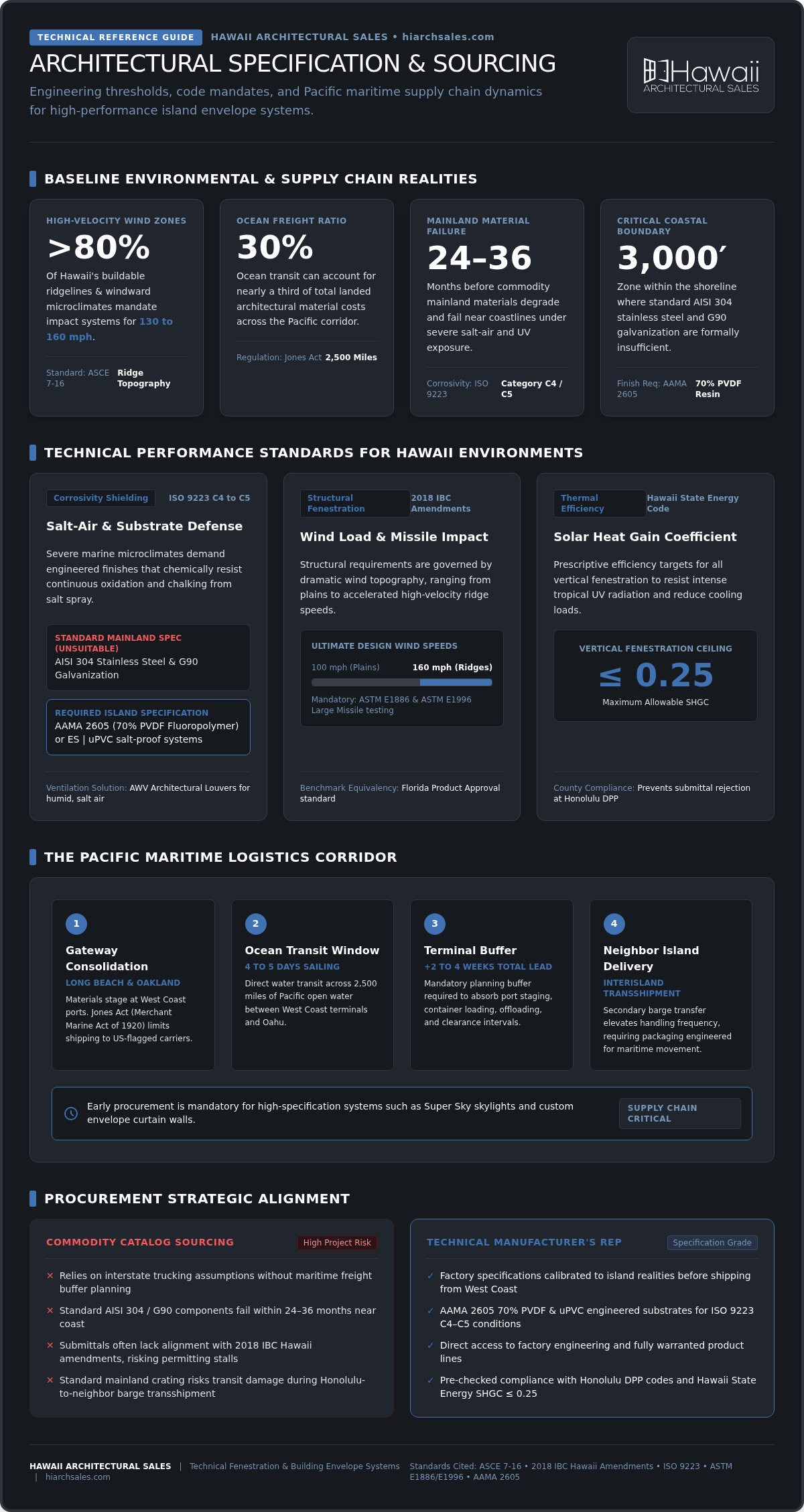
Over 80% of Hawaii's buildable ridgelines and windward microclimates require impact-resistant fenestration rated for wind speeds between 130 mph and 160 mph. If you're an architect or engineer, you've likely seen how quickly standard mainland materials fail under the pressure of salt-air corrosion and localized hurricane codes. Successfully sourcing building products for Hawaii projects is a technical challenge that demands more than a simple catalog order. It requires a strategic approach to a supply chain where ocean freight can account for 30% of material costs and the environment is unforgiving.
We understand that your primary goals are ensuring long-term durability and maintaining a predictable delivery schedule. This guide will help you master the complexities of Hawaii's unique supply chain and environmental standards to source high-performance architectural systems that last. We'll examine how to meet strict wind load requirements, mitigate extreme marine corrosivity, and select local technical partners who can streamline your project from initial specification to final delivery on the job site.
Key Takeaways
• Understand how geographical isolation and Jones Act logistics impact lead times and overall landing costs for architectural materials.
• Learn to specify finishes and systems that resist severe marine corrosivity and meet Hawaii’s unique thermal performance requirements.
• Discover why sourcing building products for Hawaii projects through a technical manufacturer’s representative is essential for securing valid warranties and factory engineering.
• Streamline your submittal process by involving local technical consultants during the design phase to navigate strict county-level building codes.
• Gain direct access to high-performance architectural systems from premier global manufacturers through Hawaii Architectural Sales.
Navigating the Unique Challenges of the Hawaii Building Supply Chain
Hawaii's geographic isolation dictates every facet of architectural procurement. Unlike mainland projects where a logistics coordinator might rely on interstate trucking, successfully sourcing building products for Hawaii projects involves a complex maritime relay across 2,500 miles of ocean. Standard mainland sourcing models frequently fail here because they don't account for the specialized handling required for high-end architectural systems. Local representation acts as a critical bridge. A technical partner ensures that factory specifications align with island realities before a single container is loaded at a West Coast terminal.
Logistics and Lead Times in the Pacific
Lead times for customized architectural glazing and envelope systems must include a significant buffer for ocean transit and port logistics. While the actual sailing time from West Coast gateways like Long Beach or Oakland is typically 4 to 5 days, the total lead time from factory to site often extends by 2 to 4 weeks due to consolidation and terminal staging. All domestic maritime commerce is governed by the Merchant Marine Act of 1920 (Jones Act), which limits shipping to US-flagged vessels and concentrates the market among a few primary carriers. For long-lead items like Super Sky skylights or custom curtain walls, early-stage procurement is mandatory to avoid project stagnation. You must also account for secondary transshipment risks. Moving materials from Honolulu to neighbor islands via interisland barge increases handling frequency, which elevates the risk of material damage if packaging isn't specifically engineered for maritime transport.
Regulatory Compliance and Local Building Codes
Compliance in Hawaii requires navigating a specific set of amendments to the 2018 International Building Code (IBC). These regulations address the state's extreme wind topography and tropical climate. Many architects use Florida Product Approval as a benchmark for local compliance. Because Florida shares similar hurricane risks, products with these certifications often meet the impact-resistance standards required for Hawaii’s ultimate design wind speeds, which can reach 160 mph on elevated ridges. Energy efficiency is another hurdle. The Hawaii State Energy Code mandates a maximum Solar Heat Gain Coefficient (SHGC) of 0.25 for vertical fenestration. Sourcing building products for Hawaii projects through a technical representative ensures that your submittals meet these prescriptive thresholds. This proactive approach prevents the costly delays associated with rejected submittals during the county-level permitting process at departments like Honolulu’s DPP.
Technical Performance Standards for Hawaii’s Environmental Demands
Hawaii’s environmental demands are among the most rigorous in the world. Standard mainland materials often degrade within 24 to 36 months when sited near the coastline. Successfully sourcing building products for Hawaii projects requires a shift toward materials engineered for ISO 9223 Category C4 to C5 marine atmospheric corrosivity. Standard AISI 304 stainless steel and G90 galvanization aren't sufficient for projects within 3,000 feet of the ocean. Architects must prioritize materials that chemically resist oxidation and withstand intense tropical UV radiation.
Corrosion Resistance and Salt-Air Durability
Selecting the right substrate is the first step in ensuring project longevity. ES | uPVC systems offer a non-conductive, salt-proof alternative to traditional metals, making them ideal for coastal multi-family developments. When aluminum is specified, it requires high-performance powder coatings or anodized finishes that meet AAMA 2605 specifications. These 70% PVDF (fluoropolymer) finishes protect the substrate from pitting and chalking caused by constant salt spray. AWV architectural louvers provide a specialized solution for airflow. They manage high-volume ventilation while maintaining structural integrity in humid, salt-heavy air. This technical specificity prevents the premature finish failure common in commodity-grade products.
High Wind Load and Hurricane Impact Ratings
Structural requirements in the islands are dictated by complex wind topography. Ultimate design wind speeds range from 100 mph in protected plains to over 160 mph on elevated ridges. You should consult the Hawaii State Building Code Council guidelines to ensure your project complies with current ASCE 7-16 standards. Glazed openings in high-velocity zones must provide impact protection tested to ASTM E1886 and E1996 Large Missile standards. Sourcing hurricane rated windows in Hawaii is a primary concern for high-end residential and commercial projects. Systems from Euro-Wall and ES | Prestige are specifically engineered for these conditions. They offer the structural performance needed for large-span openings without sacrificing the thin-profile aesthetics preferred in modern island design. For specialized assistance with these technical specifications, you can consult with Hawaii Architectural Sales to ensure your envelope meets local code.
Thermal Performance and UV Protection
Hawaii sits entirely within IECC Climate Zone 1. Sourcing building products for Hawaii projects involves meeting a maximum Solar Heat Gain Coefficient (SHGC) of 0.25 to manage interior cooling loads. High UV exposure also threatens the longevity of interior finishes and sealants. Utilizing systems like Kalwall provides diffused natural light while offering superior thermal insulation, which reduces the reliance on mechanical cooling. Selecting materials based on these prescriptive energy thresholds ensures long-term operational efficiency and occupant comfort in a tropical climate.
Evaluating Distribution Models: Manufacturer Reps vs. Commodity Suppliers
Architects and engineers often face a choice between the convenience of local commodity suppliers and the technical depth of manufacturer representatives. While a retail lumberyard is suitable for standard framing materials, sourcing building products for Hawaii projects that involve complex architectural envelopes requires a different level of expertise. Commodity suppliers typically operate on a high-volume, low-technical-support model. In contrast, a technical manufacturer's representative acts as a consultant. They bridge the gap between high-end factory engineering and the practical application on an island job site. This distinction is critical for maintaining the integrity of the design and the validity of long-term warranties.
The financial logic of the distribution model also impacts the project's bottom line. According to the UHERO Hawaiʻi Housing Factbook, the high cost of construction in the islands is driven by both logistical hurdles and material pricing dynamics. At the retail or contractor level, material procurement is subject to a cumulative General Excise Tax (GET) pass-on rate of 4.712%. By working with a technical representative, developers can often facilitate direct manufacturer shipments. This strategy reduces cascading tax markups and bypasses the additional handling fees associated with third-party warehousing.
The Value of Technical Product Representation
A technical representative provides essential design-assist services that a retail yard cannot match. When you're vetting an architectural window distributor in Hawaii, the most important factor is their ability to provide stamped engineering submittals and shop drawings. This support is vital for brands like Hopes or ES | Elite, where custom glazing must meet specific wind load $K_{zt}$ calculations. Having an on-island partner means you have access to technical troubleshooting during the critical stages of the specification-to-delivery pipeline.
Coordinating Specialty Systems
Specialty architectural systems require precise coordination to ensure they interface correctly with the rest of the building envelope. For example, integrating Kalwall translucent panels or Super Sky skylights involves more than just a purchase order; it requires a deep understanding of thermal expansion and waterproofing. Similarly, Balco expansion joint systems are highly technical components that demand specialized knowledge to specify correctly for seismic and thermal movement. Sourcing building products for Hawaii projects through an authorized representative ensures that these high-performance systems are backed by factory-direct technical support, ensuring they perform as intended in our unique environment.
A Strategic Sourcing Roadmap for Large-Scale Island Projects
Large-scale development in the islands requires a departure from standard procurement timelines. Successfully sourcing building products for Hawaii projects begins during the design development phase rather than waiting for construction documents. By involving technical representatives early, you can identify potential code conflicts or logistical bottlenecks before they impact the critical path. This proactive integration ensures that the building envelope is both technically sound and logistically feasible. It also allows for a more streamlined submittal process, as technical data is vetted for local compliance long before the contractor issues a purchase order.
Planning for Long-Lead Architectural Components
Custom architectural glazing and door systems often represent the most significant lead-time risks in an island project. For premium brands like Euro-Wall or Hopes, fabrication cycles must be meticulously synchronized with local project milestones. You should account for the fact that architectural glass lead times are sensitive to global supply chain shifts and maritime schedules. Managing the logistics of oversized skylights or curtain wall components requires specialized coordination. These items frequently necessitate dedicated containers and specialized offloading equipment at Honolulu or Lihue harbors. Identifying these "critical path" items early prevents the costly delays associated with waiting for the building envelope to be closed in.
Ensuring Performance Alignment with Design Intent
Technical data sheets must undergo rigorous review to ensure they meet both aesthetic goals and structural compliance. Verifying that sourced products align with the architect's vision while maintaining a maximum SHGC of 0.25 is a delicate balance. A strategic roadmap involves a multi-step verification process:
• Reviewing structural submittals for site-specific wind speed-up factors ($K_{zt}$).
• Cross-referencing finish specifications with AAMA 2605 requirements for salt-air durability.
• Confirming that all hardware and fasteners meet Marine Grade 316 stainless steel standards.
• Balancing high-performance requirements with the project’s specific budget constraints.
Once materials arrive in Honolulu or Lihue, immediate protection is vital. Standard mainland packaging is rarely sufficient for long-term on-site storage in Hawaii’s high-humidity, salt-heavy environment. Coordination between the representative and the contractor ensures that materials are moved to a secure, shielded environment immediately upon discharge from the port. This final step in the pipeline prevents the environmental degradation that can occur before the first unit is even installed. For expert guidance on planning your next development, contact Hawaii Architectural Sales to speak with a technical consultant.
Leveraging Expert Technical Support for Your Hawaii Project
Successful sourcing building products for Hawaii projects requires more than just a logistical plan. It demands a partnership with a representative who understands the intersection of high-performance manufacturing and island-specific environmental stressors. Since 1985, Hawaii Architectural Sales has provided this technical bridge for architects and engineers across the islands. We don't just supply materials; we act as a strategic ally throughout the project lifecycle. This localized expertise is vital in the 2026 market. Supply chain volatility and evolving energy codes require precise material selection to avoid costly field failures or permitting rejections.
Partnering with Hawaii Architectural Sales
Our portfolio consists of premium brands that have been rigorously tested for the Pacific environment. By partnering with us, you gain direct access to systems from ES | Prestige, Euro-Wall, and Hopes. These manufacturers provide the structural and aesthetic performance required for high-end hospitality and luxury residential developments. We also provide specialized technical guidance for the integration of AWV louvers, Balco expansion joints, and Kalwall translucent panels. Our team provides the design-assist support necessary to integrate these components into a cohesive, high-performance building envelope. This level of support ensures that every component is backed by a valid manufacturer warranty and factory engineering.
Streamlining the Specification Process
Efficiency in the specification phase prevents downstream delays in the delivery pipeline. Our process is designed to move your project from initial design to final material procurement with professional ease. We provide the technical data, physical samples, and stamped engineering submittals required for county-level plan reviews. This support ensures that your project meets the 0.25 SHGC thresholds and high-velocity wind load requirements discussed in previous sections. Utilizing our technical expertise during the design development phase helps you avoid the common pitfalls of island procurement.
To begin the process, you can request technical specifications or physical samples directly from our team for your specific project. We offer sourcing solutions that account for your unique site conditions, whether you're building on a windward ridge or a coastal plain. Contacting our team early allows us to secure production slots and coordinate the complex maritime logistics required for a successful island delivery. We remain committed to helping you navigate the technical demands of the Hawaii market. Our goal is to ensure your architectural vision is realized with long-term durability and technical precision.
Securing Longevity for Your Next Island Development
Successful sourcing building products for Hawaii projects is defined by technical precision and proactive logistics. By prioritizing materials like ES | Prestige or Euro-Wall that meet AAMA 2605 standards, you ensure your building envelope survives the Pacific's extreme corrosivity. Moving beyond a commodity procurement model allows you to leverage factory engineering and local technical support, bridging the gap between design intent and on-site reality. Since 1985, we've helped architects navigate these complexities while ensuring full compliance with the Hawaii State Building Code.
Managing the maritime supply chain doesn't have to be a project bottleneck. As an authorized distributor for premium systems including Kalwall and Hopes, we provide the localized knowledge needed to streamline your delivery timeline. Our role is to serve as a strategic ally, providing the submittals and samples required to move from initial specification to a finished structure that lasts. Partner with the technical experts at Hawaii Architectural Sales for your next project. We look forward to helping you build a more resilient future in the islands.
Frequently Asked Questions
Is it safe to source standard mainland building products for Hawaii projects?
It's generally not safe or cost-effective to use standard mainland materials in the islands. Standard finishes often fail within 24 to 36 months due to extreme salt-air corrosivity and high UV exposure. Sourcing building products for Hawaii projects through a local expert ensures materials are rated for ISO 9223 Category C4 to C5 environments. We recommend prioritizing AAMA 2605 coatings and Marine Grade 316 stainless steel to prevent premature degradation and warranty voidance.
What are the typical lead times for architectural windows in Hawaii?
Lead times for customized architectural glazing typically range from 12 to 24 weeks depending on the manufacturer's current production schedule. You must also account for a minimum of 2 to 4 weeks for maritime logistics and port handling. Transit from West Coast gateways like Long Beach involves 4 to 5 sailing days; however, terminal staging and interisland transshipment add significant time. Early design-phase involvement is critical to secure production slots for premium brands like ES | Prestige.
How do I ensure products meet Hawaii's strict hurricane and wind load codes?
You must verify that all fenestration complies with the 2018 International Building Code (IBC) and ASCE 7-16 standards as amended by the Hawaii State Building Code Council. This involves calculating site-specific topographic wind speed-up factors ($K_{zt}$). Sourcing through an authorized representative provides access to stamped engineering submittals. These documents confirm that systems like Euro-Wall or ES | Elite meet the 130 mph to 160 mph wind speed requirements common in Honolulu and Kailua-Kona.
What is the difference between a manufacturer's representative and a general supplier?
A manufacturer's representative like Hawaii Architectural Sales acts as a technical consultant rather than a simple retail vendor. While general suppliers focus on high-volume commodity sales, a representative provides design-assist services, shop drawings, and direct factory engineering support. This specialized model is essential for complex systems like Balco expansion joints or Kalwall daylighting panels. We bridge the gap between high-end manufacturing and the specific technical requirements of large-scale island developments.
How does salt air affect architectural aluminum and steel systems?
Salt air causes rapid pitting, oxidation, and structural breakdown in standard metal finishes that aren't engineered for marine environments. Standard G90 galvanization and AISI 304 stainless steel often suffer visible failure within two years in coastal zones. To maintain long-term durability, architectural systems require 70% PVDF (fluoropolymer) coatings and Marine Grade 316 stainless steel hardware. These specifications protect the substrate from the severe atmospheric corrosivity found in Honolulu, Lihue, and other windward coastal regions.
Can I source energy-efficient glazing for tropical climates that also meets wind standards?
Yes, you can specify high-performance systems that satisfy both tropical energy codes and hurricane standards. Hawaii’s Energy Conservation Code mandates a maximum Solar Heat Gain Coefficient (SHGC) of 0.25 to manage interior cooling loads. Sourcing building products for Hawaii projects through our team allows you to select impact-rated glass featuring advanced low-E coatings. Brands like ES | Prestige offer the structural integrity needed for high-velocity wind zones without compromising the thermal efficiency required for IECC Climate Zone 1.
Does Hawaii Architectural Sales provide installation services for the products they sell?
No, Hawaii Architectural Sales doesn't provide installation or general contracting services. We operate strictly as a specialized manufacturer's representative and distributor focused on technical product expertise and material supply. Our role is to support architects, engineers, and contractors by providing the high-performance architectural systems and engineering data required for project success. We focus on providing the technical bridge between premium global manufacturers and the local construction industry across the islands.
Which architectural brands are best suited for high-end coastal residences in Honolulu?
Brands like Euro-Wall, Hopes, and ES | Prestige are engineered specifically for the demands of high-end coastal projects. Euro-Wall provides expansive folding and sliding glass walls with high wind-load ratings and impact resistance. Hopes offers the timeless aesthetic of solid hot-rolled steel with modern thermal performance. For projects requiring maximum salt-proof durability, ES | uPVC systems provide a non-conductive alternative that resists corrosion. These brands deliver the thin-profile aesthetics and reliability required for Honolulu’s luxury residential market.