Turtle Glass Windows in Hawaii: Regulations, Lighting, and Design Guidance
What if the key to turtle-conscious window design isn’t a special type of glass? The phrase “turtle glass windows Hawaii regulations” can suggest a statewide glazing mandate, but sea-turtle protections in Hawaii focus primarily on artificial light and how it reaches the beach. Choosing a window by l...
What if the key to turtle-conscious window design isn’t a special type of glass? The phrase “turtle glass windows Hawaii regulations” can suggest a statewide glazing mandate, but sea-turtle protections in Hawaii focus primarily on artificial light and how it reaches the beach. Choosing a window by label alone won’t answer the project’s actual lighting, site, or permitting questions.
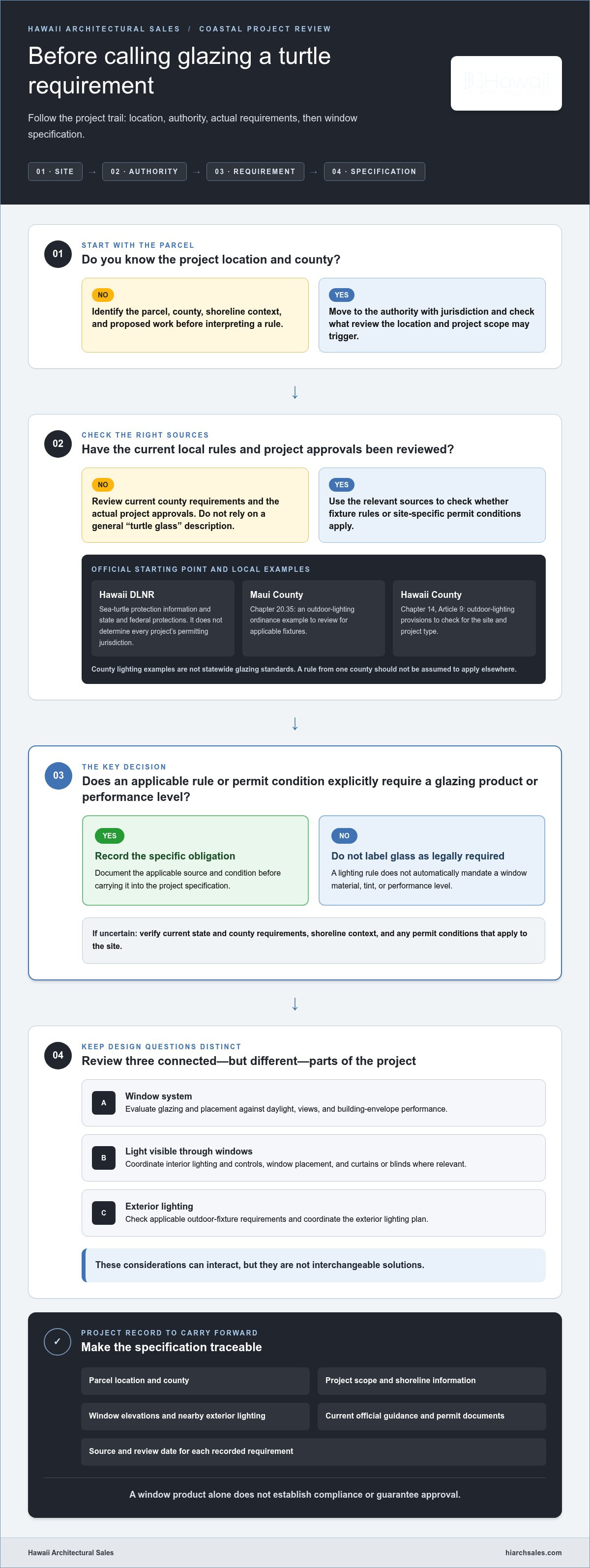
Before selecting glazing, identify the project’s location and review the requirements that apply there. County rules and coastal conditions can affect project review. Glass performance, light visible through windows, and exterior fixture requirements are related design considerations, but they are not interchangeable. A tint recommendation is not automatically a legal requirement, and a window product alone does not establish compliance.
This guide explains how to distinguish glazing decisions from turtle-sensitive lighting requirements, what to document during project review, and how to compare window-system information with the project brief. The goal is a clear specification based on site conditions and applicable requirements, not an oversimplified interpretation of “turtle glass.”
Key Takeaways
• Interpret “turtle glass windows Hawaii regulations” in context: identify the project location and verify current rules before treating glazing as a compliance requirement.
• Review window performance, interior light visible outdoors, and exterior lighting as separate design questions. Each may call for different documentation.
• Identify the county and permitting authority, then record applicable requirements and guidance before finalizing specifications.
• Separate mandatory obligations from voluntary design choices and broader performance goals in project documents.
• Compare window-system documentation with the project’s code, site, performance, and design criteria. Do not assume a product guarantees approval.
Turtle Glass Windows in Hawaii: What the Term Means, and What It Does Not
“Turtle glass” is an ambiguous search phrase, not a specification to treat as a legal product category. For coastal projects, sea-turtle concerns may involve artificial lighting, the site’s relationship to the shoreline, and project-specific permit conditions. Review the requirements for the location before translating a concern into a glazing specification.
Definition: Turtle-sensitive design considers how a project’s lighting and site conditions may affect sea turtles. The term does not, by itself, identify a named glazing standard or establish a universal window requirement.
Does Hawaii require a specific type of turtle glass?
Do not assume either that a particular glass is required or that glazing is irrelevant. The phrase turtle glass windows Hawaii regulations can blur an important distinction: a rule about artificial lighting does not automatically mandate a window material, tint, or performance level. Review current state and county requirements, the project’s shoreline context, and any permit conditions that apply to the site.
Requirements can vary by location and project. A coastal parcel may receive review that does not apply to a site farther inland. Identify the authority with jurisdiction and read the rules and approvals that apply before relying on a general description of “turtle-safe” design. This helps distinguish documented obligations from recommendations and design preferences.
Why windows can still matter to a coastal project
Windows affect daylight, views, and building-envelope performance. Their placement, size, and glazing characteristics also shape how interior spaces connect visually with the outdoors. If interior light is visible outside, that is a coordination issue for the project team, but it does not establish that a glass-specific law applies.
Artificial light can have broader ecological effects, as summarized in this overview of the ecological impact of artificial light. For a building, several decisions may interact: window placement and glazing, interior lighting and its controls, curtains or blinds, and exterior luminaires. These are not interchangeable solutions. A lighting rule may address fixtures, while the project team separately considers how to manage light visible through windows.
Keep those decisions distinct in the specification. Record the verified requirements for the site, then evaluate glazing against the project’s daylight, view, and envelope goals. Do not assign a turtle-protection threshold to glass unless an applicable authoritative requirement or documented project criterion supports it.
Which Hawaii Authorities and Rules May Affect Turtle-Sensitive Window Projects?
Start with the parcel, not a broad label such as “coastal” or “turtle glass.” Identify the county, shoreline context, proposed work, and permitting authority before interpreting a requirement. A rule for outdoor fixtures may affect the lighting plan without creating a glazing mandate. Permit conditions can add project-specific requirements, so review the actual approvals rather than relying on statewide assumptions.
Hawaii’s Department of Land and Natural Resources (DLNR) provides official sea-turtle protection information, including state and federal protections. Its guidance is a useful starting point, but it does not replace a county code review or determine every project’s permitting jurisdiction. See Hawaii state law and DLNR sea-turtle guidance, then verify the local rules and conditions that apply to the parcel.
How county, shoreline, and permit conditions shape review
County rules can differ. Maui County’s outdoor-lighting requirements and Hawaii Island’s lighting ordinance are examples of local rules to review for exterior fixtures. They are not statewide glazing standards. For each site, verify current county planning and permitting requirements, shoreline boundaries, and whether the project’s scope or location triggers additional review. A rule from one county should not be assumed to apply elsewhere.
Authority or source
Question to resolve
Source date
Hawaii DLNR, sea-turtle guidance
What official state and federal protections or lighting guidance are relevant? This does not determine county permitting jurisdiction.
Reviewed October 2026
Maui County Code, Chapter 20.35
Does the outdoor-lighting ordinance apply to this project and its fixtures?
Code passed October 10, 2022; current code reviewed October 2026
Hawaii County Code, Chapter 14, Article 9
What outdoor-lighting provisions apply to the site and project type?
Current code reviewed October 2026
Project permitting authority
Do issued approvals or permit conditions add site-specific requirements?
Use the date shown on the current project documents
What to document before interpreting a regulation
Build a concise project record before making a compliance statement. Include the parcel location and county, project scope, shoreline information, window elevations, and nearby exterior lighting conditions. Gather current permit documents and relevant official guidance, and note the source and date reviewed. If wind performance is a separate design concern, consult this Hawaii hurricane-rated window guide; it addresses a different performance question.
Once site requirements are established, evaluate window systems against documented code, envelope, and design criteria. Architectural window-system specification guidance can help connect product documentation with defined project needs.
Turtle Protection and Window Glass: Separate Lighting, Glazing, and Performance Decisions
A clear specification addresses four questions separately: how the windows perform, whether interior light is visible outdoors, how exterior fixtures are designed, and what the site’s approvals require. The phrase turtle glass windows Hawaii regulations can blur these issues, but a glazing choice alone does not establish compliance with a lighting rule or permit condition. While lighting suppliers such as Lumensense can assist with energy-efficient, properly shielded LED fixtures, those choices must be evaluated independently from the building envelope.
Category
Design question
Possible project implication
Evidence to verify
Glazing
What wind performance, daylight, solar heat gain, and design intent must the window system meet?
These criteria guide system and glass selection as part of the building envelope.
Applicable codes, project criteria, and product-system documentation.
Interior light spill
Could room layouts, window orientation, or nighttime lighting make interior light visible outdoors?
Coordinate space planning, shading, and lighting controls with the window design.
Project plans, approved conditions, and any applicable lighting guidance.
Exterior fixtures
What fixture direction, shielding, light spectrum, or operating controls are required?
Local rules may govern exterior lighting independently of glazing.
Current county code and the project’s approved lighting plan.
Site-specific review
Do shoreline context, project scope, or permit conditions add requirements?
Review may affect design decisions beyond the window specification.
Current permits and guidance from the authority with jurisdiction.
Glazing selection alone is not evidence that a project complies with turtle-related requirements. Compliance depends on the rules and approved conditions that apply to the site.
Glazing performance is not the same as a lighting-control requirement
Window systems are selected to meet project needs such as wind performance, daylight, solar heat gain, and architectural intent. These are important envelope decisions, but they do not prove that a particular tint, reflectivity, or glass type protects sea turtles. Do not assign a turtle-related benefit or threshold to glazing unless an applicable authoritative requirement supports it. For broader system context, see high-performance architectural window systems.
Coordinate interior and exterior lighting with the window design
During design, review window orientation alongside room use, shading, and planned lighting controls. Assess exterior fixtures separately, including direction, shielding, spectrum, and operating controls. These are topics to verify, not universal prescriptions. For example, Maui County’s lighting ordinance includes local fixture requirements, including a limit on blue-light content and shielding provisions. Applicability depends on the project and current rules. Base final decisions on the project’s jurisdiction, current requirements, and approved plans.
A Practical Review Sequence for Turtle-Sensitive Window Projects in Hawaii
A documented review keeps glazing decisions, lighting design, and regulatory obligations distinct. Use this sequence before finalizing the window schedule. It turns questions about turtle glass windows Hawaii regulations into checks tied to the actual site and project documents.
Five checks before the window schedule is finalized
Identify the project.
Record the county, parcel location, shoreline context, project scope, and any existing approvals or permit conditions.
Find the applicable authorities.
Determine which county and permitting authority govern the site. Confirm whether state agency guidance or other approvals are relevant to the project.
Review current official sources.
Locate the current rules that explicitly apply. Record the source, date accessed, relevant section, and the project condition or activity it addresses. Do not apply a rule from another county or site without verifying its scope.
Coordinate the design documents.
Compare window locations and elevations with the lighting plan, room layouts, shading, and relevant envelope details. Flag inconsistencies for resolution by the responsible design disciplines.
Classify each decision.
Label items as verified regulatory obligations, voluntary design choices, or general performance goals. Keep window performance criteria separate from turtle-related permit conditions unless an authoritative source explicitly connects them.
This distinction matters. A project may have documented requirements for exterior lighting while window selection responds to separate code, wind-performance, daylight, and design criteria. Do not treat a preferred design strategy as a legal obligation, or a product choice as proof that a lighting requirement has been met.
How to record decisions and unresolved requirements
Use a compliance matrix to make the review traceable across the owner, architect, and relevant consultants. For each item, record:
Requirement
State the specific question or obligation, rather than using a broad label such as “turtle-safe.”
Source
Name the current official code, permit condition, agency guidance, or approved plan, with its date and relevant section.
Responsible discipline
Assign the item to the design professional responsible for resolving it, such as the architect or lighting designer.
Evidence and status
Note the drawing, schedule, specification, or approval that documents the response. Mark unresolved interpretations for resolution through the applicable permitting process.
Checklist summary: Treat a legal requirement as verified only when the current authoritative source and its applicability to the project are documented. Product selection or distributor guidance alone cannot promise permit approval.
Selecting Hawaii Window Systems After Regulatory Requirements Are Clear
After the project team documents applicable codes, site conditions, and permit requirements, window selection can address the full design brief. “Turtle glass” should not replace that process. For projects reviewing turtle glass windows Hawaii regulations, keep any verified turtle-related permit condition distinct from the window system’s general performance requirements unless project documents explicitly connect them.
Match window-system documentation to the project brief
Review current manufacturer information against the project’s specified requirements. Compare the documented system performance and configuration with the intended opening, design, and building-envelope needs. Check that the submitted documentation matches the system and options shown in the window schedule. Information for one configuration should not be assumed to apply to another.
Organize the review by topic:
Regulatory and permit requirements
Identify the applicable source and the specific condition it addresses. If a turtle-related condition applies to lighting or site planning, do not recast it as a glass requirement.
Window-system criteria
Evaluate the documented system information against the project’s code, performance, and design criteria.
Coordination
Check that schedules, elevations, and specifications describe the same selected configuration and align with the approved design documents.
For a broader discussion of glass-system decisions, see this guide to architectural glass systems in Honolulu. A coordinated specification helps the project team assess the building envelope while keeping lighting obligations and glazing decisions clear.
Where Hawaii Architectural Sales fits in the specification process
Hawaii Architectural Sales is an independent architectural product representative and distributor serving Hawaii projects. The company provides product expertise and material distribution as project teams evaluate window-system options and documentation against established project requirements. It does not provide installation or general contracting.
The window and door portfolio includes ES Prestige, ES Elite, and ES uPVC. These systems are options for specification review, not products to describe as turtle-certified, turtle-safe, or automatically compliant. The design team should assess the relevant system documentation against project criteria and verify regulatory obligations through current authoritative sources and approved plans.
A clear brief makes product review more useful. Bring together applicable requirements, opening details, performance goals, and design intent, then compare system documentation with those criteria. Explore architectural window solutions for Hawaii projects as part of your specification process.
Specify with Confidence After the Requirements Are Clear
Sound coastal design starts by separating lighting rules from window-system decisions. The phrase “turtle glass windows Hawaii regulations” does not replace a review of current county requirements, site conditions, permit documents, and project performance goals. Once those obligations are documented, the team can evaluate glazing and coordinate windows, interior light, and exterior fixtures with greater clarity.
Hawaii Architectural Sales represents and distributes architectural products for Hawaii projects. Its window-system portfolio includes ES Prestige, ES Elite, and ES uPVC. Product documentation and technical guidance can support specification decisions, but no window system alone establishes turtle-related compliance or guarantees approval.
Do Hawaii regulations require turtle glass windows?
The reviewed guidance does not identify a statewide glazing category or universal turtle-glass specification. Sea-turtle concerns more commonly involve artificial lighting, while county rules, site conditions, and permit terms may vary. For a project in Honolulu, Lihue, Kailua-Kona, Kihei, or Lahaina, check current requirements for its specific location before deciding whether glazing is addressed. Do not treat a lighting rule as a glass mandate.
Are windows subject to sea turtle lighting rules in Hawaii?
Lighting rules generally address light sources and their effects, but interior light visible through windows can be a project coordination concern. Whether a particular rule applies to window-related light or requires a response depends on current local requirements and project approvals. Review the site’s approved plans and relevant county guidance. Consider window placement, interior lighting, and controls together, but do not assume that a fixture rule sets a glazing requirement.
Which Hawaii agency regulates turtle-safe windows?
No single agency can be assumed to regulate a “turtle-safe window” as a product category. The Hawaii Department of Land and Natural Resources provides sea-turtle protection information, while county authorities may regulate outdoor lighting and the relevant permitting authority reviews project approvals. The responsible authority depends on the issue and site. Identify the county and project jurisdiction, then consult current official guidance and permit conditions rather than relying on a general product label.
Do turtle-friendly windows need a special tint or coating?
Do not specify a tint or coating as a legal requirement unless a current authoritative source or project approval explicitly requires it. Tint recommendations may be voluntary guidance and should not be presented as Hawaii law without verification. Select glazing for documented project needs, such as daylight, solar performance, and design intent. If light visible through windows is a concern, coordinate glazing with room use, lighting controls, and shading.
How can I check whether a Hawaii project needs turtle-related permits?
Start with the parcel location, county, shoreline context, project scope, and existing approvals. Identify the permitting authority and review current official rules and permit conditions for the site. Record the source and date of any requirement you rely on. For work in Honolulu, Lihue, Kailua-Kona, Kihei, or Lahaina, do not assume requirements transfer from another island or county. Resolve unclear interpretations through the applicable permitting process.
Can a window product alone make a coastal project turtle-compliant?
No window product alone establishes that a project complies with turtle-related requirements. Compliance depends on the rules and conditions that apply to the site, which may address lighting, project design, or other matters separately from glazing. Review product documentation against the window schedule and project performance criteria, then document how applicable permit conditions are addressed. Product guidance can support specification decisions, but it does not replace authoritative requirements or project approvals.
What should architects include in a turtle-sensitive window specification?
Include the project’s verified code and performance criteria, the selected system and configuration, and the manufacturer documentation supporting that selection. Coordinate window locations and elevations with interior lighting, shading, exterior fixtures, and approved plans. List any turtle-related permit condition separately, with its authoritative source and date, rather than using a vague label such as “turtle-safe.” This keeps glazing requirements clear for design teams working across Hawaii’s different county jurisdictions.