Value Engineering Window Packages in Hawaii: Compare Costs
The lowest first-cost window package may not deliver the best value in Hawaii. Value engineering window packages in Hawaii means balancing glass selection, impact requirements, project size, and local climate conditions against the performance the building needs. The right comparison is based on the...
The lowest first-cost window package may not deliver the best value in Hawaii. Value engineering window packages in Hawaii means balancing glass selection, impact requirements, project size, and local climate conditions against the performance the building needs. The right comparison is based on the complete package, not one specification in isolation.
It’s reasonable to focus on upfront cost, especially when a project includes many openings. But solar heat, salt air, and exposure to severe weather can shape which options make sense over the building’s life. This article explains how insulated glass and coatings affect heat gain, how impact ratings influence package decisions, and why quantity, opening conditions, and Hawaii’s coastal environment matter. You’ll have a clearer framework for comparing options and understanding where a tailored window package can preserve value without paying for performance the project doesn’t require.
Key Takeaways
• Compare glass options by how they balance daylight and solar heat gain, not by appearance alone.
• Assess impact-rated windows against project exposure and requirements, since added protection can change package costs.
• Use the number and size of openings to understand how project scope affects per-window value.
• Factor in Hawaii’s sun, salt air, and ventilation needs when weighing long-term performance and frame choices.
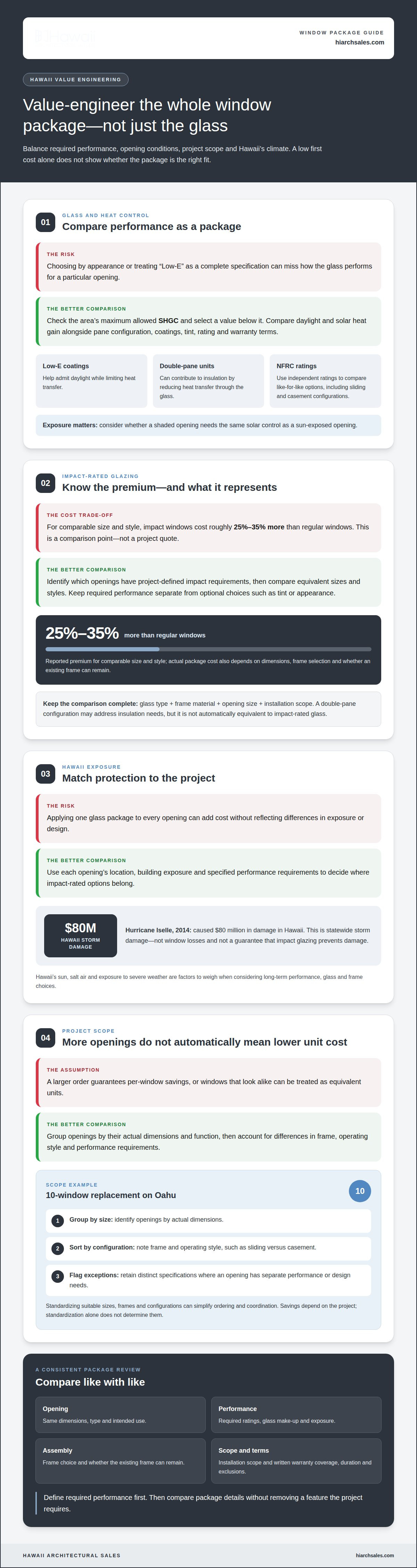
Value engineering starts by matching glass performance to each opening’s exposure. Low-E coatings help admit daylight while limiting heat transfer, which can support indoor comfort and reduce air-conditioning demand. Double-pane units can contribute to insulation by reducing heat transfer through the glass. These features can affect glazing performance in different ways, so compare them together rather than treating “Low-E” as a complete specification.
Solar heat gain coefficient, or SHGC, indicates how much solar heat passes through glazing. Check the maximum SHGC allowed for the building’s area, then select a value below that maximum. The National Fenestration Rating Council provides guidance for understanding independently rated window performance. Use its ratings to compare like-for-like glass options across sliding and casement configurations, rather than relying on product descriptions alone.
Contractors and owners can preserve performance by defining required ratings first, then comparing glass makeups, coatings, and frame configurations against those requirements. For example, consider whether a shaded opening needs the same solar control as a sun-exposed one. Keep the opening type, intended daylight, and project criteria consistent during comparisons. For Honolulu budgeting, according to Hawaii Department of Taxation, City and County of Honolulu: 4.7120% (effective January 1, 2007 - December 31, 2030).
Laminated and high-impact glass are options to evaluate where project requirements call for added glass protection. They should be compared against the required performance, not substituted solely to reduce package cost. Tints can change light transmission and appearance; etchings add a visual treatment, while coatings can manage solar heat. Each choice should be assessed alongside the selected SHGC and the opening’s purpose.
Compare complete glass packages by recording the pane configuration, rating, coating, tint, and applicable warranty terms. Read the written terms for coverage, duration, exclusions, and which components they apply to. This makes differences visible between replacement options and helps prevent a lower initial specification from removing a performance requirement. Keep the comparison tied to the same opening and design criteria.
Impact and hurricane window pricing
Impact-rated glazing changes a window package’s cost because it adds performance beyond a standard unit. For comparable size and style, impact windows cost roughly 25% to 35% more than regular windows. Treat that range as a comparison point, not a project quote. The final package also depends on opening dimensions, frame selection, and whether the existing frame can remain. A double-pane configuration may address insulation needs, but it isn’t automatically equivalent to impact-rated glass.
Hawaii’s storm history makes exposure part of the design discussion. Hurricane Iselle caused $80 Million in damage in Hawaii in 2014. That figure describes statewide storm damage, not window losses or a guarantee that impact glazing prevents damage. Instead, use the project’s location, building exposure, and specified performance requirements to identify where impact-rated options belong. Applying one glass package to every opening can add cost without reflecting differences in exposure or design.
Compare the full window assembly, not glass alone. Include glass type, frame material, opening size, and installation scope in each comparison. Aluminum windows may suit particular design requirements, while the glass selection addresses a separate performance question. Full-frame work can add scope compared with placing a new unit inside a sound existing frame. Keep these details consistent when comparing impact and non-impact alternatives, so a lower package cost doesn’t result from removing a required feature.
A practical value-engineering review starts by identifying openings with project-defined impact requirements. Then compare equivalent sizes and styles, documenting any change to glass, frame, or installation scope. Separate required performance from optional design choices, such as tint or appearance. This approach makes the cost trade-off visible without assuming every opening needs the same specification. For projects evaluating impact-rated window options, review available window solutions as part of the package comparison.
Project size and per-window savings
Project size affects how a window package is evaluated, but a larger order does not automatically guarantee a lower unit cost. On Oahu, a typical 10-window replacement project provides a useful scope example. Compare openings by size, frame, configuration, and product requirements before treating them as equivalent units. The number of windows matters, but so does how many distinct specifications the project requires.
Standardizing sizes, frames, and configurations can simplify a package when existing openings allow it. Repeating a specification across suitable openings can reduce variation in ordering and coordination. Savings depend on the project and cannot be calculated from standardization alone. For example, a 10-window plan with repeated sizes may be simpler to coordinate than one with numerous unique configurations, while still retaining requirements for particular openings.
Replacement windows should be grouped by their actual dimensions and function, not assumed to match because they look alike. A stepwise comparison helps: first group openings by size, then identify frame and operating-style differences, such as sliding versus casement. Finally, flag exceptions that need distinct performance or design choices. In a 10-window example, this separates repeatable units from openings that should keep individual specifications.
Frames and material choices also shape the comparison. Vinyl windows may be considered alongside other frame options, but material changes should not erase project requirements. Compare equivalent configurations and scope, including access and the condition of existing openings. A 10-window replacement estimate depends on the number and size of windows, selected products, site access, and opening condition. These factors make a per-window figure meaningful only when the compared scopes match.
For an actual package, price depends on the case and is provided after a quote request; cost factors include opening quantity and size, selected products, site access, and existing-opening condition. Use those factors to define a consistent comparison, then assess where repeated sizes or configurations can streamline the package. This gives owners and design teams a practical way to evaluate project-wide value without assuming every opening can use one specification.
Choosing windows for Hawaii conditions
Hawaii’s sun, salt air, ventilation needs, and opening conditions all influence window selection. Compare product features, styles, and project requirements together rather than choosing by appearance alone.
For material, vinyl requires little finish maintenance, while aluminum may suit particular openings or design needs. Aluminum can oxidize and corrode in Hawaii’s humid environment; composite or fiberglass frames avoid oxidation, peeling, and blistering. Wood-clad options can also be considered, with maintenance and exposure informing the comparison. Across an island project, weigh sun exposure, salt air, ventilation, opening size, and upkeep before selecting styles. The best fit depends on how each opening functions and the building’s design.
Window Specifications for Hawaii Energy Code
Energy-code window specifications are the performance criteria used to assess glazing and window selection for a project. They matter because glass and frame choices must suit the building’s location and intended use. Compare the applicable requirements for each area with the window’s documented performance ratings, including solar heat gain where relevant. Hung, sliding, awning, casement, bay, and bow styles may be considered; the opening and product configuration affect the suitable option.
Wind-Load and Impact Requirements
Wind-load and impact requirements define the performance a window assembly must meet for its project conditions. They matter because exposure and building design influence the appropriate specification. Establish the applicable project criteria, then compare window and glazing documentation against them. Impact-rated glazing is a distinct option, not a substitute for evaluating the full assembly. Requirements can vary by location and project, so avoid applying one specification to every opening without considering its conditions.
Permit, approval, and product-certification needs depend on scope and local requirements; window replacement alone doesn’t establish which apply. For work involving permits or regulated contracting activities, Hawaii homeowners should confirm local requirements and verify appropriate contractor credentials through Hawaii’s Professional and Vocational Licensing search.
For project-specific window options, explore Hawaii window solutions with the relevant exposure, opening, and performance criteria in view.
Hawaii Architectural Sales
Hawaii Architectural Sales helps project teams compare window package options against design priorities, opening conditions, and Hawaii’s climate. Turn to the company when weighing performance, material, and configuration choices across a project. Its team works with architects, engineers, and contractors to create high-value solutions and custom architectural solutions.
Its residential offerings include ES | Prestige, ES | Elite, and ES | uPVC, as well as Hopes. These products can form part of a broader package comparison, rather than treating one window choice as the answer for every opening. A clear project brief outlining priorities and relevant conditions helps focus the discussion on options that fit the design.
For a project-specific discussion of window package options, contact Hawaii Architectural Sales.
Move Your Window Package Toward a Clear Decision
The next step is to turn project priorities into a coordinated package discussion. Set out the intended use, design direction, opening conditions, and performance criteria for the building. This gives your team a practical basis for evaluating options and identifying where specifications should remain consistent or vary by opening.
Thoughtful value engineering for window packages in Hawaii is not simply about choosing the lowest initial-cost option. It means aligning product decisions with project requirements and long-term priorities. A focused discussion can clarify which trade-offs support the design and which could undermine it.
Hawaii Architectural Sales offers window product options including ES | Prestige, ES | Elite, and ES | uPVC. Share your project priorities and discuss the package direction with the team. Contact Hawaii Architectural Sales to start a conversation about your window package.
With clear criteria, you can make your next decision deliberately and in line with the project’s goals.
Frequently Asked Questions
Are New Windows Worth It in Hawaii?
New windows may be worth considering when existing units no longer operate well or meet a building’s needs. The decision depends on the condition of current openings, desired indoor comfort, and project performance requirements. For example, a design team planning a renovation can compare replacement options with the existing frames and opening functions before setting a package specification.
What replacement window styles are available?
Common replacement styles include hung, sliding, awning, casement, bay, and bow windows. The right choice depends on the opening, intended ventilation, and design. For example, a casement may fit a particular opening where a sliding configuration does not suit the layout. Available sizes and configurations vary by product line and existing openings, so compare styles against the building’s actual conditions.
What does value engineering mean for window packages in Hawaii construction?
Value engineering means aligning window selections with project needs while avoiding unnecessary specification differences. For Hawaii projects, teams can organize openings by function and exposure, then evaluate which should share a configuration and which require distinct criteria. This creates a clearer basis for reviewing product options without treating every opening as identical or removing a requirement simply to simplify the package.
Which window brands and suppliers serve Hawaii, and how do their prices compare?
Hawaii Architectural Sales supplies architectural product lines including custom metal and specialty systems. Product selection depends on the project type and design requirements. The information here supports comparing product suitability and package specifications, not ranking suppliers by price. For a useful comparison, keep opening conditions, intended performance, and project scope consistent across the options being reviewed.
How do window choices differ for coastal salt exposure, corrosion, humidity, and UV resistance in Hawaii?
Coastal conditions make material selection and maintenance important. Aluminum can oxidize and corrode in Hawaii’s humid environment, while vinyl requires little finish maintenance. Composite or fiberglass frames are alternatives that resist oxidation, peeling, and blistering. For projects in Honolulu, Lihue, Kailua-Kona, Kihei, or Lahaina, assess sun exposure, salt air, ventilation, opening size, and upkeep together.
What are the risks of reducing window specifications during value engineering, including warranty and insurance impacts?
Changing a specification can create a mismatch between the selected assembly and the project’s intended performance criteria. It can also complicate warranty interpretation if the written terms do not cover the revised configuration. Insurance treatment depends on the applicable policy, so a specification change alone does not establish coverage. Keep documented requirements and product selections aligned throughout design and procurement.