Aluminum Window Systems in Hawaii: Technical Guide
In Hawaii, a window system is no longer just an aesthetic choice; it's a critical structural component that must now meet standards for wind speeds up to 160 mph. You likely recognize that the combination of relentless salt spray and Hawaii's strict hurricane codes makes selecting materials a high-s...
In Hawaii, a window system is no longer just an aesthetic choice; it's a critical structural component that must now meet standards for wind speeds up to 160 mph. You likely recognize that the combination of relentless salt spray and Hawaii's strict hurricane codes makes selecting materials a high-stakes decision for any architectural project. This guide details the technical specifications and architectural standards required for the aluminum window systems Hawaii environments demand for long-term durability.
Specifying the wrong system leads to premature frame corrosion and potential structural failure during a storm event. We will explore high-performance solutions like ES Prestige and Elite, which are engineered to balance expansive glass spans with superior thermal efficiency. You'll also learn about the latest ASCE 7 wind load requirements and the necessity of AAMA 2605-26 coatings for maximum salt-air resistance. This technical overview serves as a resource for architects and engineers who require precision, reliability, and localized expertise in the building envelope.
Key Takeaways
• Understand the engineering requirements for Hawaii's wind loads, including ASCE 7 standards and specific Design Pressure (DP) ratings for hurricane-prone regions.
• Identify high-performance aluminum window systems Hawaii projects require, such as the ES Prestige and Elite lines designed for coastal resilience and luxury aesthetics.
• Mitigate salt-air corrosion by specifying advanced Kynar 500 (PVDF) coatings that meet rigorous AAMA standards for long-term durability.
• Balance expansive architectural glass spans with modern thermal efficiency requirements to meet Hawaii's unique tropical energy codes and solar heat gain standards.
• Streamline the specification process by partnering with a technical representative who bridges the gap between high-end manufacturing and practical application.
The Role of Aluminum Window Systems in Hawaii’s Architecture
High-performance aluminum window systems Hawaii relies on are more than just glass and frames. They are specialized architectural assemblies engineered for structural integrity and environmental resilience. In the islands, the building envelope faces a combination of stressors found in few other places. High-performance systems are designed to meet these challenges while maintaining the sleek, modern aesthetic that defines island luxury. Strength is non-negotiable here.
Aluminum remains the preferred choice for Hawaii’s modern architectural aesthetic because it offers exceptional strength without the bulk. This material allows architects to design with slim profiles and expansive glass spans. It facilitates the seamless indoor-outdoor transition that is central to contemporary Hawaiian living. These systems are often integrated into larger curtain wall systems for commercial or high-end residential applications where environmental resistance is mandatory.
The tropical building envelope is an unforgiving environment. Salt, humidity, and intense UV radiation constantly attack building materials. Standard residential-grade frames often fail within a few years. Professional projects require a transition to engineered architectural systems that can endure these conditions for decades. It's a critical choice for long-term value.
Aluminum vs. Vinyl in Tropical Climates
Structural rigidity is the primary differentiator between these materials. Aluminum’s inherent strength supports larger glass spans than vinyl. This is vital for projects requiring tall openings or wide sliding doors that must remain operable under pressure. Thermal expansion is another factor. Hawaii’s intense sun causes materials to expand and contract. Aluminum handles these fluctuations with minimal movement, preventing seal failure. In high-UV environments, vinyl can yellow or become brittle. High-quality aluminum systems maintain their structural properties over much longer lifecycles.
Key Environmental Stressors in the Islands
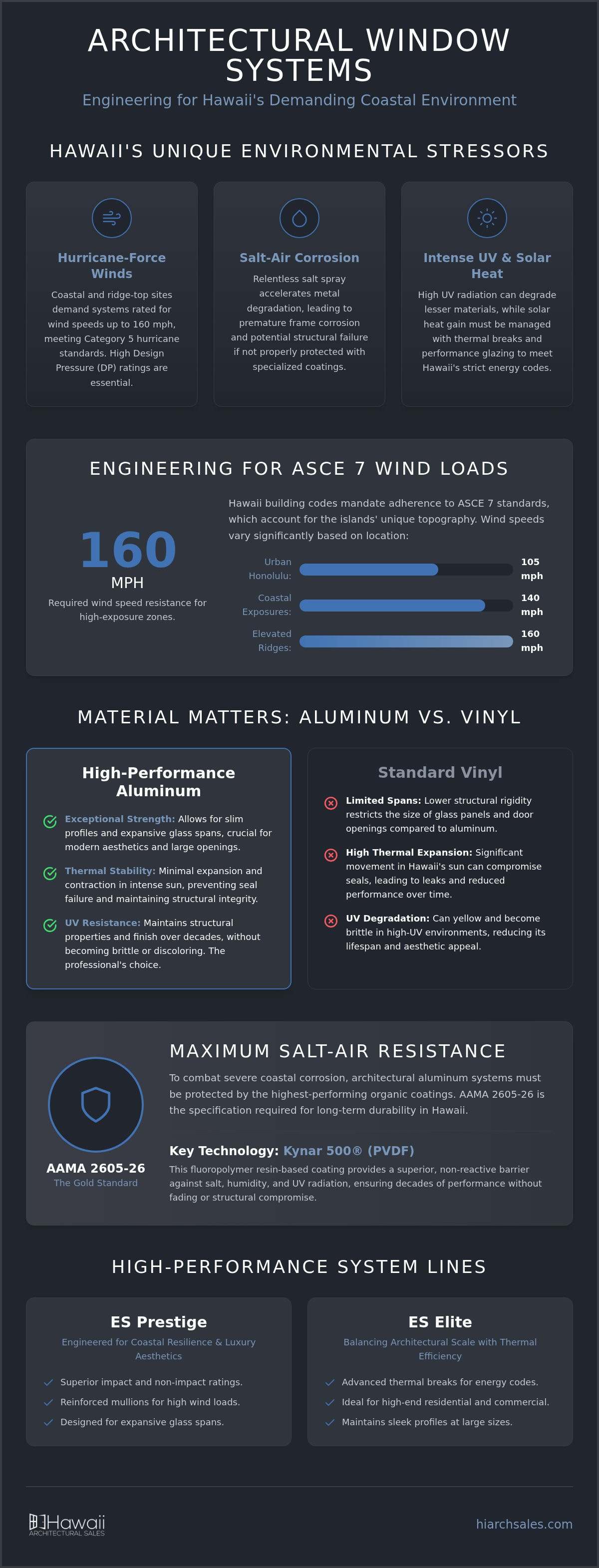
Salt-air corrosion is a constant threat. Coastal proximity accelerates metal degradation through oxidation and electrolysis. Choosing the right alloy and finish is the only way to prevent structural compromise. Trade winds also generate significant pressure. With wind speeds in certain elevated ridges reaching 140 mph, high Design Pressure (DP) ratings are essential to prevent water infiltration. Finally, solar heat gain must be managed. Aluminum must be paired with high-performance glazing and thermal breaks to reduce cooling loads and meet Hawaii's strict energy codes. These factors combined make material selection a technical priority.
Engineering for Hawaii: Wind Loads and Hurricane Ratings
Engineering aluminum window systems Hawaii projects require involves more than simple wind speed calculations. The state building code, based on the 2018 IBC and IRC with Hawaii-specific amendments, mandates adherence to ASCE 7 standards. These standards account for the islands' unique topography, where wind speeds can accelerate over ridges and through valleys. While urban Honolulu might require protection against 105 mph winds, elevated sites or coastal exposures often demand systems capable of withstanding 140 to 160 mph. This aligns with Category 5 hurricane standards, making structural engineering a primary design driver.
Design Pressure (DP) ratings are the metric used to define a system's performance under these loads. A DP rating measures the amount of positive and negative pressure a window can sustain without structural failure or water infiltration. For high-end residential and commercial projects, specifying systems like ES Prestige or ES Elite ensures that the building envelope remains secure. These systems utilize reinforced mullions, which are internal structural members that allow for larger glass spans while maintaining the rigidity necessary to resist high-velocity wind loads. Consulting with a technical representative at Hawaii Architectural Sales can help you determine the exact DP requirements for your project's specific elevation and exposure zone.
Impact vs. Non-Impact Systems
In regions where design wind speeds reach 130 mph or greater, glazed openings must be protected. Impact-rated systems use laminated glass technology, where a resilient interlayer is sandwiched between glass panes. This interlayer prevents the building envelope from breaching if the glass is struck by debris. While non-impact systems paired with shutters are an option, integrated impact glass provides 24/7 protection and maintains the building's aesthetic. For coastal properties, the long-term benefit of impact-rated systems outweighs the initial investment by providing superior security and potential insurance advantages.
Structural Performance Ratings (AAMA)
The Fenestration and Glazing Industry Alliance (FGIA) defines performance classes through AAMA ratings. These include R (Residential), LC (Light Commercial), CW (Commercial), and AW (Architectural). In Hawaii, AW-grade systems are frequently specified for high-rise and coastal applications. This grade requires the most rigorous testing for air infiltration, water penetration, and corrosion resistance in coastal areas. Architectural grade systems are designed to withstand the high-frequency use and extreme environmental pressures typical of the islands' most demanding project sites.
Comparing Premium Systems: ES Prestige and Elite
Selecting aluminum window systems Hawaii architects can rely on requires a comparison of engineering specifics rather than just surface-level aesthetics. The ES Prestige and ES Elite lines represent a significant upgrade from standard retail options. These systems are designed to integrate seamlessly with high-performance architectural glass systems Honolulu developers use to achieve both safety and transparency. While generic extrusions often lack the structural depth for high-rise or coastal applications, these premium lines provide the rigidity and finish quality necessary for the islands' most demanding environments.
The primary differentiators between these systems lie in their frame depth, glass thickness options, and hardware quality. A system’s frame depth directly impacts its structural performance and its ability to house thick, insulated glass units. Premium hardware is another critical factor. These systems utilize heavy-duty stainless steel components that resist the seizing and pitting common in high-salt environments. This level of technical specification ensures that large sliding doors and windows remain operable for decades, even when exposed to constant trade winds.
ES Prestige: High-End Residential and Commercial Standards
The ES Prestige line is engineered for projects where design flexibility is a priority. It accommodates custom sizes and complex configurations while maintaining strict U-factor and SHGC ratings. In Hawaii's tropical climate, achieving a Solar Heat Gain Coefficient below 0.25 is often necessary to reduce cooling loads. Prestige systems utilize high-quality stainless steel hardware as a standard. This is a critical specification for salt-air durability, as standard zinc or plated components often fail within years of coastal exposure. The line supports various glass thicknesses, allowing for customized acoustic and thermal performance based on the project's specific location.
Technical Comparison: Prestige vs. Elite
The Elite series utilizes advanced thermal break technology that offers a higher degree of insulation compared to the standard thermal barriers found in the Prestige line. This makes the Elite series particularly effective for projects where energy efficiency is the primary driver. Elite profiles often provide slimmer sightlines and narrower profile widths, catering to the minimalist modern architectural styles prevalent in new Oahu developments. While Prestige is known for its robust structural sections, Elite focuses on maximizing the glass-to-frame ratio without sacrificing performance.
Suitability for different island microclimates is a key consideration. A project on the humid windward side of Kauai may prioritize the heavy-duty hardware and corrosion resistance of the Prestige line to combat constant salt spray. Conversely, a high-rise on the dry, leeward coast of Oahu might benefit more from the superior thermal efficiency and sleek profiles of the Elite series. Both systems represent the transition from generic building materials to engineered architectural solutions that address the specific challenges of the Pacific.
Corrosion Resistance: Coatings and Finishes for Salt Air
Aluminum's longevity in the Pacific depends entirely on its surface treatment. While the metal is inherently resistant to rot, it is highly susceptible to electrolysis and oxidation when exposed to salt-laden air. Salt acts as a catalyst, accelerating the degradation of the protective oxide layer. For aluminum window systems Hawaii projects, specifying a finish that can withstand this chemical assault is as important as the structural engineering itself. Without the correct coating, even the strongest frame will eventually suffer from surface pitting and structural compromise.
Kynar 500 (PVDF) coatings are the industry benchmark for coastal resilience. These 70% fluoropolymer resin finishes provide an exceptional level of chemical resistance and color retention. Unlike standard polyester powders, PVDF coatings don't chalk or fade significantly under the intense UV radiation found in the islands. Anodized finishes offer a hard, metallic surface that is chemically bonded to the aluminum. While durable, anodized frames can be prone to pitting in extreme salt zones if they aren't meticulously maintained. For projects within five miles of the coast, high-performance liquid coatings are generally the safer technical choice.
The Importance of High-Performance Coatings
The difference between AAMA 2604 and AAMA 2605 standards is critical for Hawaii's environment. The AAMA 2605-26 standard is the superior performance tier. It requires a 10-year outdoor weathering test and 4,000 hours of salt spray testing. This is double the requirement of the 2604 standard. Specifying 2605 ensures the finish maintains its integrity against the abrasive nature of wind-blown sand and salt. It prevents the unsightly bubbling and peeling that often plagues lower-grade aluminum window systems Hawaii builders might otherwise use. These finishes are designed to maintain their gloss and color even after decades of exposure.
Hardware and Accessory Longevity
Frame durability is only half the battle. Hardware components must also resist the corrosive atmosphere. Specifying 316-grade stainless steel for all exposed fasteners, hinges, and rollers is mandatory for coastal proximity. This grade contains molybdenum, which provides superior resistance to chloride-induced pitting. Proper gaskets and seals also play a vital role. They prevent salt water from entering the internal chambers of the frame, where it could cause hidden electrolysis. This is how hurricane rated windows Hawaii specialists provide remain functional after years of exposure. Regular rinsing with fresh water is the most effective maintenance protocol to extend the life of these specialized components. For expert guidance on selecting the right finish for your project, contact the technical team at Hawaii Architectural Sales to review your site-specific requirements.
Navigating the Specification Process in Hawaii
Specifying aluminum window systems Hawaii projects require involves a complex transition from architectural intent to technical procurement. This process demands more than a simple product selection; it requires a partnership with a specialized Hawaii architectural window distributor. In the B2B sector, the role of a technical representative is to bridge the gap between high-end manufacturing and practical island application. They ensure that the chosen systems align with both the design vision and the stringent performance mandates of the Pacific region.
Understanding the supply chain is vital for large-scale projects. Architectural distributors focus on material expertise and distribution rather than installation. This distinction allows for a higher level of technical specialization. A distributor provides the materials and engineering data, while local contractors handle the physical placement. This structure ensures that the project benefits from both manufacturer-level knowledge and localized labor expertise. It's a pragmatic approach to managing the logistics of island construction.
Compliance with local energy codes and hurricane requirements is a baseline necessity. While the 2018 IECC and IBC provide the framework, the county-level enforcement in Hawaii adds layers of complexity. A technical consultant verifies that every glazed opening meets the specific Solar Heat Gain Coefficient (SHGC) and Design Pressure (DP) ratings required for that specific site. This verification prevents costly delays during the permitting and inspection phases.
Technical Support for Architects and Developers
Professional technical support extends far beyond a sales catalog. It includes active assistance with shop drawings, wind load calculations, and complex glazing schedules. Coordination is a primary service. A technical representative manages the communication between manufacturers like ES or Euro-Wall and the local contracting teams. This ensures that lead times are managed effectively within island logistics. Early engagement in the design-build cycle allows for accurate budgeting and prevents the mid-project specification changes that often derail schedules.
The Value of Local Representation
Local representation provides access to island-specific environmental data that mainland suppliers might overlook. Wind zones in Honolulu differ significantly from those in Lihue or the slopes of Haleakala. A local Euro-Wall distributor Hawaii expert understands these microclimates and recommends hardware and finishes accordingly. This localized knowledge ensures long-term product support and simplifies warranty facilitation. It positions the distributor as a strategic ally who is committed to the building envelope's performance over its entire lifecycle.
Advancing Building Envelope Standards for the Pacific
Designing for the islands requires a departure from standard mainland specifications. Success depends on integrating structural rigidity for 160 mph wind loads with the chemical resilience of AAMA 2605 coatings. By prioritizing high-performance aluminum window systems Hawaii projects maintain structural integrity and aesthetic value despite relentless salt-air exposure. Utilizing precision-engineered systems like ES Prestige and Elite ensures that large architectural spans meet both energy codes and hurricane safety requirements. These technical choices define the long-term viability of modern island architecture.
Hawaii Architectural Sales serves as an authorized distributor for ES Prestige and Elite lines, providing the specialized technical expertise required for complex building envelopes. We offer dedicated support for projects across Honolulu, Lihue, Kailua-Kona, Kihei, and Lahaina. Our team acts as a knowledgeable guide to ensure your specifications meet every regulatory and environmental demand. We're ready to assist with your glazing schedules and wind load requirements to ensure a seamless build process.
We look forward to helping you achieve a resilient and sophisticated design for your next development.
Frequently Asked Questions
Is aluminum or vinyl better for Hawaii coastal homes?
Aluminum is the preferred choice for Hawaii coastal homes due to its superior structural rigidity and resistance to UV degradation. While vinyl may offer lower initial costs, it often lacks the strength required for large glass spans and can become brittle under intense tropical sun. Aluminum window systems Hawaii architects specify maintain their integrity over decades, especially when protected by high-performance architectural coatings.
What aluminum finish is most resistant to salt-air corrosion?
A high-performance Kynar 500 (PVDF) coating that meets the AAMA 2605-26 standard is the most resistant finish for salt-air environments. This specific tier requires a 4,000-hour salt spray test and a 10-year outdoor weathering exposure. These coatings provide the necessary chemical resistance to prevent the pitting and electrolysis common in coastal regions, outperforming standard powder or anodized finishes in long-term longevity.
Are aluminum windows energy efficient in tropical climates?
Aluminum windows achieve high energy efficiency when engineered with thermal breaks and paired with high-performance glazing. To meet Hawaii’s energy codes, systems should target a Solar Heat Gain Coefficient (SHGC) below 0.25. This combination effectively reduces cooling loads by preventing heat transfer through the frame and glass, ensuring the building envelope remains thermally efficient despite high external temperatures.
What are the wind load requirements for windows in Honolulu?
Wind load requirements in Honolulu are governed by the Hawaii State Building Code and ASCE 7-16 standards. Design wind speeds for urban Honolulu typically range from 100 to 115 mph, but elevated ridges or coastal exposures can require ratings for 125 to 140 mph and above. It's essential to verify the specific wind zone and topography of your project site to determine the required Design Pressure (DP) ratings.
Can aluminum windows be hurricane-rated?
Yes, specifically engineered aluminum systems are designed to be hurricane-rated and impact-resistant. Systems like ES Prestige utilize laminated glass and reinforced mullions to meet stringent wind-borne debris standards. These impact-rated windows provide continuous protection against Category 5 wind speeds without the need for external shutters, maintaining the building's architectural aesthetic while ensuring maximum structural safety during storm events.
How do I maintain aluminum window frames in Hawaii?
Regularly rinsing the frames with fresh water is the most effective way to maintain aluminum window systems Hawaii environments subject to salt spray. This process removes accumulated salt crystals that can cause surface pitting over time. Additionally, hardware components should be inspected for smooth operation, and any exposed 316-grade stainless steel fasteners should be kept clean to prevent chloride-induced corrosion.
Does Hawaii Architectural Sales provide installation services?
Hawaii Architectural Sales does not provide installation services or general contracting. The company operates as a technical distributor and consultant, specializing in the procurement and specification of high-performance systems like ES Prestige and Euro-Wall. We work directly with architects, developers, and local contractors to ensure the correct materials are specified and delivered to the project site according to technical requirements.
What is the lead time for architectural aluminum window systems in Hawaii?
Lead times for premium architectural systems vary based on manufacturer production cycles and island shipping schedules. Because these systems are often custom-engineered for specific project requirements, the timeframe includes both fabrication and maritime logistics. Early engagement with a technical representative allows for better coordination of production schedules, ensuring materials arrive on-site to meet critical project milestones without unexpected delays.