AWV Architectural Louvers and Sunshades: Hawaii Performance Guide
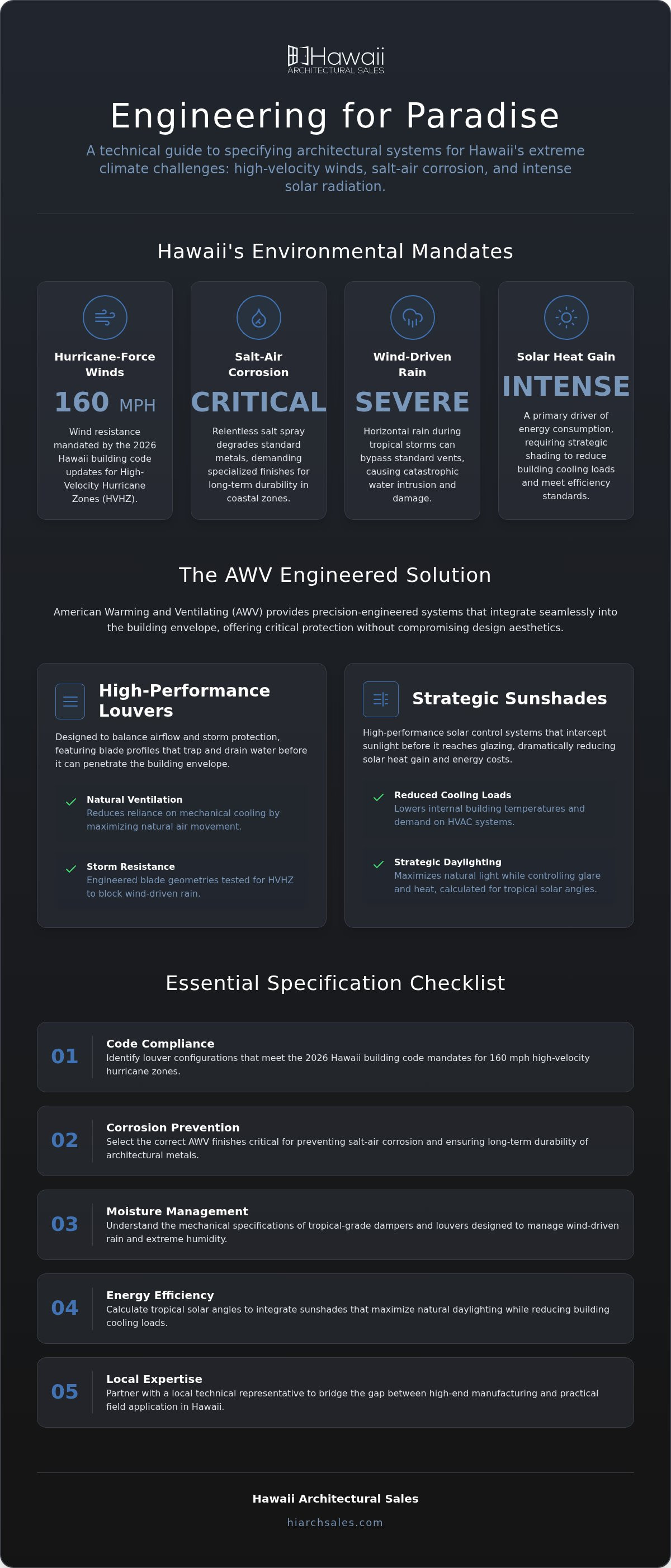
In Hawaii, an architectural louver is not just a design detail; it is a critical line of defense against a Category 5 hurricane. With the 2026 building code updates mandating wind resistance standards of up to 160 mph, the margin for error in specification has vanished. You likely recognize that the...
In Hawaii, an architectural louver is not just a design detail; it is a critical line of defense against a Category 5 hurricane. With the 2026 building code updates mandating wind resistance standards of up to 160 mph, the margin for error in specification has vanished. You likely recognize that the combination of extreme wind pressures and relentless salt-air corrosion can turn a standard product into a structural liability in just a few seasons. It is a constant challenge to find building envelope solutions that satisfy these rigorous safety mandates without compromising the project's aesthetic vision.
This guide provides a technical deep dive into specifying AWV louver and sunshade systems specifically engineered for the Hawaiian environment. We will explore how to navigate the latest ASCE 7 standards and select finishes that withstand high-salinity coastal zones. You'll learn about the performance characteristics of various blade profiles and how localized technical support can streamline your compliance process. We cover everything from structural attachment methods to the integration of sunshades that balance solar heat gain with the need for natural ventilation in our unique climate.
Key Takeaways
• Identify the specific louver configurations required to meet the 2026 Hawaii building code mandates for high-velocity hurricane zones and 160 mph wind resistance.
• Learn why selecting the correct AWV finishes is critical for preventing salt-air corrosion and ensuring the long-term durability of architectural metals in coastal environments.
• Understand the mechanical specifications of tropical-grade dampers and louvers designed to effectively manage wind-driven rain and extreme humidity.
• Discover how to calculate tropical solar angles to integrate sunshades that maximize natural daylighting while reducing building cooling loads.
• Recognize the importance of partnering with a local technical representative to bridge the gap between high-end manufacturing and practical field application in Hawaii.
Understanding AWV Systems in the Hawaii Building Envelope
For AEC professionals searching for technical specifications, the acronym AWV refers to American Warming and Ventilating, a global leader in high-performance architectural louvers, dampers, and sunshades. While search engines often return results for medical wellness visits, in the construction industry, this name represents the gold standard for building envelope components. These systems are not generic industrial vents. They are precision-engineered elements designed to integrate seamlessly into a building's facade while providing critical protection. In Hawaii, where the building envelope must manage extreme humidity, salt spray, and intense solar radiation, selecting a proven architectural manufacturer is essential for long-term structural integrity.
The building envelope serves as the primary barrier between Hawaii’s volatile environment and a building’s interior climate. Generic ventilation products often fail to account for the specific pressures of the Pacific, leading to water intrusion or mechanical failure. AWV systems distinguish themselves through superior material thickness, advanced finish options, and rigorous testing for high-velocity hurricane zones. By specifying these components, architects ensure that the building remains functional and protected without sacrificing the clean lines of modern island design.
The Role of Louvers in Tropical Ventilation
Designing for Honolulu requires a delicate balance between maximizing natural airflow and providing robust storm protection. Louvers must facilitate the movement of air to reduce reliance on mechanical cooling, yet they must also prevent water penetration during heavy Pacific rain events. High-performance architectural louvers utilize specific blade profiles to trap and drain water before it enters the HVAC system or interior spaces. This functionality allows architects to maintain open, breathable designs that remain resilient against the sudden, intense downpours common across the islands.
Sunshades and Solar Heat Gain Control
In regions like Lihue and Kailua-Kona, solar heat gain is the primary driver of energy consumption. Strategic shading is a fundamental requirement for achieving LEED certification and meeting local efficiency standards. By intercepting sunlight before it reaches the glazing, these systems lower the internal temperature and reduce the demand on cooling systems. AWV sunshades function as high-performance solar control devices engineered to meet the stringent 2026 energy codes while significantly reducing building cooling loads. This proactive approach to daylighting ensures a comfortable occupant experience while lowering operational costs over the life of the structure.
Performance Engineering: Louvers and Dampers for Tropical Climates
Hawaii's environment demands more than basic airflow management. Standard ventilation components often buckle under the dual pressure of salt-air corrosion and high-velocity winds. AWV engineering addresses these variables through rigorous testing and precision manufacturing. While many manufacturers focus solely on Cubic Feet per Minute (CFM) ratings, architectural integrity in the Pacific requires a focus on structural stability and moisture exclusion. Precision in the manufacturing process ensures that every blade and linkage operates reliably, even after years of exposure to the islands' high humidity and trade winds.
The primary challenge for Hawaii building envelopes is wind-driven rain. During tropical storms, horizontal rain can bypass standard louver blades, leading to catastrophic water damage in mechanical rooms and interior spaces. Engineering for these conditions requires specific blade geometries that trap and divert water before it enters the system. By specifying components tested for High-Velocity Hurricane Zones (HVHZ), architects can ensure their designs withstand the 160 mph wind speeds identified in the 2026 building code updates. If you need assistance navigating these technical requirements, our team provides comprehensive specification support for island projects.
Acoustical and Storm-Resistant Louver Lines
Urban Honolulu projects face the unique challenge of managing mechanical noise in high-density areas. Acoustical louver lines provide sound attenuation without sacrificing the airflow required for large HVAC systems. When these units are located on windward facades, storm-resistance becomes the priority. Specifying louvers tested to AMCA 550 standards ensures that even during a tropical storm, water penetration is minimized. This requires a careful analysis of pressure drop ratings to ensure the building's energy efficiency isn't compromised by overly restrictive airflow paths. We prioritize solutions that maintain high free-area percentages while meeting stringent water-rejection benchmarks.
Dampers for Life Safety and Airflow Management
Life safety systems in commercial high-rises rely on the flawless operation of fire and smoke dampers. In coastal zones like Waikiki, standard galvanized steel dampers often seize due to salt-air oxidation. AWV offers dampers constructed with 304 or 316 stainless steel and corrosion-resistant hardware to maintain operational readiness. These components are essential for compliance with the 2026 Hawaii State Building Codes, which prioritize resilience in the face of increasing hurricane intensity. Proper material selection ensures these critical safety devices function exactly when they're needed, regardless of how many years they've been exposed to the coastal atmosphere.
Combating Corrosion: Why AWV Specifications Matter in Salt-Air Environments
Hawaii’s geographic isolation creates a unique environmental challenge: a constant, high-salinity atmosphere that accelerates the oxidation of architectural metals. In coastal zones like Kihei or Lahaina, the combination of salt spray and intense UV radiation creates a corrosive cocktail that destroys standard industrial finishes. When a louver or sunshade fails prematurely, the cost of replacement and remediation far exceeds the initial investment. Specifying AWV components with high-performance finishes ensures that building owners avoid the cycle of frequent maintenance and structural degradation.
Standard powder coatings often lack the chemical stability required to withstand the chloride ions present in island air. These finishes typically fail through filiform corrosion, where moisture and salt penetrate the coating and spread beneath the surface. AWV addresses this by utilizing advanced pre-treatment processes and top-tier finishes that provide a robust barrier against environmental stressors. This focus on durability protects the developer's asset and maintains the building's visual appeal for decades rather than years. It’s a pragmatic approach to long-term facility management in the Pacific.
Advanced Coating Technologies: AAMA 2605 and Beyond
For projects in the Hawaiian Islands, the difference between AAMA 2604 and AAMA 2605 is the difference between a five-year and a twenty-year lifecycle. PVDF (Polyvinylidene Fluoride) coatings, such as 70% Kynar 500, offer superior resistance to the chalking and fading caused by Hawaii’s intense sun. Unlike standard powder coats that can become brittle, these high-performance liquids maintain flexibility and chemical bonds under extreme heat. AAMA 2605 is the minimum standard for coastal Hawaii facades because it provides the necessary resistance to color change and film erosion in high-salinity environments.
Material Selection: Aluminum vs. Stainless Steel
Extruded aluminum is the preferred material for most louver and sunshade applications due to its high strength-to-weight ratio and natural resistance to rust. However, projects situated in splash zones or within immediate proximity to the surf may require 316 stainless steel components. This grade of steel contains molybdenum, which specifically resists pitting and crevice corrosion caused by chlorides. Architects must also account for galvanic corrosion when integrating these systems. Using non-conductive isolators between dissimilar metals, such as aluminum louvers and steel structural supports, prevents the electrochemical reactions that lead to rapid material failure.
Strategic Daylighting: Integrating AWV Sunshades into Island Design
In Hawaii's tropical latitude, the sun occupies a high position in the sky for most of the year. Effective solar control requires more than just high-performance glazing. Integrating AWV sunshades into the building facade allows architects to intercept solar radiation before it enters the building envelope. This strategy works in tandem with other architectural daylighting solutions in Honolulu to create balanced, high-performance interiors. By calculating specific solar angles for our islands, designers can optimize the depth and spacing of sunshade blades to maximize shade during peak heat hours while preserving natural light during the morning and late afternoon.
The aesthetic flexibility of AWV's airfoil and blade designs allows these functional components to enhance a building's architectural character. We've seen these systems successfully integrated into Hawaii educational and medical facilities, where occupant comfort directly impacts performance and recovery. In these environments, sunshades serve a dual purpose; they define the building's visual identity and provide a tangible reduction in glare for students and patients. This integration is a hallmark of sophisticated island architecture that prioritizes both form and function.
Passive Cooling and Occupant Comfort
Passive cooling strategies are central to sustainable island design. Reducing glare while maintaining clear views of the Pacific landscape is a primary goal for commercial and residential high-rises. Exterior shading has a direct relationship with interior HVAC sizing; by lowering the peak cooling load, developers can specify smaller, more efficient mechanical systems. Cantilevered sunshades are particularly effective for large-span commercial glazing, providing a dramatic architectural statement while shielding expansive glass areas from direct solar gain. This approach ensures a comfortable interior environment without the energy costs associated with excessive mechanical cooling.
Structural Mounting for High Wind Loads
Engineering sunshade attachments for Hawaii requires a focus on hurricane-force uplift and downward pressures. As wind speeds in 2026 mandates reach 160 mph, the structural integrity of every mounting point is paramount. This requires close coordination between AWV systems and architectural glass systems in Honolulu. Ensuring building envelope continuity at mounting points prevents water intrusion during extreme weather events. If you are currently designing a high-load facade, consult our guide on technical glass integration for more detail on mounting standards.
Partnering with Hawaii Architectural Sales for AWV Specifications
Hawaii Architectural Sales serves as the authorized representative for AWV in the islands, providing a vital technical link between mainland manufacturing and local project requirements. Since 1985, our team has acted as consultants rather than mere distributors, ensuring that architectural components are specified correctly for the Pacific's unique environmental stressors. We don't just provide products; we offer a technical partnership that extends from initial design through final delivery. We understand that a louver system designed for a temperate mainland climate won't suffice in a high-salinity zone. By bridging this gap, we help AEC professionals avoid the common pitfalls of specifying generic products that fail to meet Hawaii's performance standards.
Our involvement begins during the design development phase, where we provide the technical expertise necessary to translate architectural vision into a compliant building envelope. This localized knowledge is essential for navigating the complexities of the 2026 building code updates, which require structures to withstand wind speeds of up to 160 mph. We provide the structural data and finish specifications required to ensure long-term durability and regulatory approval. This proactive approach minimizes the risk of revision cycles during the permitting process.
Design Consultation and Technical Review
We assist architects with customized submittals that go beyond standard product data sheets. Our technical review process ensures that every AWV component, from dampers to sunshades, is verified against project-specific wind load calculations and attachment requirements. This level of scrutiny is critical for maintaining the continuity of the building envelope, especially when coordinating with other fenestration systems. Our team also provides expert guidance for selecting an architectural window distributor in Hawaii to ensure that all exterior components are compatible in both performance and aesthetic finish.
Streamlined Procurement for Hawaii Contractors
Managing the logistics of architectural materials requires precise coordination to avoid costly project delays. For the 2026 construction season, we actively manage lead times and production schedules to align with local milestones. We handle the complexities of consolidated shipping and local delivery for sites in Honolulu, Lihue, and Kailua-Kona. This service reduces the administrative burden on contractors and ensures that materials arrive on-site in the correct sequence and condition. By providing local technical support through every phase, we ensure that the transition from design to material delivery is seamless. For expert assistance with your next project, contact Hawaii Architectural Sales for AWV technical support.
Securing the Building Envelope for 2026 Hawaii Standards
Specifying architectural components for the Pacific requires a departure from standard mainland practices. Long-term success depends on selecting high-performance finishes that resist relentless salt-air corrosion and engineering systems that meet the new 160 mph wind speed mandates. By integrating AWV louvers and sunshades, you ensure that your project remains structurally sound and energy-efficient throughout its entire lifecycle. These systems provide the critical defense needed against tropical storms while enhancing the modern aesthetic of island architecture.
Hawaii Architectural Sales brings over 40 years of local project experience to your design team. As the authorized representative for these advanced systems, we provide the localized technical data and deep code knowledge necessary for successful implementation across all islands. We bridge the gap between high-end manufacturing and the practical realities of Hawaii's job sites. Our team is ready to assist you with everything from initial wind load calculations to final material logistics. Request a Technical Consultation for AWV Systems today to refine your specifications. We look forward to helping you build a more resilient and sustainable future for our islands.
Frequently Asked Questions
What are the wind load requirements for louvers in Hawaii?
Hawaii building codes for 2026 mandate that structures in high-wind zones withstand speeds up to 160 mph. Louvers must be engineered to resist these pressures as part of the building envelope. We recommend referencing the latest ASCE 7 standards for specific project locations. Our technical team assists in selecting AWV profiles that meet these rigorous structural requirements for both windward and leeward exposures.
How do AWV sunshades help with LEED certification in tropical climates?
Sunshades contribute to LEED certification by significantly reducing solar heat gain and lowering building cooling loads. These systems help earn credits under the Energy and Atmosphere (EA) and Indoor Environmental Quality (EQ) categories. By intercepting sunlight before it hits the glazing, AWV sunshades allow for smaller HVAC systems. This improves overall energy efficiency while maintaining high levels of natural daylighting for occupants.
Which finishes offer the best protection against salt-air corrosion?
AAMA 2605 compliant finishes, such as 70% PVDF or Kynar 500 coatings, provide the highest level of protection in Hawaii. These high-performance coatings resist the chalking, fading, and film erosion caused by intense UV exposure and chloride ions. For projects within 1,000 feet of the shoreline, we specify these finishes to ensure the architectural metal maintains its structural and aesthetic integrity for decades.
Can AWV louvers be customized for unique architectural shapes?
Yes, architectural louvers can be manufactured in a wide variety of custom shapes to fit specific design intents. This includes mitered corners, circular or bullseye designs, and triangular profiles for gables. We work with your design team to ensure these custom shapes maintain necessary airflow and structural performance. Precision manufacturing allows these units to integrate seamlessly into complex facade systems across the islands.
What is the difference between a standard louver and a storm-resistant louver?
A storm-resistant louver features a specialized blade profile designed to block wind-driven rain even at high velocities. While standard louvers manage basic airflow, storm-resistant models are tested to AMCA 550 and 540 standards for high-velocity hurricane zones. These units prevent water from entering mechanical rooms or interior spaces during extreme weather events. This level of protection is essential for windward facades in the Hawaiian Islands.
Does Hawaii Architectural Sales provide installation for AWV products?
Hawaii Architectural Sales doesn't provide installation or general contracting services. We're the authorized manufacturer's representative and technical consultant for the islands. Our role is to provide material distribution, technical review, and design support from development through delivery. We coordinate with your selected contractors to ensure the correct products arrive on-site and meet all project specifications.
How do I specify AWV dampers for high-rise commercial buildings in Honolulu?
Specifying dampers for Honolulu high-rises requires a focus on life safety ratings and material durability. You should select fire and smoke dampers that comply with the 2026 Hawaii State Building Codes and UL standards. In coastal environments, we recommend specifying 304 or 316 stainless steel construction for all internal hardware. This prevents the corrosion and seizing that can occur with standard galvanized components in our humid, salty air.
What are the typical lead times for AWV architectural products in Hawaii?
Lead times for these systems depend on the complexity of the design and current factory capacity. You should generally plan for the manufacturing phase plus the time required for ocean freight to Hawaii. We coordinate closely with the factory to provide the most accurate scheduling for your project. Engaging our team during the design phase allows us to better manage these timelines for your 2026 construction schedule.