AWV Architectural Louvers Honolulu: Performance and Design Guide
Hawaii’s 2026 building code updates now require new constructions to withstand wind speeds of up to 160 mph, effectively making every building envelope component a front-line defense against Category 5 hurricane conditions. For architects and engineers, this means that selecting AWV architectural lo...
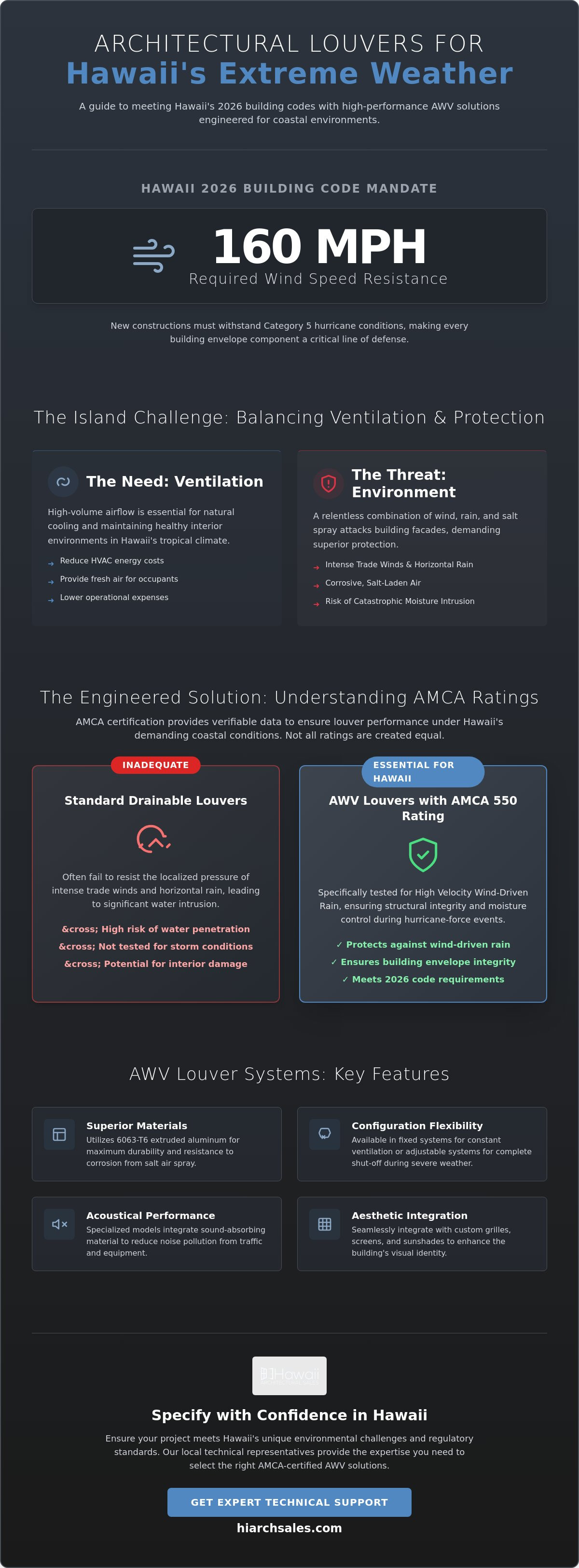
Hawaii’s 2026 building code updates now require new constructions to withstand wind speeds of up to 160 mph, effectively making every building envelope component a front-line defense against Category 5 hurricane conditions. For architects and engineers, this means that selecting AWV architectural louvers Honolulu is no longer just about airflow; it's about ensuring structural integrity and moisture control in one of the world's most demanding coastal environments. You understand the difficulty of balancing high-performance ventilation with the aesthetic goals of a modern facade while salt air spray threatens every metal surface.
This guide details how AWV systems provide superior water protection and corrosion resistance without sacrificing design flexibility. We'll explore the critical differences between standard drainable models and extreme weather units, the importance of AMCA 550 high-velocity rain ratings, and how to access local technical support through Hawaii Architectural Sales to ensure your project meets the latest safety standards. By the end of this guide, you'll be able to identify the specific AMCA-certified solutions that protect your interior spaces while maintaining the sleek, professional appearance your clients expect.
Key Takeaways
• Understand the 2026 Hawaii building code updates requiring structures to withstand 160 mph winds and the role of engineered louvers in meeting these standards.
• Learn the critical technical distinctions between standard water penetration and AMCA 550 wind-driven rain ratings for coastal reliability.
• Explore how to integrate decorative grilles and architectural sunshades to manage solar heat gain while maintaining the aesthetic integrity of the building facade.
• Discover how specifying AWV architectural louvers Honolulu through local technical representatives ensures compliance with unique regional environmental stressors and regulations.
The Role of Architectural Louvers in Hawaii’s Building Envelopes
Architectural Louvers are engineered slat systems designed to facilitate high-volume airflow while acting as a critical barrier against water, debris, and noise. In Hawaii, these components serve as the primary interface between a building's interior ventilation needs and a relentless tropical environment. Specifying high-performance AWV architectural louvers Honolulu is essential for maintaining the building envelope's integrity. Standard louvers often fail in this region because they lack the specific engineering required to resist the localized pressure of intense trade winds and horizontal rain. Without a robust louver system, a building's mechanical infrastructure remains vulnerable to the elements.
Reliability in the Pacific depends on AMCA (Air Movement and Control Association) certification. Hawaii building codes demand products that have undergone rigorous, standardized testing to ensure they perform under stress. When a louver is AMCA-certified, it provides verifiable data on water penetration and airflow resistance. This transparency allows engineers to make informed decisions. Choosing non-certified alternatives often leads to catastrophic moisture intrusion during storm events, which can result in expensive interior remediation and equipment failure.
Ventilation vs. Protection: The Island Challenge
Architects face a constant struggle: providing enough fresh air for natural cooling while keeping corrosive moisture out. Salt-laden air is a silent killer for ventilation components. It accelerates oxidation and can compromise internal mechanical systems if the louver fails to baffle the intake effectively. High-efficiency AWV systems use aerodynamic blade profiles to reduce static pressure. This reduces the energy required for HVAC fans to move air, which lowers long-term operational costs for the building owner. Effective ventilation shouldn't come at the expense of protection; it requires a system that balances these competing needs through precision engineering.
Aesthetic Flexibility in Modern Facades
Modern design treats louvers as more than mechanical necessities; they're now integral to a building's visual identity. These systems integrate seamlessly with architectural daylighting solutions Honolulu to create a unified, high-performance facade. Whether used as a continuous horizontal band or a bold vertical accent, AWV architectural louvers Honolulu offer the finish and profile variety needed for commercial landmarks and high-end residential projects. This shift toward decorative functionality allows for hidden ventilation that enhances the architect's vision. Designers can now select from various blade shapes and spacings to achieve specific shadowing effects or sightline requirements while meeting strict performance mandates.
AWV Product Lines: AMCA-Certified Solutions for 2026
AWV provides a comprehensive portfolio of extruded aluminum louver systems engineered for high-performance applications. These systems utilize 6063-T6 aluminum to provide maximum durability against the corrosive effects of salt air spray. The selection of AWV architectural louvers Honolulu requires an understanding of how different blade configurations impact both airflow and safety. As building codes now mandate resistance to 160 mph wind speeds, selecting the correct AMCA-certified model is the only way to ensure structural compliance. These products are tested under rigorous standards to verify their performance in real-world tropical conditions.
Determining whether to specify fixed or adjustable systems depends on the level of environmental control your project requires. Fixed systems offer a permanent, maintenance-free solution for constant ventilation. In contrast, adjustable systems allow operators to modulate airflow or provide a complete shut-off during severe weather events. For technical assistance in choosing between these configurations, the experts at Hawaii Architectural Sales provide regional expertise to simplify the specification process.
Urban density in areas like Waikiki introduces the challenge of noise pollution from traffic and mechanical equipment. AWV acoustical louvers address this by integrating sound-absorbing material into the blade profiles. These units reduce decibel levels while maintaining the necessary free area for ventilation. This dual-purpose design is essential for luxury hospitality and residential projects where occupant comfort is a primary metric of success.
Fixed Non-Drainable and Drainable Models
Fixed models are categorized by their ability to manage water. Non-drainable louvers are typically used for exhaust applications where water penetration is less of a concern. Drainable models feature specialized gutters in the head and blades to capture moisture and channel it to the jambs. AWV drainable louvers provide an exceptional efficiency rating by utilizing integral gutters that capture water droplets before they can entrain in the airstream. This design prevents the "cascading" effect of water during heavy rain, protecting sensitive interior mechanical systems.
Adjustable and Combination Louvers
Adjustable units provide the most flexibility for commercial HVAC integration. These louvers feature pivotable blades that can be controlled manually or via motorized actuators linked to a building management system. Combination louvers merge a fixed front blade with an adjustable rear blade. This configuration maintains a consistent exterior aesthetic while allowing for precise airflow modulation. Motorized actuation is often preferred in large-scale Honolulu developments to ensure rapid closure during sudden storm surges, providing an automated layer of protection for the building envelope.
Engineering for the Islands: Wind-Driven Rain and Extreme Weather
In the Pacific, the building envelope must withstand more than just tropical showers. It faces high-velocity wind-driven rain that easily bypasses standard ventilation systems. Specifying AWV architectural louvers Honolulu ensures that your structure is equipped with certified defenses against these conditions. While previous sections addressed standard drainable models, extreme weather applications require a much higher engineering threshold. These systems typically utilize 6063-T5 extruded aluminum, which serves as the industry standard for coastal durability. This material provides the structural rigidity necessary for high-velocity hurricane zone (HVHZ) calculations while maintaining a high strength-to-weight ratio.
Structural integrity is paramount when designing for wind speeds up to 160 mph. AWV extreme weather louvers are engineered with reinforced attachment points and heavy-duty blade profiles to meet these strict 2026 standards. These components undergo rigorous testing to ensure they don't deform or fail under extreme pressure. This level of engineering is a regulatory necessity for projects located in high-exposure coastal zones where wind loads are most severe and building codes are most stringent.
Wind-Driven Rain (WDR) Performance
There's a critical technical difference between standard water penetration and wind-driven rain. Standard tests measure water falling vertically, but the AMCA 500-L test for wind-driven rain simulates horizontal rain propelled by 29 mph and 50 mph winds. WDR louvers are essential for critical facilities and data centers in Honolulu where even minimal moisture ingress can cause catastrophic electrical failure. Unlike standard models, WDR units use complex, multi-tiered blade geometries to capture and exhaust 99% of moisture before it enters the building's interior. For projects in high-velocity hurricane zones, specifying louvers that meet AMCA 550 standards ensures protection against rain speeds up to 110 mph.
Corrosion Resistance in Salt-Air Environments
Salt spray is a constant threat to architectural metalwork and mechanical systems. In high-exposure areas like Lihue or Kailua-Kona, the proximity to the ocean means constant chloride exposure. Without proper protection, aluminum facades can experience pitting and structural degradation. AWV addresses this by offering high-performance protective coatings like Kynar 500 and Hylar 5000. These finishes provide long-term resistance to UV radiation and chemical corrosion, ensuring the louver's appearance and function remain intact for decades. Regular maintenance remains a priority; simply rinsing the louvers with fresh water helps remove salt buildup and extends the life of the coating in these aggressive environments.
Facade Integration: Custom Grilles, Screens, and Sunshades
Facade design in Hawaii requires a precise balance of environmental performance and visual continuity. AWV architectural louvers Honolulu offer more than just air management; they serve as a versatile tool for screening and solar control. These systems allow architects to maintain a consistent design language across the entire building envelope while addressing specific mechanical requirements. By utilizing custom shapes and mounting arrangements, designers can create dynamic architectural effects that distinguish a project from standard commercial developments. Each component is engineered to integrate seamlessly with other high-performance materials, ensuring a unified aesthetic that doesn't compromise on technical standards.
In parking garage applications, these systems provide the necessary free area for natural ventilation while acting as a safety barrier. Custom grilles can be engineered to match a building’s specific architectural motifs, turning a functional necessity into a prominent design feature. This versatility ensures that even utility-focused structures maintain a sophisticated appearance while meeting strict airflow and safety regulations.
Vision Screens and Mechanical Equipment Hiding
Screening mechanical equipment is a standard requirement for rooftop and ground-level installations. AWV vision screens use horizontal or vertical blade orientations to provide optimal concealment from various sightlines. This prevents unsightly HVAC units from detracting from the building’s profile. Choosing the right orientation depends on the viewer's perspective and the specific airflow needs of the equipment being hidden. Integrating these screens with hurricane rated windows Hawaii ensures that every opening in the facade meets the same high standards for durability and visual harmony. This holistic approach to the building envelope simplifies the specification process and ensures long-term reliability.
Solar Control with Architectural Sunshades
Architectural sunshades are critical for managing Hawaii’s intense solar heat gain. AWV offers cantilevered and airfoil designs that are engineered to withstand significant wind loads without sacrificing occupant views or natural light. These systems improve thermal comfort by blocking direct sunlight during peak hours, which prevents interior spaces from overheating. By intercepting solar radiation before it reaches the glazing, AWV sunshades significantly reduce the cooling load on a building's HVAC system. This reduction in energy consumption is a key factor in achieving modern sustainability goals and lowering operational costs for building owners.
For detailed performance data or custom mounting solutions, consult with the technical team at Hawaii Architectural Sales to ensure your facade integration meets both aesthetic and regulatory goals.
Specifying AWV Louvers through Hawaii Architectural Sales
Navigating the complexities of high-performance building envelopes requires more than just a product catalog. Hawaii Architectural Sales serves as a specialized consultant, bridging the gap between AWV’s factory engineering and the practical demands of the Pacific region. When you specify AWV architectural louvers Honolulu through a local representative, you gain access to a team that understands the nuances of the 2026 building code updates and the 160 mph wind load requirements. This localized support is vital for ensuring that every component of the facade remains compliant and functional under extreme stress. It's about building a partnership that lasts from the early design phase through to final installation.
Working with a dedicated architectural window distributor Hawaii provides a level of system compatibility that's often lost in fragmented procurement processes. This integrated approach ensures that louvers, sunshades, and glazing systems are designed with the same performance metrics in mind. From initial design concepts to final material delivery, the focus remains on technical precision and long-term reliability. We don't just provide parts; we provide engineered solutions that protect the building's interior and its occupants.
Technical Consultation and Product Selection
Selecting the right louver involves a rigorous review of AMCA performance data and structural calculations. HiArchSales assists architects and engineers in identifying which models provide the necessary free area while maintaining strict water rejection standards. This consultation process ensures that all specified louvers meet the specific wind-driven rain requirements of the project's location. For high-end commercial developments, the team also provides physical samples and finish color matching to ensure the louver's appearance aligns perfectly with the broader facade design. Having a technical ally to verify these details reduces the risk of specification errors that can lead to costly field modifications.
Streamlining the Supply Chain for Honolulu Projects
Logistics management is a critical service for large-scale developments in Hawaii. HiArchSales coordinates directly with AWV manufacturing to manage the production and shipping of materials, ensuring they arrive on-site according to the construction schedule. This direct coordination with contractors and developers minimizes delays and ensures that technical documentation is readily available for building inspections. It's a methodical process designed to respect the project's timeline and budget. For projects requiring immediate assistance or detailed specifications, you can contact Hawaii Architectural Sales for AWV technical support to secure the expertise needed for your next build.
Secure Your Build with High-Performance Louver Engineering
Protecting a building envelope in the Pacific requires a specialized approach to ventilation and structural defense. You now understand how AMCA-certified systems manage high-velocity wind-driven rain while maintaining aesthetic flexibility. Specifying AWV architectural louvers Honolulu ensures your project meets the rigorous 160 mph wind speed mandates of the 2026 building code updates. These systems provide the critical barrier needed against salt-air corrosion and tropical storm pressures. Balancing these technical requirements with modern design goals is essential for the longevity of any coastal development.
Hawaii Architectural Sales acts as your technical partner throughout the design and delivery process. With over 40 years of Hawaii architectural expertise, our team provides the support necessary to verify AMCA and wind load compliance for complex commercial and residential facades. We're an authorized AWV representative dedicated to delivering reliable, long-term value for every project. Request a Technical Quote for AWV Louvers to ensure your next project is both visually sophisticated and structurally resilient. We look forward to supporting your vision with precision-engineered solutions that stand up to the islands' most demanding conditions.
Frequently Asked Questions
What is the difference between a drainable and a non-drainable louver?
Drainable louvers feature integral gutters in the head and blades to capture water droplets and channel them to the jambs, which prevents moisture from entering the building's airstream. Non-drainable models lack these specialized channels and are typically specified for exhaust applications where water penetration is a secondary concern. Choosing the correct configuration depends on whether the opening is an intake or exhaust and the building's exposure to wind-driven rain.
Do AWV louvers meet Hawaii’s hurricane wind load requirements?
Yes, AWV offers specific extreme weather models engineered to meet Hawaii’s updated 2026 building codes, which require structures to withstand wind speeds up to 160 mph. These units undergo rigorous structural testing to ensure they remain intact during Category 5 hurricane conditions. It's essential to specify AMCA-certified models that have been verified for high-velocity hurricane zones to ensure full regulatory compliance for your project.
What finishes are best for architectural louvers in coastal Honolulu?
High-performance 70% PVDF coatings, such as Kynar 500 or Hylar 5000, provide the best protection against salt air spray and intense UV radiation. These finishes offer superior resistance to chalking, pitting, and chemical corrosion, which are common issues in coastal environments. Specifying a high-grade finish for your AWV architectural louvers Honolulu ensures the facade maintains its aesthetic integrity and structural health despite constant exposure to the Pacific's aggressive atmosphere.
What does AMCA certification mean for architectural louvers?
AMCA certification indicates that a louver has been tested by the Air Movement and Control Association to verify its performance data, such as airflow resistance and water penetration. This third-party validation provides architects and engineers with reliable metrics to compare different products accurately. In Hawaii, specifying AMCA-certified louvers is a standard requirement to ensure the chosen system performs as advertised under specific pressure and moisture conditions.
Can AWV louvers be used for both intake and exhaust air?
AWV louvers are versatile enough for both intake and exhaust applications, though the blade profile should be selected based on the specific air direction. Intake louvers require higher water rejection capabilities, such as drainable or wind-driven rain blades, to protect interior mechanical systems. Exhaust louvers can often utilize simpler profiles since the outgoing air pressure naturally helps repel moisture, though they must still meet all local structural wind load mandates.
How do architectural sunshades impact a building’s solar heat gain?
Architectural sunshades reduce solar heat gain by intercepting direct sunlight before it reaches the building's glazing. This external shading significantly lowers the cooling load on HVAC systems, leading to improved energy efficiency and lower operational costs. By managing thermal gain while still allowing for natural daylighting and external views, sunshades enhance occupant comfort and contribute to the building's overall sustainability profile in Hawaii's tropical climate.
Are custom shapes and sizes available for AWV louvers?
Yes, AWV systems can be fabricated in a wide variety of custom shapes, including circular, triangular, and arched configurations, to meet unique architectural requirements. These custom units maintain the same high-performance standards and AMCA certifications as standard rectangular models. This flexibility allows designers to integrate high-performance ventilation into complex facade geometries without compromising the building's visual identity or mechanical efficiency.
Does Hawaii Architectural Sales provide installation for AWV products?
Hawaii Architectural Sales does not provide installation services, general contracting, or retail hardware sales. Instead, we serve as the authorized manufacturer's representative and technical consultant, bridging the gap between AWV manufacturing and local application. We provide architects, engineers, and contractors with the technical data, product samples, and logistical support necessary to ensure the successful integration of high-performance louver systems into their developments.