Expansion Joint Systems in Hawaii: Engineering for Seismic and Coastal Resilience (2026)
In Hawaii’s high-stakes construction environment, an expansion joint is far more than a structural gap. It is the primary defense against the dual threats of seismic movement and relentless salt-air degradation. You likely recognize that specifying standard components often leads to premature failur...
In Hawaii’s high-stakes construction environment, an expansion joint is far more than a structural gap. It is the primary defense against the dual threats of seismic movement and relentless salt-air degradation. You likely recognize that specifying standard components often leads to premature failure in coastal resorts where corrosion is a constant reality. With 2026 building standards emphasizing resilience against 160 mph wind speeds and localized seismic activity, the margin for error in your specifications has disappeared.
This technical guide provides the framework you need to specify expansion joint systems Hawaii projects require for long-term durability and current code compliance. We will examine the latest seismic requirements, explore Balco’s maintenance-free coastal solutions, and discuss how to integrate these systems seamlessly into high-end architectural finishes. You’ll learn how to coordinate these critical joints with the building envelope to ensure structural stability without compromising your design vision. By focusing on precision engineering and material science, you can deliver projects that withstand the Pacific's most demanding conditions.
Key Takeaways
• Identify the critical engineering requirements for managing Pacific seismic events and tropical thermal expansion in high-rise construction.
• Learn why 316 stainless steel and specific performance alloys are essential for resisting salt-air corrosion in Hawaii’s coastal environments.
• Navigate the technical differences between specialized seismic and thermal expansion joint systems Hawaii architects specify for multi-directional movement.
• Ensure 2026 code compliance by understanding the latest updates to state building standards and mandatory resilience requirements.
• Discover how expert technical consulting streamlines the coordination between expansion joints and complex building envelope systems.
Engineering Expansion Joint Systems for Hawaii’s Environmental Extremes
Hawaii presents a structural engineering environment unlike any other in the United States. While mainland projects might focus on simple thermal shifts, expansion joint systems Hawaii architects specify must account for a volatile combination of high-velocity wind loads, seismic activity, and aggressive salt-air corrosion. An Expansion joint is not a passive component; it is an active structural defense. In 2026, with building standards requiring resilience against wind speeds up to 160 mph, these systems must maintain structural integrity while allowing for significant movement across the building envelope.
Standard mainland specifications often fail within years of installation in the islands. The high chloride content in the air creates a corrosive micro-environment that pits and weakens standard aluminum alloys or galvanized steel components. This degradation is accelerated by the intense UV exposure found in tropical latitudes. A successful specification requires a total building movement analysis. This analysis must integrate seismic shifts, diurnal thermal expansion, and wind-induced sway to ensure the joint does not become a point of failure. We focus on providing technical solutions that address these localized stressors before they compromise the structure.
Seismic Movement and Pacific Building Standards
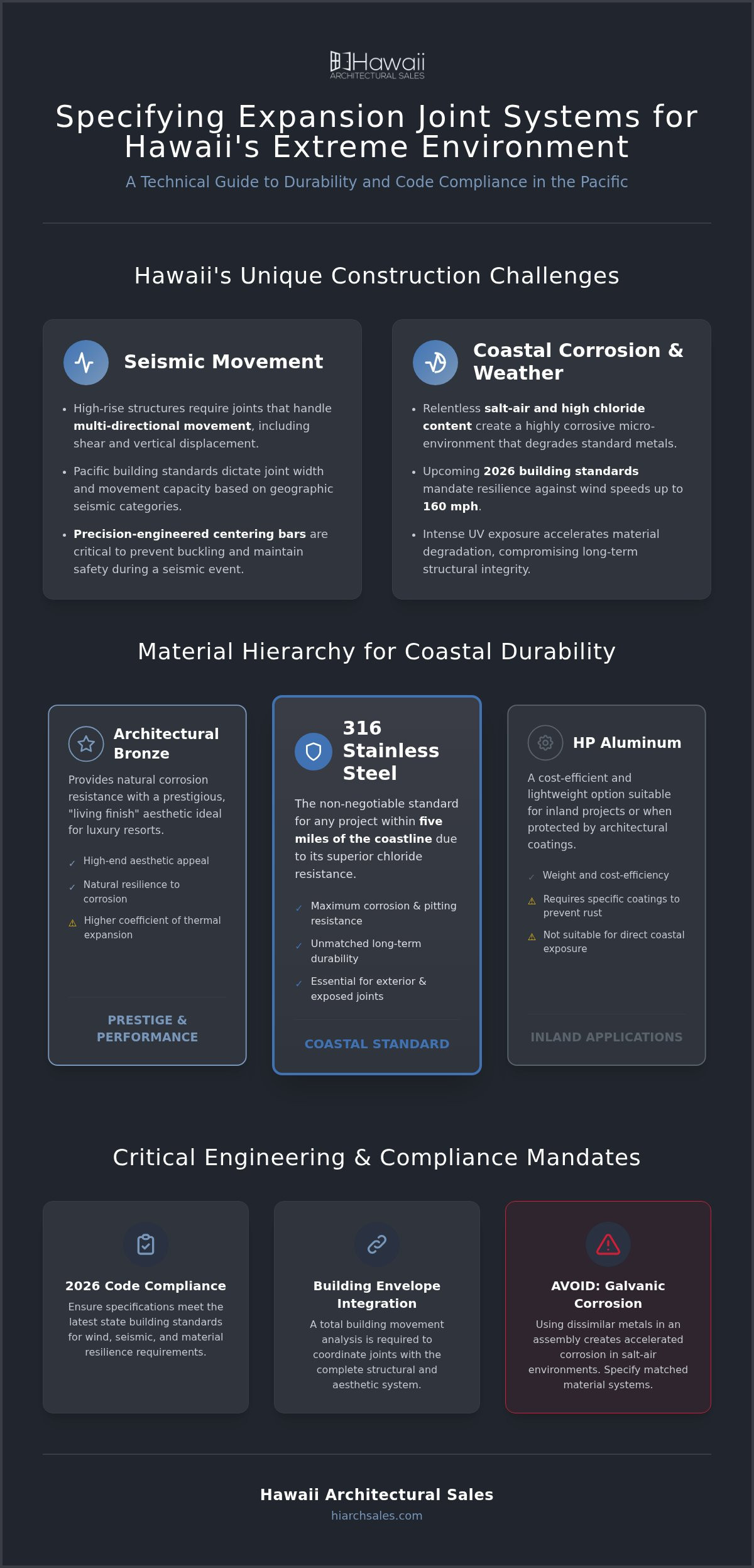
Seismic design in Hawaii is dictated by specific geographic categories that influence joint width and movement capacity. High-rise structures in Honolulu require joints that accommodate multi-directional movement, including shear and vertical displacement. Precision-engineered centering bar systems are critical in these applications. These bars ensure that the cover plate remains centered over the joint opening during a seismic event. This prevents the system from buckling or becoming a trip hazard, maintaining safety during and after a quake.
Thermal Dynamics in Hawaii’s Microclimates
Managing thermal expansion in large-span structures like shopping centers or the Honolulu airport involves more than just calculating temperature ranges. High diurnal temperature swings and intense solar heat gain cause building materials to expand and contract at different rates. Specifying Balco systems allows for these movements without creating unsightly gaps. Many high-end projects now require zero-profile aesthetics where the joint disappears into the finish. We help architects balance these aesthetic goals with the physical reality of material movement, ensuring the building envelope remains sealed and functional.
Material Science in the Pacific: Corrosion Resistance and Structural Movement
In the Pacific, material selection is a matter of structural survival. While interior joints might prioritize cost, exterior expansion joint systems Hawaii projects utilize must withstand constant chloride exposure. The hierarchy of materials is strictly defined by the project's proximity to the ocean. We typically categorize material performance based on the following standards:
316 Stainless Steel
The non-negotiable standard for any project within five miles of the coastline.
Architectural Bronze
Provides natural corrosion resistance with a prestigious aesthetic for luxury resorts.
High-Performance Aluminum
Suitable for inland projects or when protected by localized architectural coatings.
Aluminum remains a popular choice for its weight and cost-efficiency. However, it requires specific architectural coatings to survive in the islands. Without these protective layers, aluminum components quickly develop white rust and pitting. Bronze offers a high-end aesthetic; it provides natural resilience but requires careful engineering to prevent staining of adjacent finishes. Architects often choose bronze for its living finish, but they must account for the higher coefficient of thermal expansion compared to stainless steel.
One of the most overlooked technical failures in island construction is galvanic corrosion. This occurs when dissimilar metals are used in a single assembly. In a salt-air environment, the moisture acts as an electrolyte. This causes the more reactive metal to corrode at an accelerated rate. We specify Balco assemblies that incorporate isolation spacers and specialized coatings to prevent this electrochemical reaction. Balco’s specialized coatings are specifically engineered for high-salt environments, providing a barrier that prevents the metal from reacting with the atmosphere. You can review our full range of corrosion-resistant expansion joint solutions to see how we address these specific island challenges.
316 Stainless Steel: The Gold Standard for Salt-Air Resilience
The difference between 304 and 316 stainless steel is critical for island longevity. 304 stainless steel is prone to tea staining and pitting when exposed to salt spray. 316 stainless steel includes molybdenum, which significantly increases its resistance to chloride-induced corrosion. For projects in Lihue or Kailua-Kona, where the salt concentration is high, 316 is the only viable choice for metal covers. Balco utilizes these high-grade alloys in their QuakeSpan™ series to ensure that movement capabilities don't degrade over time due to surface failure. These covers maintain their structural integrity even in the most aggressive marine conditions, reducing the need for frequent maintenance.
Elastomeric Seals and UV Degradation
Metals are only one part of the system. The elastomeric seals must also withstand Hawaii’s intense tropical UV exposure. Standard rubber seals often become brittle and crack within a few years of installation. We specify Santoprene seals for their superior UV resistance and thermal stability. Santoprene is a thermoplastic vulcanizate that maintains its flexibility across a wider temperature range and resists the color fading common in high-exposure areas. This ensures that the expansion joint systems Hawaii professionals specify remain watertight and aesthetically consistent for the life of the building. Using these high-performance seals prevents water infiltration, which is the leading cause of structural damage in coastal high-rise buildings.
System Categorization: Seismic vs. Thermal Joint Solutions for Island Infrastructure
Selecting the correct system requires a precise understanding of the expected movement profile. In Hawaii, infrastructure projects must distinguish between predictable thermal expansion and the multi-directional requirements of seismic activity. While thermal joints manage the daily growth and shrinkage of materials due to tropical heat, seismic systems are engineered for extreme, life-safety events. High-performance expansion joint systems Hawaii engineers specify often fall into two primary categories: Balco’s QuakeSpan™ for seismic resilience and JointSpan™ for thermal control.
Integration is the next critical step. For many Honolulu projects, fire-rated barriers must be installed within the joint assembly. These barriers provide the necessary protection without restricting the movement capacity of the primary joint. Similarly, Hawaii’s open-air architecture, seen in resort corridors and shopping centers, demands waterproof solutions. These systems utilize internal gutters and specialized seals to manage heavy tropical rainfall. This prevents water from migrating into the structural slab, where it could cause long-term damage to the building's core components. These systems don't just fill gaps; they protect the investment from the inside out.
Seismic Solutions for High-Occupancy Structures
Life safety is the priority for high-occupancy structures like hospitals and emergency response centers. During a major seismic shift, these buildings must remain operational. Balco’s QuakeSpan™ systems are engineered to accommodate 100% of the joint's movement capacity. This ensures that the floor and wall covers remain intact and functional even during multi-directional swaying. By specifying these advanced systems, architects provide a safe path of egress and protect the building’s structural integrity. We consult with engineering teams to match these systems to the specific seismic category of the island project, ensuring every detail meets 2026 standards.
Specialized Joints for Parking and Heavy Traffic
Parking structures in coastal resorts face unique challenges. They must endure heavy dynamic loads from vehicles while resisting the corrosive effects of salt air. Waterproofing is essential here. If water penetrates the joint, it leads to rebar corrosion and concrete spalling. We provide heavy-duty joints that incorporate integrated waterproofing membranes to protect the structural steel. These systems are also designed for pedestrian safety. They feature slip-resistant surfaces and maintain ADA compliance. This ensures a seamless transition for guests moving between parking decks and high-end resort finishes without creating a liability risk.
Specifying for Longevity: Building Envelope Integration and 2026 Code Compliance
Compliance in 2026 requires a rigorous approach to the building envelope. Hawaii’s updated standards now mandate that structures withstand wind speeds of up to 160 mph, aligning with Category 5 hurricane resilience. This shift means expansion joint systems Hawaii architects specify must do more than accommodate movement; they must maintain the integrity of the air and water barrier under extreme pressure. We often look to Florida Product Approval as a benchmark for performance. While it's a mainland standard, its testing for High Velocity Hurricane Zones (HVHZ) provides the most reliable data for how a joint assembly will perform during a severe Pacific storm event.
A fragmented approach to specification often leads to coordination gaps at the transition points. Successful projects utilize a 'system' approach, ensuring that expansion joints are designed in tandem with architectural glass systems Honolulu engineers trust for high-rise facades. If the joint doesn't tie directly into the glazing’s moisture management system, the entire envelope is compromised. We provide technical documentation and detailing support to ensure these transitions are airtight, preventing the pressurized moisture infiltration that's common in coastal high-rises. You can contact our technical team to review specific detailing for your building envelope transitions.
Fire Barrier Integration and Life Safety
Fire safety requirements in multi-story island structures are non-negotiable. We specify Balco fire barriers that provide multi-hour ratings while maintaining full movement capacity. It's critical to ensure these barriers are tested in 'full cycle' movement. This means the barrier has been proven to remain effective even after the joint has expanded and contracted thousands of times. Coordination between the fire-stopping material and the architectural cover plate is essential to prevent the barrier from being pinched or torn during seismic shifts. We help specify assemblies that meet UL standards without compromising the floor's aesthetic finish.
Envelope Continuity and Weatherproofing
Continuity is the most difficult aspect of envelope design. This is especially true when integrating joints with high-performance bifold door systems in luxury resorts. A common mistake is falling into the 'or equal' trap during the bidding process. Substituting Balco’s precision-engineered systems for generic alternatives often results in joints that don't interface correctly with the weatherproofing membranes. We recommend drafting tight specifications that require factory-fabricated transitions. This ensures that the water barrier remains continuous from the roofline down through the parking deck, protecting the structure from the pervasive humidity and salt spray of the islands.
Technical Support and Procurement through Hawaii Architectural Sales
Hawaii Architectural Sales serves as the bridge between advanced manufacturing and the unique logistical demands of the Pacific. We understand that specifying expansion joint systems Hawaii engineers rely on involves more than selecting a part number from a catalog. It requires a deep understanding of how these joints interact with other high-performance building components. There is a significant technical synergy between Balco expansion joints and the systems provided by a Euro-Wall distributor Hawaii architects trust. Coordinating these systems ensures that building movement doesn't compromise the operation of large-scale folding doors or specialized daylighting solutions like Kalwall and Super Sky.
Our role involves custom engineering and modification. We work directly with Balco to adapt systems for the specific seismic and corrosive profiles of the islands. This often involves adjusting the movement capacity of a QuakeSpan™ system or selecting specific 316 stainless steel finishes that aren't standard in mainland inventory. We bridge the gap between manufacturer capabilities and island-specific requirements. This ensures that every component specified is fit for purpose in a tropical marine environment, where precision is mandatory for structural survival.
Architectural Consulting and Specification Support
We provide comprehensive support during the design phase to streamline the procurement process. This includes providing high-fidelity technical drawings and BIM models for Balco systems. Architects can integrate these joint details directly into their structural plans, reducing the risk of coordination errors. Navigating the 2026 seismic requirements is complex, but our team offers expert guidance to ensure chosen systems meet the latest state standards. We also verify material compatibility across the entire building facade. This prevents common issues like chemical or galvanic reactions between expansion joints and adjacent glazing or cladding systems.
Partnering for Long-Term Structural Success
A dedicated manufacturer’s representative provides a level of localized expertise that mainland suppliers cannot match. We manage the complex logistics of island-wide distribution. Whether your project is in Honolulu, Lihue, or Lahaina, we ensure that materials arrive on site exactly when they're needed. This reliability is vital for maintaining construction schedules on major developments. We invite you to contact Hawaii Architectural Sales for a technical consultation. Our team is ready to assist you in selecting and detailing the most resilient expansion joint systems Hawaii has to offer for your next high-end project.
Future-Proofing Hawaii’s Vertical Landscape
The complexity of 2026 building standards requires a shift from generic specifications to high-performance, localized solutions. Architects and engineers must balance the stringent 160 mph wind load requirements with the multi-directional movement demands of Pacific seismic zones. By prioritizing 316 stainless steel and precision-engineered Balco assemblies, you ensure that your building envelope remains resilient against the relentless salt-air corrosion typical of coastal developments. Successful projects integrate these expansion joint systems Hawaii requires with a cohesive strategy that encompasses fire safety, waterproofing, and aesthetic continuity.
As your authorized Balco representative, we provide the technical guidance necessary to navigate these evolving regulatory and environmental challenges. We act as your strategic ally from the initial design phase through final material procurement; it's a partnership that prioritizes long-term structural success. Our expertise in 2026 Hawaii building codes and building envelope synergy allows you to specify with confidence. Contact Hawaii Architectural Sales for technical Balco specifications and expert support on your next high-performance project. We're ready to help you achieve lasting structural integrity.
Frequently Asked Questions
What are the most common causes of expansion joint failure in Hawaii?
Structural failure in island projects typically stems from salt-air corrosion and inadequate movement calculations. Standard aluminum components often succumb to chloride pitting within years of installation if they aren't properly coated. Additionally, many failures occur because the specified joint couldn't handle the multi-directional shifts required by Hawaii’s unique seismic and wind-load combinations.
How do I choose between aluminum and stainless steel for coastal expansion joints?
The decision depends on the project's proximity to the shoreline. We recommend 316 stainless steel for any structure within five miles of the coast due to its superior resistance to salt spray. Aluminum is a viable, cost-effective alternative for inland projects, provided it features a high-performance architectural coating to prevent white rust and atmospheric degradation.
What seismic movement capacity is required for Honolulu high-rise buildings in 2026?
Current 2026 standards generally require expansion joint systems Hawaii engineers specify to accommodate 100% of the joint's movement capacity. This ensures the building remains operational after a seismic event. These systems must also maintain their seal integrity while subjected to the Category 5 wind speeds of up to 160 mph mandated by updated building codes.
Can expansion joints be fire-rated while still allowing for 100% movement?
Yes, Balco fire barriers are engineered to provide multi-hour protection without compromising movement. These barriers are full-cycle tested, meaning they maintain their fire-resistive properties even when the joint is at its maximum expansion or contraction. This ensures life safety is maintained during both thermal shifts and major seismic events.
Does Balco offer ADA-compliant expansion joint covers for pedestrian areas?
Balco provides a range of floor covers specifically designed to meet ADA requirements. These systems feature slip-resistant surfaces and maintain a flush profile with the surrounding floor finish. This prevents trip hazards in high-traffic resort lobbies and commercial corridors while still allowing for the necessary structural movement beneath the surface.
How does salt-air exposure affect the lifespan of elastomeric joint seals?
High chloride levels and intense tropical UV rays accelerate the hardening of standard rubber seals. This causes them to become brittle and crack, leading to water infiltration. We specify Santoprene seals for expansion joint systems Hawaii applications because they remain flexible and color-stable under extreme environmental stress, significantly extending the system's service life.
What is the difference between QuakeSpan™ and JointSpan™ systems?
QuakeSpan™ is designed for seismic applications where multi-directional movement and centering-bar stability are required. It's built for extreme events. JointSpan™ is a thermal solution intended for more predictable, linear movement caused by daily temperature swings. QuakeSpan™ is the standard for high-occupancy structures, while JointSpan™ is often used in smaller, low-rise island buildings.
How do I integrate expansion joints with a waterproof roofing system in Hawaii?
Successful integration requires factory-fabricated transitions and internal gutter systems. The joint assembly must tie directly into the primary waterproofing membrane to ensure continuity. This prevents tropical rainwater from bypassing the seal and reaching the structural slab, which is a leading cause of rebar corrosion and spalling in island parking decks and rooftops. For professional assistance with structural leaks, learn more about the services offered by Waffen Waterproofing Pte Ltd.