Hawaii High-Performance Aluminum Windows: 2026 Guide
In 2026, a standard window is no longer sufficient to meet Hawaii's rigorous building codes, where design wind speeds in specific coastal zones now reach up to 160 mph. You've likely seen how quickly salt-air corrosion can seize a window track or how solar heat gain can overwhelm a building's coolin...
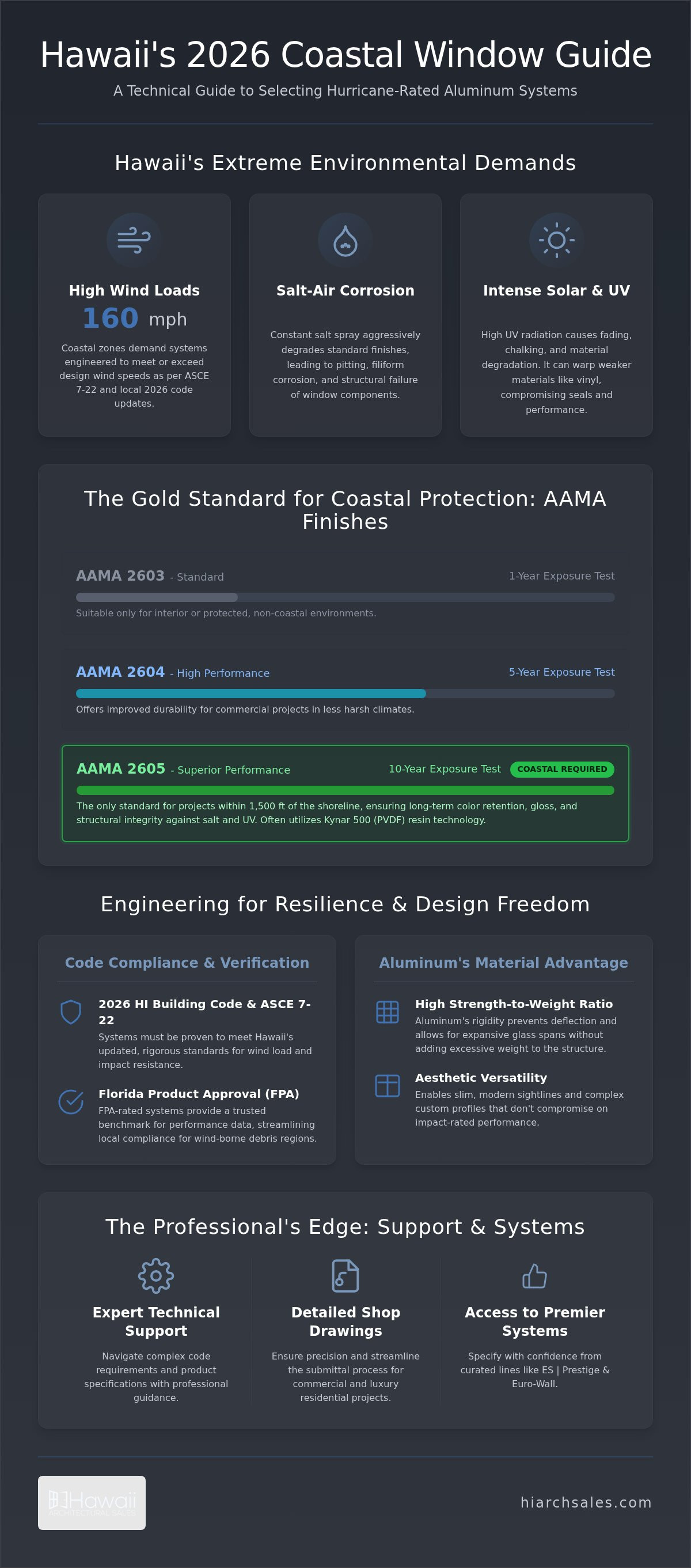
In 2026, a standard window is no longer sufficient to meet Hawaii's rigorous building codes, where design wind speeds in specific coastal zones now reach up to 160 mph. You've likely seen how quickly salt-air corrosion can seize a window track or how solar heat gain can overwhelm a building's cooling system. Selecting the right aluminum window systems Hawaii demands requires moving beyond aesthetics to focus on engineering and material science.
We understand that architects and engineers need more than just a product; they need a system that survives the Pacific's unique environmental pressures. This guide helps you master the technical specifications and material standards required to select durable, hurricane-rated solutions. You'll learn how to identify AAMA 2605 high-performance finishes to prevent degradation and ensure compliance with the latest local wind-load updates. We also preview how to find a distributor that provides the professional brand representation and technical shop drawings your project requires. We'll cover everything from Florida Product Approval benchmarks to the specific egress requirements mandated by the 2026 code cycle.
Key Takeaways
• Specify AAMA 2605 finishes to prevent salt-air corrosion and ensure the long-term structural integrity of your coastal glazing.
• Navigate 2026 Hawaii building code updates and ASCE 7-22 requirements to guarantee your project meets strict wind-load and impact standards.
• Evaluate the engineering behind aluminum window systems Hawaii professionals select, including specialized lines like ES | Prestige and Euro-Wall.
• Access professional technical support and detailed shop drawings to streamline the specification process for complex commercial or luxury residential builds.
Aluminum Window Systems in Hawaii’s Architectural Context
Aluminum has long served as the primary material for Hawaii’s most demanding architectural projects. While early island designs relied on basic jalousies for ventilation, the modern aluminum window systems Hawaii architects specify today are complex, high-performance assemblies. This shift is driven by the need to balance aesthetic transparency with the extreme structural demands of the Pacific environment. Aluminum remains the dominant choice because it offers a level of durability and precision that alternative materials like wood or vinyl cannot match in a tropical climate.
The inherent properties of aluminum include a natural oxide layer that resists corrosion, providing a foundational advantage for coastal builds. However, the evolution of these systems now includes sophisticated thermal breaks and reinforced chambers designed to meet 2026 wind-load standards. Because Hawaii shares many environmental challenges with the southeastern United States, specifying systems with Florida Product Approval (FPA) has become a standard practice for ensuring local compliance. These rated systems provide the necessary data to satisfy Hawaii’s strict wind-borne debris requirements.
Structural Integrity vs. Weight
The strength-to-weight ratio of aluminum is its most significant technical advantage. Unlike vinyl, which often warps under intense UV exposure, aluminum maintains its structural profile over decades. This rigidity allows for much larger glass spans. In Honolulu’s mid-rise and high-rise developments, where wind loads increase significantly with elevation, aluminum provides the stiffness required to prevent deflection without adding excessive weight to the building's primary structure. This balance enables the expansive, floor-to-ceiling ocean views that define modern luxury residential design.
The Aesthetic Versatility of Modern Aluminum
Beyond structural performance, aluminum provides unmatched design flexibility through custom extrusions. Architects can specify slim sightlines that disappear into the landscape while still housing the heavy-duty hardware required for impact-rated glass. These systems integrate seamlessly with advanced architectural glass systems in Honolulu, allowing for a cohesive building envelope. Whether it's a minimal-frame sliding door for a residence in Kailua-Kona or a custom window wall for a commercial project in Kihei, aluminum’s ability to match complex profiles ensures that technical performance doesn't come at the expense of the architectural vision.
Material Science: Corrosion Resistance and Marine-Grade Finishes
Hawaii's microclimates, particularly in high-salt areas like Lihue or Lahaina, create a hostile environment for architectural metals. Standard powder coatings often fail within years due to filiform corrosion, where salt penetrates the finish and spreads beneath the surface. For aluminum window systems Hawaii professionals specify, the coating isn't just decorative; it's a critical structural barrier. Without a marine-grade finish, the aluminum substrate eventually pits and degrades, compromising the entire glazing assembly.
The chemistry of the finish determines how well the system resists the combination of high UV radiation and constant salt spray. While anodized finishes provide a hard, metallic surface, they can be susceptible to "crazing" or staining if salt deposits aren't washed away regularly. In contrast, Kynar 500 (PVDF) coatings use a fluoropolymer resin that remains chemically inert. This makes PVDF the preferred choice for color retention and chemical resistance in tropical coastal zones. When selecting aluminum finishes for coastal areas, the specification must focus on the resin's ability to withstand long-term exposure without chalking or fading.
Understanding AAMA 2603, 2604, and 2605
Architects must specify the American Architectural Manufacturers Association (AAMA) 2605 standard for any project within 1,500 feet of the high-tide line. While AAMA 2603 and 2604 are suitable for inland or protected environments, they don't offer the necessary protection for the islands. AAMA 2605 is the gold standard, requiring a 10-year Florida outdoor exposure test. This standard ensures the finish maintains its gloss and color despite the intense solar heat gain and humidity characteristic of the Hawaiian Islands.
Hardware and Component Durability
Hardware is often the first point of mechanical failure in coastal glazing. Specifying salt resistant window frames is only effective if the internal components match that durability. All rollers, hinges, and fasteners must utilize 316 marine-grade stainless steel. This is vital to prevent galvanic corrosion, which occurs when dissimilar metals react in the presence of an electrolyte like salt water. If you use standard steel or zinc-plated fasteners in an aluminum frame, the resulting reaction will quickly seize the hardware and damage the frame. You can consult with Hawaii Architectural Sales to review hardware schedules and ensure every component meets these stringent marine standards.
Engineering for the Islands: Wind Loads and Thermal Performance
Designing the building envelope in the Pacific requires a rigorous approach to structural engineering. For aluminum window systems Hawaii projects, this begins with navigating ASCE 7-22 wind load requirements. In coastal and high-elevation zones, systems must now withstand wind loads of up to 160 mph. These pressures don't just test the glass; they test the entire assembly, including the frame's deflection limits and the anchorage to the substrate. Engineering for these extremes ensures that the window remains a secure barrier during a storm event, preventing internal pressurization that can lead to catastrophic roof failure.
Hurricane and High Wind Load Compliance
Compliance often hinges on understanding the difference between large-missile and small-missile impact ratings. Large-missile impact testing involves a 9-pound 2x4 timber traveling at high speed, while small-missile testing uses steel ball bearings. In Hawaii, any area with a design wind speed of 130 mph or greater is a wind-borne debris region. Specifying hurricane rated windows in Hawaii is the most effective way to protect the building envelope. Systems like ES | Prestige are engineered for high-velocity hurricane zones (HVHZ), offering the structural depth required to house thick, laminated glass while maintaining their architectural profile under intense cyclic pressure.
Energy Efficiency and Thermal Breaks
While wind resistance is a safety requirement, thermal performance is a daily operational necessity. Aluminum is naturally conductive, which can lead to significant solar heat gain in tropical climates. Modern aluminum window systems Hawaii designers specify use polyamide struts to create a thermal break. These reinforced plastic strips separate the interior and exterior aluminum extrusions, effectively stopping the transfer of heat. This technology is critical for meeting the Hawaii Energy Code (IECC) requirements for commercial facades. Implementing thermal break window systems in Hawaii significantly reduces cooling loads, providing a measurable return on investment through lower utility costs over the building's lifecycle.
High-performance glazing also provides secondary benefits that enhance the occupant experience. Impact-rated glass is inherently laminated, which provides superior acoustic insulation against Honolulu's urban noise and an added layer of security against forced entry. By selecting glass with a low Solar Heat Gain Coefficient (SHGC), architects can maintain high visible light transmittance while rejecting the infrared heat that causes interior temperatures to spike. This balance ensures that occupants enjoy unobstructed views without the discomfort of radiant heat or the need for heavy window treatments.
Selecting the Right System: ES Prestige, Elite, and Specialty Lines
Selecting the optimal aluminum window systems Hawaii projects require involves matching specific brand engineering to the site's exposure level. While aesthetics are a priority, the structural depth and glazing capacity of each system define its practical application. We act as a technical bridge, helping architects choose between systems that offer varied levels of wind-load resistance and design flexibility. Each manufacturer in our portfolio serves a distinct role in the island's architectural landscape.
Comparing ES | Prestige and ES | Elite
The distinction between these two lines centers on structural performance and cost-efficiency. ES | Prestige is the heavy-duty standard for high-exposure coastal estates and commercial projects requiring maximum wind-load resistance. It supports thicker glass packages and offers deeper frame depths, making it the preferred choice for the 160 mph wind zones found in certain island regions. In contrast, ES | Elite provides a solution for luxury condos and residential builds where high-end aesthetics are required at a more accessible price point. Architects can refer to the ES | Elite vs. Prestige comparison guide to review detailed load tables and frame specifications.
Specialty Systems for Wide Openings
Modern Hawaiian architecture often demands seamless transitions between indoor and outdoor spaces. Euro-Wall specializes in wide-span solutions that don't compromise on safety. Their multi-slide and folding systems allow for massive openings while maintaining full Florida Product Approval. When specifying hurricane rated folding glass walls, Euro-Wall’s pivot and stacking door configurations offer technical advantages in water infiltration resistance and ease of operation. These systems are engineered to handle the cyclic pressures of island storms while providing the ultra-slim sightlines luxury clients expect.
For projects requiring even slimmer profiles than aluminum can provide, Hopes offers custom steel solutions. While aluminum is the standard for most aluminum window systems Hawaii applications, Hopes steel windows provide a unique aesthetic for historic or ultra-modern designs where frame thickness must be minimized. Each of these brands offers unique benefits depending on your specific site conditions and design goals. To ensure your specifications align with local codes and performance requirements, you can request technical data and shop drawings from Hawaii Architectural Sales.
Strategic Specification: Sourcing Aluminum Systems in Hawaii
Sourcing high-performance aluminum window systems Hawaii projects demand requires a departure from the traditional retail model. While retail dealers often focus on high-volume sales or installation services, an architectural products representative serves as a technical consultant during the design and engineering phases. This distinction is critical for architects and engineers who must ensure that the specified systems meet the 2026 wind-load and corrosion standards discussed in previous sections. We provide the technical data and detailed shop drawings necessary to integrate complex glazing into the building's structural plans without compromising architectural intent.
Partnering with an Architectural Window Distributor
Engaging a window distributor in Hawaii early in the design phase allows for the optimization of custom configurations. This early collaboration ensures that non-standard openings or wide-span Euro-Wall systems are engineered correctly before the project reaches the bidding stage. A representative also verifies that the selected AAMA 2605 finishes and 316 stainless steel hardware packages maintain their product warranties in Hawaii’s high-salt environments. This level of technical oversight prevents costly delays and ensures long-term material compatibility across the building envelope, particularly when mixing aluminum frames with other architectural glass systems.
From Specification to Material Delivery
Writing effective specifications for ES | Prestige or Hopes systems requires localized knowledge of the regulatory landscape. A localized partner understands how to coordinate complex logistics for seamless delivery to Honolulu, Lihue, or Kailua-Kona. Managing lead times is essential when transporting materials from mainland manufacturers to the neighbor islands. We handle the complexities of island distribution, ensuring that the materials arriving on-site match the engineering requirements of the project. This strategic approach to sourcing moves beyond a simple transaction. It positions the distributor as a strategic ally who manages the technical details of the building envelope, from the initial wind-load calculation to the final material transport. By bridging the gap between high-end manufacturing and practical island application, we help ensure that the finished project performs as intended for decades.
Securing the Future of Island Design
Designing for the Pacific requires a technical shift toward resilience and precision. We've established that the longevity of aluminum window systems Hawaii professionals specify depends on the synergy of marine-grade finishes and high-wind load engineering. By prioritizing AAMA 2605 standards and 316 stainless steel hardware, you protect your project from the inevitable pressures of salt-air corrosion and tropical storm events. These specifications aren't just recommendations; they're the foundation of a durable building envelope.
Partnering with a dedicated architectural representative provides the technical depth necessary to navigate these complex variables. As an authorized distributor for ES | Prestige, Euro-Wall, and Hopes, we specialize in Hawaii-compliant solutions that meet the unique regulatory demands of the islands. Our team provides the in-depth technical support and detailed shop drawings required to move from initial concept to successful material delivery. We bridge the gap between high-end manufacturing and practical island application.
What is the best aluminum finish for a beachfront home in Hawaii?
A high-performance AAMA 2605 fluoropolymer coating is the best finish for beachfront properties in Honolulu or Lihue. These coatings, often referred to by brand names like Kynar 500, provide the highest level of resistance to salt-spray, UV degradation, and humidity. While standard finishes may chalk or pit within years, AAMA 2605 systems are tested for ten years of exposure to ensure color retention and structural integrity in harsh marine environments.
Are aluminum window systems in Hawaii required to be hurricane-rated?
Yes, aluminum window systems Hawaii projects must be hurricane-rated if located in designated wind-borne debris regions. Under the 2026 building code updates, any area with a design wind speed of 130 mph or greater requires impact-resistant glazing. In specific coastal or high-elevation zones, systems must withstand loads up to 160 mph. Specifying Florida Product Approval rated systems ensures your project meets these rigorous safety and structural standards.
How do thermal breaks improve energy efficiency in tropical climates?
Thermal breaks improve energy efficiency by creating a structural barrier that stops heat from conducting through the aluminum frame. In tropical climates like Kailua-Kona, this prevents external solar heat from radiating into the interior space. By separating the exterior and interior extrusions with a polyamide strut, these systems significantly reduce the demand on cooling systems. This technology helps commercial facades meet Hawaii Energy Code requirements while lowering monthly utility costs.
Can I use ES Prestige windows for commercial high-rise projects?
ES | Prestige systems are specifically engineered for high-exposure commercial high-rise projects and luxury developments. These systems offer the structural depth and reinforced chambers necessary to handle the increased wind pressures found at higher elevations in Honolulu. Because they are designed for High-Velocity Hurricane Zones, they allow architects to specify expansive glass spans while maintaining the structural safety required for multi-story residential and commercial applications.
What is the difference between AAMA 2604 and AAMA 2605 coatings?
The primary difference lies in the durability of the resin and the length of the required exposure testing. AAMA 2604 finishes are high-performance coatings tested for five years, whereas AAMA 2605 is the superior standard requiring ten years of testing. For projects within 1,500 feet of the ocean in Kihei or Lahaina, AAMA 2605 is mandatory. It provides significantly better resistance to the chalking and fading caused by Hawaii’s intense UV rays.
Does Hawaii Architectural Sales provide installation for the systems they sell?
Hawaii Architectural Sales does not provide installation or general contracting services. We operate strictly as a manufacturer’s representative and distributor for premium lines like ES | Prestige and Euro-Wall. Our role is to provide technical expertise, shop drawings, and material coordination for architects and contractors. This focus allows us to act as a specialized consultant, ensuring the systems specified are technically sound and fully compliant with local building codes.
How do Euro-Wall systems handle high wind loads compared to standard sliders?
Euro-Wall systems are engineered to exceed the performance of standard sliders by utilizing reinforced extrusions and advanced hardware. These folding and multi-slide systems carry Florida Product Approval, meaning they have undergone rigorous cyclic pressure and impact testing. Unlike basic residential sliders, Euro-Wall handles the extreme wind loads common in Hawaii’s coastal zones while offering much larger openings. This engineering provides a secure building envelope without sacrificing the indoor-outdoor lifestyle luxury clients expect.
What is the typical lead time for custom aluminum window systems in Hawaii?
Lead times for custom aluminum window systems Hawaii projects vary based on the manufacturer and the complexity of the order. Because these high-performance systems are built to specific project dimensions and wind-load requirements, they require careful coordination. We manage the logistics of material transport from mainland factories to Honolulu or neighbor island ports. We recommend engaging our technical team early in the design phase to establish a timeline that aligns with your construction schedule.