Impact Rated Windows Hawaii: The 2026 Architect’s Guide to High-Performance Glazing
What if the floor-to-ceiling vistas that define a Hawaii luxury project are actually its greatest structural liability? For architects designing in wind zones exceeding 170 mph, the challenge is rarely just about the view. It's about engineering for survival against windborne debris and extreme pres...
What if the floor-to-ceiling vistas that define a Hawaii luxury project are actually its greatest structural liability? For architects designing in wind zones exceeding 170 mph, the challenge is rarely just about the view. It's about engineering for survival against windborne debris and extreme pressure cycles. You recognize that specifying impact rated windows Hawaii requires more than just selecting a product from a catalog. It demands a technical solution that survives the relentless salt air of Kihei or Lahaina while meeting the rigorous ASTM E1886 and E1996 standards.
This guide provides the technical roadmap you need to address Hawaii's evolving building codes and windborne debris requirements for 2026. You'll learn how to maintain seamless indoor-outdoor flow with large-span glazing without compromising on structural integrity. We examine high-performance systems from ES Prestige, Hopes, and Euro-Wall that balance architectural vision with Florida Product Approval benchmarks. From corrosion-resistant aluminum to ultra-durable steel frames, we preview the materials and distribution partnerships necessary to achieve full code compliance in the most demanding coastal environments.
Key Takeaways
• Identify specific Windborne Debris Region requirements across the islands to ensure your project meets 170+ mph wind load standards.
• Discover why the choice between PVB and SGP interlayers is critical when specifying impact rated windows Hawaii for high-risk coastal zones.
• Compare the structural advantages of ES Prestige aluminum and Hopes steel systems to maintain large glass spans without compromising safety.
• Learn to calculate Design Pressure (DP) accurately and specify AAMA 2605 finishes that won't pit or peel in Hawaii's salt-air environments.
• Leverage a consultative distribution model to bridge the gap between high-end manufacturing and complex architectural application requirements.
Understanding Impact Rated Windows in the Hawaii Building Landscape
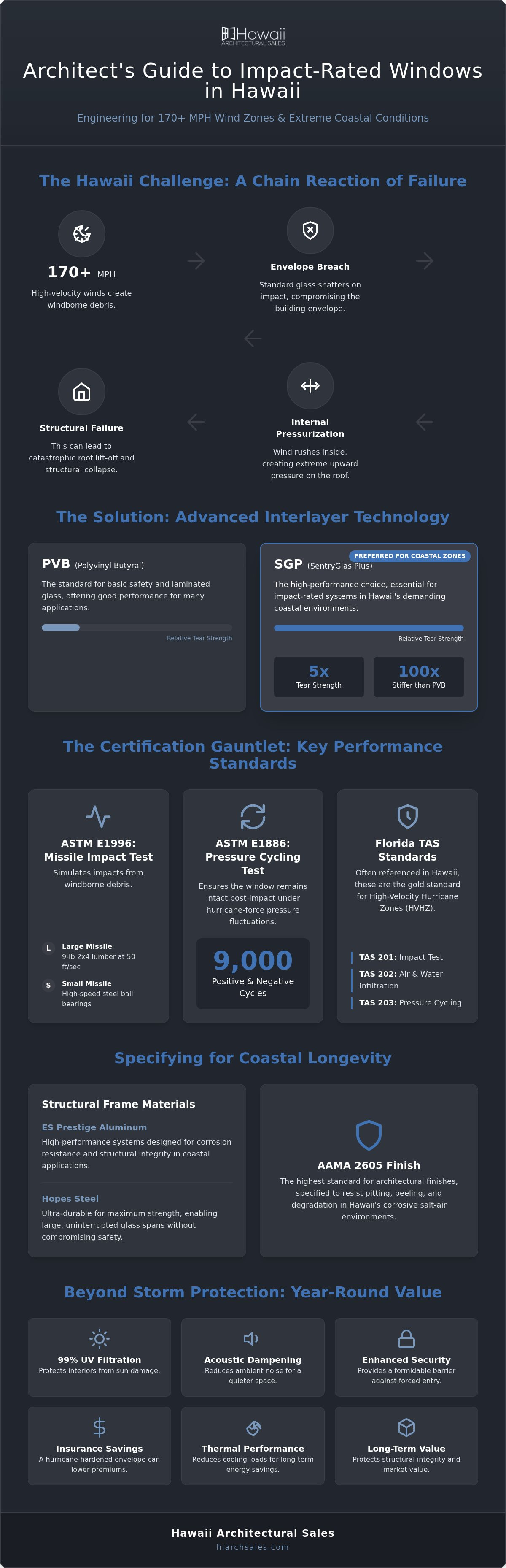
Hawaii's geography dictates strict engineering requirements that vary significantly between islands. Windborne Debris Regions (WDR) are defined by the ASCE 7 standard. In these zones, structures must withstand impacts from flying debris during high-wind events. Standard glazing often fails not just from the physical impact, but from the resulting internal pressurization. When a standard window shatters, wind enters the building. This creates an upward force that can lift the roof from the structure. This is why impact rated windows Hawaii are now a technical necessity rather than a luxury upgrade.
Historically, builders relied on heavy shutters to protect openings. Modern architectural trends favor large glass spans and indoor-outdoor flow, making shutters an aesthetic liability. Integrated impact glazing allows for these expansive openings without compromising the design vision. Beyond storm safety, Laminated glass technology provides 99% UV filtration and significant acoustic dampening. These systems protect interior finishes from sun damage and minimize ambient noise, enhancing the overall occupant experience. They also serve as a formidable barrier against forced entry, providing security year-round.
Hawaii’s Unique Environmental Demands
The state's micro-climates require specialized specifications. Projects in coastal areas like Lahaina face extreme salt-spray corrosion, while high-elevation sites in Lihue experience intensified wind loads. While Hawaii's building codes are based on the 2018 International Building Code (IBC), they often mirror Florida’s High-Velocity Hurricane Zone (HVHZ) standards for testing and certification. Architects must also navigate the 2015 International Energy Conservation Code (IECC). This mandates specific thermal performance alongside structural resilience, requiring a balanced approach to glazing selection.
The ROI of Premium Impact Systems
Specifying architectural-grade systems like ES Prestige or Hopes steel provides long-term value that standard retail vinyl cannot match. These materials resist the pitting and degradation common in coastal air. From a financial perspective, a hurricane-hardened envelope often qualifies for lower insurance premiums. Additionally, high-performance thermal breaks in these premium systems reduce cooling loads. This provides ongoing energy savings that offset the initial investment. Choosing impact rated windows Hawaii is a strategic decision that protects the building's structural integrity and its long-term market value.
The Engineering Behind Windborne Debris Resistance
An impact-rated window is a laboratory-tested system designed to remain intact after a direct strike from windborne debris. In the 2026 market, these systems are defined by their ability to prevent building envelope breaches during extreme weather events. The core of this resilience lies in the laminated glass construction. Two or more panes of glass are bonded together with a transparent polymer interlayer. While Polyvinyl Butyral (PVB) is common for standard safety, high-performance projects often require SentryGlas Plus (SGP). SGP interlayers are significantly stiffer and offer five times the tear strength of traditional PVB, making them the preferred choice for impact rated windows Hawaii in coastal zones.
The certification process relies on the Missile Test. ASTM E1996 defines large missile testing as a 9-pound 2x4 lumber missile fired at 50 feet per second. Small missile testing involves high-speed impacts from steel balls. Success isn't just surviving the hit; the window must then endure pressure cycling. This involves 9,000 cycles of positive and negative pressure to simulate the relentless turbulence of a hurricane. If you're specifying for high-risk zones, you can review technical performance data to ensure your selections meet these rigorous benchmarks.
TAS and ASTM Standards for Hawaii Projects
Hawaii architects frequently look to Florida Product Approval as a gold standard for performance. This involves Testing Application Standards (TAS) 201, 202, and 203. TAS 201 covers the impact test, 202 handles air and water infiltration, and 203 measures the pressure cycling endurance. Nationally, ASTM E1886 and E1996 serve as the primary references for windborne debris resistance. Adhering to these standards ensures the glazing system can withstand the 170+ mph wind loads required in specific Hawaii counties.
Structural Integrity and Frame Engineering
A resilient glass pane is useless if the frame fails under load. Engineering the connection between the glass and the frame is critical. High-performance systems use a wet glaze method with high-strength structural silicone to bond the glass to the sash. This prevents the glass from popping out during extreme pressure shifts. Reinforced aluminum and steel frames, such as those from ES Prestige or Hopes, provide the necessary rigidity to prevent twisting or buckling. Design Pressure (DP) is a numerical rating that defines the specific wind pressure a window system can withstand without structural failure or water leakage. Specifying impact rated windows Hawaii ensures building envelope integrity by utilizing systems that have passed these rigorous structural tests.
Selecting Architectural Systems for Coastal Performance
Selecting the right frame material is as critical as the glass itself. In Hawaii's high-salt environments, standard vinyl or uPVC often lacks the structural rigidity needed for large-span impact rated windows Hawaii. While uPVC can offer thermal benefits, it often lacks the architectural sophistication and long-term UV resistance required for luxury projects. Aluminum and steel remain the industry standards for high-performance glazing. Aluminum offers natural resistance to oxidation, especially when treated with high-performance coatings. Steel, specifically from Hopes, provides the highest strength-to-weight ratio, allowing for the narrowest sightlines available in the architectural market.
Architects must weigh the benefits of each material against the specific demands of the project site. ES Prestige systems utilize high-grade aluminum to provide a balance of luxury aesthetics and high-performance engineering. For projects requiring massive, unobstructed views, Euro-Wall provides folding and sliding systems that maintain structural integrity across expansive openings. Hopes Steel Windows remain the ultimate choice for projects demanding extreme durability and the thinnest possible profiles, offering a timeless aesthetic that survives the harshest coastal conditions.
ES Prestige and Elite Lines
ES Prestige has become the preferred choice for Hawaii’s premium residential market. These systems balance sophisticated design with the heavy-duty resilience required for coastal exposure. The frames feature advanced thermal breaks and corrosion-resistant finishes designed to withstand constant salt-air exposure without pitting or peeling. This reliability makes them a staple for architects who refuse to compromise on either form or function. For a detailed analysis of these specifications, see our technical overview of ES | Prestige: High-Performance Architectural Window Systems for Hawaii.
Euro-Wall: Folding and Multi-Slide Impact Solutions
Modern Hawaii architecture often requires massive openings to merge indoor and outdoor living spaces. Euro-Wall systems are engineered to achieve these wide-span openings while meeting stringent hurricane codes. A critical component of these systems is the water-rated sill, which is essential in tropical environments prone to heavy, wind-driven rain. These sills ensure that even during a storm, moisture ingress is strictly controlled. As a technical partner, we assist with the complex specifications required for these large-scale openings. Explore our capabilities as a Euro-Wall Distributor Hawaii: Authorized Technical Representation for 2026.
Hopes Steel Windows offer a handcrafted solution for projects where sightlines are the primary design driver. Their hot-rolled steel profiles provide unmatched strength, allowing for larger glass areas with minimal frame interference. When specifying impact rated windows Hawaii, Hopes provides a structural solution that combines extreme wind load resistance with a level of longevity that aluminum and uPVC cannot match. This makes them an ideal specification for legacy properties and high-exposure coastal estates.
Critical Specifications: Wind Loads, Salt Spray, and Energy Codes
Calculating the required Design Pressure (DP) for a project involves more than a cursory glance at a wind map. Architects must account for building height, risk category, and specific island topography. A coastal property in Kona faces different aerodynamic pressures than a high-rise in Honolulu. Specifying impact rated windows Hawaii requires a precise understanding of these variables to ensure the glazing system remains anchored during peak gusts. Under the 2018 IBC, wind speed requirements can exceed 170 mph in certain counties, making the structural calculation for every opening a non-negotiable step in the design phase.
Environmental resilience also extends to the finishes. In high-salt environments, standard powder coatings will oxidize and peel within years. We recommend specifying AAMA 2605-compliant finishes. These high-performance organic coatings provide superior resistance to UV degradation and salt-spray erosion. Energy performance is equally critical. Hawaii’s tropical sun requires a low Solar Heat Gain Coefficient (SHGC), typically 0.25 or lower, to minimize cooling loads. Balancing this with high Visual Transmittance (VT) ensures that while heat is rejected, daylighting remains maximized for the occupants.
Navigating the Building Envelope
Modern commercial facades require a holistic approach to the building envelope. Impact-rated glazing must often integrate with other performance systems. For instance, incorporating AWV architectural louvers allows for natural ventilation while maintaining the structural integrity of the high-wind zone envelope. In projects where diffused daylighting is preferred over clear views, Kalwall systems provide a translucent, impact-rated alternative. These materials must work in concert with expansion joints and structural seals to prevent water ingress during wind-driven rain events.
Specifying for Longevity
The lifespan of impact rated windows Hawaii depends heavily on the hardware. In coastal Lihue or Kona, 316-grade stainless steel components are essential for all hinges, handles, and fasteners. Standard 304-grade steel often fails to prevent "tea staining" and pitting in maritime conditions. Regular maintenance schedules, including freshwater rinsing of tracks and seals, are necessary to preserve the system's warranty and functionality. For a deeper dive into these technical requirements, you can read our Hurricane Rated Windows in Hawaii: The Architect’s Technical Guide. Contact our technical team at hiarchsales.com to review your project's specific wind load maps and material requirements.
Sourcing Premium Impact Solutions through Hawaii Architectural Sales
Success in high-performance glazing isn't just about the product; it's about the integrity of the supply chain. While retail outlets focus on high-volume sales, an architectural distributor provides technical oversight. This ensures that the impact rated windows Hawaii specified in the design phase are actually compatible with the site's structural reality. We bridge the gap between global manufacturers and local job sites, ensuring that complex engineering requirements translate into successful installations on the ground.
Distribution expertise matters because Hawaii's logistics are unique. Moving oversized, heavy impact-rated glass between islands requires specialized handling to prevent delamination or frame damage. Our role as a consultative partner means we vet every specification against current 2026 wind load maps and energy codes before the order is even placed. This proactive approach prevents costly field modifications and ensures that the specified systems perform exactly as engineered when the pressure rises.
Technical Representation and Support
We provide the technical data necessary for engineering approval. This includes detailed shop drawings and performance certifications for products like ES | Elite and Euro-Wall. For complex commercial envelopes, we consult on material compatibility, ensuring that glazing systems interface correctly with structural components and expansion joints. This level of support reduces the risk of RFI delays and ensures the building envelope meets its performance targets. Our technical support includes:
• Provision of TAS and ASTM testing documentation for county building departments.
• Coordination of multi-island logistics and specialized delivery schedules.
• Technical consultation for high-wind and salt-air specifications in coastal zones.
Your Partner in the Building Envelope
Our portfolio extends beyond windows and doors to include comprehensive envelope solutions. From Super Sky skylights to Balco expansion joints and AWV architectural louvers, we represent a curated selection of industry leaders. This allows architects to source multiple critical components through a single technical partner. Whether you're designing a luxury estate in Kihei or a commercial facility in Honolulu, our deep local knowledge, established since 1985, provides a stable foundation for your project.
Initiating a consultation for your 2026 project ensures that you have the most current data on wind load requirements and product availability. Our team is ready to assist with the technical specifications required to protect your architectural vision and meet stringent safety standards. Contact Hawaii Architectural Sales for Technical Product Expertise to begin the specification process for your next high-performance project.
Securing the Building Envelope for Hawaii’s Future
Designing for Hawaii's coastal environments requires a fundamental shift from standard glazing to high-performance engineering. You must account for 170+ mph wind loads and the relentless degradation of salt air. Specifying impact rated windows Hawaii ensures that your architectural vision remains structurally sound while meeting the rigorous 2018 IBC and 2026 technical benchmarks. By selecting systems from ES Prestige or Euro-Wall, you achieve a precise balance of expansive views and hurricane-resistant integrity.
Hawaii Architectural Sales has served the local architectural community since 1985. As an authorized distributor for ES Prestige and Euro-Wall, we provide the technical expertise in AAMA and TAS standards required for complex engineering approvals. We don't just supply materials; we act as a consultative bridge between manufacturing and site delivery. Request a Technical Consultation for Your Impact-Rated Window Project to ensure your specifications meet the highest performance standards. We look forward to supporting the resilience of your next high-stakes design.
Frequently Asked Questions
Do I legally need impact-rated windows for my project in Hawaii?
Building codes require impact-rated protection if your project is located in a Windborne Debris Region (WDR). Under the 2018 International Building Code, these regions are defined by specific wind speed thresholds. Each Hawaii county has unique amendments that dictate these requirements. You should verify your project's specific risk category and location on current wind maps to ensure full legal compliance.
What is the difference between hurricane-resistant and impact-rated windows?
Hurricane-resistant is a broad marketing term, while impact-rated refers to a specific technical certification. Impact-rated systems have passed rigorous laboratory tests like ASTM E1886 or TAS 201. These tests prove the window can survive a direct strike from flying debris and endure subsequent pressure cycles. Only certified impact-rated systems provide the verified structural integrity required for high-wind zones.
Can impact-rated windows also help with energy efficiency in the Hawaii heat?
Laminated glass used in impact rated windows Hawaii provides excellent thermal performance. The interlayer naturally filters out 99% of harmful UV rays, protecting interior furniture and finishes. When specified with high-performance thermal breaks and low-E coatings, these systems significantly lower the Solar Heat Gain Coefficient. This efficiency is vital for maintaining occupant comfort in Hawaii's intense tropical sun.
How do I know if a window is truly rated for high wind loads in Honolulu?
You must verify the manufacturer's technical data for a specific Design Pressure (DP) rating. Look for test reports confirming compliance with TAS 201, 202, and 203 or Florida Product Approval benchmarks. These documents ensure the window can withstand the specific aerodynamic pressures found in Honolulu's high-risk zones. Our technical team can provide these certifications for engineering approval.
Are steel windows better than aluminum for impact resistance in salt-air zones?
Both materials are highly effective, but they offer different structural advantages. Hopes hot-rolled steel provides unmatched strength for projects requiring the thinnest possible sightlines. Aluminum systems, such as ES Prestige, offer exceptional durability in salt-air environments when specified with AAMA 2605 finishes. The choice depends on your project's aesthetic goals and specific structural load requirements; both materials easily achieve high impact ratings.
What happens if an impact-rated window is hit by debris during a storm?
The glass will likely crack upon impact, but the polymer interlayer ensures the building envelope remains sealed. This is the primary function of impact rated windows Hawaii. By preventing shards from scattering and keeping the opening closed, the system stops internal pressurization. This protection is what prevents the structural failure of the roof during a hurricane or tropical storm.
Does Hawaii Architectural Sales provide installation services for their windows?
Hawaii Architectural Sales is a material distributor and technical consultant, not an installation company. We specialize in sourcing high-performance systems and providing engineering support to architects. Our team assists with shop drawings and logistics to bridge the gap between manufacturing and delivery. You'll need to partner with a licensed glazing contractor for the physical installation of the materials we supply.
How long does it typically take to source custom architectural impact windows in Hawaii?
Lead times vary based on material choice and system complexity. Custom steel or high-end aluminum systems typically require 16 to 24 weeks from approved shop drawings to island delivery. This timeline accounts for specialized manufacturing and the logistics of trans-pacific shipping. Early technical consultation is essential to align these lead times with your 2026 construction schedule.