Daylighting Systems in Hawaii: The Architect’s Technical Guide to Performance and Design
In the Hawaiian islands, a poorly specified skylight is more than a design flaw; it is a thermal liability that directly impacts a building's cooling budget. With residential and commercial electricity rates averaging around 40 cents per kilowatt-hour, the highest in the United States, every lumen o...
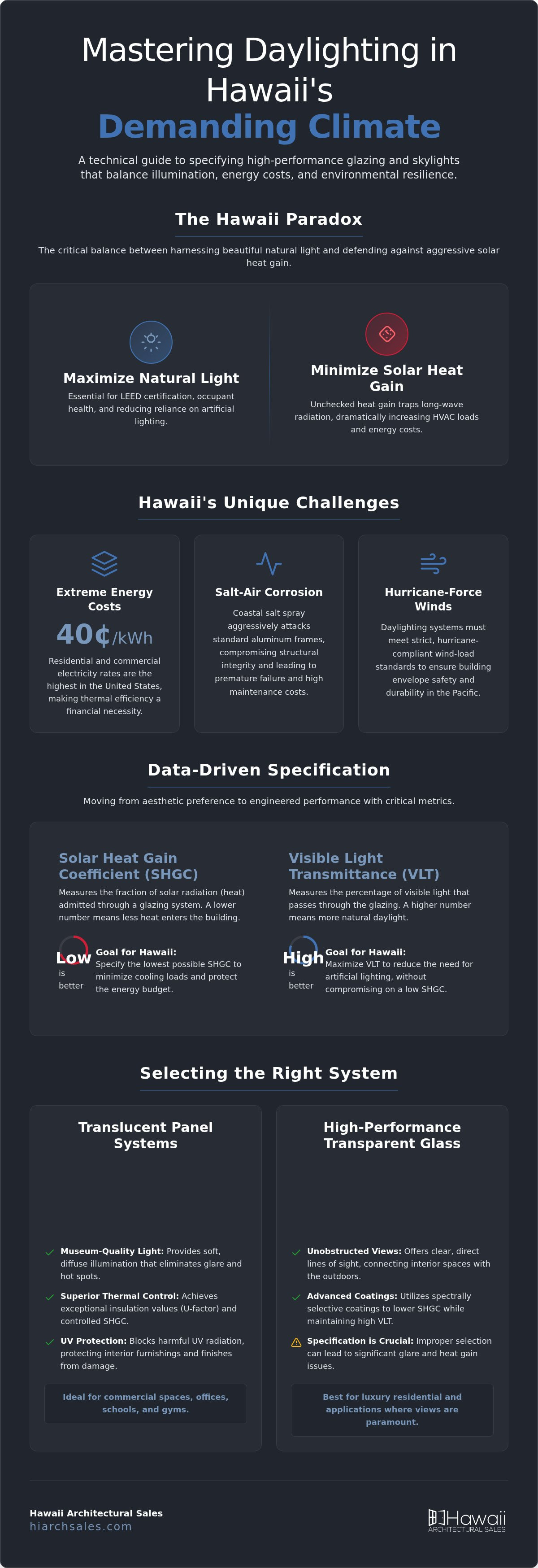
In the Hawaiian islands, a poorly specified skylight is more than a design flaw; it is a thermal liability that directly impacts a building's cooling budget. With residential and commercial electricity rates averaging around 40 cents per kilowatt-hour, the highest in the United States, every lumen of natural light must be weighed against its solar heat gain. Architects and engineers understand that while daylighting is essential for LEED certification and occupant health, the local environment demands more than standard glazing. Salt-air corrosion, strict wind-load requirements, and the 2026 ban on fluorescent lamps under Act 225 make high-performance daylighting systems Hawaii’s most critical building envelope component.
We recognize the challenge of balancing these extreme environmental factors with the need for energy-efficient illumination. This technical guide provides the expertise needed to master daylighting design that meets hurricane-compliant standards and reduces reliance on artificial lighting. You'll learn how to navigate the 2021 International Energy Conservation Code (IECC) amendments and select durable systems from brands like Kalwall and Super Sky. We will analyze strategies for maximizing the 6% roof area allowance for skylights while maintaining total control over glare and thermal performance in demanding coastal climates.
Key Takeaways
• Learn to balance aesthetic goals with the technical realities of Hawaii’s tropical solar loads and high energy costs.
• Identify the specific performance metrics required to specify daylighting systems Hawaii that meet 2021 IECC standards and LEED requirements.
• Compare the functional advantages of translucent systems like Kalwall against high-performance transparent glazing for various project types.
• Master the engineering requirements for coastal durability, focusing on wind-load compliance and corrosion-resistant framing.
• Understand how partnering with a technical consultant during the design phase ensures precise material specification and structural integrity.
The Challenge of Natural Light in Hawaii’s Tropical Environment
Designing for the Pacific requires a technical shift in how architects view the sun. Daylighting is the strategic practice of placing windows, skylights, and other openings to provide effective internal lighting while minimizing reliance on artificial energy. In most regions, this is a straightforward energy-saving measure. In the islands, however, practitioners face what we call the "Hawaii Paradox." This is the constant tension between maximizing the beauty of natural light and minimizing the aggressive solar heat gain that accompanies it.
When implementing daylighting systems Hawaii, architects must account for the state's unique electricity landscape. With rates averaging 40 cents per kilowatt-hour, any light that introduces excessive heat becomes a direct financial liability. Short-wave radiation enters the building and converts into long-wave heat, trapped by the building envelope. This process increases HVAC loads significantly, often negating the energy savings gained from turning off electric lights. Precision in specification is the only way to break this cycle.
Environmental durability is another primary concern. In coastal communities like Lihue or Lahaina, salt-air corrosion can destroy standard aluminum frames in just a few years. Systems must be engineered with high-performance finishes and non-corrosive components to ensure long-term structural integrity. Without these technical safeguards, a daylighting installation quickly becomes a maintenance burden rather than an asset.
Balancing Illumination with Solar Heat Gain
Standard transparent glass often fails in tropical high-sun environments because it lacks the necessary thermal resistance. While it offers clear views, it also creates "hot spots" that make open-plan offices uncomfortable for occupants. These localized temperature spikes force HVAC systems to work harder to maintain a baseline environment. High-performance daylighting systems Hawaii utilize advanced glazing or translucent technologies to harvest light while rejecting heat. This strategy is essential for light harvesting under LEED certification guidelines, where automated controls dim artificial lighting as natural levels rise.
Managing Glare and UV in Commercial Spaces
The psychological benefits of natural light are well-documented, but screen glare can lead to immediate productivity loss in commercial settings. Direct sunlight creates high-contrast environments that cause eye strain and discomfort. Furthermore, Hawaii’s intense UV radiation levels can damage interior finishes, artwork, and furniture within months of exposure. We recommend strategies that achieve "museum-quality" light through advanced diffusion. This approach scatters incoming rays to provide a soft, consistent wash of light that eliminates glare and protects interior investments without sacrificing the vibrancy of the space.
Technical Metrics: Specifying for Performance and Efficiency
Evaluating daylighting systems Hawaii requires a transition from aesthetic preference to data-driven engineering. Architects must categorize building envelope elements into transparent (clear views), translucent (diffused light), and opaque (insulated solid) categories. According to the Whole Building Design Guide, a successful strategy integrates these components to balance visual comfort with thermal loads. This framework ensures that natural light serves as a functional utility rather than an environmental burden.
The City and County of Honolulu currently operates under the 2018 IECC with local amendments via Ordinance 23-25. Meeting these standards requires high-performance glazing and framing systems with integrated thermal breaks. These breaks are non-conductive barriers within the aluminum profile that prevent heat from migrating from the exterior to the interior. Without them, even the most advanced glass will lose efficiency through the frame itself. This conductive heat transfer is a primary contributor to cooling load spikes in commercial structures.
Understanding SHGC and VLT Ratios
Solar Heat Gain Coefficient (SHGC) measures the fraction of solar radiation admitted through a window or skylight. In Hawaii's high-irradiance environment, a low SHGC is vital to protect the cooling budget. Visible Light Transmittance (VLT) measures the percentage of the visible spectrum that passes through the glazing. The "holy grail" for local architects is a high light-to-solar-gain ratio. This means achieving a high VLT to provide ample illumination while maintaining an exceptionally low SHGC to block infrared heat. Consulting with a technical representative at Hawaii Architectural Sales can help you navigate these specific performance data points during the schematic design phase.
U-Value and Thermal Insulation in the Tropics
U-value measures the rate of heat transfer; in Hawaii, it is essential for preventing outdoor heat from conducting through the glazing into cooled spaces. High insulation levels reduce the energy required to maintain internal temperatures. Translucent systems like Kalwall achieve superior U-values compared to standard glass through the use of specialized translucent insulation fillers. Under the locally amended 2018 IECC, skylights in Hawaii Zone 1 must typically meet a maximum U-factor of 0.75. These metrics ensure the building envelope remains a high-performance barrier against the tropical sun.
Translucent vs. Transparent: Selecting the Right Daylighting System
Selecting the appropriate technology for daylighting systems Hawaii depends on the project's specific visual and thermal requirements. High-end residential projects often prioritize transparent views to connect occupants with the landscape. Conversely, commercial and institutional spaces usually require diffused, glare-free illumination to maintain productivity and comfort. Implementing Architectural Daylighting Solutions in Honolulu requires a precise understanding of these functional differences to achieve a high-performance facade that balances light quality with energy efficiency.
Kalwall Translucent Systems for Diffused Light
Kalwall translucent systems utilize advanced sandwich panel technology to provide glare-free illumination. These systems consist of a structural thermal break grid core bonded to two fiberglass reinforced faces. This design scatters sunlight deep into interior spaces, eliminating the "hot spots" common with standard glass. The lightweight nature of these panels offers a significant structural advantage. Architects can design larger spans with less supporting steel, reducing overall project costs and material requirements. These panels also feature self-cleaning properties and exceptional durability against tropical storms, ensuring long-term performance in high-impact zones.
Super Sky Skylights for Iconic Spans
Super Sky skylights are the industry standard for transparent, iconic spans. These systems are specified when visual transparency and "view" daylighting are primary design goals. They allow for the creation of custom shapes such as pyramids, vaults, and massive commercial atriums that define a building’s aesthetic. These systems integrate with high-performance glass lines like ES | Prestige to maintain thermal efficiency across large glazed areas. Custom engineering ensures these large-scale structures meet rigorous safety standards while providing unobstructed views of the Hawaiian sky.
Every system has structural limits based on wind loads and material weight. While translucent panels offer greater span flexibility due to their low mass, transparent glass requires more robust framing to support its weight. Specifying daylighting systems Hawaii involves balancing these structural realities with the desired architectural impact. We recommend evaluating the specific use-case of each space to determine whether diffused light or visual transparency provides the most value to the building's occupants.
Engineering for the Pacific: Wind Loads and Corrosion
In Hawaii, the building envelope faces some of the most demanding structural challenges in the world. High-performance daylighting systems Hawaii must be engineered as an integral part of the curtain wall rather than a standalone aesthetic feature. This structural integration ensures the entire building behaves predictably under extreme atmospheric pressure. For a deeper look at similar requirements for vertical openings, see our guide on hurricane rated windows in Hawaii. When daylighting systems fail to integrate with the primary engineering, they become weak points that can lead to catastrophic internal pressurization during a storm.
Meeting Hawaii Wind Load Standards
Interpreting wind speed maps requires a localized understanding of the islands' unique topography. Projects in Kihei may face different localized wind pressures than those in Kailua-Kona due to the "venturi effect" between mountains. Impact-rated glazing is essential for maintaining the building's pressure boundary. If a skylight or translucent panel is breached by flying debris, the resulting pressure change can lift a roof from the inside. Both Super Sky and Kalwall systems undergo rigorous structural testing protocols, including ASTM E1886 and E1996 standards for large missile impact. These tests confirm that the systems can withstand the cyclical pressure loads typical of Pacific hurricanes.
Corrosion-Resistant Framing and Finishes
Corrosion is the primary cause of premature failure for architectural systems in the Pacific. Standard Class I anodized aluminum often shows signs of pitting and salt-bloom within five miles of the coastline. To combat this, we specify high-performance Kynar 500 or Hylar 5000 finishes. These 70% PVDF resin-based coatings provide a robust chemical barrier against salt-air and intense UV radiation. The hardware is just as critical as the finish. Specifying 300-series stainless steel fasteners and non-reactive EPDM gaskets prevents galvanic corrosion. This occurs when dissimilar metals meet in a moist, salty environment, leading to rapid material degradation. Using non-conductive separators ensures the structural integrity of the frame remains intact for decades.
A proactive maintenance cycle is necessary to protect these investments. We recommend a regular fresh-water rinsing schedule to remove salt deposits before they bond to the architectural finish. This simple step, combined with annual inspections of the seals and gaskets, ensures the system continues to perform at its peak. For technical assistance with your project's structural specifications, contact Hawaii Architectural Sales.
Specifying Daylighting: The Role of a Technical Representative
Specifying high-performance daylighting systems Hawaii requires a transition from general design intent to precise engineering. For architects, the authorized technical representative serves as a strategic ally rather than a simple vendor. This partnership is essential for navigating the complexities of the building envelope, where aesthetic goals must align with stringent local energy codes and environmental demands. Engaging an architectural window distributor in Hawaii during the schematic design phase allows for the early identification of structural or thermal challenges before they become costly change orders.
From Design Concept to Material Delivery
The procurement process for specialized architectural materials in the islands involves unique logistical and technical hurdles. Technical representatives provide custom shop drawings and performance simulations that go beyond standard manufacturer data. These simulations verify how specific configurations of Kalwall or Super Sky systems will perform under Hawaii’s specific solar angles and irradiance levels. Beyond the data, the representative manages the logistics of shipping oversized architectural components to the islands. This includes specialized crating and coordination with local freight handlers to ensure that high-performance glazing arrives on-site without damage or delays. We ensure that every specified product carries the necessary certifications to meet the locally amended 2018 IECC and Honolulu building codes.
The Advantage of Localized Expertise
Localized expertise is a critical asset when designing for Hawaii’s varied microclimates. A technical representative understands the nuances between a windward project facing constant salt spray and a leeward project dealing with extreme heat gain. This knowledge informs the selection of finishes, fasteners, and glazing types that mainland suppliers might overlook. While we do not provide installation services, we bridge the gap between design and execution by connecting architects with a network of qualified local contractors who are experienced with these specific systems. This ensures the installation matches the high standards of the specification.
Long-term product support is the final pillar of the technical representative’s role. We provide ongoing warranty representation and technical assistance throughout the building's lifecycle. Should a project require future expansion or maintenance, having a local partner who understands the original design intent and structural requirements is invaluable. This commitment to reliability and long-term value ensures that daylighting systems Hawaii remain functional and efficient for decades, protecting both the architect’s vision and the client’s investment.
Advancing High-Performance Design in the Pacific
Implementing efficient daylighting requires a precise balance between solar heat gain control and visual comfort. We've examined how technical metrics like SHGC and U-values dictate performance under the 2018 IECC. By selecting the right daylighting systems Hawaii demands, such as Kalwall’s diffused panels or Super Sky’s iconic transparent spans, architects can achieve both aesthetic brilliance and structural resilience. These systems must be engineered to withstand high-velocity hurricane winds and the relentless salt-air corrosion typical of coastal environments.
Success in complex building envelopes depends on early collaboration with experts who understand local regulatory and environmental demands. Hawaii Architectural Sales provides specialized technical support for architects and developers across all islands. As an authorized distributor for Kalwall and Super Sky systems, we bring over 40 years of experience in Hawaii’s architectural market to your project team.
How do daylighting systems impact the cooling load of a building in Hawaii?
Managing daylighting systems Hawaii requires understanding that they reduce cooling loads when specified with a low Solar Heat Gain Coefficient (SHGC). While natural light replaces artificial bulbs, it can also introduce unwanted infrared heat. High-performance systems mitigate this by blocking non-visible radiation, preventing the building from becoming a greenhouse. In cities like Honolulu, where electricity costs are roughly 40 cents per kilowatt-hour, managing this thermal transfer is essential for the operational efficiency of any large-scale development.
What is the difference between translucent panels and traditional skylights?
Translucent panels provide diffused, glare-free light, whereas traditional skylights typically use transparent glass for direct views. Translucent systems like Kalwall use sandwich panel technology to eliminate "hot spots" and shadows in commercial interiors. Traditional skylights from Super Sky are ideal for dramatic visual connections and iconic atriums. Translucent options often offer superior insulation values, while transparent systems prioritize high-clarity aesthetics for high-end retail or residential spaces across Maui and Oahu.
Are daylighting systems in Hawaii hurricane-rated?
Professional-grade daylighting systems must be hurricane-rated to meet the stringent local building codes. Systems from Super Sky and Kalwall are specifically engineered to withstand the high-velocity wind loads found in coastal areas like Lihue and Lahaina. These systems undergo rigorous testing to ensure they remain intact during extreme pressure cycles. Using impact-rated glazing is a critical requirement for maintaining the structural integrity of the building envelope during a major Pacific storm event.
How do I meet the 2018 IECC requirements for skylight area in Honolulu?
Under Honolulu Ordinance 23-25, you can increase the skylight area to 6% of the total roof area if you install daylight-responsive controls. These controls automatically dim artificial lighting in response to natural light levels. This trade-off ensures the building remains energy-efficient despite the larger glazed area. We provide the technical data required to verify compliance with these amended 2018 IECC standards during the permitting process for new commercial construction projects.
What maintenance is required for commercial daylighting systems in coastal areas?
Regular fresh-water rinsing is the most effective maintenance strategy for systems in coastal areas like Kihei or Kailua-Kona. This prevents salt-air deposits from bonding to the frame finishes and causing pitting. You should also schedule annual inspections of seals and gaskets to ensure long-term weatherproofing. While we don't provide installation or maintenance services, we recommend using high-performance Kynar finishes to reduce the frequency of professional cleaning and protect against localized corrosion.
Can daylighting systems help achieve LEED credits for my Hawaii project?
High-performance daylighting systems Hawaii can contribute significantly to several LEED categories. They primarily earn points under the Energy and Atmosphere (EA) and Indoor Environmental Quality (EQ) credits. By reducing artificial lighting needs and improving occupant comfort, these systems help projects meet sustainability goals. Our technical team assists architects in documenting the Solar Heat Gain Coefficient and Visible Light Transmittance data required for successful LEED submittals on complex Pacific projects.
Do Kalwall panels yellow over time under Hawaii’s intense UV rays?
Modern Kalwall panels are engineered with high-performance resin systems that resist UV degradation. These panels maintain their translucent clarity and structural integrity even under the intense solar radiation found in the islands. The specialized face sheets are designed to prevent yellowing or "fiberbloom," which were issues with older fiberglass technologies. This ensures that the light quality remains consistent throughout the decades-long lifespan of the building facade, regardless of its exposure level.
What is the maximum span possible for a Super Sky commercial skylight?
The maximum span for Super Sky systems is determined by project-specific engineering and wind-load requirements. These custom-engineered skylights can cover massive commercial atriums and vaulted spaces with spans exceeding 50 feet in many configurations. In Hawaii, these spans are limited by the need to withstand high-velocity hurricane winds safely. We work with architects to develop structural shop drawings that balance ambitious design goals with the necessary structural support for large-scale spans.