Hurricane Rated Folding Glass Walls: A Technical Comparison for Hawaii Architects
In the high-stakes environment of Hawaii's coastal construction, a folding glass wall is a structural component first and a design feature second. With the 2026 building code updates requiring new structures to withstand wind speeds of up to 160 mph, architects can't afford to prioritize aesthetics...
In the high-stakes environment of Hawaii's coastal construction, a folding glass wall is a structural component first and a design feature second. With the 2026 building code updates requiring new structures to withstand wind speeds of up to 160 mph, architects can't afford to prioritize aesthetics over the integrity of the building envelope. You understand the challenge of delivering an expansive, open-concept view while ensuring the system doesn't rattle, leak, or fail when a tropical storm hits. Specifying hurricane rated folding glass walls requires a precise balance of Design Pressure (DP) ratings and long-term material durability.
This guide helps you navigate these complex requirements without sacrificing the luxury finish your clients expect. You'll discover how to specify high-performance systems that meet Hawaii’s stringent wind-load and impact regulations. We provide a technical comparison of top-tier brands like Euro-Wall and ES Prestige, offering the DP ratings and specification-ready data you need to ensure safety and performance in Zone 4 corrosion regions. By focusing on engineering-first solutions, you can maintain design intent while fulfilling your professional responsibility to the building's structural health.
Key Takeaways
• Differentiate between missile impact testing and Design Pressure (DP) to ensure full compliance with the 2026 Hawaii State Building Code.
• Evaluate the performance specifications of hurricane rated folding glass walls from Euro-Wall and ES Prestige for large-span coastal openings.
• Identify why AAMA 2605 coatings and high-grade hardware are essential for longevity in Hawaii’s "Zone 4" extremely severe corrosion environments.
• Streamline the technical review process by aligning manufacturer submittals with site-specific wind-load requirements and county regulations.
• Discover how to specify engineered systems that maintain luxury design intent while meeting the highest structural safety standards.
The Engineering of Hurricane Rated Folding Glass Walls in Hawaii
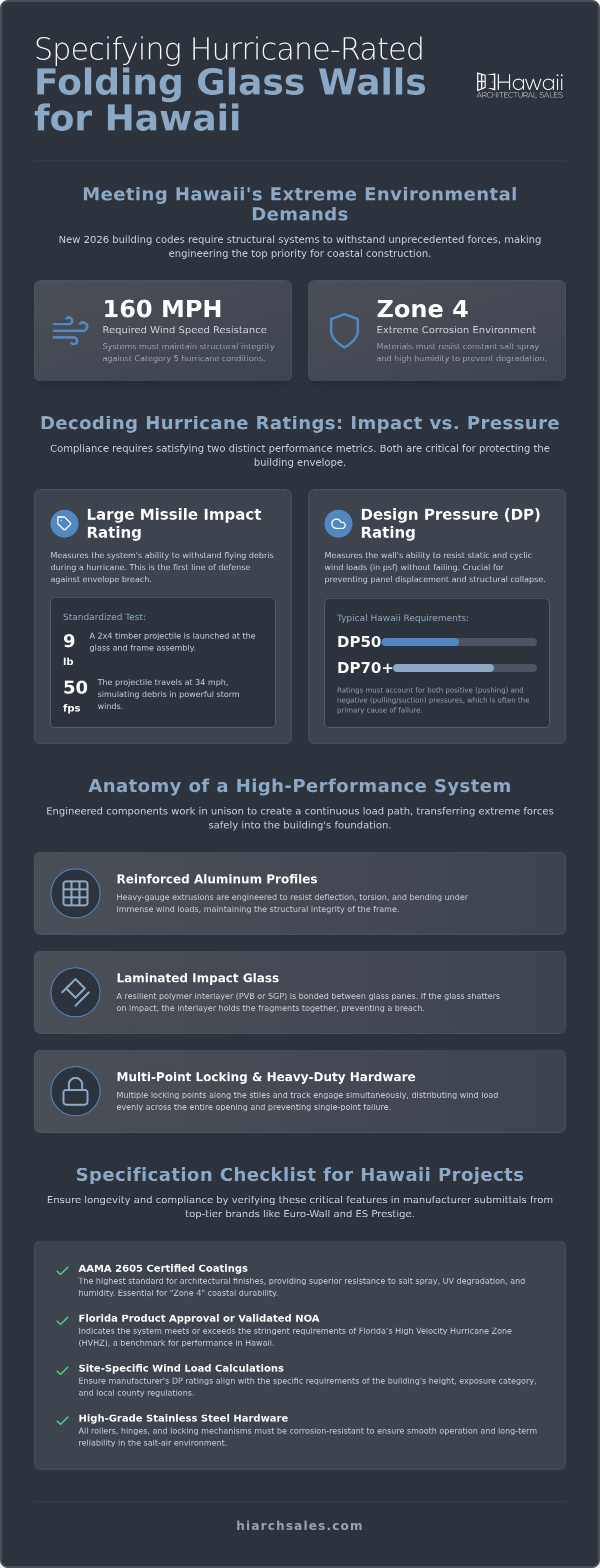
Hurricane-rated folding walls are specialized architectural systems designed to maintain the building envelope's integrity under extreme atmospheric stress. Unlike standard folding doors, hurricane rated folding glass walls undergo rigorous testing for missile impact and high design pressure. In Hawaii, where micro-climates and coastal exposure create unpredictable wind patterns, these systems are essential. They function as a defensive barrier, utilizing reinforced aluminum profiles and high-performance interlayers to prevent structural failure. This engineering ensures the system remains a fixed part of the building's defense during a storm.
Hawaii's unique geography necessitates strict adherence to standards similar to Florida’s High Velocity Hurricane Zone (HVHZ) requirements. Because the islands are susceptible to Category 5 conditions with wind speeds up to 160 mph, specifying a system with a Florida Product Approval or a validated Notice of Acceptance (NOA) is a standard practice for mitigating risk. These certifications ensure the system has survived tests where heavy debris is launched at the glass and frames at high speeds. This level of verification is the only way to guarantee performance in the face of a direct hit.
The core components of these systems include:
Reinforced Aluminum Profiles
Heavy-gauge extrusions designed to resist deflection and maintain frame alignment under load.
Laminated Glass
Advanced laminated glass technology uses a resilient interlayer that holds the glass shards together even if the outer pane shatters.
Multi-Point Locking
Strategic locking points along the track and stiles that distribute wind load evenly across the structural opening.
Wind Loads and Design Pressure (DP) in Hawaii
Design Pressure (DP) ratings are the primary metric for evaluating a wall's performance. A DP rating indicates the pounds per square foot (psf) of pressure a system can withstand before failing. In Honolulu and surrounding coastal regions, wind speeds can reach 160 mph, requiring DP ratings that often exceed DP50 or DP70 depending on the building's height and exposure. It's vital to distinguish between positive pressure, where wind pushes against the glass, and negative pressure, where suction pulls the panels outward. Systems must be rated for both, as negative pressure is often the primary cause of panel displacement. "Hurricane-rated" is a legal engineering designation based on these verified metrics, not a descriptive marketing term.
The Impact of Large Openings on Structural Stability
Large-span folding walls significantly alter the wind-load calculations for luxury residences. When a large portion of the building envelope is comprised of glass, the potential for internal pressure buildup increases. If the glass fails, the sudden influx of air can cause a "blow-out" effect, where the internal pressure assists the external wind in lifting the roof or collapsing walls. Specifying systems from brands like Euro-Wall or ES Prestige ensures the opening remains sealed, protecting the structure's interior. A continuous load path ensures that the extreme forces exerted on the folding glass wall are successfully transferred from the glazing and frames into the building’s foundation, preventing localized structural failure.
Impact Ratings vs. Design Pressure (DP): Decoding Specifications
Specifying hurricane rated folding glass walls requires a clear distinction between impact resistance and Design Pressure (DP). While both are necessary for compliance, they serve different protective functions. Impact ratings measure the system's ability to withstand flying debris, while DP ratings measure its capacity to resist static wind loads. In Hawaii, where coastal wind speeds can reach 160 mph, architects must ensure that both metrics align with the specific exposure category of the project site. Failure to match these specifications can lead to catastrophic failure of the building envelope during a storm event.
The testing process for these systems is rigorous and standardized. To achieve a Large Missile Impact rating, the system must survive the strike of a nine-pound 2x4 timber traveling at 50 feet per second. Following the impact, the unit undergoes cyclic wind pressure testing, where it is subjected to thousands of positive and negative pressure cycles to simulate the duration of a hurricane. Small Missile Impact testing, often used for higher elevations, utilizes steel balls. For most residential and commercial projects in Hawaii, Large Missile Impact is the benchmark. These standards are heavily influenced by the Florida Building Code, which serves as the national gold standard for hurricane-resistant engineering.
Design Pressure (DP) ratings correlate directly to wind speed. For instance, a DP70 rating indicates the system can withstand 105 psf (pounds per square foot), which is equivalent to approximately 165 mph winds. This exceeds the 160 mph requirement for Category 5 hurricanes. Architects should also prioritize water infiltration ratings. Wind-driven rain in regions like Kailua-Kona can force water through standard seals. A high DP rating for wind does not always guarantee high water resistance; these are separate test results that must be reviewed during the submittal process.
Glazing Standards for Hurricane Zones
The anatomy of impact glass is critical for high-performance openings. While standard PVB interlayers are common, high-performance systems often utilize SGP (SentryGlas Plus) interlayers. SGP is five times stronger and up to 100 times stiffer than standard laminates, allowing for larger panel sizes and higher DP ratings. This technology is a significant upgrade over standard tempered glass, which provides no protection against debris penetration. When evaluating impact rated glass doors in Hawaii, architects must also balance safety with the Solar Heat Gain Coefficient (SHGC) to manage the intense tropical sun.
Water Infiltration and Air Leakage
The bottom track is often the technical "weak link" in folding wall systems. While flush tracks are aesthetically desirable for a seamless transition, they rarely provide the water dam height necessary to pass high-velocity water infiltration tests. For coastal projects, specifying a high-sill option is often mandatory to prevent flooding during wind-driven rain events. High-performance systems from Euro-Wall and ES Prestige offer engineered drainage solutions that manage water without compromising the structural integrity of the frame. If you are currently drafting a building envelope schedule, you can contact our technical team for a review of your specific wind-load requirements.
Euro-Wall vs. ES Prestige: Comparing Premium Folding Systems
Selecting between Euro-Wall and ES Prestige involves analyzing specific project constraints such as span width, panel height, and target DP ratings. Both manufacturers provide high-performance hurricane rated folding glass walls that exceed Hawaii’s structural requirements while maintaining the slim sightlines necessary for luxury residential and commercial design. These systems are engineered to remain functional under extreme stress, ensuring that the aesthetic of an open-concept layout doesn't compromise the safety of the building envelope.
Euro-Wall Folding Systems: Maximum Spans
Euro-Wall is recognized for pushing the engineering limits of folding systems. Their products are capable of reaching heights of 12 feet or more while maintaining full impact ratings. This is achieved through reinforced aluminum extrusions and high-performance rollers that support the significant weight of laminated glass panels. For architects prioritizing expansive views, Euro-Wall offers some of the largest individual panel widths available in the hurricane-rated market. Their thermally broken aluminum frames are essential for meeting energy efficiency standards, effectively reducing heat transfer in Hawaii's tropical climate. As an authorized Euro-Wall distributor Hawaii representative, we provide the technical submittals required to verify these maximum spans against site-specific wind loads.
ES Prestige: The Balance of Value and Performance
ES Prestige offers a sophisticated solution for luxury coastal developments where high wind-load performance must be balanced with project logistics. The ES-8000T series is particularly effective for large-scale openings, providing a robust aluminum window wall system that integrates seamlessly with ES Prestige windows in Hawaii. This continuity in the building envelope allows for a uniform aesthetic across the entire facade. For the 2026 construction cycle, ES Prestige maintains reliable lead times and logistical advantages, ensuring that high-performance materials arrive on-site according to the project schedule. Their systems are engineered to meet DP70+ requirements, providing the structural stability required for high-exposure coastal sites.
Both brands address the technical challenge of salt-air corrosion, a critical factor for any property within 500 feet of the shoreline. Standard powder coatings often fail within years in Hawaii's Zone 4 environment. To combat this, these systems utilize 316 stainless steel hardware and specialized AAMA 2605 coatings. These finishes resist UV degradation and salt-spray pitting, preserving both the mechanical function and the appearance of the hardware. By utilizing high-strength alloys, these manufacturers achieve thin profiles that don't compromise structural integrity, allowing architects to specify hurricane rated folding glass walls that feel lightweight and modern while meeting Category 5 wind-speed standards.
Coastal Durability: Salt-Air Resistance and Hardware Integrity
Hawaii’s coastal environment is classified as a "Zone 4" extremely severe corrosion region. For properties in Lahaina or Lihue, the constant exposure to salt-laden air makes durability as critical as structural performance. Salt destroys standard finishes. Standard powder coatings typically fail within two to three years in these conditions. When specifying hurricane rated folding glass walls, architects must prioritize finishes and hardware that withstand this relentless chemical attack without seizing. Precision hardware is non-negotiable.
Specifying AAMA 2605 coatings is the industry standard for maximum UV and salt-air resistance. These high-performance fluoropolymer finishes are engineered to resist chalking and fading for over 20 years. Beyond the finish, the internal mechanisms must utilize 316-grade stainless steel hardware. This specific alloy contains molybdenum, providing superior resistance to pitting and crevice corrosion compared to 304-grade steel. This is mandatory for projects within 500 feet of the shoreline. Without these materials, the folding mechanism can seize, rendering the system inoperable exactly when a storm approaches.
Corrosion-Resistant Finishes
Anodized finishes provide a hard surface, but high-performance fluoropolymer coatings offer superior chemical resistance in high-salt areas. Darker colors can increase the thermal expansion of aluminum profiles, potentially affecting the alignment of large panels during peak sun exposure. Filiform corrosion is a specific risk where thread-like filaments of corrosion spread under the coating of architectural aluminum. This often starts at unprotected cut edges or fastener holes that haven't been properly sealed during the assembly process.
Track and Drainage Engineering
Efficient drainage is essential to prevent salt buildup within the frame. Salt crystals left behind by evaporating sea spray can block standard weep holes, causing water to back up into the interior. Euro-Wall systems utilize self-draining track technologies that flush debris and salt through the system more effectively than traditional designs. While these needs are universal for high-performance openings, you may want to compare these drainage profiles with multi-slide glass doors in Hawaii to determine which configuration best suits your project's sill height requirements.
Designing for longevity in a High-Velocity Hurricane Zone (HVHZ) requires a proactive maintenance protocol. Regular rinsing with fresh water is necessary to remove salt deposits from tracks and hinges. If you are currently designing a coastal project and need to verify material compatibility for your specific micro-climate, contact our technical team for a specification review.
Specifying Folding Glass Walls for Hawaii Commercial Projects
Hawaii's commercial landscape requires a methodical approach to material specification, especially when dealing with the increased wind-load requirements of the 2026 building code. For architects working on the neighbor islands, from resort developments in Kihei to commercial hubs in Kailua-Kona, the specification process begins with a precise identification of site-specific wind zones. Specifying hurricane rated folding glass walls is not a one-size-fits-all task. It requires a technical review that aligns manufacturer submittals with local county regulations. We assist by providing the engineering data and shop drawings necessary to verify that every component of the building envelope meets the performance standards required for the project's specific exposure.
Coordinating the logistics of material distribution for projects on Maui or the Big Island involves more than just shipping. It requires a deep understanding of lead times and the structural requirements of the building site. Our role is to bridge the gap between high-end manufacturing and practical application on the ground. We provide technical expertise from the initial consultation through the final delivery of materials, ensuring that the specified systems arrive on-site with the correct certifications and performance data. This stability is essential for maintaining project timelines in Hawaii’s complex construction market.
Working with an Authorized Distributor
There is a significant difference between a standard retail supplier and a technical manufacturer's representative. A retail supplier often lacks the deep engineering knowledge required to navigate Hawaii’s stringent building codes. As an authorized representative, we provide specialized support for architects, including the provision of DP rating certifications essential for building permit applications. Understanding these nuances is critical when selecting a partner for a high-stakes envelope. You can review our architectural window distributor Hawaii guide to better understand the selection criteria for technical representation.
From Design to Material Delivery
Early-stage design assistance is vital for large-span openings that use folding systems. These systems exert unique forces on the header and foundation that must be accounted for in the structural design. We ensure that your chosen system is compatible with other high-performance components, such as pivot door systems in Hawaii, to maintain a cohesive aesthetic and performance level throughout the project. Whether you are finalizing specifications for Euro-Wall or ES Prestige, our team provides the technical data needed to secure the building envelope against Category 5 conditions. This collaborative approach ensures that the final installation meets both the design intent and the legal safety requirements of the state.
Securing the Building Envelope for Hawaii’s Coastal Future
Specifying the right system requires a deep understanding of how Design Pressure and impact ratings interact with Hawaii’s unique micro-climates. It’s not just about the view; it’s about ensuring the building envelope remains intact during Category 5 wind events. By selecting high-performance hurricane rated folding glass walls from manufacturers like Euro-Wall and ES Prestige, you ensure that luxury aesthetics are backed by structural integrity. Long-term durability in a Zone 4 corrosion environment depends entirely on the precision of the hardware and the quality of the protective coatings specified during the design phase.
Since 1985, Hawaii Architectural Sales has served as a specialized technical representative for architects and developers across the islands. As an authorized distributor for Euro-Wall and ES Prestige, we provide the engineering data and material support required for complex coastal projects. We invite you to contact Hawaii Architectural Sales for technical specifications and project quotes to ensure your next design meets the highest standards of safety and performance. We look forward to supporting your vision with reliable, high-performance solutions that stand the test of time.
Frequently Asked Questions
What is the minimum DP rating required for folding glass walls in Hawaii?
The minimum Design Pressure (DP) rating depends on your specific project location and exposure category. Under the 2026 building code updates, new constructions must withstand wind speeds of up to 160 mph. While many inland projects start at DP50, coastal or high-elevation sites often require DP70 or higher. You should always verify the site-specific wind-load requirements with a structural engineer before finalizing your window and door schedule.
Can folding glass walls be impact-rated without looking bulky?
Yes, modern engineering allows hurricane rated folding glass walls to maintain slim sightlines. Manufacturers like Euro-Wall and ES Prestige utilize high-strength aluminum alloys and SGP interlayers. These materials provide the necessary structural rigidity without the need for thick, heavy frames. This allows architects to achieve a luxury, open-concept aesthetic that meets stringent safety regulations for wind-borne debris regions across all Hawaii counties.
How do Euro-Wall folding doors handle wind-driven rain?
Euro-Wall systems utilize engineered drainage paths and high-sill options to manage extreme water infiltration. Their self-draining track technologies are designed to flush water and salt debris out of the system effectively. To meet hurricane-grade water ratings, these systems typically require a water-rated sill rather than a flush track. This ensures the building remains dry even during the sustained, high-velocity rain events common in coastal Hawaii environments.
What is the difference between Florida Product Approval and Hawaii building codes?
Florida Product Approval, particularly for High Velocity Hurricane Zones (HVHZ), is a rigorous testing benchmark that many Hawaii architects use for specification. While Hawaii follows the International Building Code (IBC) with local amendments, it doesn't have a state-level "approval" system like Florida's. Instead, Hawaii building officials accept Florida Product Approvals or Miami-Dade Notices of Acceptance (NOA) as evidence that a system meets the required impact and wind-load standards.
Do I need a special track for hurricane-rated folding walls?
A specialized high-sill or "water-rated" track is almost always required for a system to achieve a hurricane rating. While flush tracks are popular for seamless transitions, they often fail water infiltration tests because they lack a sufficient dam height. If your project requires hurricane rated folding glass walls, you must specify a track designed to resist wind-driven rain. We can help you select a track that balances performance with your design goals.
How does salt air affect the warranty of hurricane-rated glass systems?
Salt air is highly corrosive and can void standard hardware and finish warranties if the correct materials aren't specified. For properties within 500 feet of the shoreline, manufacturers generally require AAMA 2605 powder coatings and Type 316 stainless steel hardware to maintain warranty coverage. Standard finishes often fail within years in Hawaii’s Zone 4 corrosion environment. Specifying coastal-grade components is the only way to ensure long-term mechanical reliability and finish integrity.
Are ES Prestige folding walls suitable for high-rise commercial applications?
The ES Prestige line, specifically the ES-8000T thermally broken system, is engineered for high-performance commercial and high-rise applications. These systems are designed to handle the increased wind pressures found at higher elevations while providing excellent thermal efficiency. They have been tested for both large and small missile impact, making them a reliable choice for luxury condos and resort developments that must adhere to the strictest safety and performance standards.
Can I get hurricane-rated folding walls for a project on Kauai or Maui?
Yes, Hawaii Architectural Sales provides technical representation and material distribution for projects on all islands, including Kauai, Maui, and the Big Island. We coordinate the logistics of getting high-performance systems to neighbor island sites like Kihei or Lihue. Our team assists with technical submittals and shop drawings to ensure the materials meet the specific wind-load requirements of each county’s building department, regardless of the project's physical location.