Impact Rated Glass Doors in Hawaii: A Technical Guide for Architects and Developers
With NOAA forecasting up to 13 tropical cyclones for the 2026 Central Pacific season, the structural integrity of Hawaii’s coastal developments has never been under greater scrutiny. Architects and developers understand the inherent tension between creating expansive, light-filled spaces and meeting...
With NOAA forecasting up to 13 tropical cyclones for the 2026 Central Pacific season, the structural integrity of Hawaii’s coastal developments has never been under greater scrutiny. Architects and developers understand the inherent tension between creating expansive, light-filled spaces and meeting the rigid safety requirements of Wind-Borne Debris Regions. Balancing these aesthetic goals with the reality of salt-air corrosion and strict county-level enforcement is a complex technical challenge that requires precision engineering.
Specifying the right impact rated glass doors Hawaii projects require ensures that your building envelope remains intact during extreme weather while preserving the indoor-outdoor luxury lifestyle your clients demand. This guide provides a technical overview of the engineering standards and performance benefits of high-velocity hurricane zone systems. We'll examine the 2018 IBC standards currently enforced across the islands, including recent updates in Kauai and Maui. We also analyze the durability of high-performance hardware in maritime environments and the specific capabilities of premium systems like ES Prestige and Euro-Wall to help you maintain code compliance without compromising architectural vision.
• Understand the physics of internal pressurization and why maintaining building envelope integrity is critical for preventing structural failure during high-wind events.
• Navigate the specific regulatory requirements for Wind-Borne Debris Regions (WBDR) across different islands and their respective building code amendments.
• Evaluate the technical specifications of interlayers and frame engineering required for high-performance impact rated glass doors Hawaii developers specify.
• Identify the secondary performance benefits of impact-rated systems, including enhanced forced-entry deterrents and superior acoustic insulation against trade winds.
• Explore how premium systems like Euro-Wall and ES Prestige enable massive architectural openings while meeting stringent ASTM E1886 and E1996 standards.
Architects designing for the Hawaiian islands face a unique set of environmental pressures. It's not just about aesthetic integration or salt spray resistance; it's about maintaining the structural integrity of the building envelope under extreme conditions. While large glass spans are a hallmark of luxury coastal architecture, they represent a potential vulnerability. If a single door fails during a storm, the consequences often extend far beyond the immediate opening.
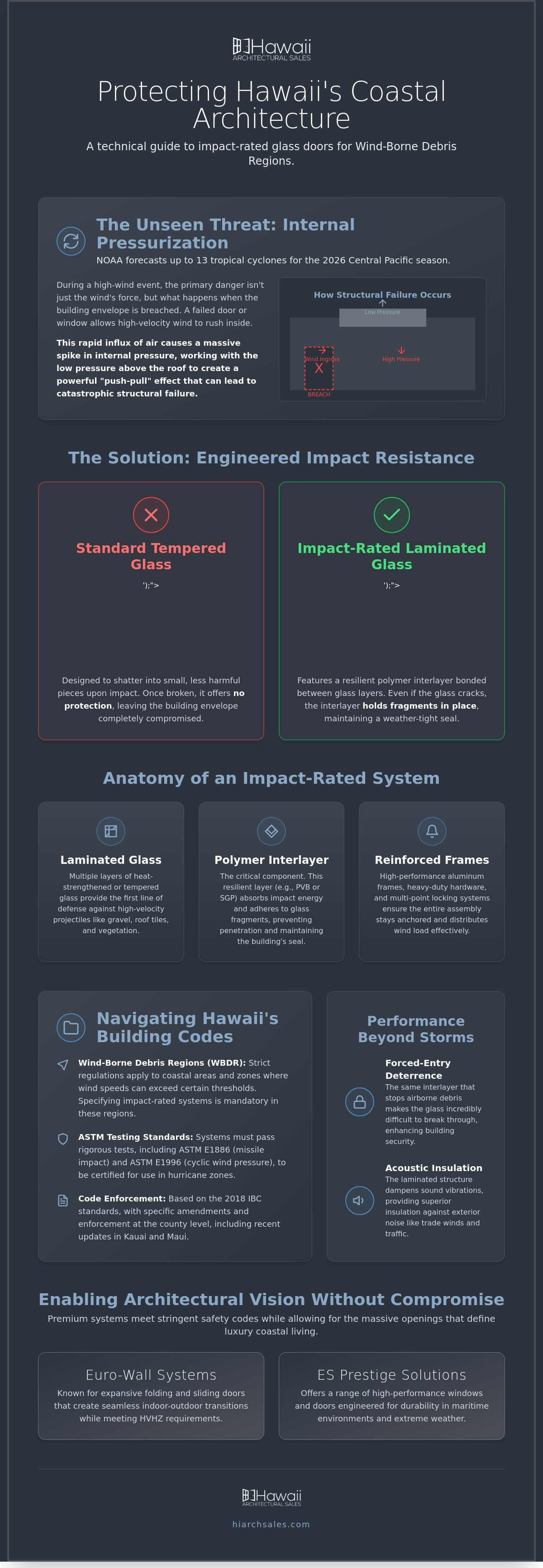
The primary risk is internal pressurization. When a high-velocity wind event breaches a door, air rushes into the structure at an incredible rate. This creates a rapid spike in internal pressure that works in tandem with the low pressure created by wind moving over the roof. This "push-pull" effect can lead to catastrophic structural failure, including the roof being lifted off the building. Specifying impact rated glass doors Hawaii developers rely on is a strategic decision to prevent this sequence. It's about protecting the entire investment, not just the entryway.
In professional circles, we distinguish between the myth of "hurricane-proof" products and the reality of impact-rated standards. No material is completely indestructible. Instead, impact-rated systems are engineered to meet specific ASTM standards, ensuring the barrier remains intact even after a strike. This is vital in Hawaii's "V-risk" zones, where topography can accelerate wind speeds and increase the density of airborne debris. For a developer, these systems aren't just safety features; they're the primary engineering solution for enabling the indoor-outdoor lifestyle while maintaining the building's structural health.
Understanding the Threat of Wind-Borne Debris
High wind speeds alone rarely cause glass failure in modern builds. The danger lies in what the wind carries. In Hawaii’s suburban and coastal environments, wind-borne debris can range from volcanic gravel and roof tiles to tropical vegetation. These objects become high-velocity projectiles, or "missiles," during a storm. Impact-rated systems are tested specifically to withstand these strikes without breaching the building envelope. This ensures that even if the glass is damaged, the barrier remains functional.
Impact Rating vs. Standard Tempered Glass
Standard tempered glass is often insufficient for high-performance coastal projects. While it's stronger than annealed glass and breaks into safer pieces, it's designed to fail completely upon impact. Once shattered, the building envelope is compromised. Laminated glass is the industry standard for impact resistance. It consists of two or more glass layers bonded by a resilient polymer interlayer. This interlayer holds the glass fragments together if the pane is struck, maintaining a weather-tight seal and preventing the internal pressurization that leads to structural collapse. This distinction is critical for architects who must balance massive glass openings with strict safety requirements.
Engineering a door to survive a hurricane involves a sophisticated assembly where every component must work in unison. It isn't enough to simply use thick glass. The entire system must be tested to ensure the glass stays within the frame under extreme cyclic pressure. For the impact rated glass doors Hawaii architects specify, this means the glass, the interlayer, and the frame must exceed the performance requirements of the ASTM E1996 windborne debris standard.
The frame is just as critical as the glazing. A high-performance frame prevents the glass from blowing out or being pushed into the building. Premium aluminum systems often incorporate thermal break technology. This is essential in Hawaii to mitigate solar heat gain while providing the structural rigidity needed for massive openings. Heavy-duty hardware and multi-point locking systems further ensure the door remains secure. These locks distribute wind load across multiple points on the frame, preventing the door from bowing or unlatching under the intense "push-pull" forces of a tropical cyclone.
The Role of the Polymer Interlayer
The interlayer is the invisible hero of impact resistance. Polyvinyl Butyral (PVB) is the common industry standard, providing excellent adhesion and clarity. For projects requiring even higher structural performance or thinner profiles, SentryGlas Plus (SGP) interlayers offer five times the tear strength and 100 times the rigidity of standard PVB. These interlayers don't just stop debris; they also filter up to 99% of harmful UV rays, protecting high-end interior finishes from the intense Hawaiian sun without sacrificing the views your clients demand.
Frame Engineering for High Wind Loads
Frames for impact-rated systems must be significantly more robust than standard residential profiles. Manufacturers typically use reinforced aluminum or stainless steel to manage the deflection caused by extreme wind loads. The method of securing the glass is also vital. The 'wet glaze' method uses high-strength structural silicone to bond the glass to the frame, while 'dry glaze' uses specialized gaskets. Both must be engineered to resist salt-air corrosion, particularly in coastal areas like Honolulu and Kihei. This hardware durability is non-negotiable for long-term performance. For technical support on choosing the right frame configuration, you can consult with our architectural specialists about your specific project requirements.
The Hawaii State Building Code defines a Wind-Borne Debris Region (WBDR) as any area where the ultimate design wind speed is 130 mph or greater. In these zones, the building envelope must be protected against impact to prevent the internal pressurization risks discussed previously. For architects, this means specifying impact rated glass doors Hawaii authorities will approve during the permitting phase. A critical regulation to monitor is the 30-foot rule. This mandate requires that all glazed openings located within 30 feet of the exterior grade must be impact-resistant or protected by approved shutters. While higher openings may sometimes qualify for small-missile ratings, the ground-level openings that define luxury lanais almost always require Large Missile Level D certification.
Compliance is verified through two primary engineering standards: ASTM E1886 and ASTM E1996. ASTM E1886 defines the specific test method, while ASTM E1996 provides the performance specifications for the debris. These standards ensure that the door system can withstand a physical strike and the subsequent pressure cycles without the glazing pulling out of the frame or the locking points failing. For developers, adhering to these standards isn't just a legal necessity; it's a fundamental requirement for project insurance and long-term liability management.
Island-Specific Considerations (Oahu, Kauai, Maui, Big Island)
Code enforcement varies significantly across the counties. Honolulu County enforces the 2018 International Building Code (IBC) with local amendments. Maui County transitioned to the 2018 IBC on October 28, 2023, which brought stricter oversight to coastal West Maui developments. Kauai County followed with a comprehensive update on October 10, 2024, adopting the 2018 IBC and IRC with wind speed maps that are among the most stringent in the state. On the Big Island, developers must often balance these wind requirements with high seismic design categories, requiring frame systems that are both resilient to vibration and rigid enough for impact loads.
Testing Protocols: The 'Large Missile' Test
The Large Missile Level D test is the benchmark for residential and commercial entry points. It involves firing a 9-pound 2x4 timber at 50 feet per second at the center and corners of the glazing. To pass, the door must survive the impact and then endure 9,000 cycles of positive and negative pressure. This cycling simulates the chaotic "push-pull" forces of a sustained hurricane. Many premier manufacturers use Florida Product Approval (FPA) or Miami-Dade NOAs to demonstrate compliance. Because Florida's High-Velocity Hurricane Zone (HVHZ) standards are often more rigorous than baseline Hawaii requirements, these certifications provide a reliable margin of safety for high-end coastal projects.
While storm safety is the primary driver for specifying the impact rated glass doors Hawaii projects require, the secondary advantages provide significant long-term value for the property owner. These systems offer daily performance improvements that standard glazing cannot match. Beyond structural integrity, impact-rated openings serve as a multifaceted solution for security, acoustics, and energy management. For architects, these benefits allow for a more streamlined specification process, as one system addresses multiple high-performance requirements simultaneously.
Security and Intrusion Resistance
Impact glass is a superior deterrent for forced entry compared to standard tempered glass or aftermarket security films. While films provide a basic level of protection, they're often prone to peeling and don't offer the structural bond found in factory-laminated interlayers. Laminated systems provide a "time-to-breach" advantage that is critical for both luxury residential and commercial properties. Because the polymer interlayer remains bonded to the glass shards even after a severe impact, it maintains a structural barrier that prevents smash-and-grab theft. This permanent security feature operates 24/7 without the need for active deployment, making it the ultimate solution for high-value coastal developments.
Sound Attenuation in Urban Honolulu
Acoustic performance is a major consideration in dense areas like Kaka’ako or Waikiki. Standard glass often fails to block high-frequency urban noise, such as sirens, traffic, and the constant whistle of trade winds. Impact-rated doors feature a thicker glass-and-interlayer composition that naturally dampens sound vibrations. This is particularly relevant when specifying Architectural Glass Systems in Honolulu, where achieving a high Sound Transmission Class (STC) rating is essential for occupant comfort. The same interlayers that stop wind-borne debris also act as a sound-deadening barrier, creating a serene indoor environment regardless of the external noise level.
Energy efficiency is another area where these systems excel. The tropical Hawaiian climate demands strict control over solar heat gain to manage cooling costs. Most impact-rated systems incorporate high-performance Low-E coatings and thermal breaks within the aluminum frames. These features reduce the Solar Heat Gain Coefficient (SHGC), keeping interiors cooler and reducing the load on HVAC systems. Additionally, many insurance providers in Hawaii offer premium incentives for buildings with a fully hardened envelope. By mitigating the risk of total loss from internal pressurization, these doors pay for themselves over time through lower insurance costs and reduced energy consumption. You can review the performance data of our impact-rated systems to see how these specifications align with your project’s efficiency goals.
Selecting the right impact rated glass doors Hawaii projects require involves balancing rigid performance data with clear architectural intent. While basic code compliance is the baseline, premium systems offer the engineering necessary to support massive spans and sophisticated aesthetics. For architects, the challenge often lies in finding a system that doesn't sacrifice thin sightlines for structural strength. Working with an authorized Hawaii distributor is essential to ensure that the chosen hardware and glass configurations are specifically optimized for local wind-load requirements and salt-air exposure.
Beyond aluminum, Hopes Steel Windows provide a unique solution for projects requiring a historic or industrial aesthetic. These systems combine the legendary durability and thin profiles of solid steel with modern impact technology. They're particularly effective for luxury residential projects where the architect wants to maximize the glass-to-frame ratio while still meeting the Large Missile Level D standards required in coastal zones. This level of customization requires a partner who understands both the manufacturing limits and the local county-level amendments.
Large Span Openings: Folding and Multi-Slide Doors
Euro-Wall has established itself as a leader in enabling massive architectural openings that remain fully impact-rated. Engineering a folding wall to withstand hurricane-force winds is a significant technical hurdle, as the hinges and tracks must manage immense pressure without bowing. Euro-Wall systems overcome this through reinforced pivots and high-performance stainless steel components. These systems allow for seamless transitions in luxury lanais, providing the protection of a hardened envelope without the bulky frames typical of retail-grade products. For a deeper look at these configurations, you can explore our guide on High-Performance Bifold Door Systems in Hawaii.
The ES Advantage for Coastal Projects
ES Solutions, particularly the ES Prestige and ES Elite lines, are designed for high-performance modernism. The ES Prestige line is specifically engineered for high-rise commercial applications and luxury residences in areas like Kaka'ako, where wind pressures increase with elevation. These aluminum systems are finished with high-durability coatings to resist the corrosive effects of constant salt spray. The ES Elite line offers even more refined aesthetics, providing the narrow sightlines desired in contemporary design without compromising the building's integrity. When specifying these systems, it's helpful to reference our technical overview of Hurricane Rated Windows in Hawaii to ensure a cohesive performance strategy across the entire building envelope. Our team provides the localized technical support necessary to navigate these specifications from initial design through final permitting.
Protecting the building envelope is a non-negotiable requirement for coastal developments across the islands. By adhering to the latest 2018 IBC standards and specifying systems tested to ASTM E1996, you ensure that your project remains resilient against internal pressurization and catastrophic structural failure. These high-performance systems do more than provide storm safety; they deliver superior sound attenuation, UV protection, and forced-entry deterrents for high-end residential and commercial builds.
Specifying the precise impact rated glass doors Hawaii developers need requires a partner who understands the localized regulatory landscape and the specific environmental demands of our region. Hawaii Architectural Sales brings over 40 years of technical expertise to your project, serving all islands from Honolulu to Kailua-Kona. As an authorized representative for industry leaders like Euro-Wall and ES Prestige, we provide the specialized support necessary to bridge the gap between ambitious architectural design and rigid safety standards. Contact Hawaii Architectural Sales to specify impact-rated systems for your next project and ensure your building envelope is engineered for long-term performance and reliability.
Are impact rated glass doors required by law in Honolulu?
Yes, the 2018 International Building Code (IBC) mandates protection for structures located in Wind-Borne Debris Regions. Honolulu County enforces these standards where design wind speeds reach 130 mph or higher. Architects must ensure ground-level glazed openings within 30 feet of the grade are either impact-resistant or protected by approved shutters. This legal requirement is essential for obtaining building permits and ensuring project insurance compliance across Oahu.
What is the difference between hurricane-rated and impact-rated doors?
"Impact-rated" refers specifically to a system’s ability to withstand physical strikes from flying debris, while "hurricane-rated" often only describes resistance to static wind pressure. An impact-rated door must pass the ASTM E1886 and E1996 missile tests. These protocols prove the door won't breach even if the glass is struck. While all impact doors are wind-load rated, not all wind-load rated doors are engineered to survive debris impacts.
Can impact-rated glass still break during a storm?
Yes, the glass is expected to crack or "spiderweb" when struck by high-velocity debris. The critical factor is that the polymer interlayer remains intact. This interlayer holds the glass fragments together, preventing a breach of the building envelope. By maintaining this barrier, the system prevents the internal pressurization that leads to roof failure and catastrophic structural collapse during a severe weather event.
Do impact-rated doors provide better energy efficiency in Hawaii?
Yes, these systems typically offer superior energy performance compared to standard glazing. The laminated glass assembly and heavy-duty frames often incorporate Low-E coatings and thermal breaks to manage Hawaii’s intense solar heat gain. These components work together to lower the Solar Heat Gain Coefficient (SHGC). This reduces the load on HVAC systems and helps maintain consistent indoor temperatures in tropical coastal environments.
How do I identify if a glass door is truly impact-rated?
You can verify a door's rating by checking for a permanent etch, known as a "bug," in the corner of the glass. This etch should list the manufacturer and the specific ASTM testing standards met. Additionally, the manufacturer should provide a Florida Product Approval (FPA) number or a Miami-Dade Notice of Acceptance (NOA). These documents confirm the system has passed independent laboratory testing for high-velocity hurricane zones.
Are impact-rated doors bulletproof?
No, impact-rated doors aren't designed to be bulletproof. While the laminated glass provides a high level of intrusion resistance and can deter forced entry, the testing standards differ. Impact ratings focus on large, blunt objects like 2x4 timbers at lower velocities. Ballistic glazing requires specialized glass-clad polycarbonates designed to stop high-velocity projectiles. You shouldn't specify impact-rated systems if your project requires ballistic protection.
What maintenance is required for impact-rated doors in salt-air environments?
Regular maintenance is vital to prevent salt-air corrosion in Hawaii’s maritime environment. You should rinse the frames and glass with fresh water at least once every three months to remove salt deposits. Hardware and tracks require lubrication with non-corrosive, marine-grade products. This prevents the moving parts from seizing and ensures the multi-point locking systems continue to operate smoothly during a storm event.
Is it possible to get impact-rated pivot doors for luxury homes?
Yes, premium manufacturers like Euro-Wall produce impact rated glass doors Hawaii developers use for luxury pivot entries. These systems are engineered with reinforced frames and specialized hardware to manage the immense wind loads found in coastal zones. They allow architects to create grand, oversized entryways without compromising the structural integrity of the building envelope or failing to meet local county building codes.