Mastering Wind-Driven Rain Louvers in Hawaii: A Specification Guide
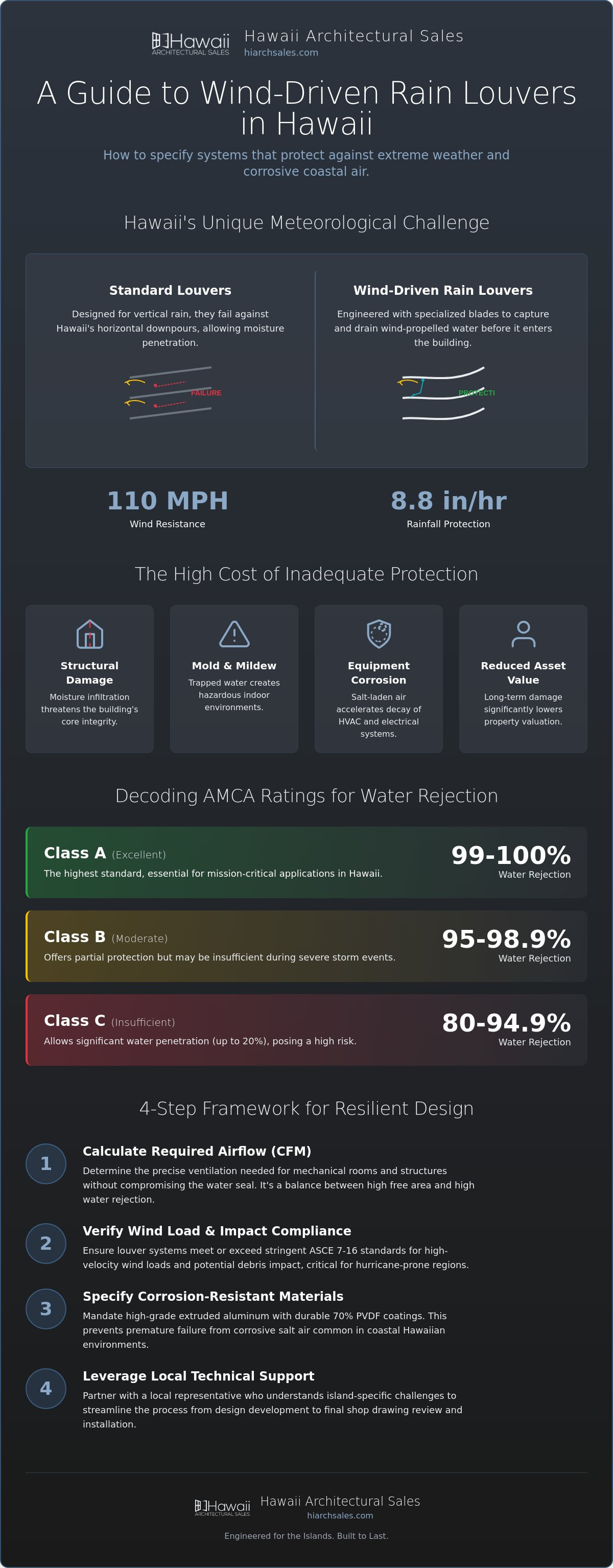
Can a standard louver actually protect a building's interior when a Kona storm drives 8.8 inches of rain per hour against the facade at 110 miles per hour? For architects and engineers in the islands, the building envelope is under constant siege from both horizontal downpours and corrosive salt air...
Can a standard louver actually protect a building's interior when a Kona storm drives 8.8 inches of rain per hour against the facade at 110 miles per hour? For architects and engineers in the islands, the building envelope is under constant siege from both horizontal downpours and corrosive salt air. You understand that a failure in moisture management doesn't just cause a mess; it threatens the structural integrity and long-term value of your project. Selecting the right wind-driven rain louvers Hawaii requires more than just checking a box on a submittal form.
In this specification guide, you'll learn how to safeguard your building by selecting industrial louver systems that exceed local performance requirements. We'll show you how to navigate complex AMCA 540 and 550 ratings to ensure your design withstands extreme wind loads while maintaining a refined aesthetic. From analyzing the durability of 70% PVDF coatings to understanding ASCE 7-16 compliance, this overview provides the technical clarity needed to bridge the gap between high-end manufacturing and practical island application. By the end, you'll have a clear framework for specifying AWV systems that keep interiors dry and facades flawless.
• Identify why standard louver designs fail during Hawaii's intense trade wind events and how horizontal rain bypasses conventional blades.
• Navigate the technical requirements for wind-driven rain louvers Hawaii by decoding AMCA performance ratings and water rejection classes.
• Learn why high-grade extruded aluminum is essential for preventing corrosion and ensuring the longevity of building envelopes in coastal environments.
• Follow a structured four-step process to calculate required airflow while meeting stringent ASCE 7 wind load and impact standards.
• Discover how local technical support streamlines the transition from design development to final shop drawing review for AWV systems.
In many regions, building design assumes rain falls vertically or at a slight angle. Hawaii's geography dictates a different reality. Standard louvers are typically tested for "still air" water penetration, where gravity does most of the work. This approach fails to account for the physics of the islands. To understand why, one must first define What is a louver in a high-stakes environment: it's not just a vent, but a critical defensive barrier. In Hawaii, rain is rarely a passive event. High-velocity winds grab raindrops and accelerate them horizontally, forcing moisture through the gaps of traditional louver blades at incredible speeds.
When architects specify wind-driven rain louvers Hawaii, they're solving for a unique set of meteorological pressures. Conventional louvers might stop 90% of vertical rain, but during a storm, that remaining 10% translates into gallons of water entering the building envelope. This infiltration leads to immediate and long-term damage, including mold growth, ruined insulation, and the corrosion of internal structural components. For high-rise developments in Honolulu or coastal resorts in Kihei, the cost of a louver failure often exceeds the cost of the entire ventilation system.
Trade Winds vs. Extreme Storm Events
Hawaii's weather patterns present two distinct threats to moisture management. First, the persistent trade winds create constant low-pressure zones on the leeward sides of buildings. This pressure differential literally sucks water through standard louver openings, even during moderate rainfall. Second, "Kona storms" bring erratic, high-intensity winds from the opposite direction, often catching buildings off-guard. Standard vertical rain testing doesn't simulate these conditions. High-performance wind-driven rain louvers Hawaii are necessary because they're engineered to handle 100% water rejection at intake velocities that would overwhelm a standard blade profile. Without this specialized geometry, the constant misting from trade winds can saturate mechanical rooms over several days, leading to electrical shorts and equipment failure.
The Vulnerability of Mechanical Rooms and Parking Structures
Mechanical rooms and parking structures are the most frequent points of failure in Hawaii's commercial developments. These spaces require massive volumes of airflow to cool machinery or exhaust fumes, yet they're often located on the building's exterior. It's a difficult balance. In coastal projects across Lihue or Lahaina, the air isn't just wet; it's laden with salt. Standard louvers allow this salt-heavy moisture to bypass the facade, where it settles on HVAC units and electrical panels. This accelerated corrosion can cut the lifespan of expensive equipment by half. Specifying AWV systems through a knowledgeable partner ensures that the louver design provides the necessary CFM while maintaining a total moisture seal, protecting the building's most vulnerable internal systems from the harsh Pacific environment.
A wind-driven rain louver is an architectural component designed to provide ventilation while preventing moisture infiltration during high-velocity wind events. Unlike standard louvers that rely on gravity alone to shed water, these systems use specialized blade profiles to capture and drain water before it enters the building. For projects requiring wind-driven rain louvers Hawaii, the primary benchmark for performance is the Air Movement and Control Association (AMCA) certification. AMCA Publication 511 dictates how manufacturers must display their data, while the AMCA 500-L test standard provides the actual laboratory results for water penetration and airflow.
The performance hierarchy is straightforward but critical for island specifications. Class A louvers provide 99% or greater water rejection. Class B drops to 95%, and Class C falls as low as 80%. In the context of a tropical storm, a Class C rating is often insufficient, as it allows 20% of the driven rain to pass through the facade. Hawaii engineers often find that "Free Area" is only half of the specification equation. A louver with high free area might offer excellent ventilation but fail to meet the necessary AMCA ratings for industrial louver systems required for building envelope protection. Balancing these two metrics is essential to prevent internal flooding.
Interpreting AMCA 500-L Data
Reading a wind-driven rain penetration chart requires looking at two specific wind speeds: 29 mph and 50 mph. The 50 mph test is particularly relevant for the islands, as it simulates the sustained gusts common during storm seasons. As core velocity increases, water rejection typically decreases. You must ensure the louver maintains its Class A rating at the specific intake velocity your HVAC system requires. If you're struggling to verify these technical charts against your design, the team at Hawaii Architectural Sales can provide detailed submittal reviews and technical guidance.
Vertical vs. Horizontal Blade Performance
Vertical blade designs are generally superior for extreme moisture exclusion. Gravity assists the vertical channels in draining water quickly to the sill, which prevents the "carryover" effect where wind pulls water off the blade tips. While some architects prefer the look of horizontal blades, many high-performance systems use a "dual-module" approach. This features a standard horizontal louver on the exterior for aesthetics, backed by a high-efficiency vertical core for protection. This configuration is especially effective when integrated alongside hurricane rated windows Hawaii to create a unified, storm-resistant facade that doesn't compromise on visual appeal.
Hawaii's environment is exceptionally aggressive toward architectural metals. While performance ratings for wind-driven rain louvers Hawaii are vital, those ratings don't mean much if the assembly fails due to corrosion within five years. For these reasons, extruded aluminum, specifically 6063-T5 or T6 alloy, is the industry standard across the islands. This material offers a superior strength-to-weight ratio and inherent resistance to oxidation compared to steel. However, the design of the building envelope often involves multiple metals. Specifiers must be vigilant about galvanic corrosion. This occurs when dissimilar metals, such as aluminum and carbon steel, come into contact in the presence of an electrolyte like salt-laden moisture. Without proper isolation, the aluminum will sacrificialy corrode, compromising the louver's structural integrity.
Finishing is the next line of defense. Standard anodizing provides a hard surface, but it's often insufficient for high-salt environments. We typically recommend high-performance organic coatings. These factory-applied finishes provide a barrier that prevents salt and moisture from reaching the aluminum substrate. In locations like Kailua-Kona or Lahaina, the combination of high humidity and salt spray makes material selection the most important factor in the louver's lifecycle. Regular maintenance is still required. A simple freshwater rinse twice a year helps remove accumulated salt crystals that can eventually break down even the most robust finishes.
The Role of Kynar 500® and Hylar 5000® Finishes
Standard finishes often blister or peel under the intense Hawaiian sun. To ensure longevity, you should specify factory-applied organic coatings containing 70% PVDF resins, commonly known by the brand names Kynar 500® or Hylar 5000®. These finishes meet the stringent AAMA 2605 standard. This is the highest level of performance for salt-spray resistance and color retention. In Hawaii’s high-UV index environment, these coatings prevent the chalking and fading that plague lesser finishes. While field-applied coatings might seem cost-effective initially, they can't match the durability and bond strength of a factory-baked finish applied in a controlled environment.
Specifying for Salt-Air Proximity
Proximity to the shoreline dictates the level of protection required. Projects in "Coastal Zones," generally defined as being within 3,000 feet of the high-tide line, demand specialized hardware. Even the highest-quality louver blades will fail if the assembly's fasteners corrode. We specify 300-series stainless steel fasteners for all wind-driven rain louvers Hawaii to prevent structural degradation. This is particularly critical for resorts and commercial developments where exposure is constant. For a deeper look at specific material options and design configurations, you can explore our guide on AWV architectural louvers Honolulu. Proper fastener selection ensures the louver remains securely anchored during the high-pressure events common in tropical storms.
Specifying wind-driven rain louvers Hawaii requires a methodical approach to ensure both technical compliance and long-term performance. A louver that looks correct on a drawing may fail in the field if it hasn't been vetted against local wind loads and airflow requirements. Follow these four steps to secure your building envelope.
Step 1: Determine Required Airflow (CFM) and Maximum Pressure Drop.
Start with the mechanical requirements. You must know the volume of air needed for the space and the maximum resistance the HVAC system can handle.
Step 2: Identify Wind Load and Impact Requirements.
Consult ASCE 7-16 standards and local county amendments. In Hawaii, design wind speeds range from 100 to over 150 mph. If your project is in a wind-borne debris region where speeds reach 130 mph or greater, impact-rated louvers are mandatory.
Step 3: Select the AMCA Class based on critical nature of the space.
For mechanical rooms housing expensive switchgear or sensitive equipment, a Class A (99%+) water rejection rating is the only responsible choice.
Step 4: Coordinate with the Building Envelope Representative.
Engage a technical consultant early to verify that the selected louver assembly integrates correctly with the surrounding facade and structural supports.
Calculating Net Free Area and Velocity
A common error in specification is sizing a louver based solely on the rough opening. High-performance wind-driven rain louvers Hawaii often have more complex blade geometries, which can result in a lower percentage of Net Free Area compared to standard sight-proof louvers. If the free area is too low, intake velocity will spike. This can lead to excessive pressure drops that force fans to work harder, increasing energy costs and potentially pulling moisture through the core. Always size your louver based on the "core velocity" required to maintain a Class A rating while meeting your CFM targets.
Meeting Hawaii County Wind Load Codes
Hawaii's building codes are enforced at the county level and often incorporate stringent amendments like Appendix W of ASCE 7-16. To ensure compliance, many engineers look for louvers with Miami-Dade or Florida Product Approval as a benchmark for extreme weather performance. Coordination with Balco joint systems Hawaii is also essential for managing thermal expansion and seismic movement across the facade. The louver must be anchored to withstand site-specific pressures without compromising the surrounding expansion joints. To get started on your project's technical submittals, contact Hawaii Architectural Sales today for expert guidance on local code compliance.
Specifying high-performance building components in the islands requires more than a technical data sheet. It demands a partnership with a representative who understands the local regulatory landscape and the logistical realities of Pacific construction. Hawaii Architectural Sales acts as the essential bridge between AWV and local architectural firms. We provide localized expertise that ensures the wind-driven rain louvers Hawaii you specify meet the stringent demands of our environment. Our team serves every island, providing technical support from the initial design development phase through the final shop drawing review. This localized presence ensures that your project remains compliant with county-specific amendments to the building code.
Having a single point of contact for the building envelope simplifies the communication chain. Instead of coordinating with multiple mainland manufacturers, architects can rely on our team to manage the technical nuances of the louver package. We provide pragmatic solutions that prioritize reliability and long-term value. Our role is to act as a consultant, helping you navigate the high-stakes nature of large-scale commercial and resort design. We understand that a dry building interior is the only acceptable outcome, and we provide the technical oversight necessary to achieve it.
Streamlining the Building Envelope Procurement
Procuring industrial louver systems in Hawaii presents unique logistical challenges that can often lead to project delays. We reduce lead times by leveraging established manufacturer relationships and coordinating distribution across Honolulu, Lihue, Kihei, and Lahaina. This coordination ensures that all components arrive on-site together and meet a consistent performance standard. It's often highly efficient to work with a partner who also serves as an Architectural window distributor Hawaii. This unified procurement strategy prevents the technical conflicts that often arise when different suppliers provide separate parts of the facade.
Custom Solutions for Unique Island Architecture
Modern Hawaiian architecture often requires specialized geometries that go beyond standard catalog options. We collaborate with design teams to provide custom shapes, mitered corners, and integrated blank-off panels that maintain the aesthetic integrity of the facade. Whether you're designing a high-rise in Kaka'ako or a coastal resort on the Big Island, we ensure that your wind-driven rain louvers Hawaii integrate seamlessly into the curtain wall or storefront system. We provide the technical clarity needed to balance massive airflow requirements with total moisture exclusion. To ensure your building envelope is prepared for the next tropical storm season, contact Hawaii Architectural Sales for a comprehensive technical consultation.
Specifying the correct wind-driven rain louvers Hawaii is a decision that impacts a building's performance for decades. It's not just about meeting a basic ventilation requirement; it's about protecting sensitive mechanical systems and interior finishes from the relentless physics of the Pacific. By prioritizing AMCA Class A ratings and high-performance PVDF finishes, you ensure your project withstands both horizontal downpours and the corrosive effects of salt air. Integrating these components into a unified, storm-resistant facade requires technical precision and a deep understanding of local county building codes.
As the authorized Hawaii representative for AWV, Hawaii Architectural Sales provides the specialized knowledge needed for complex coastal building envelope protection. Our team bridges the gap between high-end manufacturing and practical island application, drawing on decades of experience with local regulatory standards. We are here to act as your strategic ally, ensuring every specification is technically sound and logistically viable across all islands. Consult with our technical experts on your next Hawaii louver project to verify your design's performance and durability. We look forward to helping you build a more resilient future for the islands.
What is the difference between a standard louver and a wind-driven rain louver?
Standard louvers primarily rely on gravity to shed vertical rain and prevent water from entering a building. In contrast, wind-driven rain louvers Hawaii use complex, aerodynamic blade geometries to capture and drain water that is forced horizontally by high-velocity winds. These systems are specifically tested under simulated storm conditions to ensure water doesn't carry over into the building envelope during intense weather events.
Do I need hurricane-rated louvers for a project in Honolulu?
You typically need hurricane-rated louvers if your project is located in a wind-borne debris region where design wind speeds reach 130 mph or greater. Honolulu County follows ASCE 7-16 standards, which require impact-resistant openings in these specific zones. Specifying louvers tested to AMCA 540 ensures the blades and frames can withstand the impact of flying debris during a tropical cyclone or high-wind event.
What AMCA rating should I specify for a coastal building in Hawaii?
Specify an AMCA Class A rating for any coastal project where moisture exclusion is a priority. A Class A rating indicates that the louver provides 99% or greater water rejection at wind speeds of both 29 mph and 50 mph. This is the highest industry standard for wind-driven rain louvers Hawaii and is essential for protecting sensitive mechanical rooms from persistent trade winds and salt spray.
How does salt air affect the lifespan of industrial louver systems?
Salt air accelerates the oxidation of metal surfaces, leading to pitting and structural failure if the materials aren't correctly specified. In Hawaii's coastal environments, salt crystals accumulate on the louver blades and can eat through standard finishes. Using corrosion-resistant 6063-T5 aluminum alloys and high-performance coatings is the only way to prevent premature degradation and ensure a long lifecycle for the ventilation system.
Can I use wind-driven rain louvers for both intake and exhaust?
Yes, these louvers are highly effective for both intake and exhaust applications. However, you must carefully verify the pressure drop for each direction of airflow. The sophisticated blade profiles that stop rain can sometimes create higher resistance for exhaust air. This may require you to increase the louver size or adjust fan specifications to maintain the required CFM without overworking the mechanical system.
What is the best finish for architectural louvers in a high-UV, high-salt environment?
A factory-applied 70% PVDF resin coating is the most durable finish for Hawaii's intense environmental conditions. These coatings meet the AAMA 2605 standard, which is the highest benchmark for salt-spray resistance and color retention. Unlike standard finishes, PVDF coatings resist the chalking and fading caused by high UV levels while providing a robust barrier against the corrosive effects of the Pacific air.
How do I calculate the free area needed for my HVAC system?
Calculate the required free area by dividing your target CFM by the maximum allowable air velocity through the louver core. It's a common mistake to size a louver based on the rough opening alone. You must use the manufacturer's certified Net Free Area data to ensure the intake velocity doesn't exceed the point where water begins to penetrate the blades and enter the building.
Does Hawaii Architectural Sales provide installation for AWV louvers?
No, Hawaii Architectural Sales does not provide installation services or act as a general contractor. We serve as the authorized technical representative and distributor for AWV architectural louvers across all islands. Our role is to provide architects and engineers with technical expertise, material distribution, and shop drawing reviews to ensure the correct high-performance systems are specified for each unique project.