Skylights Commercial Hawaii: A Technical Guide to High-Performance Daylighting
Can a commercial skylight system truly survive a 150-mph tropical gust while simultaneously slashing your building's cooling load? In the Pacific, the building envelope faces a unique set of stressors that standard specifications rarely address. You're likely familiar with the frustration of balanci...
Can a commercial skylight system truly survive a 150-mph tropical gust while simultaneously slashing your building's cooling load? In the Pacific, the building envelope faces a unique set of stressors that standard specifications rarely address. You're likely familiar with the frustration of balancing aesthetic daylighting with the pragmatic fears of leaks during tropical downpours and the rising HVAC costs associated with high solar heat gain. Selecting the right skylights commercial Hawaii projects demand requires more than just a glance at a catalog. It requires a deep understanding of localized wind loads and salt-air corrosion resistance.
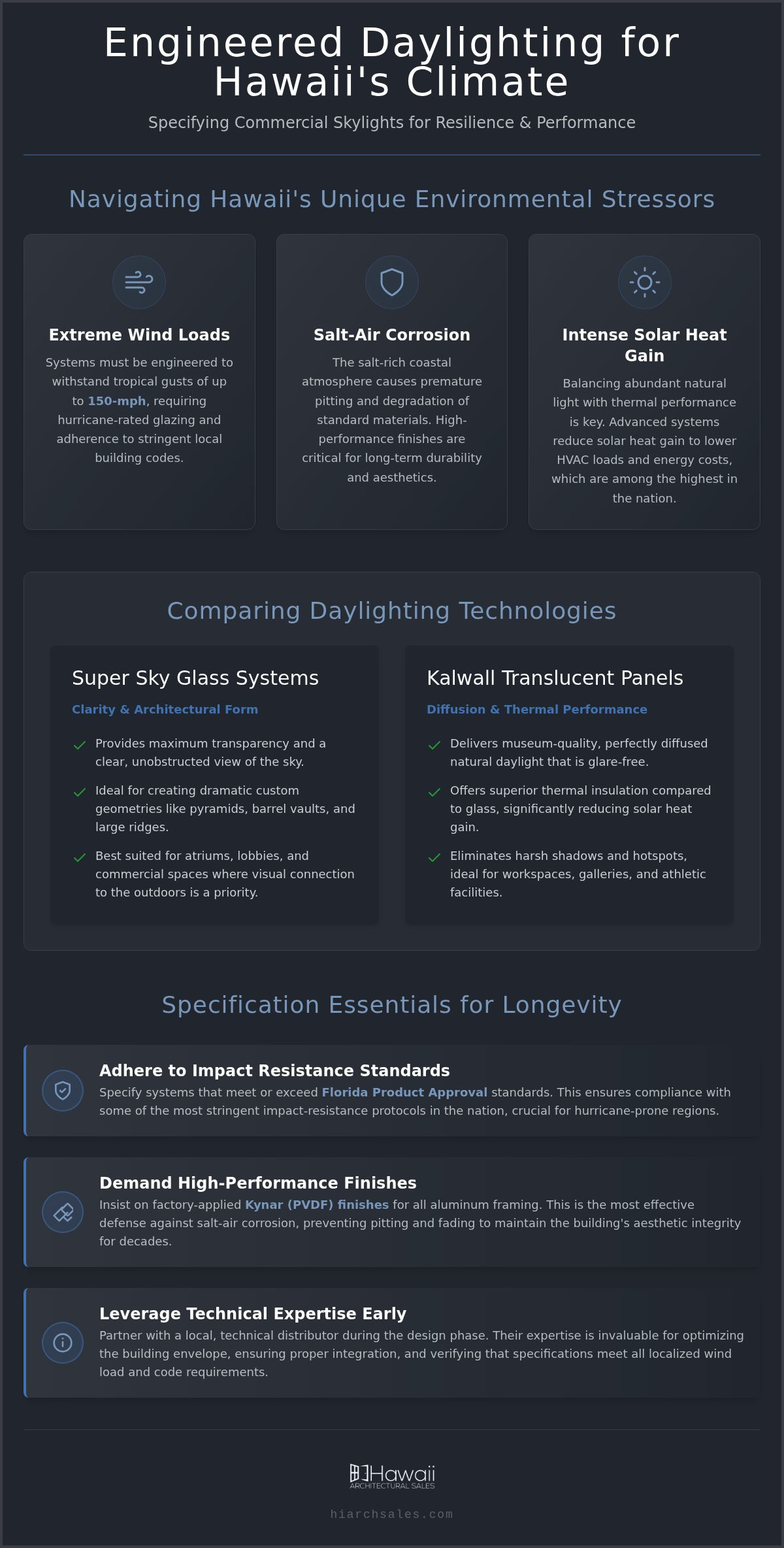
This technical guide shows you how to specify engineered daylighting systems that maintain structural integrity in extreme environments. We'll explore the critical requirements for hurricane-rated glazing and the performance differences between glass and translucent systems. You'll gain a clear framework for choosing high-performance solutions from manufacturers like Super Sky and Kalwall. These systems are designed to reduce energy consumption while meeting the stringent 2026 Hawaii building codes. We also detail how proper material selection prevents the premature degradation common in coastal climates.
Key Takeaways
• Identify the specific engineering requirements needed to protect commercial systems from Hawaii's unique combination of salt-air corrosion and extreme wind loads.
• Evaluate the performance differences between Super Sky glass systems and Kalwall translucent panels to determine the best fit for your project's thermal and aesthetic goals.
• Understand the application of Florida Product Approval standards when specifying skylights commercial Hawaii to ensure compliance with stringent impact-resistance protocols.
• Learn how to leverage a technical distributor's expertise during the design phase to optimize the building envelope and ensure long-term structural integrity.
• Discover why high-performance finishes like Kynar are critical for maintaining the visual and functional quality of architectural frames in tropical coastal climates.
The Role of High-Performance Commercial Skylights in Hawaii Architecture
Commercial skylights are not merely oversized windows. They are structural components designed to span significant distances in facilities like airports, shopping centers, and office complexes. In the Pacific, the selection of skylights commercial Hawaii projects require involves a sophisticated understanding of the building envelope's role in tropical climates. Unlike residential units, these high-performance systems must manage intense solar radiation while maintaining structural integrity against localized environmental pressures. They serve as a critical barrier, protecting interiors from salt-laden humidity while inviting the islands' abundant natural light into deep floor plates.
The high-performance building envelope in the tropics acts as a thermal and structural shield. Architects are increasingly moving toward integrated solutions that treat the roof and facade as a single, cohesive unit. This approach ensures that daylighting doesn't come at the cost of thermal comfort or structural safety. By specifying systems that are engineered for these specific variables, designers can achieve a balance between transparency and resilience that standard off-the-shelf products can't provide.
Daylight Harvesting and Energy Efficiency
Effective daylighting is a cornerstone of modern energy-efficient design. By integrating advanced daylighting principles, architects can significantly reduce a building's reliance on artificial lighting. This reduction in electrical load is critical in Hawaii, where energy costs are among the highest in the nation. High-performance skylights help projects achieve LEED certification by contributing to credits for Indoor Environmental Quality and Energy and Atmosphere. Recent legislative trends, such as Senate Bill 632, indicate a move toward even more stringent green building standards across the islands.
Natural light provides benefits beyond the balance sheet. Studies consistently show that well-lit office spaces improve occupant wellness and increase productivity. The technical challenge for engineers is balancing visible light transmittance (VLT) with thermal insulation. High-performance systems use specialized coatings and infills to allow light to enter while reflecting the infrared spectrum, which is responsible for heat gain. This precision engineering keeps HVAC costs manageable even during the peak of summer.
Aesthetic Integration in Island Design
The shift toward architectural daylighting solutions Honolulu developers prefer reflects a desire for seamless indoor-outdoor transitions. In commercial lobbies and atriums, custom-engineered systems allow the sky to become a dynamic part of the interior experience. These systems offer several advantages over standard roof windows:
Custom Geometries
Ability to create pyramids, barrel vaults, and massive ridge systems that define a building's silhouette.
Material Compatibility
Framing finishes that complement the unique light quality and landscape of Hawaii.
Structural Spans
Engineering that supports large areas of glass or translucent panels without excessive internal support structures.
This focus on structural durability and specialized material selection is a principle shared by expert contractors nationwide; for example, MAK Roofing and Construction Company applies similar high standards to roofing and remodeling services for commercial clients in El Paso.
Choosing the right material is essential for long-term visual appeal. Standard aluminum frames can quickly pit and fade in Hawaii's salt-rich air. High-performance commercial systems utilize superior finishes and sealants that preserve the aesthetic intent of the design for decades, ensuring the building remains a landmark rather than a maintenance burden.
Engineering for the Islands: Wind Loads, Salt Air, and Solar Heat Gain
Hawaii's microclimates present a significant challenge for skylights commercial Hawaii installations. Engineering must account for wind speeds that vary significantly across the islands. The current state building code, based on the 2018 IBC with local amendments, mandates rigorous structural testing for different regions:
• Honolulu and Oahu's specialized wind zones.
• Lihue and the high-wind exposures of Kauai.
• Kailua-Kona and the variable conditions of the Big Island.
These requirements are becoming more stringent as the state moves toward a six-year adoption cycle to improve building resilience. Designing for these loads ensures that large-span systems remain intact during severe weather events, preventing catastrophic envelope failure.
Corrosion Resistance for Coastal Environments
Salt spray is the primary cause of premature failure in building envelopes across the islands. Standard aluminum frames often suffer from pitting and oxidation within years of exposure. Specifying salt resistant window frames and skylight structures is mandatory for any project within five miles of the coast. High-performance coatings like Kynar 500 or specialized Class I anodizing provide the necessary barrier against chloride attack. These finishes maintain their color and structural integrity far longer than standard powder coatings.
Hardware choice is equally critical. Zinc-plated or standard steel fasteners will corrode, compromising the structural integrity of the entire system. We recommend 300-series stainless steel hardware for all exterior connections. This ensures the skylight remains securely anchored during high-wind events. Neglecting these details often leads to expensive remediation and potential safety hazards as the structure ages.
Managing Thermal Performance and Solar Gain
Managing solar heat gain is the most common objection from facility managers concerned about HVAC costs. In Hawaii's high-UV environment, the Solar Heat Gain Coefficient (SHGC) must be carefully tuned. High-performance glass systems utilize low-E coatings and tints to block infrared radiation while maintaining high visible light transmittance. Translucent systems provide inherent thermal insulation and diffused light, which eliminates hot spots and glare while reducing solar heat gain.
Large-span systems also require thermal break technology within the framing. This prevents the aluminum from acting as a heat bridge, transferring exterior temperatures directly into the building. For projects requiring the highest level of resilience, architects often reference the Florida Product Approval system to verify that components can withstand both pressure and impact. If you are currently drafting specifications, consulting with a technical representative during the design phase can help ensure your system meets both energy and structural goals.
Comparing Daylighting Technologies: Super Sky vs. Kalwall Systems
Selecting the appropriate technology for skylights commercial Hawaii projects involves a strategic choice between transparency and diffusion. Most high-performance specifications move beyond basic acrylic bubbles toward the engineering precision of glass systems or translucent sandwich panels. Each technology addresses different priorities regarding aesthetics, thermal control, and structural complexity. Understanding these differences is essential for optimizing the building envelope and ensuring long-term performance in tropical environments.
Super Sky: Engineered Glass Systems
Super Sky is the industry leader for glass-based geometries. Its systems allow for massive clear spans that define the aesthetic of luxury shopping centers or high-end hotel atriums. These custom-engineered structures are capable of forming complex shapes, including pyramids, domes, and barrel vaults. They integrate seamlessly with architectural glass systems Honolulu architects specify for high-visibility landmarks. These are the premier skylights commercial Hawaii developers choose when a direct visual connection to the sky is required.
Beyond aesthetics, Super Sky utilizes high-performance glazing that balances clarity with safety. This ensures that even the largest glass spans meet stringent impact requirements without sacrificing light quality. By using specialized coatings, these systems manage solar heat gain while providing the "wow" factor that only clear glass can deliver. It's a structural statement that doesn't compromise on building security.
Kalwall: High-Insulation Translucent Daylighting
Kalwall offers a fundamentally different approach through translucent sandwich panels. The primary advantage of this technology is the science of diffuse light. By scattering sunlight, Kalwall eliminates the harsh hot spots and deep shadows often found under clear glass. This creates a glare-free environment that is ideal for schools, airports, and athletic facilities. These panels are also significantly lighter than glass, which often reduces the structural requirements for the supporting roof and makes them easier to handle during the construction phase.
From a thermal perspective, Kalwall is exceptionally efficient. Its high R-value panels provide superior insulation, which is a major factor in reducing the cooling load of a building. This isn't just about comfort; it's about exploiting the energy-saving potential of high-performance daylighting. By reducing the reliance on artificial lighting and minimizing heat transfer, Kalwall helps facility managers lower their long-term operational costs.
Choosing between these systems depends on the specific goals of the facility. A retail mall might prioritize the dramatic views and high visible light transmittance of a Super Sky system to enhance the consumer experience. Conversely, an airport terminal or a gymnasium might benefit more from the soft, even illumination and thermal stability provided by Kalwall. Both systems represent the pinnacle of high-performance daylighting, providing the durability needed to withstand the Pacific's environmental stressors while delivering long-term value.
Navigating Compliance: Impact Ratings and Florida Product Approval
Hawaii does not maintain a proprietary building product approval database. Consequently, architects frequently rely on the Florida Product Approval (FPA) system to vet skylights commercial Hawaii projects. FPA represents the most rigorous testing standard for high-velocity hurricane zones in the United States. For a building envelope to remain secure during a tropical cyclone, skylights must perform as part of a unified defense. This ensures protection against both windborne debris and the extreme pressure fluctuations that can lead to structural failure.
Impact testing typically follows ASTM E1886 and ASTM E1996 protocols. Large missile testing involves a 9-pound 2x4 timber impacting the system at 50 feet per second. Small missile testing uses steel balls to simulate smaller debris at higher speeds. Following the impact, the system undergoes cyclic wind pressure testing. This process simulates the thousands of pressure reversals that occur during a prolonged storm. These standards are the benchmark for hurricane rated windows Hawaii and commercial skylight assemblies alike.
Water penetration testing is equally vital for tropical storm resilience. ASTM E331 protocols test the system under static pressure to ensure wind-driven rain cannot bypass the seals during a downpour. A structural engineer must verify localized wind load pressures for every specific project. This ensures the specified system matches the unique elevation and exposure of the site, preventing costly envelope breaches.
Understanding Hurricane and Impact Ratings
It's vital to distinguish between "impact-resistant" and "hurricane-rated" systems. Impact-resistant glass is designed to stay within the frame after a strike, preventing internal pressurization. A hurricane-rated system implies the entire assembly, including frames, sealants, and anchors, has passed cyclic pressure tests. Large-span systems require specific engineering to manage the massive loads generated across their surface area. High-performance frames must be robust enough to transfer these loads to the building's primary structure without deformation.
Local Code Compliance in 2026
Hawaii is currently transitioning its building codes to a more frequent update cycle. The state adheres to the 2018 International Building Code (IBC) with local amendments, but 2026 trends suggest a shift toward a six-year adoption cycle to keep pace with resilience technology. Every commercial project requires project-specific engineering calculations, often evidenced by a Professional Engineer (PE) stamp. Collaborating with a technical distributor ensures that the materials specified meet these evolving mandates. You can request technical documentation for Super Sky or Kalwall to ensure your submittals meet all current local requirements.
Specifying Commercial Skylights: Partnering with a Hawaii Representative
Successful integration of skylights commercial Hawaii projects relies on early engagement with technical experts who understand the Pacific's unique environmental pressures. Hawaii Architectural Sales serves as a dedicated distributor and manufacturer's representative. We don't perform installation or general contracting. Instead, we function as a technical consultant to bridge the gap between high-end manufacturing and the practical application of building envelope components. This specialized role ensures that the systems specified are both architecturally ambitious and structurally sound.
The Specification Process for Architects
Architects should engage a representative during the design development phase to maximize the performance of the building envelope. This early collaboration allows for the precise customization of systems to meet project-specific goals. We provide the technical resources necessary for a seamless design process, including:
Detailed Documentation
Access to technical drawings, BIM models, and comprehensive performance data for Super Sky and Kalwall systems.
Structural Coordination
Ensuring the building's primary frame is engineered to support the specific loads and attachment points required by large-span assemblies.
Regulatory Alignment
Verifying that all components meet the 2026 Hawaii State Building Code and localized wind load requirements.
By providing clear, vetted specifications, we streamline the procurement process for general contractors. This precision minimizes the risk of costly change orders or delays during the construction phase. It ensures that the final product delivered to the site matches the original design intent and performance requirements exactly.
Logistics and Support in the Islands
The logistics of transporting large-scale, fragile architectural components to Hawaii require specialized management. As a local Euro-Wall distributor Hawaii projects can rely on, we oversee the complex transport of materials from mainland manufacturing facilities to the job site. This localized oversight reduces project risk. We manage the intricacies of shipping and handling to ensure that components arrive intact and on schedule, regardless of the project's location on Oahu, Kauai, Maui, or the Big Island.
Our on-island presence provides technical assistance for complex building envelope challenges that may arise during the construction process. Choosing skylights commercial Hawaii developers trust requires more than just a product selection; it requires a partner with deep localized knowledge. With over 40 years of experience, we understand how to mitigate the effects of high solar heat gain and salt-air corrosion. This expertise ensures that the daylighting systems specified today will maintain their structural integrity and aesthetic quality for decades to come.
Optimizing the Building Envelope for Pacific Resilience
Specifying skylights commercial Hawaii projects require means balancing architectural vision with the pragmatic realities of tropical exposure. It's not just about light; it's about resisting salt-air corrosion, withstanding extreme wind pressures, and managing significant solar heat gain. Whether you prioritize the clear, geometric spans of Super Sky or the diffused, highly insulated performance of Kalwall, selecting a system rated for local conditions is the only way to ensure long-term structural integrity and occupant comfort.
Hawaii Architectural Sales brings over 40 years of local expertise to your design process. As an authorized representative for Super Sky and Kalwall, we specialize in high-performance building envelopes that meet the islands' most stringent standards. We provide the technical documentation, BIM models, and localized knowledge necessary to navigate the 2026 building codes with confidence. Contact Hawaii Architectural Sales for Technical Specifications to begin your project review. We're ready to help you achieve a resilient and efficient design.
Frequently Asked Questions
What is the best skylight material for the high-salt environment in Hawaii?
High-performance aluminum framing with Kynar 500 or Class I anodized finishes is the industry standard for salt-air resistance. These coatings provide a robust barrier against chloride attack and pitting common in coastal regions. Additionally, using 300-series stainless steel fasteners is essential to maintain structural integrity. This combination ensures that skylights commercial Hawaii projects withstand the corrosive atmosphere without the premature degradation found in standard storefront or residential systems.
Do commercial skylights in Honolulu need to be hurricane-rated?
Yes, commercial skylights in Honolulu must comply with the Hawaii State Building Code, which mandates specific wind load and impact resistance. Depending on the building's exposure category and elevation, systems often require hurricane-rated glazing to prevent envelope failure during a tropical cyclone. These requirements are verified through rigorous testing, such as ASTM E1886 and E1996, ensuring the assembly remains secure under cyclic wind pressures and debris impact.
How do I prevent solar heat gain from a large glass skylight in the tropics?
Managing solar heat gain requires specifying glazing with a low Solar Heat Gain Coefficient (SHGC). For clear glass systems, high-performance low-E coatings and ceramic frits are effective at reflecting infrared radiation while maintaining visibility. Alternatively, translucent systems like Kalwall provide inherent thermal insulation and light diffusion. These technologies eliminate hot spots and reduce the cooling load on HVAC systems, which is a critical consideration for any high-performance building envelope in the tropics.
What is the difference between Super Sky and Kalwall daylighting systems?
Super Sky specializes in custom-engineered glass systems, offering maximum transparency and complex geometries like domes or barrel vaults. It is ideal for high-visibility atriums. Kalwall utilizes translucent sandwich panels that provide superior thermal insulation and glare-free, diffused daylight. While Super Sky emphasizes the visual connection to the sky, Kalwall focuses on energy efficiency and uniform light distribution. Both are premier choices for skylights commercial Hawaii developments requiring structural durability.
Can I get a custom-shaped skylight for a commercial project in Kailua-Kona?
Custom-engineered shapes are available for projects across all islands, including the Big Island. Super Sky provides the engineering expertise to design pyramids, polygons, and ridge skylights tailored to specific architectural requirements. These systems are fabricated to withstand the unique wind loads of the Kona coast. We provide the technical drawings and BIM models necessary to integrate these complex shapes into your building's structural frame while ensuring local code compliance.
Why is Florida Product Approval important for Hawaii architectural projects?
Florida Product Approval (FPA) is the primary benchmark for Hawaii projects because it provides a standardized database for high-wind and impact testing. Since Hawaii does not maintain its own product approval system, architects rely on FPA's rigorous cyclic pressure and missile-impact protocols to verify performance. Using FPA-approved components ensures that specified daylighting systems are capable of withstanding the extreme environmental stressors found in hurricane-prone regions like the Pacific.
Does Hawaii Architectural Sales provide installation services for skylights?
Hawaii Architectural Sales does not provide installation or general contracting services. We operate as a technical distributor and manufacturer's representative for Super Sky and Kalwall. Our role involves providing technical expertise, material supply, and logistics management for architects and contractors. We assist during the design phase with specifications and drawings, then coordinate the delivery of engineered components to the job site for installation by qualified local contractors.
How do I determine the wind load requirements for a commercial skylight on Kauai?
Wind load requirements for Kauai must be determined by a licensed structural engineer using ASCE 7 standards and the Kauai County amendments to the building code. These calculations account for the island's unique topography, the building's height, and its proximity to the shoreline. We collaborate with your engineering team to ensure the specified skylight system is rated for these project-specific pressures, providing the necessary PE stamps and technical documentation for permitting.