Specifying Balco Expansion Joints for Hawaii’s High-Movement Environments
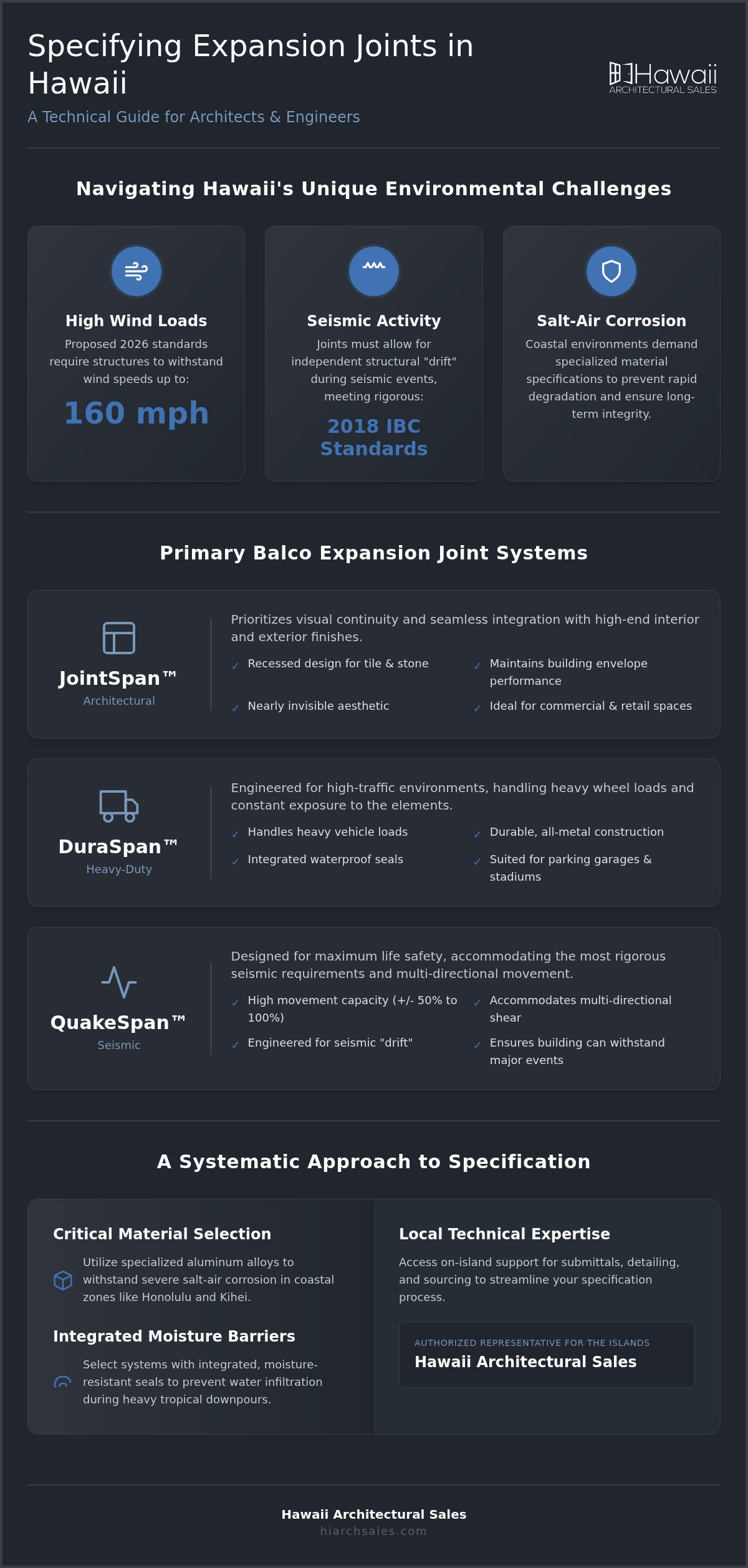
Proposed building standards for 2026 indicate that new Hawaii structures must withstand wind speeds of up to 160 mph. For architects and engineers, this means the margin for error in structural movement is narrower than ever. You already know that the combination of high seismic activity and salt ai...
Proposed building standards for 2026 indicate that new Hawaii structures must withstand wind speeds of up to 160 mph. For architects and engineers, this means the margin for error in structural movement is narrower than ever. You already know that the combination of high seismic activity and salt air corrosion can quickly turn a standard specification into a maintenance nightmare. Selecting the right Balco expansion joints Hawaii requires a deep understanding of how these systems perform under island-specific environmental stressors.
It's a challenge to balance 2018 IBC requirements with the practicalities of high-humidity climates. This technical guide simplifies that process. We'll examine the critical differences between architectural, parking, and seismic joint covers to ensure your project meets current safety standards. You'll also learn how to leverage local technical support from Hawaii Architectural Sales to streamline your submittals. By the end of this article, you'll have a clear roadmap for sourcing durable, compliant expansion systems that protect your design's structural integrity.
Key Takeaways
• Learn how Hawaii’s unique thermal expansion and proposed 160 mph wind standards impact structural movement and material selection.
• Differentiate between JointSpan, DuraSpan, and QuakeSpan systems to identify the ideal solution for your project's specific joint width and movement profile.
• Discover the material specifications, including specialized aluminum alloys, necessary to withstand salt-air corrosion in coastal environments like Honolulu and Kihei.
• Master a systematic approach to specifying Balco expansion joints Hawaii by balancing seismic requirements with environmental exposure factors.
• Access local technical expertise for submittals and detailing through Hawaii Architectural Sales, the authorized representative for the islands.
Understanding Structural Movement in Hawaii’s Unique Climate
An Expansion joint is a deliberate structural gap designed to safely absorb the expansion and contraction of building materials. In Hawaii, these gaps aren't just a standard code requirement; they're a critical defense against the islands' intense environmental conditions. High solar radiation and seismic activity create constant, multi-directional movement that can compromise a building’s integrity if left unmanaged.
Joint covers act as the bridge over these essential gaps. They maintain the building envelope’s continuity while allowing the structure to move without damaging finishes or structural components. For architects, prioritizing these joints during the early design phase is vital. Integrating Balco expansion joints Hawaii into your initial schematics prevents the common mistake of undersizing joints, which often leads to costly field modifications or premature system failure.
The Mechanics of Thermal Expansion in the Tropics
Hawaii’s proximity to the equator results in high UV exposure and significant solar heat gain. Concrete and steel surfaces can reach temperatures far higher than the ambient air, causing them to expand. When the sun sets or trade winds cool the structure, these materials contract. This daily thermal cycle puts immense pressure on rigid building components. Without a high-performance joint system, this stress manifests as unsightly cracks in floor slabs and exterior facades.
Humidity also plays a major role in material performance. Moisture-resistant joint seals are necessary to prevent water infiltration during heavy tropical downpours. Selecting a system with integrated moisture barriers ensures that the building remains watertight even as the joint opens and closes. For common materials used in Hawaii, the thermal expansion coefficient for concrete is approximately 10 millionths per degree Celsius, while structural steel is roughly 12 millionths.
Seismic Activity and Building Safety in Hawaii
While thermal movement is a daily occurrence, seismic movement is a sudden and high-stakes event. Hawaii’s seismic zones vary by island, but the potential for tectonic shifts remains a primary concern for structural engineers. Expansion joints are engineered to provide the necessary "drift" during an earthquake, allowing separate building sections to move independently without colliding. This independent movement prevents catastrophic structural damage and protects the lives of occupants.
Specifying systems that meet the 2018 International Building Code (IBC) and local county amendments is a non-negotiable safety standard. Balco expansion joints Hawaii are tested to accommodate the rigorous seismic requirements found in the islands. By selecting a system designed for high-movement capacity, you ensure that the building can withstand both the slow creep of thermal expansion and the violent forces of a seismic event.
Primary Balco Expansion Joint Systems for Architectural Applications
Selecting the appropriate system for Balco expansion joints Hawaii depends on a precise calculation of the nominal joint width and the anticipated movement range. Balco categorizes its offerings into three primary systems: JointSpan, DuraSpan, and QuakeSpan. Each serves a distinct structural and aesthetic purpose, allowing architects to match the technical performance of the joint to the specific demands of the building's occupancy and location.
JointSpan™: Architectural Solutions for Interior and Exterior
When planning for high-quality interior finishes, you can visit Gyp Artisan to explore premium gypsum boards and finishing solutions that integrate seamlessly with these architectural systems.
JointSpan systems prioritize the visual continuity of the building's interior and exterior finishes. These covers are available in recessed configurations to accommodate tile, carpet, or stone, ensuring the expansion gap remains nearly invisible to the end user. For exterior facades, they integrate seamlessly with architectural daylighting solutions Honolulu to maintain the thermal and moisture performance of high-performance glass walls. This system is ideal for commercial offices and retail spaces where a minimalist design is as important as structural flexibility.
DuraSpan™: Heavy-Duty Movement for Parking and Open-Air
Open-air structures like parking garages and stadiums require systems that handle heavy wheel loads and constant exposure to the elements. DuraSpan systems are engineered for these high-traffic environments. They feature integrated waterproof seals that are essential for protecting structural elements from Hawaii's intense rainfall and humidity. These systems resist the mechanical wear caused by vehicles while providing the necessary movement capacity for large, exposed concrete slabs. If you are designing for a high-traffic environment, you can consult with our technical team to review load-bearing requirements.
QuakeSpan™: Large-Scale Seismic and Base Isolation
For critical infrastructure, standard movement joints are insufficient. QuakeSpan systems are designed for buildings with significant seismic requirements, offering multi-directional movement capacity that can exceed several feet. These are often used in base-isolated structures like hospitals to ensure operational continuity after a seismic event. Architects frequently specify these alongside architectural glass systems Honolulu to provide a holistic, resilient envelope that protects both the structure and its expensive glazing components.
Every specification must also account for life safety. Regardless of the cover chosen, the assembly must include fire-rated barriers where required by code. Balco provides UL-listed fire barriers that install beneath the joint cover. This maintains the fire-resistance rating of the floor or wall assembly without hindering the system's ability to move. Integrating these barriers early in the detailing process ensures that your project remains compliant with Hawaii building codes while protecting the building's occupants.
Engineering for Hawaii: Salt-Air Corrosion and Seismic Requirements
Specifying Balco expansion joints Hawaii requires more than just meeting movement criteria. In coastal regions like Honolulu or Kihei, the "Salt Air Factor" is a primary cause of premature system failure. Airborne chlorides from the Pacific Ocean penetrate standard metal finishes, leading to pitting and oxidation that can seize moving parts. For projects within five miles of the coast, standard mill-finish aluminum isn't sufficient to maintain long-term functionality.
Corrosion-Resistant Finishes for Coastal Projects
Architects should choose high-performance finishes to ensure system longevity. Clear or color-anodized aluminum provides a durable surface that resists light corrosion, but Kynar 500 coatings offer superior resistance to UV degradation and salt spray. For the most aggressive environments, 316-grade stainless steel remains the gold standard. This material provides the highest level of chloride resistance, ensuring that joint mechanisms remain functional for decades. Implementing a quarterly maintenance schedule to rinse the covers with fresh water prevents salt-crust buildup that can interfere with the joint's movement range.
Seismic Joint Width and Movement Capacity
Seismic risk varies significantly across the islands. While Oahu has moderate requirements, Hawaii Island faces much higher seismic loads due to active volcanic activity. These geological differences dictate the required joint width and the complexity of the cover system. QuakeSpan systems for Balco expansion joints Hawaii are engineered to handle multi-directional movement across the X, Y, and Z axes, which is essential for complex building geometries. The anticipated seismic drift of a structure directly dictates the required width and movement capacity of the specified joint cover system.
Maintaining life safety during a seismic event also depends on fire barrier performance. If an earthquake occurs, the expansion joint must move freely without tearing the fire barrier beneath it. Balco’s fire-rated systems are tested to maintain their integrity even after being subjected to their full movement cycle. This ensures that smoke and flames don't migrate between floors or building sections. This level of engineering provides critical protection for occupants during and after a seismic event.
Best Practices for Specifying Expansion Joint Covers in Honolulu
Specifying Balco expansion joints Hawaii requires a methodical approach to ensure both structural performance and aesthetic integration. Architects must move beyond general product selection and follow a rigorous technical process. This ensures the chosen system handles the specific movement profiles and environmental stressors found in the islands. Follow these five essential steps for a successful specification:
Step 1: Identify movement requirements.
Calculate the combined effects of thermal expansion, seismic drift, and wind sway.
Step 2: Determine environmental exposure.
Assess whether the joint is interior, exterior, or within a high-corrosion coastal zone.
Step 3: Select cover material and finish.
Match the architectural intent with durable materials like 316-grade stainless steel or Kynar-coated aluminum.
Step 4: Coordinate with adjacent building envelope systems.
Ensure the joint assembly doesn't conflict with glazing, roofing, or wall systems.
Step 5: Ensure fire-rating compliance.
Verify that the assembly maintains the required fire resistance for floor and wall structures.
Coordinating with the Building Envelope
Expansion joints are often the most vulnerable points in a building’s exterior. Failure to properly manage transitions between the joint and adjacent high-performance bifold door systems Hawaii can lead to air and water infiltration. You must ensure that waterproofing membranes and roofing systems tie directly into the expansion joint’s moisture barrier. This continuity is essential for protecting the interior from Hawaii’s heavy seasonal rains. Properly detailed transitions prevent leaks and ensure the building envelope remains airtight even during maximum movement cycles.
Technical Documentation and BIM Coordination
Precision in the design phase reduces field errors and costly change orders. Utilizing Balco’s BIM library allows for accurate structural modeling; this ensures the joint width accommodates the full range of movement without interfering with other building components. Submittals must meet specific Hawaii engineering review standards, which often require detailed calculations for seismic drift. Early consultation with an architectural window distributor Hawaii provides a holistic view of the envelope. This coordination ensures that every opening and joint works together for maximum resilience. You can contact Hawaii Architectural Sales for assistance with technical submittals and product selection.
Technical Support and Distribution for Balco in Hawaii
Hawaii Architectural Sales serves as the authorized representative for Balco in Hawaii, providing a direct link between the manufacturer’s engineering team and local design firms. Since 1985, we've specialized in high-performance building envelopes, offering the localized knowledge necessary to navigate the islands' unique regulatory and environmental landscape. Specifying Balco expansion joints Hawaii through a local expert ensures that your project benefits from decades of experience in material performance and code compliance.
Working with an authorized representative provides a level of service that generic manufacturer websites cannot match. We act as a technical consultant throughout the design process, helping you identify the most efficient systems for your specific structural requirements. This partnership reduces the risk of specification errors and ensures that the selected joint covers meet both the aesthetic and functional goals of the project.
Localized Expertise for Complex Island Projects
Our team provides comprehensive support for projects across all major islands, from Lihue to Kailua-Kona. We understand the complexities of island logistics and the challenges of transporting large-scale architectural components to remote job sites. By managing the procurement and shipping process, we help keep your project on schedule and minimize the risk of transit-related delays. You gain access to Balco’s full range of life safety solutions through a single point of contact, streamlining the communication between the design team, the manufacturer, and the contractor.
From Specification to Material Delivery
The transition from a design concept to a finished building requires precise documentation. We support the design team by providing detailed technical submittals, assistance with specification writing, and custom detailing for unique joint conditions. This early involvement ensures that the project's Balco expansion joints Hawaii are correctly sized and finished for their intended environment before they arrive on-site. Our role is to ensure that every component delivered matches the approved submittals and meets the high standards required for Hawaii's infrastructure.
It's important to note that Hawaii Architectural Sales focuses exclusively on material distribution and technical support. We provide the expertise and the products, but the physical installation is performed by independent general or specialty contractors. This clear division of roles allows us to focus entirely on being a strategic ally for architects and engineers, ensuring you have the data and materials needed for a successful building envelope. Whether you're in the early schematic phase or finalizing a complex submittal package, our local team is available to provide the technical guidance your project demands.
Securing Structural Integrity in the Islands
Designing for Hawaii requires a specialized approach to structural movement that accounts for extreme UV exposure, high seismic risk, and salt-air corrosion. You've seen how selecting the correct system is essential for long-term building performance. Integrating these Balco expansion joints Hawaii early in your design phase prevents costly structural failures and ensures compliance with 2018 IBC standards. By prioritizing high-performance materials like 316-grade stainless steel, you protect your architectural vision against the islands' harshest environmental stressors.
Hawaii Architectural Sales has served the local architectural community since 1985 as an authorized Balco representative. We provide the technical expertise and material distribution necessary for high-performance building envelopes across all islands. Our team is ready to assist with your technical submittals and product selection to ensure your project’s success. Contact Hawaii Architectural Sales for Balco Technical Support today to streamline your specification process. We look forward to partnering with you on your next resilient design.
Frequently Asked Questions
What are the main types of Balco expansion joint systems available in Hawaii?
Balco offers three primary categories: JointSpan, DuraSpan, and QuakeSpan. JointSpan focuses on architectural aesthetics for interior and exterior floors and walls. DuraSpan is engineered for high-traffic environments like parking garages and open-air stadiums. QuakeSpan provides the multi-directional movement capacity required for large-scale seismic events. You can source all these Balco expansion joints Hawaii through Hawaii Architectural Sales to ensure your project meets local building codes and environmental demands.
How do I choose between a seismic and a thermal expansion joint?
Selection depends on the type and magnitude of anticipated structural movement. Thermal joints primarily manage the expansion and contraction caused by daily temperature cycles. Seismic joints are designed for much larger, multi-directional movements caused by earthquakes or high-wind sway. If your project requires significant drift capacity, QuakeSpan is the appropriate choice. We recommend consulting with a technical representative to review your structural engineer's drift calculations before finalizing your project specification.
Does Hawaii Architectural Sales provide installation for Balco products?
No, Hawaii Architectural Sales doesn't perform installation or general contracting. We serve as the authorized representative and material distributor for Balco in the islands. Our role is to provide technical support, assist with specification writing, and supply the correct materials to the job site. The physical installation of the joint covers and fire barriers is performed by independent specialty or general contractors who follow the provided manufacturer guidelines and detailing.
Are Balco expansion joints fire-rated?
Yes, Balco systems can be fire-rated for up to four hours when integrated with specialized fire barriers. These UL-listed barriers are installed beneath the joint cover to maintain the fire-resistance rating of the floor or wall assembly. It's critical to specify these barriers during the design phase to ensure life safety compliance. These systems are tested to maintain their integrity even after undergoing their full seismic or thermal movement cycles without failure.
What materials are best for expansion joints in coastal Hawaii environments?
For projects located near the coastline, 316-grade stainless steel is the most reliable material due to its high chloride resistance. If aluminum is preferred for aesthetic or weight reasons, a Kynar 500 coating or high-quality anodized finish is necessary to prevent salt-air corrosion. Standard mill-finish aluminum will quickly pit and oxidize in Hawaii’s humid, salt-heavy environment. Selecting these high-performance materials ensures the Balco expansion joints Hawaii remain functional and visually appealing for decades.
Can expansion joints be customized to match specific architectural finishes?
Yes, many Balco systems offer recessed cover plates designed to accept various floor finishes like tile, stone, or carpet. If you are considering specialized surface materials, you can learn more about Home Expo Asia to explore how vinyl flooring can be integrated with these systems. This allows the expansion joint to blend seamlessly with the surrounding architectural design. For wall and ceiling applications, covers can be finished in a wide range of anodized colors or Kynar coatings to match your specific palette. This level of customization ensures that structural requirements don't compromise the interior or exterior aesthetic of your building.
You can access a comprehensive library of BIM models and CAD drawings directly through Hawaii Architectural Sales. These digital tools are essential for accurate structural modeling and coordination with other building envelope components. By integrating these models early in the design process, you can identify potential conflicts and ensure the joint width is properly sized for the anticipated movement. Our local team can provide the specific files needed for your project’s technical submittals.
How does seismic activity in Hawaii affect joint cover selection?
Seismic risk varies across the islands, with Hawaii Island requiring much higher movement capacities than Oahu or Kauai. This variation dictates whether you need a standard architectural joint or a high-performance QuakeSpan system. Seismic activity requires joint covers that move along the X, Y, and Z axes simultaneously. Choosing a system with sufficient multi-directional drift capacity prevents building sections from colliding and ensures the structure remains safe and operational after a major seismic event.