Avoiding Hawaii Construction Material Delays: 2026 Guide
Treating island logistics like mainland delivery is the fastest way to derail a project timeline. When you are coordinating architectural assemblies across Oahu and outer islands, avoiding construction material delays in Hawaii demands strategic procurement long before site work begins. With ocean f...
Treating island logistics like mainland delivery is the fastest way to derail a project timeline. When you are coordinating architectural assemblies across Oahu and outer islands, avoiding construction material delays in Hawaii demands strategic procurement long before site work begins. With ocean freight transit and custom manufacturing lead times routinely stretching between 8 and 20 weeks, even a minor design oversight can freeze active jobsites.
Every project team knows the strain of idle crews waiting on envelope components and the friction of Neighbor Island transshipment bottlenecks. You shouldn't have to absorb expensive change orders just to build in the Pacific. This 2026 guide outlines actionable strategies to overcome ocean shipping hurdles, streamline technical submittals to eliminate administrative stalls, and keep both commercial and residential builds moving forward on schedule. Ahead, we break down proven methods to coordinate jobsite-sequenced deliveries and secure reliable supply chains for your island projects.
Key Takeaways
• Understand island freight vulnerabilities and ocean shipping schedules, which are fundamental to avoiding construction material delays in Hawaii.
• Front-load technical submittals and engineering reviews early to resolve wind-load and finish discrepancies before fabrication begins.
• Build resilient procurement timelines that replace mainland assumptions with dedicated buffers for production queues, ocean transit, and harbor processing.
• Mitigate tight urban jobsite constraints and outer island transshipment risks through strategic local warehousing and phased delivery staging.
• Work with an authorized local architectural distributor to bridge communication gaps with mainland manufacturers and maintain project milestones.
Navigating Island Logistics: Why Hawaii Construction Projects Face Unique Material Delays
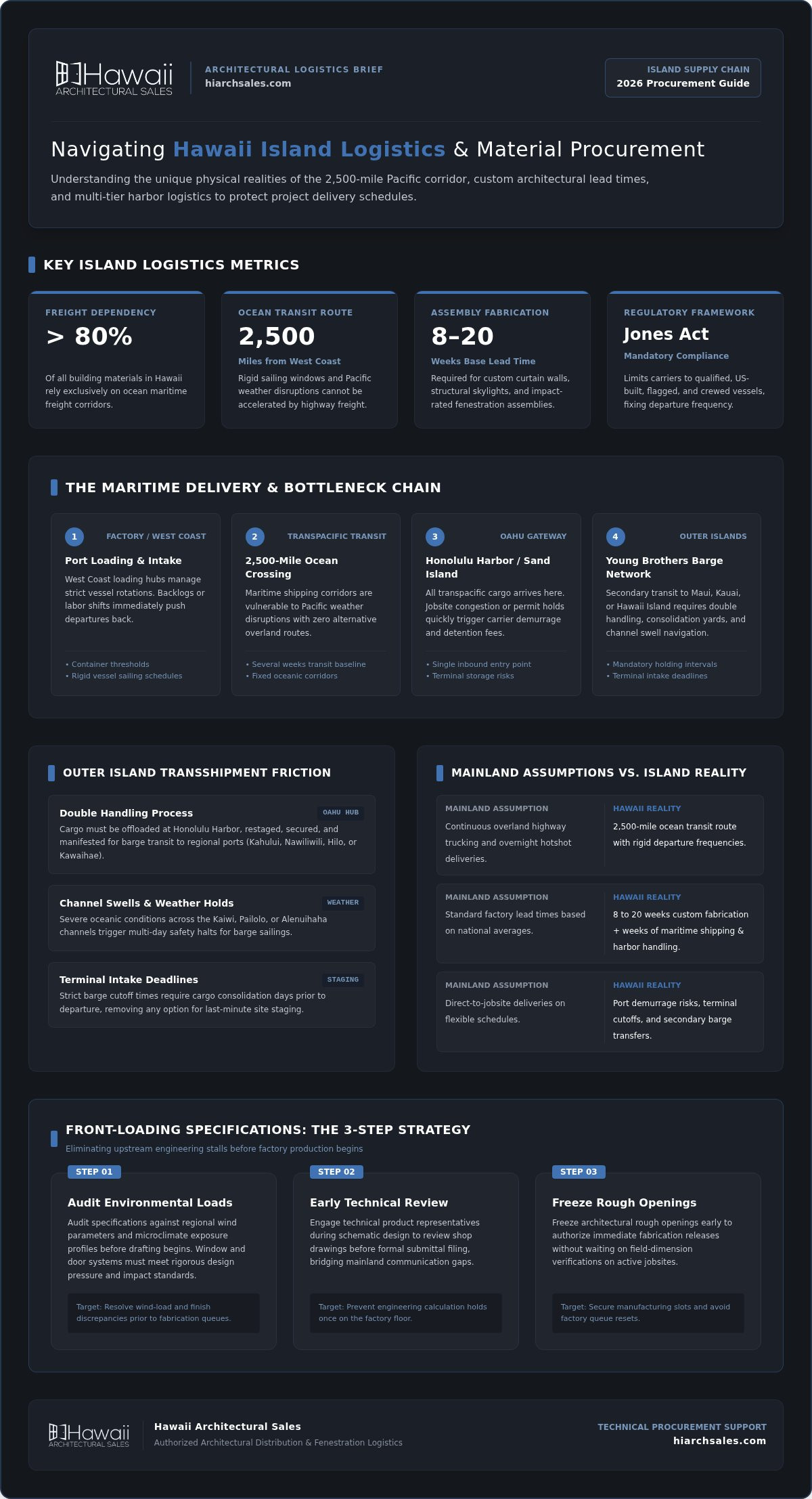
Mainland scheduling software often fails in the Pacific because it assumes continuous overland freight routes. Hawaii relies on ocean freight for more than 80 percent of all building materials, creating an inescapable dependence on maritime shipping corridors. The 2,500-mile ocean transit route from West Coast ports introduces rigid sailing windows, container availability thresholds, and Pacific weather disruptions that mainland projects never encounter. Additionally, Jones Act compliance mandates that domestic cargo moves exclusively on qualified, US-built, flagged, and crewed vessels, limiting carrier choices and departure frequencies. For island project teams, procurement risk is defined by rigid ocean transit schedules that cannot be accelerated by highway hotshots or overnight freight.
Lead times reflect this physical separation. Manufacturing architectural assemblies like custom curtain walls, structural skylights, and impact-rated fenestration routinely requires 8 to 20 weeks of fabrication alone. Ocean transit and offloading add several more weeks to that baseline. Successfully avoiding construction material delays in Hawaii means building schedules directly around these maritime bottlenecks rather than mainland production averages.
The Reality of Maritime Freight and Port Infrastructure
All transpacific maritime cargo arrives through Honolulu Harbor before heading anywhere else. Efficient supply chain management at the port level requires balancing strict vessel schedules with local terminal capacity. When West Coast loading hubs experience backlogs or labor constraints, entire vessel rotations shift, delaying ocean crossings. Once containers dock at Sand Island, local issues can trigger steep downstream fees. If congested jobsites or permit holds prevent immediate delivery, carrier demurrage and container detention fees accumulate rapidly while crates remain packed at terminal yards.
The Inter-Island Freight Bottleneck
Supplying the outer islands introduces a secondary logistics tier. Cargo bound for Maui, Kauai, or Hawaii Island must transfer to inter-island barges operated by Young Brothers. This process creates mandatory holding intervals that mainland schedules consistently underestimate:
Double Handling
Materials offloaded at Honolulu Harbor must be re-staged, secured, and manifested for barge transit to regional ports like Kahului, Nawiliwili, Hilo, or Kawaihae.
Channel Swells and Weather Holds
Severe ocean conditions across the Kaiwi, Pailolo, or Alenuihaha channels frequently trigger safety holds, halting barge departures for consecutive days.
Terminal Cutoffs
Barge intake deadlines require cargo to sit in consolidation yards days prior to sailing, eliminating any possibility of last-minute staging.
Understanding these maritime handoffs is the first step toward avoiding construction material delays in Hawaii and preserving on-site installation schedules.
Front-Loading Specifications to Prevent Upstream Delays
Most project stalls don't start at sea; they originate in the drafting room. When custom architectural assemblies arrive at the factory floor with conflicting details, manufacturers place production on hold until engineers clarify structural calculations. Amid widespread ongoing supply-chain disruptions, losing your scheduled fabrication slot pushes delivery schedules back by months. Preventing these upstream bottlenecks requires a disciplined three-step technical approach:
Step 1
Audit project specifications against regional wind parameters and microclimate exposure profiles before drafting begins.
Step 2
Engage technical product representatives during schematic design to review shop drawings before formal submittal filing.
Step 3
Freeze architectural rough openings early to authorize fabrication releases without waiting on field-dimension verifications.
Resolving Hawaii Structural and Performance Codes Early
Island environmental loads demand verified engineering compliance. Window and door systems must meet rigorous design pressure and impact standards. Reviewing our technical guide on hurricane rated windows in Hawaii highlights why documented testing reports prevent immediate submittal rejections by county building officials. Beyond wind engineering, coastal air demands durable finishes like AAMA 2605 fluoropolymer coatings to resist salt spray corrosion, while thermal performance values must align precisely with Hawaii Energy building code pathways.
Eliminating the Submittal-RFI Review Cycle
Incomplete submittal packages trigger repetitive RFI cycles between mainland drafting departments and local design teams. Each revision cycle sidelines manufacturing while factory queues advance without your project. Pre-vetted shop drawings that incorporate manufacturer-verified hardware, glass makeups, and structural attachments bypass administrative review stalls and secure zero-rejection submittals.
Standardizing glazing units and frame finishes across custom openings also cuts lead-time variance significantly. When your project team coordinates with a local architectural technical representative during design development, you resolve building envelope discrepancies before fabrication starts. This front-end precision is critical for avoiding construction material delays in Hawaii and protecting on-site milestones.
Developing a Hawaii-Specific Material Procurement Timeline
Applying standard mainland scheduling logic to Hawaiian projects practically guarantees project slippage. Mainland schedules assume short freight runs and rapid replacement cycles if shipments arrive damaged. A Hawaii procurement workflow requires dedicated timeline phases for factory tooling, overland transit, port staging, and Pacific passage. For specialized building envelopes, such as custom ES Prestige architectural windows, establishing an integrated Construction Logistics Plan ensures milestones reflect oceanic realities rather than mainland assumptions.
Avoiding construction material delays in Hawaii hinges on mapping your critical path backward from the required dry-in milestone rather than forward from groundbreaking.
Milestone Breakdown: From Factory Release to Jobsite Delivery
Every procurement milestone carries non-negotiable physical constraints. Once shop drawings receive final engineering sign-off, assemblies move through three distinct logistical phases:
Factory Fabrication (8 to 12 Weeks)
Extrusion, thermal barrier assembly, custom anodizing or fluoropolymer painting, glazing, and crating for custom architectural systems.
Mainland Inland Freight (1 to 2 Weeks)
Dedicated flatbed or intermodal rail transport from regional manufacturing facilities to West Coast consolidation terminals.
Maritime Handling and Dispatch (3 to 5 Weeks)
Port terminal staging, container stuffing, ocean transit across the Pacific, harbor offloading, devanning, and local trucking to jobsite staging yards.
Building Strategic Buffer Windows for Critical Path Components
Long-lead building envelope packages dictate project critical paths. Large custom skylights, monumental multi-slide glass walls, and translucent assemblies require early procurement commitments. When planning major commercial envelopes, reviewing architectural daylighting solutions in Honolulu demonstrates how complex structural systems require precise milestone scheduling.
Incorporate a non-negotiable four-week contingency buffer ahead of your scheduled dry-in date. This window absorbs unexpected factory queue shifts, West Coast container vessel omissions, or seasonal channel storms without compromising rough carpentry, framing, or interior mechanical trades. Additionally, project teams must secure container bookings with maritime carriers four to six weeks prior to factory crating dates. Securing space early at West Coast hubs guarantees your freight actually boards its scheduled vessel rather than rolling to subsequent sailings. This deliberate coordination remains the foundation of avoiding construction material delays in Hawaii.
Strategic Staging, Warehousing, and Jobsite Sequencing Across the Islands
Mainland contractors rely heavily on just-in-time delivery models, but applying that mindset to island projects creates immediate operational failure. When shipping components across thousands of miles of ocean, banking on zero-day buffers leaves projects vulnerable to port strikes, vessel delays, and container holds. Avoiding construction material delays in Hawaii requires decoupling transpacific ocean arrival dates from active jobsite installation schedules through strategic staging.
Dense urban footprints in downtown Honolulu and coastal parcels across Neighbor Islands lack adequate laydown space for crated assemblies. Off-site local warehousing bridges this gap. It allows full container unpacks, controlled quality audits, and phase-sequenced flatbed deliveries matched precisely to daily installation capacity. This staged approach protects vulnerable, premium architectural assemblies, such as multi-panel Euro-Wall folding doors, from site congestion, accidental trades damage, and extreme weather exposure.
Overcoming Tight Urban and Remote Island Laydown Limits
Restricted site footprints demand organized logistical staging. Waikiki and Kakaako projects contend with rigid municipal street-use permits, narrow offloading hours, and tightly coordinated crane-pick windows. Storing weeks of crated inventory on-site simply isn't an option. Similarly, outer island projects in Kihei or Lahaina often lack secure, enclosed storage facilities capable of shielding sensitive hardware and finished extrusions from windblown sand and ocean spray. Utilizing dedicated regional warehousing allows subcontractors to call out only the exact panels, frames, and track assemblies needed for immediate installation.
Preventing Handling Damage and Ocean Freight Claims
Maritime transit subjects architectural crates to continuous vibration, high humidity, and shifting cargo loads inside steel ocean containers. Discovering hidden glass fractures or dented frames weeks after delivery forces a complete factory reproduction cycle and another sailing window, immediately derailing the critical path. Uncrating and conducting rigorous piece-by-piece quality inspections immediately upon container devanning is non-negotiable for preserving freight claims and keeping timelines intact.
A structured logistics and inspection workflow prevents downstream disputes:
Arrival Verification
Cross-check packing manifests against Bill of Lading documentation before signing maritime receiving paperwork.
Physical Packaging Review
Inspect exterior timber crating for puncture marks, banding failures, or signs of water intrusion during transit.
Component Verification
De-crate and inspect glass edge work, frame finishes, and specialized hardware against shop drawings within 48 hours of harbor discharge.
Partnering with an Authorized Local Architectural Distributor to Protect Timelines
Mainland factory sales representatives rarely grasp the operational realities of Pacific ocean freight or local county submittal expectations. When urgent coordination issues emerge, a five-hour or six-hour time zone gap stalls critical communication. Authorized local distributors act as hands-on technical advocates, bridging the gap between local design teams, general contractors, and manufacturing facilities. To evaluate representation standards for your next project, read our detailed review on selecting an architectural window distributor in Hawaii. Having local specialists on island ensures technical challenges are resolved during Hawaii business hours, keeping delivery schedules on track.
Direct Technical Support from Design Through Closeout
A seasoned distributor conducts rigorous quality audits before shop drawings enter the factory queue. By verifying drafting submittals against precise factory tooling constraints and structural engineering limits, they eliminate the technical discrepancies that halt production lines. For complex glazing configurations, exploring criteria in architectural glass systems in Honolulu helps teams align thermal and wind-load performance early. Authorized distributors deliver focused technical expertise and material supply without taking on installation or general contracting roles. This operational boundary keeps manufacturer warranty channels intact and prevents commercial conflicts between trades.
Maintaining Reliable Material Pipelines for Island Projects
Longstanding factory relationships yield distinct scheduling benefits during volatile shipping cycles. When mainland fabrication plants face severe seasonal production backlogs, premier distributor ties help secure manufacturing priority that isolated direct buyers cannot command. Local distributor teams also coordinate directly with West Coast freight forwarders, lock down container space, and manage island harbor drayage to keep materials moving seamlessly through port gates.
Ultimately, avoiding construction material delays in Hawaii requires aligning with supply chain specialists who understand local transit dynamics from day one. Contact Hawaii Architectural Sales to safeguard your building envelope timeline and secure engineered architectural systems across Oahu, Maui, Kauai, and Hawaii Island.
Build Certainty into Your Island Supply Chain
Navigating oceanic transit requires deliberate planning from early design through final delivery. Successfully avoiding construction material delays in Hawaii comes down to three disciplined practices: front-loading technical submittals to protect factory fabrication queues, structuring realistic ocean buffers into project schedules, and utilizing local warehousing for sequenced jobsite staging. When your project team respects island logistics instead of mainland assumptions, unexpected port or factory holds won't compromise your critical path.
Serving Hawaii building professionals continuously since 1985, Hawaii Architectural Sales bridges the gap between mainland manufacturing and local jobsites. As an authorized distributor for premier envelope systems including ES, Euro-Wall, and Kalwall, our specialists deliver direct technical support across Oahu, Maui, Kauai, and Hawaii Island. Partner with Hawaii Architectural Sales to secure your project procurement and keep your commercial or residential builds moving forward on schedule.
Frequently Asked Questions
Why do construction materials take so much longer to arrive in Hawaii than on the mainland?
Hawaii's geographic isolation mandates a 2,500-mile maritime crossing from West Coast shipping hubs. While mainland jobsites rely on continuous interstate trucking networks, island deliveries depend on fixed weekly sailing schedules and Jones Act vessels. When combined with lengthy manufacturing queues for custom architectural assemblies, any minor factory delay cascades across the sailing window, adding weeks to baseline lead times.
Can just-in-time material delivery work for construction jobsites in Honolulu?
Just-in-time delivery fails in Honolulu because Pacific shipping leaves no margin for transit variances. Port congestion, seasonal vessel holds, and strict municipal street-use permits in dense areas like Kakaako prevent precise day-of arrivals. Successful project teams utilize off-site warehousing on Oahu instead. Staging crated materials locally allows trade crews to call out phase-sequenced deliveries matched to daily installation needs without crowding urban footprints.
What is the typical ocean freight transit time from the West Coast to Hawaii?
Pure ocean transit from West Coast ports to Honolulu Harbor typically takes 4 to 7 days at sea. However, total freight coordination spans three to five weeks. That window includes inland container drayage to mainland docks, terminal loading, container discharge at Sand Island, and harbor gate clearance. Incorporating realistic logistics buffers into master schedules is essential for avoiding construction material delays in Hawaii.
How do technical submittal errors create compounding material delays for island projects?
Submittal discrepancies halt factory production until engineers issue formal clarifications, bumping your project out of the fabrication queue. If an unvetted submittal misses regional wind-pressure ratings or local coastal exposure standards, mainland plants freeze custom fabrication. Missing a production window means waiting weeks for the next available factory slot, directly jeopardizing scheduled ocean sailing dates and planned building dry-in milestones.
What happens if architectural materials are damaged during ocean transit to Hawaii?
Damaged shipments require an immediate carrier inspection claim and an entirely new manufacturing and shipping cycle. Because custom architectural glass or specialized aluminum frames cannot be sourced locally, remanufacturing can sideline a jobsite for months. Prompt uncrating inspections immediately upon harbor delivery are critical. Early documentation preserves maritime carrier liability and expedites priority re-orders through authorized manufacturer representatives.
Why should contractors work with a local architectural distributor instead of ordering direct from mainland factories?
Local distributors provide on-island technical advocacy and active logistics coordination during Hawaii business hours. Mainland sales reps often don't understand county submittal nuances or inter-island barging complexities. Established distributors like Hawaii Architectural Sales bridge design teams and manufacturers, vetting shop drawings and troubleshooting field challenges across Honolulu, Kihei, and Lihue. This proactive coordination is vital for avoiding construction material delays in Hawaii.
How do shipping logistics differ when delivering materials to Neighbor Islands like Maui or Kauai?
Neighbor Island deliveries require secondary transshipment via Young Brothers barges from Honolulu Harbor to regional ports. Shipments heading to Kahului, Nawiliwili, or Kawaihae face mandatory consolidation cutoffs and channel weather delays that Oahu projects bypass. Projects in Kailua-Kona or Lahaina also face tighter laydown limits and fewer commercial storage facilities, demanding earlier procurement releases and meticulous flatbed staging.