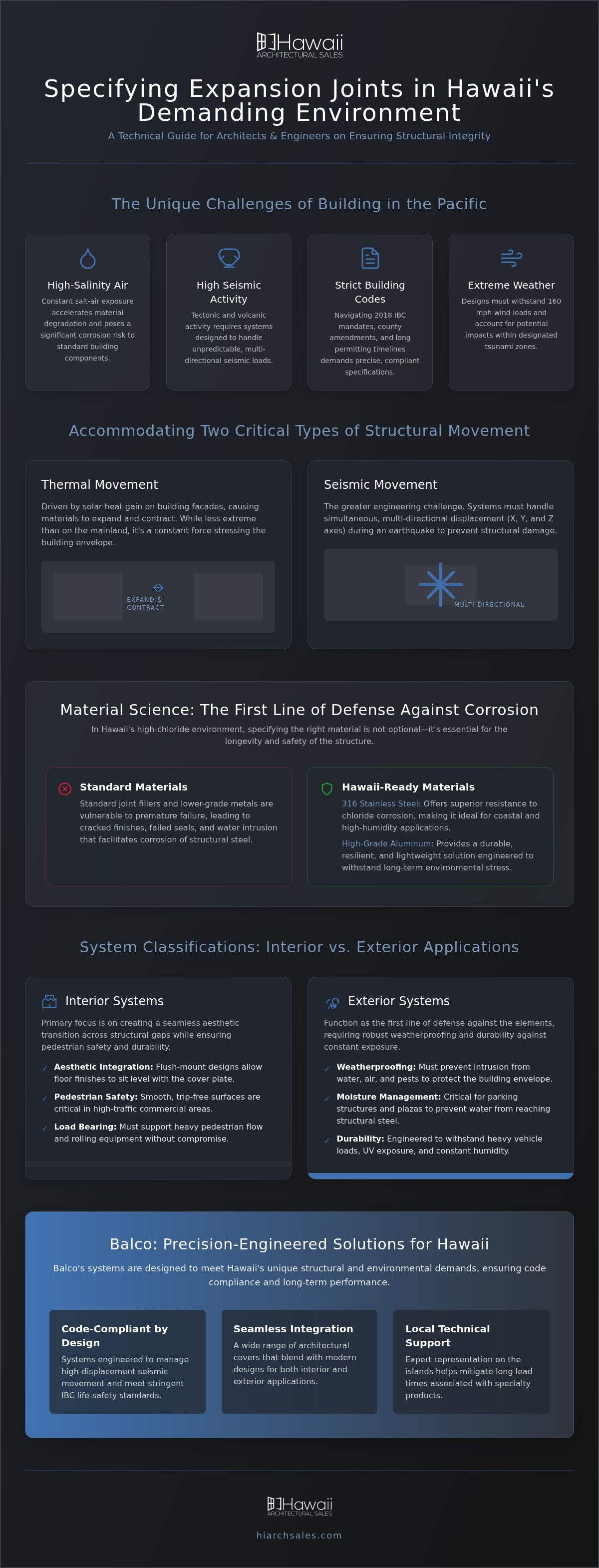
In the corrosive, high-seismic environment of the Pacific, a standard expansion joint is often the most vulnerable point of a building envelope. You understand that specifying the wrong system leads to premature material degradation and costly redesigns, especially when O‘ahu permitting timeli...
In the corrosive, high-seismic environment of the Pacific, a standard expansion joint is often the most vulnerable point of a building envelope. You understand that specifying the wrong system leads to premature material degradation and costly redesigns, especially when O‘ahu permitting timelines can exceed 12 months. It's a high-stakes decision where a single oversight in salt-air resistance or seismic movement capacity can compromise the entire structure's integrity.
This guide helps you master the complexities of specifying the seismic and thermal expansion joint systems Hawaii projects require to withstand high-salinity air and strict 2018 IBC mandates. You'll learn how to navigate Hawaii's unique 160 mph wind load requirements and tsunami design zones while ensuring your specifications remain code-compliant. We'll preview Balco's highly engineered solutions that blend with modern architectural designs and discuss how local technical representation can mitigate the long lead times often associated with specialty island products.
Key Takeaways
• Learn how to specify expansion joint systems Hawaii projects require to manage both thermal expansion and high-displacement seismic movement.
• Identify the critical material science behind 316 stainless steel and high-grade aluminum to prevent premature failure in high-chloride island environments.
• Navigate the complexities of current IBC requirements and county-specific amendments to ensure code-compliant movement joint calculations.
• Discover how Balco’s precision-engineered systems integrate seamlessly into modern designs while meeting stringent life-safety standards.
• Understand the technical distinctions between interior aesthetic concealment and exterior weatherproofing for wall and floor applications.
The Role of Expansion Joint Systems in Hawaii’s Built Environment
An Expansion joint is more than a simple break in construction; it's a continuous, designed gap that isolates building segments to allow for independent movement. For large-scale commercial projects, expansion joint systems Hawaii designers specify must function as high-performance bridges between structural blocks. Unlike standard joint fillers or sealants used in residential driveways, these architectural systems are engineered to maintain the building envelope's integrity while accommodating significant structural shifts. They provide a path for movement that prevents the building from damaging itself under stress.
Hawaii's geological profile creates a unique set of demands. While the islands don't experience the extreme temperature swings of the mainland, the intense UV exposure and consistent humidity accelerate material fatigue. More critically, the tectonic and volcanic activity across the archipelago necessitates systems that can handle unpredictable seismic loads. Standard fillers lack the elastic memory and mechanical durability to survive these forces, often leading to cracked finishes or failed seals if not properly specified. In a high-performance building envelope, the joint must be as resilient as the walls it separates.
Thermal vs. Seismic Movement
Thermal movement in the islands is driven primarily by solar heat gain on building facades. Even with Hawaii's temperate climate, dark-colored exterior finishes can reach temperatures that cause measurable expansion and contraction. However, seismic movement presents the greater engineering challenge. Systems must be designed for lateral, vertical, and shear forces that occur during an earthquake. Seismic joint design must accommodate multi-directional movement, which refers to the simultaneous displacement across the X, Y, and Z axes during a seismic event. This capability ensures that building sections don't collide or pull apart beyond their structural limits during a tremor.
Maintaining the Building Envelope Integrity
A failed joint is an entry point for water, air, and pests. In Hawaii's high-salinity environment, water intrusion doesn't just damage interior finishes; it facilitates the corrosion of the structural steel within the slab. Specifying robust expansion joint systems Hawaii architects can rely on means looking at the assembly as a holistic part of the building skin. This includes the integration of fire-rated joint assemblies, which are mandatory for maintaining the fire-separation requirements of multi-story structures. These systems must also work in tandem with other envelope components, such as architectural daylighting solutions Honolulu professionals use to create high-performance facades. When the joint system and the facade work together, the building remains weather-tight and safe during both daily thermal cycles and rare seismic events.
Technical Classifications: Categorizing Systems by Application
The effective specification of expansion joint systems Hawaii projects require starts with a precise classification of the application. Systems are categorized based on their orientation and the surfaces they bridge, such as floor-to-floor, floor-to-wall, and wall-to-wall configurations. The primary distinction lies between interior systems, which prioritize aesthetic integration and pedestrian safety, and exterior systems, which must act as the first line of defense against the elements. The selection of expansion joint systems Hawaii designers choose often depends on the specific load-bearing requirements of the facility.
Structural engineers often reference the Hawaii construction guide for hurricanes and earthquakes to determine the necessary movement capacities for these classifications. In high-traffic commercial environments, load-bearing capacity is the critical metric for floor joints. These systems must support heavy pedestrian flow and rolling equipment without compromising the structural gap. For parking structures and open-air plazas, the requirements shift toward moisture management and the ability to withstand heavy vehicle loads while remaining weather-tight and durable under constant exposure.
Interior Architectural Joint Covers
Interior specifications focus on creating a seamless transition across structural gaps. Flush-mount designs are recessed into the floor slab, allowing floor finishes like tile or carpet to sit level with the cover plate for a clean visual profile. Surface-mount designs are typically used for retrofits or areas where slab block-outs aren't available. To maintain design intent, these covers are available in high-end architectural finishes such as clear anodized aluminum, brass, and stainless steel. Beyond aesthetics, maintaining ADA compliance is mandatory. Systems must provide a smooth, slip-resistant surface that remains stable across wide expansion gaps to ensure universal accessibility for all building occupants.
Exterior Vertical and Horizontal Systems
Exterior joints must maintain a weather-tight seal under extreme environmental pressure. In Hawaii's high-wind zones, vertical wall joints are engineered to prevent air and water infiltration during 160 mph wind events. These systems often utilize multi-layered seals or secondary water barriers to ensure redundancy in the building skin. Horizontal roof joints utilize specialized bellows or heavy-duty cover plates to manage intense water runoff and resist the prolonged UV exposure that can degrade standard rubber components. These systems require careful coordination with commercial curtain wall systems Hawaii contractors install, ensuring the building envelope remains continuous. If you need assistance with complex exterior details, our team can provide a technical review of your project specifications to ensure long-term performance.
Material Science: Defeating Corrosion in High-Chloride Island Air
High-chloride coastal air is the primary driver of material failure for expansion joint systems Hawaii projects face. Salt-laden moisture acts as a powerful electrolyte, triggering electrochemical reactions that can destroy unprotected architectural metals in a matter of months. While standard specifications might suffice for inland mainland regions, the proximity of almost every Hawaiian project to the ocean demands a more rigorous approach to material science. Specifying engineers must prioritize alloys and coatings that resist the specific chemical stressors of the Pacific to avoid premature replacement costs.
Architectural longevity in the islands depends on understanding how different metals react to this environment. If you don't account for the accelerated oxidation rates found in Honolulu or Kailua-Kona, the structural integrity of the joint cover can be compromised long before the building's first major renovation. Selecting the right materials isn't just about aesthetics; it's a matter of life safety and building envelope performance.
Specifying Metals for the Coast
The choice between 304 and 316 stainless steel is critical for long-term durability. While 304 stainless steel is suitable for interior or leeward applications with minimal salt exposure, 316 stainless steel is non-negotiable for windward coastal specifications. The addition of molybdenum in the 316 alloy provides superior resistance to chloride-induced stress. Pitting corrosion is a localized form of accelerated oxidation that creates small, deep cavities in a metal surface, potentially causing structural failure of joint covers even while the surrounding material appears intact.
For aluminum components, clear or color anodizing is essential. This process thickens the natural oxide layer, creating a hard, non-reactive surface that prevents oxidation. In highly visible architectural areas, Kynar finishes offer exceptional color retention and chemical resistance. Designers must also be vigilant about galvanic corrosion. When dissimilar metals, such as aluminum and stainless steel, come into direct contact in a salt-air environment, an electrochemical reaction occurs. Using non-conductive isolators or compatible fasteners is a standard requirement for Balco assemblies to prevent this degradation.
Elastomeric Seals and UV Resistance
Metal isn't the only component at risk. Hawaii's high UV index can cause standard PVC seals to become brittle and crack within years of installation. We recommend Santoprene or EPDM seals for their superior thermal stability and UV resistance. These materials maintain their elasticity through thousands of movement cycles without losing their weather-tight seal or fading in the intense tropical sun.
Maintenance protocols for coastal expansion joint systems are straightforward but vital. Regular cleaning with fresh water and mild detergents removes the accumulated salt crust that traps moisture against the metal surface. This simple step, combined with annual inspections of the elastomeric seals, ensures the system reaches its full engineered lifespan. By specifying high-performance materials from the start, you reduce the long-term maintenance burden on the building owner.
Specification Criteria for Hawaii Building Codes and Seismic Loads
The 2018 International Building Code (IBC), which was adopted by the State of Hawaii in April 2021, dictates the performance requirements for all structural movement joints. Specifying expansion joint systems Hawaii projects can pass through permitting requires a deep understanding of these code-mandated movement capacities. Architects must accurately calculate the "nominal" joint width, which is the gap size at the median temperature during installation, versus the "maximum" opening width. This maximum width represents the furthest distance the structural gap will reach during a design-level seismic event. If a system is only specified for its nominal width, it will likely fail when the building undergoes its full calculated displacement.
Life safety remains the highest priority in these specifications. Fire-rated joint assemblies must comply with ASTM E1966 or UL 2079 standards to prevent the passage of fire, heat, and toxic smoke through the building's floor and wall partitions. For multi-story commercial structures, these assemblies are non-negotiable. A complete submittal package should include the manufacturer's movement calculations, fire-rating certifications, and detailed shop drawings showing how the joint interacts with surrounding structural elements.
Seismic Design Categories in the Islands
Seismic requirements vary significantly across the archipelago. Projects in Honolulu County typically deal with different Seismic Design Categories (SDC) than those in Hawaii County, where volcanic and tectonic activity is more frequent and intense. In high-SDC zones, standard slide-plate systems may be insufficient. Designers often specify "pop-out" mechanisms, where the joint cover is designed to safely eject during extreme movement to prevent structural damage, or advanced "slide" mechanisms that telescope to accommodate massive lateral shifts. The challenge for modern architects is balancing these safety requirements with the desire for narrow, nearly invisible sightlines that don't disrupt the interior design.
Coordination with Other Building Systems
A building is only as strong as its weakest transition. Expansion joints must be coordinated with other high-performance components, such as the hurricane rated windows Hawaii developers use to meet 160 mph wind load requirements. If the joint system doesn't transition seamlessly into the window mullions or curtain wall, the entire building envelope's weather-tightness is compromised. Managing these transitions between floor-to-floor and floor-to-wall joints requires early-stage planning to ensure continuity of the water and fire barriers. To ensure your project meets these complex multi-system requirements, you can request a technical submittal review from our local experts before the final specification is issued.
Balco Expansion Joint Systems: Precision Engineering for the Islands
Balco has established itself as the industry standard for expansion joint systems Hawaii engineers specify for high-displacement seismic movement. Their systems aren't generic off-the-shelf components; they're highly engineered assemblies designed to survive the most demanding structural shifts. Balco's precision manufacturing ensures that every joint cover, fire barrier, and water seal meets stringent performance metrics while offering the design flexibility required for modern architectural projects. This level of precision is vital when managing the complex movements described in previous sections, particularly in high-seismic zones across the islands.
Customization is a core strength of the Balco product line. Hawaii's unique architectural landscape often requires non-standard solutions to bridge irregular structural gaps or to meet specific aesthetic goals. Balco provides the ability to modify cover plate widths, materials, and load capacities to suit the specific needs of a project. This ensures that the expansion joint doesn't just function as a safety component but also integrates seamlessly with the building’s visual design. Hawaii Architectural Sales acts as the technical bridge, ensuring these custom requirements are accurately communicated to the factory and delivered to the job site.
Key Balco Technologies
Innovation at Balco is driven by a focus on reliability and post-event performance. Their seismic cover systems are engineered to accommodate massive displacement and, in many cases, are designed to reset after a movement event occurs. This reduces the need for immediate repairs following a tremor. For life safety, Balco’s integrated fire barriers are tested to maintain their hourly ratings even during full movement cycles, ensuring no breach in the fire-rated assembly. Designers can also achieve a cohesive look by selecting aesthetic options that complement high-end window lines, such as ES | Prestige. This synergy allows for a unified architectural language across the entire building envelope.
The Value of Local Technical Representation
Navigating the specification of specialty architectural products in the Pacific requires more than just a catalog; it requires local expertise. Hawaii Architectural Sales has served the islands since 1985, providing the technical support necessary to streamline the submittal process for architects and engineers. We understand the regulatory environment in Honolulu and the logistics of delivering materials to Lihue or Kailua-Kona. Our role as an authorized representative is to provide the engineering data and material distribution required to keep projects on schedule.
We provide the materials and the technical expertise, while contractors handle the physical installation. This partnership ensures that the specified Balco systems are delivered correctly and on time, despite the long lead times often associated with specialty island products. If you're currently designing a facility that requires high-performance movement joints, contact Hawaii Architectural Sales for Balco technical support to ensure your specifications are durable, code-compliant, and aesthetically integrated.
Securing the Building Envelope for Long-Term Performance
Specifying expansion joint systems Hawaii projects can rely on requires a disciplined approach to material science and structural engineering. As outlined in this guide, the selection of 316 stainless steel and UV-stable elastomers is vital for resisting the accelerated corrosion and intense solar exposure found across the islands. These components are not just aesthetic covers; they are critical life-safety elements that must align with the 2018 IBC and specific county seismic mandates to ensure structural integrity during movement events.
Hawaii Architectural Sales has served the local building industry since 1985. As an authorized Balco representative, we provide expert technical support for architects and engineers who need to master complex movement requirements. We assist you in bridging the gap between high-performance manufacturing and practical island application to ensure your specifications are durable and code-compliant. Our localized knowledge helps mitigate lead-time challenges and ensures material availability for projects on all islands. We are ready to help you secure your next building envelope with confidence.
What is the difference between an expansion joint and a control joint?
An expansion joint is a through-structure gap designed to allow independent movement of building segments, whereas a control joint is a shallow groove placed in concrete to manage shrinkage cracks. For large-scale projects, expansion joint systems Hawaii architects specify must bridge these structural gaps while maintaining the building envelope's integrity. Control joints are typically limited to surface-level slab management and don't accommodate the multi-directional seismic or thermal loads found in major architectural assemblies.
How do I determine the correct width for a seismic expansion joint?
Determining the correct width involves calculating the maximum expected displacement during a design-level seismic event. Structural engineers must account for the nominal width at the time of installation and the maximum opening width defined by the 2018 IBC. This calculation ensures that the joint cover can telescope or slide sufficiently without colliding with adjacent structural elements. We recommend early-stage consultation to verify these widths before finalizing your architectural floor and wall finishes.
Are fire-rated expansion joints required for all commercial buildings in Hawaii?
Fire-rated expansion joints are mandatory whenever a movement joint penetrates a fire-resistance-rated floor, wall, or ceiling assembly. These systems must be tested and certified to ASTM E1966 or UL 2079 standards. In multi-story commercial developments in Honolulu or Maui, these fire barriers are essential for maintaining life safety and preventing the spread of toxic smoke and heat between building compartments. You must verify the specific fire-rating requirements for each partition during the design phase.
Which materials are best for expansion joints located near the ocean?
For coastal projects in areas like Kailua-Kona or Lahaina, 316 stainless steel and high-grade anodized aluminum are the preferred materials. These alloys provide superior resistance to the pitting corrosion caused by high-chloride island air. Additionally, elastomeric seals should be specified as Santoprene or EPDM to ensure they don't become brittle under Hawaii's high UV index. Using 304 stainless steel in windward coastal exposures often leads to premature material failure and higher maintenance costs.
Can expansion joints be made waterproof for exterior plazas?
Yes, exterior expansion joints can be engineered to be completely waterproof through the use of secondary water barriers and integrated drainage tubes. These systems collect moisture that bypasses the primary seal and channel it into the building's drainage network. This is a critical requirement for open-air plazas and parking structures in high-rainfall zones. It prevents water intrusion from damaging the structural steel or interior finishes located below the joint while allowing for full movement.
How often should architectural expansion joints be inspected in Hawaii?
Architectural expansion joints in Hawaii should be inspected at least once per year to ensure long-term performance. In high-salinity coastal environments like Kihei, more frequent visual checks help identify salt crust buildup or UV-related seal degradation. Maintenance teams should wash the metal covers with fresh water and mild detergent to remove chlorides. Regular inspections confirm that the fire barriers and water seals remain intact and capable of accommodating structural movement without obstruction.
Does Hawaii Architectural Sales provide installation for Balco joints?
Hawaii Architectural Sales is the authorized representative and distributor for Balco systems, but we don't provide installation services or general contracting. Our role is to provide technical product expertise, engineering data, and material distribution across all islands. We work closely with architects to refine specifications and with contractors to ensure the correct materials are delivered to the job site. The physical installation is handled by the project's qualified subcontractors or specialized trades.
What is the standard lead time for specialty expansion joint systems in Honolulu?
Lead times for specialty expansion joint systems Hawaii projects require depend on the complexity of the design and factory production schedules. While standard components may be available sooner, custom-engineered seismic joints typically require several weeks for manufacturing and transit to Honolulu or the neighbor islands. We recommend initiating the submittal and procurement process as early as possible to account for Pacific logistics. This ensures materials arrive before the scheduled installation phase to avoid delays.