Florida Product Approval for Hawaii Projects: A Technical Roundup of Hurricane Testing Standards
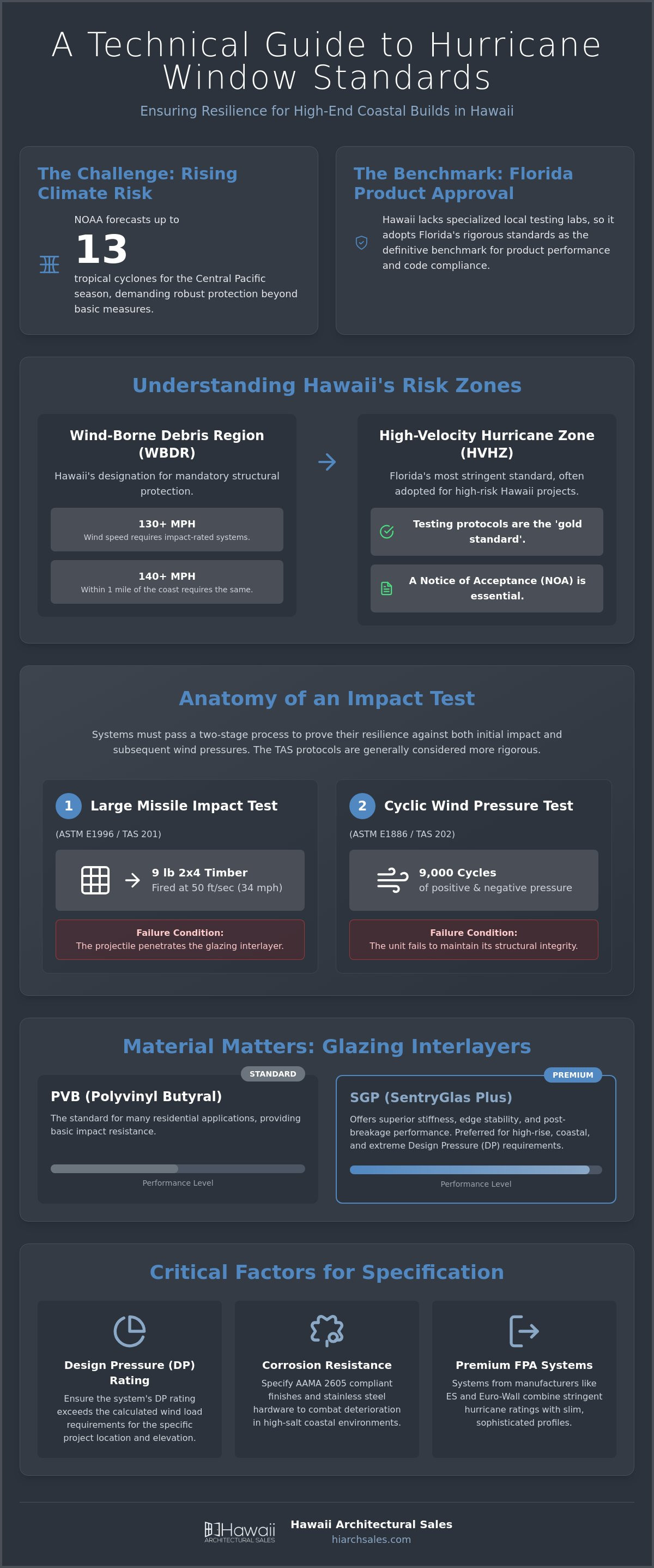
With NOAA forecasting up to 13 tropical cyclones for the 2026 Central Pacific season, relying on basic protection for high-end coastal builds is no longer a viable risk management strategy. You likely understand the frustration of navigating complex Hawaii State Building Code amendments while trying...
With NOAA forecasting up to 13 tropical cyclones for the 2026 Central Pacific season, relying on basic protection for high-end coastal builds is no longer a viable risk management strategy. You likely understand the frustration of navigating complex Hawaii State Building Code amendments while trying to avoid the clunky, industrial frames often associated with impact-rated glazing. Balancing these structural demands with the aesthetic goals of a luxury project requires a deep dive into the specific hurricane window testing standards Hawaii professionals use to ensure long-term resilience.
This technical roundup clarifies why Florida Product Approval has become the definitive benchmark for Hawaii projects. You will gain a clear understanding of how premium systems from ES and Euro-Wall meet the most rigorous 2026 standards without compromising architectural intent. We will examine the critical differences between ASTM and TAS testing; we will also provide a shortlist of systems engineered for High-Velocity Hurricane Zones. This overview provides the technical confidence needed to specify materials that survive both extreme wind loads and high-salt coastal environments.
• Understand why Florida Product Approval serves as the technical benchmark for building resilience in Hawaii's unique wind-borne debris regions.
• Analyze the physics behind TAS 201 and ASTM E1996 to better navigate the hurricane window testing standards Hawaii architects must apply to coastal designs.
• Review high-performance glazing systems from ES and Euro-Wall that combine stringent hurricane ratings with slim, sophisticated profiles.
• Learn to calculate critical Design Pressure (DP) ratings and specify corrosion-resistant finishes that ensure long-term durability in high-salt environments.
• Streamline your project workflow by leveraging expert technical support for complex FPA documentation and local building code compliance.
Hawaii's geographical isolation means the state lacks the specialized laboratory infrastructure required to certify building components against extreme wind events. To solve this, local authorities rely on the technical data generated by Florida's testing facilities. The Florida Product Approval (FPA) system provides a standardized framework that Hawaii architects use to verify the performance of glazing systems against hurricane window testing standards Hawaii regulators recognize. This regulatory bridge ensures that materials installed in the Central Pacific can withstand the same pressures as those in the Atlantic's most storm-prone regions.
Hawaii State Building Code and Florida Alignment
The 2018 International Building Code (IBC) provides the baseline for Hawaii's Building Codes, yet local amendments create a more stringent environment. As of July 2026, legislative efforts like House Bill 356 aim to mandate even higher standards for new construction in areas with wind speeds exceeding 140 mph. For professionals specifying hurricane rated windows Hawaii projects must often meet Miami-Dade benchmarks. This is where the Notice of Acceptance (NOA) becomes essential. It serves as a comprehensive engineering report, detailing exactly how a product performed under high-velocity testing.
HVHZ vs. WBDR: Understanding the Risk Zones
Identifying the correct risk zone is the first step in any specification process. Hawaii uses the Wind-Borne Debris Region (WBDR) to categorize areas where structural protection is mandatory. While Florida’s High-Velocity Hurricane Zone (HVHZ) is specific to Miami-Dade and Broward counties, the testing standards used there are frequently adopted for Hawaii's coastal developments. A Wind-Borne Debris Region is defined as any area where the design wind speed is 130 mph or greater, or 140 mph or greater for structures located within one mile of the coastal mean high water line.
In coastal Lihue or the slopes of Haleakala, wind speeds can reach 150 mph. In these island microclimates, the choice between impact-rated glazing and external shutters is clear. Impact-rated systems offer 24/7 protection and maintain the building's aesthetic integrity. By utilizing FPA-approved systems, you ensure compliance with the hurricane window testing standards Hawaii counties demand while providing long-term security for high-value properties.
Understanding the technical nuances of impact testing is essential for any professional working within Hawaii's wind-borne debris regions. While many products claim impact resistance, the specific protocols they follow determine their actual performance limits. The hurricane window testing standards Hawaii projects rely on typically involve two primary testing tracks: ASTM and TAS. These protocols ensure that a window unit can withstand both the initial strike of a projectile and the subsequent wind loads of a sustained storm.
The Large Missile Impact test is the most rigorous requirement for lower-level openings. It involves firing a 9lb 2x4 timber at a speed of 50 feet per second directly at the glass unit. If the projectile penetrates the interlayer, the unit fails. Following this impact, the window must endure 9,000 cycles of positive and negative pressure to simulate the turbulent winds of a tropical cyclone. This cyclic load test ensures the unit maintains its structural integrity even after the glass has shattered. If you need assistance reviewing specific test reports for your project, Hawaii Architectural Sales can provide the necessary technical documentation.
The choice of interlayer significantly impacts these results. Polyvinyl Butyral (PVB) is standard for many residential applications, but SentryGlas Plus (SGP) provides superior stiffness and edge stability. For high-rise developments or projects with extreme Design Pressure requirements, SGP is often the preferred specification because it remains upright and functional even if both lites of glass are compromised. You can find detailed breakdowns of these requirements within the Florida Building Code, which serves as the technical foundation for many Hawaii specifications.
The Three Pillars of Impact Testing: TAS 201, 202, and 203
In High-Velocity Hurricane Zones, the TAS protocols are the gold standard. These three tests work in tandem to certify a product's resilience:
TAS 201
This is the initial impact test that simulates flying debris during a storm event.
TAS 202
This test evaluates air, water, and structural uniformity across the entire fenestration unit under static pressure.
TAS 203
This is the final cyclic pressure test that ensures the glass remains securely in the frame after being impacted.
Large Missile vs. Small Missile Requirements
The building's height and occupancy determine the required missile level. Large Missile D (Level D) is generally required for all openings located within the first 30 feet of a structure. This protects against heavy debris like tree limbs or construction materials. For glazing located higher than 30 feet, small missile testing is often acceptable. This involves firing 10 small steel balls at the glass to simulate roof gravel or smaller fragments carried by high-altitude winds. Architects must carefully verify these heights to ensure the correct hurricane window testing standards Hawaii codes are applied to every floor of a commercial tower.
Choosing the right system involves more than just passing a test. It requires balancing structural capacity with architectural intent. While vinyl options might suffice for inland residential builds, luxury coastal projects and high-rise towers in Honolulu demand the superior strength of aluminum or steel. These materials offer the rigidity necessary to meet hurricane window testing standards Hawaii engineers require for high-load environments. Aluminum provides excellent corrosion resistance and lightweight strength; meanwhile, steel offers unmatched durability and thinner profiles for historic or industrial aesthetics.
Providing the necessary protection for these structures aligns with the broader goals of disaster mitigation. As highlighted by FEMA on Building Codes, adopting and enforcing modern standards is the most effective way to protect lives and property from natural hazards. By selecting FPA-approved systems, you ensure your project adheres to these globally recognized safety benchmarks.
ES Prestige and Elite: Engineering for High-Rise Hawaii
ES systems represent the benchmark for high-performance aluminum glazing in the Pacific. The ES Prestige line is engineered specifically for high-rise applications where wind load capacity and thermal efficiency are non-negotiable. It handles extreme design pressures while maintaining a sophisticated appearance. For projects requiring ultra-slim sightlines without sacrificing safety, ES Elite offers a specialized solution that combines narrow profiles with full impact ratings. Architects can access a ES Prestige windows Hawaii technical guide for detailed performance data and wind load charts.
Euro-Wall: Impact-Rated Large Format Openings
Achieving Florida Product Approval for large-span openings is a significant engineering feat. Euro-Wall specializes in folding and multi-slide glass walls that maintain structural integrity even at massive scales. Their systems are tested to resist water infiltration and structural failure under TAS 202 protocols. Specifying impact rated glass doors Hawaii developers prefer ensures that expansive ocean views aren't compromised by bulky, non-compliant frames. These systems include pivot doors and multi-slide configurations that provide seamless transitions while meeting HVHZ standards.
Specialized Solutions: Hopes and Kalwall
For projects with unique aesthetic or functional requirements, Hopes and Kalwall offer FPA-approved systems that go beyond standard aluminum frames. Hopes Steel Windows prove that historic, handcrafted aesthetics can meet modern High-Velocity Hurricane Zone requirements. Steel's inherent strength allows for even thinner sightlines than aluminum while providing superior impact resistance. Conversely, Kalwall provides translucent daylighting systems. These panels offer high thermal insulation and impact resistance, allowing light into a structure without the vulnerability of traditional glass in high-debris zones.
While the initial focus often rests on impact resistance, the hurricane window testing standards Hawaii projects must adhere to also encompass long-term environmental performance and structural capacity. Specifying the correct system requires a deep understanding of how local topography and climate interact with a building's envelope. In 2026, architects must look beyond the impact rating alone to ensure a product remains functional and aesthetically sound for decades. This involves a precise analysis of Design Pressure, corrosion resistance, and energy efficiency mandates.
Calculating Design Pressures for Island Terrain
Design Pressure (DP) ratings are not a one-size-fits-all metric. They must be calculated based on the specific wind speeds of a project's microclimate and its exposure category. Exposure B typically applies to urban areas like downtown Honolulu; however, coastal properties often fall into Exposure D, which carries significantly higher wind loads. DP ratings reflect a window's ability to resist both positive and negative wind forces. In Hawaii, topographic features like steep ridges and coastal cliffs can create "wind tunnels" that accelerate air speeds. These effects necessitate higher DP ratings to prevent structural failure during a storm. If you are unsure which rating your project requires, you can find detailed guidance in our commercial window products Hawaii specification guide.
Salt-Air Durability and Material Selection
A window that passes a hurricane impact test can still fail prematurely if it cannot withstand Hawaii's corrosive salt air. Standard aluminum frames often succumb to pitting and oxidation in environments like Kailua-Kona and Kihei within just a few years. To prevent this, specifications should mandate AAMA 2605 compliant finishes, such as high-performance Kynar coatings or heavy-duty anodization. For projects with the highest corrosion risks, ES uPVC systems offer an alternative to aluminum. These frames are inherently resistant to salt spray and provide excellent thermal breaks, which are critical for meeting modern energy codes. Balancing these material choices ensures that the structural integrity verified during testing isn't compromised by environmental degradation over time.
Energy efficiency is the final piece of the specification puzzle. Hawaii's energy codes require a low Solar Heat Gain Coefficient (SHGC) to minimize cooling loads in our tropical climate. Utilizing high performance glazing Honolulu architects trust allows for expansive glass areas without overwhelming the building's HVAC system. This synergy between hurricane safety and thermal performance is what defines a truly premium installation. For a technical review of your current window schedule, contact the experts at Hawaii Architectural Sales for specialized support.
The transition from design intent to physical compliance is often where the most significant project delays occur. Navigating the mountain of Florida Product Approval (FPA) documentation and technical Notice of Acceptance (NOA) reports requires more than just a vendor; it requires a strategic partner. As a specialized consultant for hurricane window testing standards Hawaii, Hawaii Architectural Sales bridges the gap between high-end manufacturing and local site requirements. We ensure that every specified unit aligns with both the architectural vision and the stringent safety mandates of the 2026 building cycle.
Selecting the right architectural window distributor Hawaii professionals rely on means gaining access to a curated portfolio of elite brands. We don't just supply products; we provide the technical expertise necessary to verify that systems like ES | Prestige or Euro-Wall meet the specific Design Pressure (DP) ratings required for island microclimates. This proactive approach eliminates the friction often found during the permitting and submittal phases of complex developments.
Technical Consulting for the Building Envelope
Our role begins in the early phases of design. We provide architects with precise CAD details and verified performance data to streamline the submittal process. For developers, we offer value engineering solutions that maintain structural integrity while optimizing costs. This expertise is particularly vital when specifying specialty building materials Hawaii projects require for complex or non-traditional facades. Whether you're integrating Kalwall translucent panels or Super Sky skylights, we ensure the building envelope remains resilient and compliant.
Your Partner for Compliant High-End Fenestration
Procuring specialty materials for island projects involves unique logistical challenges. We manage the entire process, from technical specification to delivery, reducing lead times and minimizing site-side hurdles. Our portfolio includes industry-leading names like Hopes, Balco, and AWV, giving you a single point of contact for diverse fenestration needs. This methodical approach respects your project timeline and ensures that your hurricane window testing standards Hawaii requirements are met without compromise. Contact Hawaii Architectural Sales today for a technical consultation on your next project.
Adhering to the most rigorous hurricane window testing standards Hawaii requires isn't just a matter of code compliance; it's a commitment to long-term structural resilience. By utilizing Florida Product Approval as a technical benchmark, you ensure your project is protected by engineering that has survived the most extreme atmospheric conditions. We've explored how high-performance brands like ES | Prestige, Euro-Wall, and Hopes provide the necessary impact resistance while maintaining the slim sightlines essential for luxury design. Success in 2026 relies on balancing these structural demands with material durability and energy efficiency.
Since 1985, Hawaii Architectural Sales has served as a steady partner for the region's architects and engineers. We specialize in high-performance building envelope solutions and maintain deep expertise in Hawaii State Building Code compliance. As an authorized representative for industry leaders like ES | Prestige, Euro-Wall, and Hopes, we provide the technical support needed to bridge the gap between design and compliance. We invite you to leverage our localized knowledge for your next development. Request a Technical Consultation for Your Hurricane-Rated Fenestration Project today to ensure your building envelope is engineered for lasting security.
Is Florida Product Approval mandatory for all windows in Hawaii?
Florida Product Approval (FPA) is not a legal mandate under the Hawaii State Building Code; however, it's the most widely accepted method for proving compliance. Because Hawaii lacks its own independent testing laboratories, local building departments rely on FPA or Miami-Dade certifications to verify that products meet required impact standards. Architects typically specify FPA-approved systems to ensure a smooth permitting process and guaranteed structural performance.
What is the difference between a Notice of Acceptance (NOA) and an FPA number?
A Notice of Acceptance (NOA) is a specific certification issued by Miami-Dade County for products used in High-Velocity Hurricane Zones. An FPA number is a statewide Florida approval. While both are used to demonstrate adherence to hurricane window testing standards Hawaii projects require, the NOA is often considered the more rigorous technical document. It provides exhaustive engineering data for the most extreme wind conditions.
Can I use non-impact windows with hurricane shutters in Hawaii?
Yes, the 2018 International Building Code allows for non-impact glazing if it's protected by an approved impact-protective system, such as shutters. However, many luxury residential and commercial projects in Hawaii now favor impact-rated glass. This choice maintains the building's aesthetic integrity and provides passive protection that doesn't require manual deployment or mechanical systems to function during a sudden storm event.
How do I find the Florida Product Approval for a specific window brand?
You can search for specific approvals on the official Florida Building Commission website using the manufacturer's name or the FPA number. This database provides the technical limitations, installation instructions, and design pressure ratings for each certified system. Hawaii Architectural Sales also maintains a library of these documents for our partners, including certifications for ES | Prestige and Euro-Wall systems.
Do high-velocity hurricane zone (HVHZ) standards apply to all islands in Hawaii?
Technically, HVHZ is a Florida-specific regulatory designation for Miami-Dade and Broward counties. In Hawaii, the requirement for impact resistance depends on whether the project is located within a Wind-Borne Debris Region (WBDR). These regions include areas where design wind speeds reach 130 mph or higher. This encompasses many coastal and elevated areas across all islands, requiring hurricane window testing standards Hawaii professionals trust for high-load environments.
What is the 'Large Missile' test, and why does it matter for my project?
The Large Missile test involves firing a 9lb 2x4 timber at 50 feet per second at the glazing unit to simulate heavy flying debris. This test is critical for ground-level and lower-floor openings where the risk of impact from large objects is highest. It ensures the building envelope remains sealed even if the glass is struck. This prevents internal pressurization, which is a leading cause of roof failure during hurricanes.
How does salt air affect the hurricane rating of a window over time?
Salt air does not change the initial test rating, but it can degrade the structural integrity of the frame and hardware over time. Corrosion can weaken the anchorage or the frame's ability to hold the glass in place during a wind event. This is why specifying high-performance finishes like AAMA 2605 compliant Kynar coatings is essential. It ensures the window maintains the strength verified during its original hurricane testing.
Does the Hawaii State Building Code require TAS 201 testing for commercial buildings?
The Hawaii State Building Code primarily references ASTM E1886 and E1996 for impact resistance in commercial structures. While TAS 201 is not explicitly named as the sole requirement, it's widely accepted as an equivalent or superior testing protocol. Most premium systems we distribute carry both certifications. This provides architects with the technical flexibility needed to meet or exceed local code requirements across various island jurisdictions.