Salt Air Resistant Building Materials Oahu: The Architect’s Guide to Coastal Durability
How much of your client's long-term budget is being consumed by the invisible, relentless salt spray of the Pacific? For architects designing on Oahu, the coastal environment is not just a backdrop; it is a structural adversary. Standard aluminum frames and hardware that thrive in mainland climates...
How much of your client's long-term budget is being consumed by the invisible, relentless salt spray of the Pacific? For architects designing on Oahu, the coastal environment is not just a backdrop; it is a structural adversary. Standard aluminum frames and hardware that thrive in mainland climates often succumb to rapid corrosion and aesthetic failure within just a few years of oceanfront exposure. You understand the frustration of seeing a pristine facade degraded by salt crusting and hardware that ceases to function due to the aggressive local atmosphere.
This guide provides a technical roadmap for specifying salt air resistant building materials Oahu projects demand for true longevity. We will explore how to integrate high-performance architectural systems, such as ES uPVC and ES Prestige aluminum, that withstand Hawaii's unique environmental pressures without compromising modern design. By shifting to a systems-based approach, you can ensure your coastal structures achieve lasting durability and reduced maintenance costs. We will analyze AAMA-compliant finishes, specialized uPVC solutions, and the critical hardware specifications necessary to protect your professional reputation and your client's investment.
Key Takeaways
• Identify the specific salt spray zones within 3,000 feet of the shoreline to accurately assess corrosion risks for coastal projects.
• Specify AAMA 2605-compliant PVDF coatings to ensure aluminum architectural systems maintain their finish and structural integrity in aggressive environments.
• Evaluate high-performance salt air resistant building materials Oahu requires, such as ES uPVC and ES Prestige systems, for maximum longevity.
• Integrate holistic envelope solutions, including AWV architectural louvers and Kalwall panels, to provide ventilation and daylighting without salt-induced degradation.
• Leverage the technical expertise of an authorized representative to secure manufacturer-backed warranties and ensure compliance with Hawaii's environmental demands.
The Coastal Challenge: Understanding Salt Air on Oahu
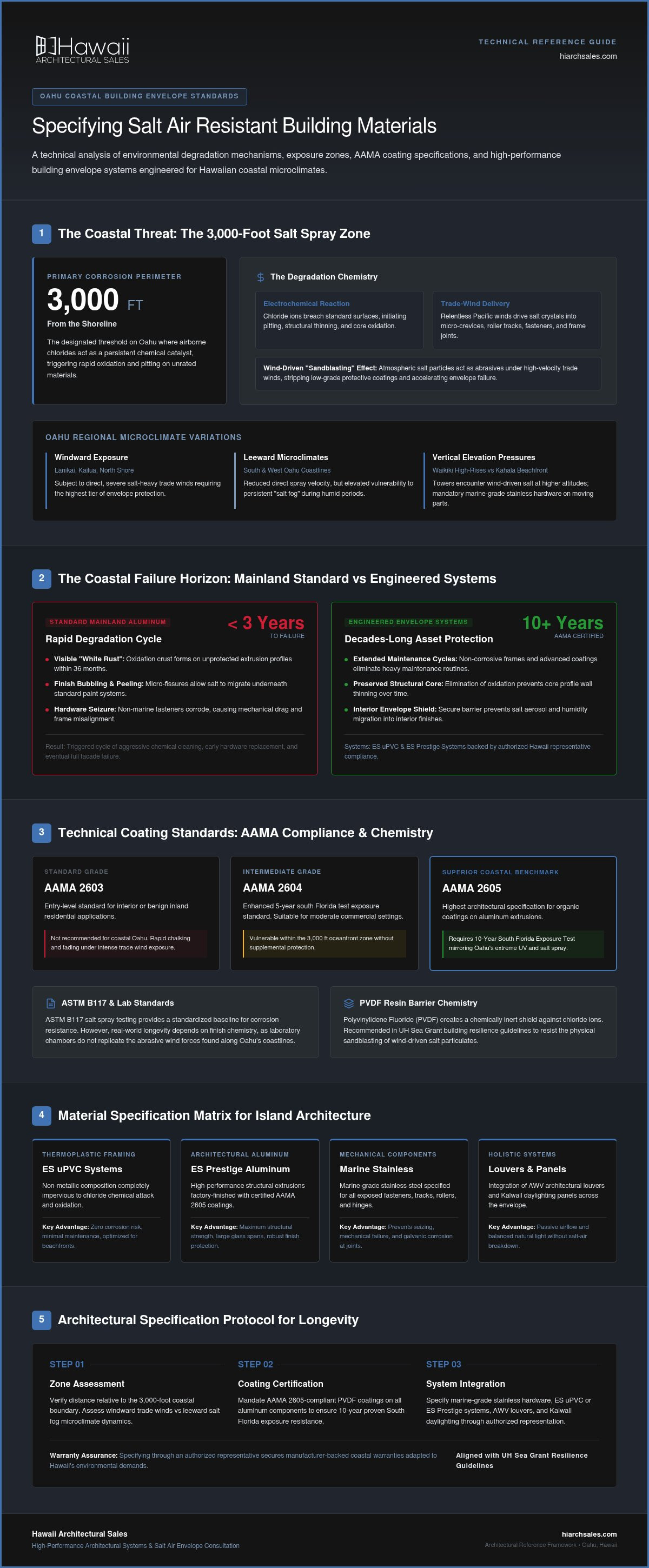
Designing for Oahu requires a deep understanding of how the Pacific Ocean interacts with the built environment. The "Salt Spray Zone" is a critical designation for local architects, generally covering any site within 3,000 feet of the shoreline. Within this perimeter, airborne chlorides act as a constant chemical catalyst for material degradation. The chemistry is straightforward but devastating. Salt air facilitates an electrochemical reaction that accelerates the oxidation of building components. When chloride ions breach the surface of standard metals, they initiate pitting and structural weakening that can compromise the entire building envelope.
Selecting salt air resistant building materials Oahu professionals can trust is a prerequisite for long-term project success. Standard mainland specifications often fail here because they don't account for the relentless trade-wind delivery of salt particles. These winds don't just blow past a building; they drive salt into every crevice, track, and fastener. Without high-performance barriers, the result is a rapid loss of both function and form. It's a reality that demands a shift from standard residential grades to high-performance architectural systems.
Geography of Corrosion: Honolulu to the North Shore
Exposure levels are not uniform across the island. Windward locations like Lanikai and the North Shore face direct, salt-heavy trade winds that demand the highest levels of protection. In contrast, leeward areas may have lower direct spray but still suffer from "salt fog" during high-humidity periods. This localized microclimate determines the lifespan of your materials. For example, a high-rise in Waikiki faces different pressures than a beachfront home in Kahala. Vertical structures encounter wind-driven salt at higher elevations, making the use of marine-grade stainless steel hardware essential for any moving parts or exposed fasteners.
The Hidden Costs of Material Failure
The financial impact of choosing inadequate materials extends far beyond the initial construction budget. Standard aluminum frames often show visible "white rust" and finish bubbling within three years of installation in oceanfront zones. This triggers a cycle of frequent cleaning, hardware replacement, and eventually, full system failure. Using salt air resistant building materials Oahu specific systems, like ES uPVC or ES Prestige, changes the economic outlook of a property. These systems offer:
Extended Maintenance Cycles
High-performance coatings and non-corrosive uPVC frames reduce the need for aggressive cleaning.
Structural Integrity
Prevention of core material thinning due to oxidation ensures the building stays safe for decades.
Asset Protection
A secure, corrosion-resistant envelope prevents salt and moisture from damaging interior finishes and mechanical systems.
Technical Standards for Salt-Resistant Architectural Systems
High-performance architectural systems rely on rigorous testing to prove their worth in coastal environments. For the salt air resistant building materials Oahu projects require, the American Architectural Manufacturers Association (AAMA) provides the definitive framework. AAMA 2605 is the superior specification for high-performance organic coatings on aluminum extrusions. It requires a 10-year south Florida exposure test, which mirrors the intense UV and salt-spray conditions found on Oahu. Without this certification, a building's exterior finish is likely to fail long before the structure itself.
Technical specifications often reference ASTM B117 salt spray testing. While this laboratory test provides a baseline for corrosion resistance, real-world performance depends on the chemical composition of the finish. PVDF (Polyvinylidene Fluoride) coatings are preferred because they create a chemically inert barrier against chloride ions. Following the University of Hawaiʻi Sea Grant building resilience guidelines, architects should prioritize finishes that resist the "sandblasting" effect of wind-driven salt and debris. These standards ensure that the building envelope remains both functional and aesthetically sound over its intended lifespan.
Coating Performance: AAMA 2603 vs. 2604 vs. 2605
Choosing the wrong finish leads to premature chalking and color fading. AAMA 2603 and 2604 are suitable for inland projects with limited exposure, but they lack the resin density needed for the shoreline. A 70% PVDF resin base, found in the ES Prestige line, is non-negotiable for beachfront properties. This level of specification ensures that the facade maintains its aesthetic intent despite relentless UV radiation and chloride attack. For technical assistance in matching these standards to your specific project requirements, consult with the experts at Hawaii Architectural Sales.
Marine-Grade Hardware Specification
Durability isn't just about the frame; it's about the moving parts. Standard 304 stainless steel will often develop surface "tea staining" or pitting within months of oceanfront exposure. Specifying 316 marine-grade stainless steel for hinges, handles, and fasteners is essential. As a leading Euro-Wall distributor Hawaii architects trust, we emphasize that even the "unseen" components like rollers and track systems must meet these high-performance standards. Internal gaskets and thermal breaks must also be chemically compatible with salt-rich environments to prevent galvanic corrosion between dissimilar metals.
Comparing Material Durability: Aluminum, Steel, and uPVC
Selecting the right substrate is as critical as the finish itself. While aluminum remains the architectural standard, Oahu's unique conditions often favor alternative materials for specific zones. Each material reacts differently to the electrochemical pressures of the coast, impacting both the structural integrity and the cooling efficiency of the building. Understanding these differences is essential when specifying salt air resistant building materials Oahu architects rely on for long-term performance.
Hopes Steel Windows represent the pinnacle of aesthetic luxury, offering the slimmest possible sightlines. Because steel is inherently vulnerable to oxidation, these systems utilize specialized protective coatings and advanced manufacturing techniques to mitigate corrosion. For projects where the architectural vision demands the strength and profile of steel, these specialized systems provide a durable solution that standard steel components cannot match. However, the choice of material also dictates the thermal performance of the building envelope. In Hawaii, where cooling loads are a primary concern, the thermal conductivity of the frame material plays a major role in energy efficiency.
The Case for ES | uPVC in Extreme Coastal Zones
ES | uPVC represents a fundamental shift in coastal engineering. Unlike metallic substrates, uPVC is chemically immune to chloride attack. It does not pit, peel, or corrode, making it one of the most effective salt air resistant building materials Oahu has available for high-exposure sites. Over a ten-year maintenance cycle, uPVC systems require significantly less attention than aluminum. Modern uPVC profiles have evolved beyond their early iterations; they now offer the refined, high-end aesthetics required for luxury Honolulu residences while providing superior thermal insulation that reduces interior heat gain.
Aluminum Excellence: ES Prestige and Elite
Aluminum remains a dominant choice because it provides the structural rigidity necessary for expansive glass openings. The ES | Prestige line is engineered specifically to balance this structural strength with high-performance corrosion resistance. For projects requiring the hurricane rated windows Hawaii building codes mandate, aluminum is often the preferred substrate due to its ability to withstand extreme wind pressures. To ensure longevity, these systems incorporate advanced thermal breaks. These breaks do more than just improve energy efficiency; they prevent the interior condensation that can trap salt particles and moisture against the frame, which is a common cause of localized corrosion in standard systems.
Holistic Envelope Design: Beyond Windows and Doors
A truly resilient building envelope on Oahu requires a unified strategy. It's not enough to focus only on windows and doors. Every component that penetrates or connects the facade must withstand the same chloride attack and UV exposure. For architects, this means specifying salt air resistant building materials Oahu manufacturers have designed for high-performance envelopes. A failure in a louver or expansion joint can allow salt-laden air to bypass the primary barrier. This leads to internal structural corrosion and mechanical failure. Maintaining a holistic approach ensures that the entire structure remains protected for decades.
Daylighting with Kalwall and Super Sky
Kalwall translucent panels provide a durable alternative to traditional glazing. They offer diffused light and maintain a high thermal barrier. These systems work well in salt-spray zones because their composite surfaces don't suffer from the pitting common in metal-heavy facades. Super Sky systems provide the structural integrity needed for expansive skylights in large-span commercial projects. These technologies are foundational to architectural daylighting solutions Honolulu architects use to balance aesthetics with protection. High-performance glazing often includes coatings that help shed salt crusting during rain. This reduces manual maintenance and preserves the visual clarity of the system over time.
Louvers and Joint Systems for High-Salt Facades
Ventilation systems must allow airflow without permitting salt ingress. AWV architectural louvers are designed to solve this problem. Specifying AAMA 2605 coatings for these louvers ensures they match the durability of the primary fenestration. This prevents salt from entering HVAC intakes and damaging internal equipment. Structural movement also requires attention. Balco expansion joint systems manage seismic shifts in coastal environments. These joints utilize 316 stainless steel and high-grade elastomers to prevent the joint from becoming a failure point for moisture and salt entry. Maintaining finish consistency across all facade elements ensures the building remains visually cohesive as it ages. It's essential to specify these systems together to avoid weak points in the building envelope.
For a comprehensive technical review of your facade specifications, contact Hawaii Architectural Sales to consult with our expert team.
Specifying for Longevity with Hawaii Architectural Sales
Choosing the correct substrate and finish is only the first step in ensuring coastal durability. The technical specification process for salt air resistant building materials Oahu requires a partner who understands the intersection of high-performance engineering and local environmental stressors. Since 1985, Hawaii Architectural Sales has served as a technical consultant to the island's architectural community. We don't just supply products; we provide the localized expertise necessary to prevent the premature failures that often plague coastal construction. Our role as an authorized representative is to bridge the gap between elite manufacturing standards and the practical realities of building in Hawaii.
One of the most critical benefits of this partnership is accessing manufacturer-backed warranties. Many standard warranties include restrictive clauses for installations within a certain distance of the shoreline. We work directly with our manufacturers to ensure that your specifications meet the rigorous requirements for coastal coverage. This oversight provides peace of mind for both the architect and the property owner, ensuring that the building envelope is protected by the full weight of the manufacturer's performance guarantees.
Consultative Support for Architects and Developers
We provide comprehensive technical support for the complex architectural glass systems Honolulu projects demand. This includes assisting with wind load calculations to ensure compliance with stringent local building codes and hurricane safety requirements. Our team facilitates material sampling and finish selection, allowing you to see and feel the difference between standard coatings and AAMA 2605-compliant PVDF finishes. By involving us early in the design phase, you can ensure that the aesthetic vision of the project is supported by a structurally sound and corrosion-resistant foundation.
Streamlining the Supply Chain
Logistics are a major factor in the success of any Hawaii-based project. We manage the supply chain to ensure high-performance materials are delivered efficiently to Oahu, Maui, and Kauai. Our team coordinates the arrival of disparate systems, from ES Prestige window units to Balco expansion joints, ensuring that every component is compatible and ready for installation. This integrated approach eliminates the specification gaps that often lead to moisture intrusion or galvanic corrosion between mismatched materials. We ensure that the entire building envelope functions as a single, cohesive unit designed for the long term.
If you are currently designing a coastal structure, leverage our decades of island experience to secure your project's future. Contact Hawaii Architectural Sales today for a technical consultation and ensure your material specifications are optimized for Oahu's aggressive salt-spray environment.
Securing the Future of Coastal Architecture on Oahu
Designing for the Pacific shoreline requires moving beyond standard specifications to embrace high-performance systems. Success in these aggressive environments depends on adhering to AAMA 2605 standards and selecting substrates like ES uPVC or 70% PVDF-coated aluminum. It's essential to address the entire building envelope, including louvers and expansion joints, to protect both the structure's integrity and your professional reputation. Integrating salt air resistant building materials Oahu projects require ensures that modern aesthetics remain uncompromised by corrosion or premature failure.
Hawaii Architectural Sales has served as a technical specialist for high-performance building envelopes since 1985. As an authorized representative for ES, Euro-Wall, and Kalwall, we provide the localized expertise necessary to navigate Hawaii's unique environmental demands. Our team is ready to assist you from the design phase through to final delivery, ensuring every component meets the highest durability standards. Request a Technical Consultation with Hawaii Architectural Sales to optimize your next coastal project for long-term reliability and performance. We look forward to partnering with you on your next design.
Frequently Asked Questions
What are the best salt air resistant building materials for Oahu oceanfront homes?
The best salt air resistant building materials Oahu offers for oceanfront projects include ES uPVC and high-performance aluminum systems with AAMA 2605-compliant finishes. Substrates like uPVC are naturally immune to chloride corrosion, making them ideal for the North Shore or Lanikai. For aluminum, the ES Prestige line provides the structural strength needed for large openings while resisting oxidation. These materials ensure that coastal structures maintain their aesthetic and structural integrity despite constant exposure to trade-wind salt spray.
Do uPVC windows really last longer than aluminum in Hawaii?
ES uPVC windows typically offer superior longevity in extreme coastal zones because they're non-metallic and immune to salt-air corrosion. While high-quality aluminum frames are durable, they rely on specialized coatings to prevent oxidation. In contrast, uPVC doesn't pit, peel, or corrode at the substrate level. This makes it a highly effective solution for Honolulu oceanfront properties where maintenance reduction and long-term durability are the primary architectural goals. It's a pragmatic choice for the most aggressive environments.
What is the difference between AAMA 2604 and AAMA 2605 for coastal buildings?
AAMA 2605 is the superior technical standard for high-performance organic coatings, requiring a 10-year south Florida exposure test. AAMA 2604 only requires a five-year test and is better suited for inland projects with less aggressive environmental stressors. For Oahu's coastal perimeter, 2605-compliant PVDF coatings are essential. These finishes provide the necessary resistance to color fading, chalking, and chemical degradation caused by the intense UV radiation and airborne chlorides found along the shoreline.
Are Euro-Wall doors hurricane rated for Hawaii's high wind zones?
Euro-Wall doors are engineered to meet stringent hurricane ratings and are suitable for Hawaii's high wind zones. These systems are tested for large-missile impact and high design pressures, ensuring they remain secure during severe weather events. As an authorized representative, Hawaii Architectural Sales assists with technical specifications to ensure these folding and sliding glass walls comply with local building codes in Honolulu, Lihue, and other coastal regions throughout the islands. They provide both safety and expansive views.
How often should salt-resistant architectural windows be maintained on Oahu?
Salt-resistant architectural windows on Oahu should be rinsed with fresh water every three to six months to prevent salt crusting. Properties located directly on the shoreline may require more frequent cleaning to maintain finish clarity and hardware functionality. Regular maintenance prevents chloride buildup from dwelling on the surface, which can eventually breach even high-performance coatings. Using materials like ES uPVC can reduce the intensity of this maintenance cycle compared to standard metal systems in high-exposure areas.
Can steel windows like Hopes be used in high-salt environments?
Hopes steel windows can be utilized in high-salt environments when specified with their proprietary high-performance protective coatings. These systems combine the narrow sightlines of luxury steel with advanced manufacturing techniques designed to mitigate oxidation. It's critical to pair these frames with marine-grade hardware and ensure a regular maintenance schedule. This approach allows architects to achieve a sophisticated aesthetic without compromising the structural lifespan of the building envelope in coastal Honolulu projects. Expertise in specification is key here.
Why is 316 stainless steel required for coastal hardware instead of 304?
316 stainless steel is required for coastal hardware because it contains molybdenum, which specifically prevents chloride pitting corrosion. Standard 304 stainless steel often develops surface tea staining and structural pitting within months of exposure to Oahu's salt spray. For hinges, handles, and track systems, 316-grade components are the industry standard for long-term reliability. Specifying this grade ensures that moving parts continue to function smoothly in aggressive oceanfront environments across Honolulu and the neighbor islands. To learn more about specialized architectural metal fabrication and marine-grade components, visit Donewright Stainless.
What daylighting systems work best for commercial buildings near the Honolulu coast?
Kalwall translucent panels and Super Sky skylight systems are the most effective daylighting solutions for commercial buildings near the Honolulu coast. Kalwall’s composite surfaces are naturally resistant to the pitting that affects metal-framed skylights. Super Sky systems provide the structural integrity needed for large spans while utilizing salt-resistant finishes. These systems allow for high levels of natural light and superior thermal performance without the risk of rapid degradation common with standard commercial glazing assemblies in high-salt zones.