UPVC Window Systems in Hawaii: A Technical Guide to High-Performance Building Envelopes
In Hawaii’s "Zone 4" extremely severe corrosion environment, the traditional reliance on aluminum frames is often a recipe for structural failure and aesthetic degradation within a decade. Architects and engineers across the islands understand that salt air and intense UV radiation are relentless. Y...
In Hawaii’s "Zone 4" extremely severe corrosion environment, the traditional reliance on aluminum frames is often a recipe for structural failure and aesthetic degradation within a decade. Architects and engineers across the islands understand that salt air and intense UV radiation are relentless. You have likely seen high-end aluminum systems pit and corrode; meanwhile, standard vinyl frames often warp or yellow under the tropical sun. These failures lead to increased maintenance costs and compromised building integrity.
This technical guide demonstrates why ES | uPVC window systems Hawaii represent the next evolution in building envelope technology. These systems offer a maintenance-free alternative that outperforms traditional materials in thermal efficiency and durability. By choosing the right uPVC specifications, you can significantly reduce HVAC loads and meet the stringent 160 mph wind load requirements increasingly mandated for new construction. We will examine the engineering behind these high-performance systems; we will also preview how they address the specific regulatory demands of the 2018 International Residential Code while providing a sophisticated, long-term solution for Hawaii’s most demanding coastal projects.
Key Takeaways
• Differentiate between standard vinyl and high-performance uPVC to prevent structural warping and discoloration in Hawaii's extreme UV environments.
• Discover why uPVC provides a zero-corrosion solution for coastal projects where traditional aluminum frames often fail due to salt-air exposure.
• Learn the technical requirements for uPVC window systems Hawaii to comply with 160 mph wind load standards and Florida Product Approval benchmarks.
• Identify strategies to reduce long-term HVAC loads and energy costs through the superior thermal insulation of rigid, UV-stabilized frame assemblies.
• Gain a technical framework for specifying ES | uPVC in commercial and residential building envelopes to ensure long-term reliability and code compliance.
Optimizing the Building Envelope for Hawaii’s Environmental Extremes
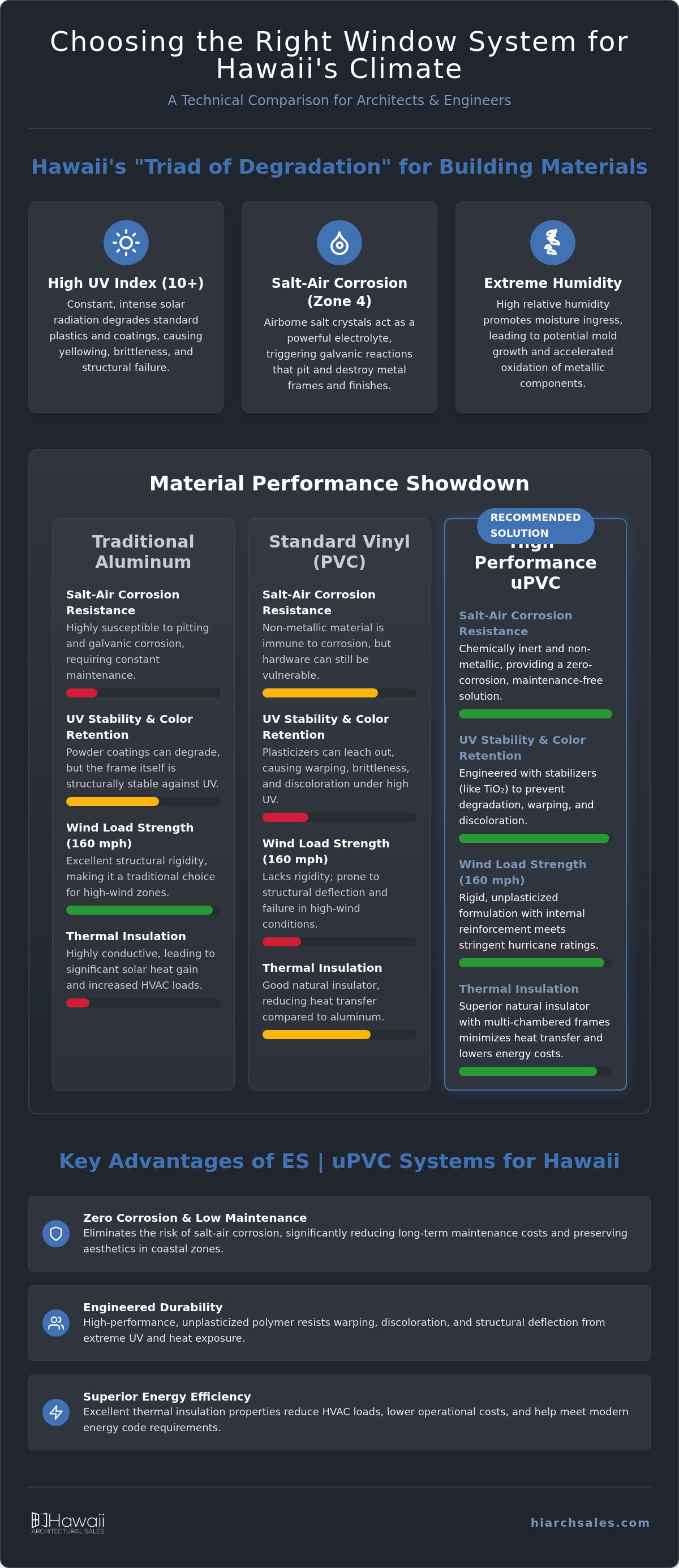
Hawaii’s unique geography places building envelopes under constant duress. The "triad of degradation" consists of three primary environmental stressors that rapidly accelerate the aging of standard building materials. These include:
High UV Index
Consistent exposure to a UV index of 10 or higher, which can degrade standard plastics and coatings.
Salt-Air Corrosion
Persistent airborne salt crystals in "Zone 4" coastal environments that trigger galvanic reactions.
Extreme Humidity
High relative humidity that promotes moisture ingress, mold growth, and metal oxidation.
In coastal microclimates like Kihei and Lahaina, these factors converge to compromise structural integrity and aesthetic value faster than in mainland environments. For professionals designing for these conditions, selecting a material that resists these specific stressors is a technical necessity. Aluminum has traditionally been the default choice for commercial projects. However, it struggles significantly in Hawaii’s extremely severe corrosion zones. In contrast, Unplasticized Polyvinyl Chloride (uPVC) is a chemically inert and non-conductive material. It doesn't react with salt or moisture. This makes it the modern architectural answer to tropical durability.
The Salt-Air Corrosion Challenge
In coastal zones, salt spray acts as a powerful electrolyte. When it settles on metal frames, it triggers galvanic corrosion that can strip away even high-performance powder coatings. This creates a cycle of constant maintenance for property managers in Kailua-Kona or Lihue. uPVC window systems Hawaii eliminate this risk entirely. Because the material is non-metallic, it's immune to the electrochemical reactions that destroy aluminum. It doesn't pit. It doesn't corrode. This material choice translates to a longer service life and a significant reduction in long-term maintenance costs for the building owner. It's a pragmatic solution for high-stakes coastal architecture.
Thermal Performance in Tropical Climates
Thermal conductivity is a critical metric for Hawaii’s energy efficiency standards. Aluminum is a highly efficient conductor of heat; this often leads to significant solar heat gain through the frame itself. This forces HVAC systems in Honolulu commercial and residential projects to work harder, which increases energy consumption and operational costs. uPVC acts as a natural thermal insulator. Its multi-chambered frame design reduces the transfer of heat from the exterior to the interior. For projects requiring even higher efficiency, integrating thermal break window systems Hawaii ensures a high-performance facade that maintains comfortable interior temperatures. Specifying ES | uPVC provides a strategic advantage in meeting both modern building codes and client expectations for sustainability.
UPVC vs. Standard Vinyl: Engineering Superiority for Tropical Climates
In the architectural industry, the terms "vinyl" and "uPVC" are frequently used interchangeably. This is a technical inaccuracy that can lead to poor material selection for Hawaii’s unique climate. Standard vinyl, or Polyvinyl Chloride (PVC), typically contains plasticizers to increase flexibility. These additives are a liability in high-heat environments. Under Hawaii's intense solar load, plasticizers can leach out of the material, which causes the frames to become brittle, warp, or lose their structural shape. uPVC is a high-performance polymer devoid of plasticizers for maximum rigidity.
For uPVC window systems Hawaii, the "unplasticized" nature of the material is what ensures long-term performance. It creates a frame that is significantly harder and more durable than standard residential vinyl. This rigidity is essential for maintaining the tight tolerances required for high-performance building envelopes. While standard vinyl may suffice in temperate mainland climates, it often fails in 10+ UV index zones. ES | uPVC is engineered to withstand these extremes without the risk of structural deflection.
UV Stability and Color Retention
Hawaii’s solar intensity triggers rapid molecular degradation in inferior polymers. To combat this, ES | uPVC utilizes high concentrations of Titanium Dioxide (TiO2). This mineral acts as a stabilizing agent that reflects UV radiation. It prevents the sun's rays from penetrating the frame and breaking the polymer chains. Standard vinyl products often lack sufficient TiO2 levels, which results in yellowing, chalking, or "alligatoring" of the surface within a few years. Because ES | uPVC is chemically stabilized, it maintains its color-fast finish for 30 years or more without the need for repainting. Architects can partner with our technical consultants to review localized weathering reports and performance data.
Structural Rigidity and Multi-Chamber Design
The structural integrity of a window system depends on its internal geometry. ES | uPVC profiles feature a sophisticated multi-chambered design. These internal walls serve two primary functions. First, they create insulating air pockets that disrupt thermal transfer. Second, they provide the necessary stiffness to resist wind pressure. For large-span openings in commercial or high-end residential projects, these profiles are often enhanced with internal steel reinforcements. This combination allows for expansive glazing areas while ensuring the frame remains dimensionally stable. Unlike standard vinyl, which may sag or bow over time, the rigid composition of uPVC ensures that hardware remains aligned and seals stay airtight for the life of the building.
UV Stability and Salt-Air Corrosion Resistance in Coastal Architecture
In the most aggressive coastal environments like Lihue or Kailua-Kona, the choice of frame material determines a building's longevity. While wood offers natural beauty, it requires constant refinishing to prevent rot and UV damage. Aluminum, even with high-performance coatings, remains susceptible to oxidation once salt crystals breach the finish. uPVC represents a fundamental shift in material strategy. It provides a zero-corrosion solution because the material is chemically incapable of rusting or pitting. This inherent resistance makes uPVC window systems Hawaii a superior investment for developers who prioritize low lifecycle costs.
Property value in Hawaii is closely tied to the condition of the building envelope. Corroded window frames are a visible sign of neglect that can deter buyers or tenants in the luxury market. By specifying a material that maintains its structural and aesthetic integrity for decades, owners avoid the steep costs of mid-cycle window replacements. Maintenance for uPVC is remarkably simple. It requires only periodic rinsing with fresh water to remove surface salt; metal frames often require specialized cleaning agents to prevent permanent staining. This reduction in the maintenance burden is a key selling point for high-end residential and commercial developments.
Material Performance Comparison
Technical performance data reveals a clear hierarchy among architectural materials. In standardized ASTM B117 salt-spray testing, uPVC shows no signs of degradation after thousands of hours of exposure. This contrasts sharply with aluminum, which can show surface pitting if the protective layer is compromised. When evaluating salt resistant window frames, architects should consider the following performance ratings:
Corrosion Resistance
uPVC (Excellent), Aluminum (Moderate to High with specialized coatings), Wood (Low).
Thermal Insulation
uPVC (High), Wood (High), Aluminum (Low without significant thermal breaks).
UV Resistance
uPVC (High with TiO2 stabilization), Aluminum (High), Wood (Low).
Aesthetics and Architectural Flexibility
A common misconception is that high-performance uPVC requires bulky profiles. Modern engineering allows for slim sightlines that mimic the minimalist look of aluminum. These systems are available in a variety of finishes, including architectural colors that won't flake or peel under intense solar exposure. Integrating these frames with high-performance architectural glass systems Honolulu allows designers to achieve expansive, light-filled spaces without sacrificing durability. This synergy between frame and glass ensures that the building envelope remains a high-value asset throughout its operational life.
Navigating Wind Load Requirements and Hurricane Ratings for Hawaii Windows
Hawaii's wind topography creates complex pressure differentials, especially on elevated ridges or in high-rise corridors like Kaka’ako. Design Pressure (DP) ratings are the critical metric for ensuring building safety in these zones. A DP rating indicates a window's ability to withstand both positive and negative wind loads without structural failure or water infiltration. Because Hawaii lacks its own large-scale testing facilities, the industry relies on Florida Product Approval (FPA) as the primary benchmark. FPA certification ensures that uPVC window systems Hawaii have undergone rigorous testing for high-velocity hurricane zones, providing a level of reliability that standard residential products cannot match.
Specifying for Honolulu's high-rise structures requires a deep understanding of how wind speed increases with altitude. A window that meets code at ground level may fail on the 40th floor where wind speeds are significantly higher. ES | uPVC systems utilize multi-chambered profiles and internal steel reinforcements to achieve high DP ratings. These systems are designed to manage the extreme cycling of wind pressures during tropical storms, maintaining the integrity of the building envelope when it's most vulnerable. For architects, this engineering focus translates to reduced liability and enhanced occupant safety.
Impact Resistance and Laminated Glass
The frame is only one part of the structural equation. High-performance envelopes require the synergy of rigid uPVC frames and impact-rated glazing. Laminated glass, featuring a resilient interlayer, prevents the building envelope from breaching even if the glass shatters. This is essential for protecting the interior from sudden pressure changes that can lead to catastrophic roof failure. Protecting the building envelope during tropical storms and hurricanes is a matter of precise material coordination. For a deeper dive into these technical specifications, see our guide on hurricane rated windows Hawaii.
Meeting Hawaii Building Codes
The current statewide building code is based on the 2018 International Residential Code (IRC). However, individual counties like Maui and Kauai often adopt stricter amendments for wind-borne debris regions. Navigating these variations requires a partner who understands both the engineering and the local regulatory environment. ES | uPVC systems are engineered to meet stringent coastal wind load requirements. Working with a specialized architectural window distributor Hawaii ensures that your project remains compliant with both current standards and the reported 2026 building code updates, which may mandate resistance to wind speeds up to 160 mph. To ensure your project meets localized DP requirements, contact Hawaii Architectural Sales for technical documentation and engineering support.
Specifying ES uPVC Systems: Guide for Hawaii Architects
Hawaii Architectural Sales has operated as a premier manufacturer’s representative and distributor since 1985. We specialize in bridging the gap between high-end manufacturing and practical island application. This localized knowledge is essential when specifying uPVC window systems Hawaii for diverse projects ranging from high-density Honolulu residential towers to luxury estates in Kihei and Lahaina. We act as a strategic ally in the building process. Our team provides the stability and technical oversight required for high-stakes construction. By focusing on the building envelope as a complete system, we help architects mitigate risks associated with environmental degradation and regulatory compliance.
Technical Support for Professionals
Accessing accurate technical data is a prerequisite for professional specification. We provide architects and engineers with a comprehensive suite of digital assets. This includes detailed CAD drawings and BIM models that facilitate seamless integration into modern design workflows. Beyond providing documentation, we offer specialized consultation on wind load calculations and glass selection. This ensures that every component of the building envelope is optimized for its specific island microclimate. Professionals can customize ES | Prestige and other high-performance uPVC solutions to meet unique project requirements. This service-oriented approach provides the technical foundation needed to support complex architectural visions.
Material Distribution and Logistics
Our operational focus is rooted in high-level representation and material distribution. We do not offer installation services or general contracting. This deliberate specialization allows us to concentrate entirely on technical product expertise and supply chain reliability. Our process involves a rigorous technical review of project requirements before sourcing materials from our manufacturing partners. We manage the logistical complexities of delivering uPVC window systems Hawaii to Lihue, Kailua-Kona, and beyond. By partnering closely with the project’s general contractor, we ensure a smooth transition from the design phase to material delivery. This collaborative model ensures that the performance specifications defined during design are realized in the final build. Contact Hawaii Architectural Sales for a technical consultation on your next project to discuss how ES | uPVC can enhance your building envelope's performance.
Advancing Hawaii’s Building Standards with High-Performance Envelopes
Selecting the right fenestration system is a technical decision that impacts a building's performance for decades. We have examined how uPVC outperforms aluminum in corrosion resistance and thermal efficiency. These systems provide the structural rigidity necessary to meet Hawaii's stringent wind load requirements while maintaining aesthetic appeal under intense UV exposure. By prioritizing material science and engineering data, professionals can ensure their projects remain durable and energy-efficient in the face of tropical stressors.
As an Authorized ES | uPVC Representative with 40 years of localized building experience, Hawaii Architectural Sales provides the technical support architects and engineers need for complex specifications. We offer a steady partnership focused on reliability and long-term value. Our team is ready to help you integrate these advanced uPVC window systems Hawaii into your next commercial or residential project. We invite you to Request a Technical Consultation for ES | uPVC Systems to secure the expertise your building envelope requires. We look forward to supporting your design objectives with precision and localized expertise.
Frequently Asked Questions
What is the difference between vinyl and uPVC window systems?
uPVC stands for unplasticized polyvinyl chloride. Unlike standard vinyl used in some residential products, it doesn't contain plasticizers that leach out in high heat. This creates a rigid, dimensionally stable frame that won't become brittle or warp. It is specifically engineered for structural integrity in extreme environments. uPVC window systems Hawaii are designed to maintain their performance and shape despite the intense solar loads found across the islands.
Are uPVC windows strong enough for hurricane-force winds in Hawaii?
Yes, high-performance uPVC systems are engineered to meet stringent wind load requirements. ES | uPVC systems often feature internal steel reinforcements and multi-chambered profiles to achieve high Design Pressure (DP) ratings. These systems are tested against Florida Product Approval standards, which are the benchmark for hurricane resistance. They provide the structural stability needed to withstand the high-velocity winds common in coastal zones and elevated ridges throughout Hawaii.
Do uPVC windows yellow or warp in high Hawaii UV levels?
They do not yellow or warp when properly stabilized with Titanium Dioxide (TiO2). This mineral reflects UV radiation and prevents the polymer chains from breaking down. Standard vinyl might fail in Hawaii’s UV index of 10 or higher, but ES | uPVC remains color-fast and rigid. This makes it a reliable choice for projects in Kihei and Lahaina where solar intensity is a constant factor for building envelopes.
How do uPVC windows compare to aluminum in salt-air environments?
uPVC is fundamentally superior to aluminum in salt-air environments because it's non-metallic and chemically inert. It cannot rust, pit, or undergo galvanic corrosion. While aluminum requires specialized coatings that can still fail if scratched, uPVC provides a zero-corrosion solution. This is a critical advantage for coastal properties in Lihue or Kailua-Kona. It significantly reduces the maintenance burden and extends the operational life of the window system.
Are uPVC windows energy efficient for tropical climates?
They are highly energy efficient because uPVC is a natural thermal insulator. Unlike aluminum, which conducts heat into the building, uPVC frames reduce solar heat gain. Their multi-chambered design creates air pockets that further disrupt thermal transfer. This helps maintain stable interior temperatures in tropical climates. Using these systems can lead to a lower HVAC load and reduced energy consumption for both residential and commercial buildings in Honolulu.
Can uPVC windows be used in high-rise commercial buildings in Honolulu?
Yes, these systems are suitable for high-rise applications when engineered for specific elevation wind loads. High-rise structures in Honolulu face increased wind pressures that require precise DP ratings. ES | uPVC profiles are reinforced to handle these stresses while providing the necessary air and water infiltration resistance. Architects should consult with a technical representative to ensure the chosen system meets the localized building codes and structural requirements for their specific project height.
Does Hawaii Architectural Sales provide installation for ES | uPVC windows?
No, Hawaii Architectural Sales is a specialized manufacturer’s representative and distributor; we don't provide installation services. Our focus is on providing technical product expertise and material supply for architects, developers, and contractors. We assist with the specification process and ensure that the uPVC window systems Hawaii delivered to your site meet all engineering requirements. For installation, we recommend partnering with a qualified general contractor familiar with high-performance building envelopes.
What is the typical lifespan of a uPVC window system in Hawaii?
A high-quality uPVC system typically has a lifespan of 30 years or more in Hawaii’s environment. Because the material doesn't corrode and is stabilized against UV degradation, it doesn't require the frequent repainting or structural repairs common with wood or aluminum. Simple periodic cleaning with fresh water is usually sufficient to maintain the system. This longevity makes it a pragmatically sound investment for long-term property value in high-end Hawaii real estate developments.